


KEY TAKEAWAY
Caring for an addicted loved one can trigger emotional suppression; healing requires questioning old beliefs, and learning to express feelings.
It's not safe to feel this right now.
There's too much going on.
If I start crying, I'll push them away...
Sound familiar?
You've been holding it together in this situation for so long, it's become a reflex.
A loved one is in addiction, and somewhere along the way you decided that your job is to stay functional... and be the one who doesn't crumble.
And expressing the feelings underneath all of that, somehow feels dangerous.
But what if you could start to resolve this pattern now?
How It Works, And How to Fix It
Here's the walkthrough, from a therapist's perspective:
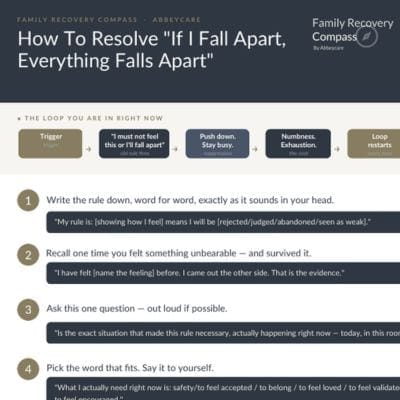
Situation: Someone close to you is struggling with addiction. You are holding the household together.
Schema: "I must control my emotions or I'll be rejected" (Emotional Inhibition)
Automatic Thought: "If I let myself feel this, I'll fall apart, be judged, criticised, maybe even rejected."
Emotions: Numbness, exhaustion. Occasional flashes of grief or rage, that are pushed back down.
Behaviour: Staying busy. Dismissing offers of support. Emotional detachment, protection.
Result: Increasing isolation. The feelings continue building up...
**Here's how to resolve the pattern:

Step 1: Identify The Rule
Somewhere, you have a rule about feelings.
It might sound like:
Showing emotions is weak.
Or:
The way to be accepted/loved/not rejected, is not showing how I feel.
Write the rule down, word for word.
Does the rule sound like something you would say yourself?... or something you've picked up from someone else?
Most people find it sounds like someone else, when they see it written down.
Is it possible that the conditions that led you to this conclusion, don't apply anymore? Or are no longer relevant?
Step 2: Test The Rule Against Reality
Have you ever fallen apart forever from feeling something?
Think of a time you felt something painful, overwhelming... but came out the other side in one piece.
Is it painful? Absolutely.
But that doesn't mean we won't survive.
We need to recognise the pain is a pattern from the past, that's getting re-triggered by current circumstances.
It's not a new or real threat, right now, in the outside world.

Step 3: Is The Old Threat, Actually Present, Now?
The belief that expressing feelings is dangerous, is usually built on a single moment from the past, when we felt like we HAD to suppress things.
Is that exact same situation playing out in the world, now? (Spoiler: probably not.)
Step 4: Start To Unravel The Schema
Now: What need is not being met by this rule?
Think: safety/security/acceptance/love/belonging/validation/encouragement.
This rule started as a way to protect you, but what if it has outlived its usefulness?
What if it is no longer needed, and actually doing more harm than good?

Step 5: Resolve The Cause
Imagery Rescripting:
Revisit a memory where expressing emotion felt unsafe, and imagine, in detail, giving your younger self the support they needed.
This breaks the link between vulnerability and danger, reducing emotional triggers around your loved one's addiction.
Reparenting:
Write a dialogue between the part of you that suppresses feelings, and the part that's hurting, letting each side explain what it's trying to protect, or what it needs most.
Understanding the underlying intention, makes it easier to express emotions in the now, without feeling overwhelmed.

Improving Emotional Tolerance:
When strong emotions arise, ask: "What are the facts, and what am I predicting? Do I really see this in the outside world?"
This stops fear-based assumptions from driving our behaviour.
***
Is it clear to you now, that this pattern of emotional suppression, started some time ago, but is simply being retriggered by the current situation with your loved one's addiction?
And, therefore, that they are not the source of this issue?
Do you get a sense that the old rules about suppressing emotions that were unconsciously applied in that old situation - to help you survive - no longer apply?
And that they certainly don't apply in this current situation?
Over the next few weeks, notice consciously what differences you see in your own reactions - no matter how small.
And take them as a sign of progress... well deserved.
This situation, is not about you. It never was.
But you can start to change how you react to it.
Hope it helps.