Alcoholism is a disease characterised by continuous heavy drinking. Until people with alcohol use disorder admit to problems with alcohol and stop drinking, the risk of alcohol use disorder continues which affects both physical and mental health.
Alcohol starts to injure the brain once it reaches the bloodstream.
Excessive consumption can lead to Alcohol-Related Brain Damage, or ARBD, which is a type of brain disorder caused by alcohol consumption. Brain shrinkage caused by alcohol abuse is permanent, as alcohol kills brain cells and grey matter.
For more information and effects click ‘Learn More’.
Family Recovery Compass is a newsletter for friends and family members who feel trapped between supporting a loved one in addiction, and protecting their own wellbeing.
Every week, we tackle one specific situation in addiction family dynamics, and deliver practical decision-making frameworks and exact dialogue scripts – that help you respond with confidence instead of reaction.
Every month, we bring you an unfiltered recovery conversation with someone who’s either experienced addiction firsthand, or works closely with those in recovery.
No sanitised success stories – just practical insights on what actually works in recovery, that you can apply, in your life too.
Recovery capital is the internal and external resource used to begin the recovery process and maintain sobriety. This combines personal, social, and community support to provide a joined-up approach that supports the addict through recovery.
Do you or a loved one need addiction treatment for alcohol or drugs? Thousands blindly walk into addiction treatment in expensive rehab centres and find that the reality doesn’t meet expectations.
If you’re considering rehab treatment, first check our ultimate guide for complete instructions on how to find the right rehab centre for you.
Take-home Naloxone kits help families and loved ones respond quickly in an opioid overdose emergency, until emergency services arrive. Kits contain nasal or injectable forms of Naloxone.
Changes in legislation mean Naloxone kits are now more widely available from pharmacies and drug services, including Abbeycare.
For additional information, click ‘Learn More’ below.
Overcoming alcohol addiction means first ceasing alcohol intake, and taking care of physical and chemical withdrawal symptoms.
Detoxing from alcohol means undergoing withdrawal from alcohol, but with the assistance of prescribed medication and detox phase, to substitute in place of the alcohol itself.
Alcohol rehab focuses on tackling the problems underneath alcoholism, such as grief, trauma, depression, and emotional difficulties, in order to reduce continuing drinking after treatment.
Inpatient services at an alcohol rehab programme provides 24 hour access to specialist care.
Alcohol home detox provides a means of semi-supervised addiction treatment in the comfort of your home. It’s often suitable for those with inescapable practical commitments, or where a reduced budget for treatment is available.
An at-home detox is the most basic detox option available from Abbeycare, and assumes you have support available, post-detox, for the other important elements of long-term addiction recovery.
The term alcoholism refers to the consumption of alcohol to the extent that the person is unable to manage their own drinking habits or patterns, resulting in side-effects that are detrimental to the quality of life and health of the alcoholic, or those around them.
An alcoholic is someone who continues to compulsively abuse alcohol in this way, despite the negative consequences to their lives and health.
Immediately following treatment, the early stages of recovery and abstinence are most vulnerable to lapses.
At Abbeycare, a structured and peer-reviewed aftercare plan is usually prepared whilst still in treatment. This comprises social, peer, and therapeutic resources individuals draw upon, following a residential treatment programme for drug or alcohol misuse.
Clinically managed residential detoxification is:
– A structured detox that uses medication-assisted treatment and regular physical health observations
– Takes place in an inpatient rehabilitation unit or hospital
– Typically lasts from 7-10 days, but in Abbeycare, it is incorporated into a 28-day rehab programme
Family Therapy at Abbeycare Scotland or Gloucester is realistic, compassionate, and appropriate for families and loved ones of addicts.
Family therapeutic interventions in residential rehabilitation have been designed to support those living with or caring for participants entering the Abbeycare Programme.
Support for families in a group setting allows for a safe, constructive, and confidential place to listen and share common experiences.
Inpatient rehab is drug and/ or alcohol treatment in a rehab centre, where patients remain on-site for the duration of inpatient rehabilitation.
It includes detoxification from drugs, therapy (group work and 1-2-1 sessions), and aftercare planning. Inpatient rehabs typically last 28 days, but this varies on an individual basis.
Long-term treatment at Abbeycare has been developed for those suffering from alcohol or drug addiction. Completing a long-term drug and alcohol inpatient programme may be the solution to problematic substance use.
Motivational Enhancement Therapy can be used by trained addiction recovery therapists to elicit internal changes within and promote long-term recovery from substance use disorder.
All the answers to addiction can be found within with this comprehensive and successful therapy concept leads to behavioural changes, reflective listening, self-motivational statements, and a comprehensive recovery process.
Outpatient drug or alcohol rehab is daytime treatment as opposed to living in a treatment facility.
Outpatient treatment is similar to inpatient in terms of the methods used to treat substance abuse. Where they differ is in their approach to recovery.
Abbeycare’s prison to rehab is a 12-week structured rehab programme which involves direct transfer from prison. The suitability of the candidate is decided by prison staff.
Short-term residential treatment programmes are the chance to press the reset button and access a therapeutic programme designed to create recovery from the use of alcohol and drugs.
Feeling stuck in a rut. Want to stop but can’t seem to achieve sobriety?
Click below.
The 12-step programme was created by alcoholics anonymous (AA), and is specifically designed to aid addicts in achieving and maintaining abstinence.
The central ethos behind the programme is that participants must admit and surrender to a divine power to live happy lives. Ideas and experiences are shared in meetings, and help is sought in an attempt to achieve abstinence.
Abbeycare’s policy to respect your privacy and comply with any applicable law and regulation regarding any personal information we may collect about you, including across our website and other sites we own and operate.
Hippy crack (Nitrous oxide, N2O, laughing gas) addiction is defined by:
Inhaling 50 – 70 balloons per session, leading to vitamin B12 deficiency (<200 pg/mL) and peripheral neuropathy [1]
Increasing the ‘usual’ amount of N2O (e.g. 500 to 1000 balloons p/wk) within a 12-month period, to achieve the same effect [1]
Physical Indicators Of Hippy Crack Addiction
Hypoxia
Hypoxia is a physical indicator of nitrous oxide dependence as a result of a low blood solubility (blood-gas partition coefficient = 0.47) and rapid oxygen dilution in the alveoli within 2 - 5 minutes of drug-taking, leading to [2]:
Fainting in 4 – 6% after taking 8 – 10 ‘hits’ in one session via various inhalation methods (e.g. cream dispenser, plastic bag, or gas bulb) [3]
Skin pallor caused by low oxygen saturation levels (76% vs normal range = 95 – 100%) and hypotension (60/40 mmHg) after consuming up to 250 balloons per day for 9 months [4][5]
Around 90% of those who faint after consuming nitrous oxide are drunk or high on other drugs at the same time, leading to intense euphoria within 1 - 2 minutes and possibly asphyxial death caused by a lack of oxygen after consuming high concentrations (>50%) of N₂O in an enclosed space [3].
Vitamin B12 Deficiency
Being deficient in Vitamin B12 is a physical indicator of laughing gas abuse as a result of nitrous oxide inactivating methionine synthase via oxidation of the cobalt in vitamin B12, resulting in:
Hypochromic macrocytic anaemia in 20%, with a mean corpuscular volume of 107.1 fL (normal values 83–101 fL) and fatigue, headaches, and dyspnea caused by B12 deficiencies (<200 pg/mL) in up to 60% after 1 year of nitrous oxide abuse [6]
Jaundice of the skin and whites of the eyes caused by elevated bilirubin levels in the blood (5.2 mg/dL vs normal values = 0.3 to 1.2 mg/dL) after repeated inhalation [7]
Kulkantrakorn et al, (2024) studied a 19-year-old girl who developed macrocytic anaemia after consuming nitrous oxide continuously for 8 weeks, presenting with low serum B12 levels (65.2 pg/mL), a complete blood count of 100 f/L, and fatigue and weakness that persisted for 2 months [4].
Oesophageal/ Facial Burns
Oesophageal/facial burns are physical indicators of nitrous oxide dependence as a result of direct contact with freezing temperatures (around - 40 ̊ C) as the gas is discharged from a pressurised container for direct inhalation or to fill a balloon, leading to frostbite on the lips, nose, or throat as the skin and underlying tissue drops to –2 ̊ C [8][9].
Murphy et al, (2024) noted a 17-year-old female who sustained a contact burn injury to the chin and lower lip (0.5% total body surface area) after directly inhaling nitrous oxide gas from a canister, requiring treatment with silver dressings and paraffin for 10 days to encourage re-epithelialisation [8].
Being addicted to nitrous oxide also leads to burns on the fingertips, hands, arms, and legs (up to 4% TBSA) due to gas leaking from a ‘cracker’ device, although some burns heal within 4 weeks, others require a split-thickness skin graft, often resulting in hypopigmented scarring and contour deformities [8].
Balance Issues
Ataxia is a physical indicator of nitrous oxide dependence as a result of N₂O-induced subacute combined degeneration of the spinal cord, resulting in an unsteady gait and limb weakness in 34 – 52% after 6 months of drug abuse [10].
Kulkantrakorn et al (2024) found that 7 patients aged 19 – 32 developed acute or subacute ataxia after misusing nitrous oxide for up to 1 year, leading to:
A wide-based gait, unsteadiness, and weakness in the arms and legs caused by hyper signal intensity at the posterior aspect of the spinal cord (along C4-C7 levels)after 9 months of daily inhalation
Motor weakness in both legs (graded 3 out of 5 on the MRC scale), residual footdrop, and distal foot numbness due to segmental T2 hyperintense foci at the posterolateral cord after using nitrous oxide twice weekly for over 2 months
Ataxic neuropathy and instability during a tandem walk after 6 months of weekly use, with weakness in ankle and toe movements and ongoing balance issues (e.g. difficulties standing on one foot) for up to 1 year [4].
Chen, et al (2016) studied a 20-year-old who struggled to walk independently due to a segmental hyperintense lesion on the spinal cord after 2 years of recreational nitrous oxide use, resulting in an unsteady gait and involuntary lower limb movements, although balance and gait improved within 3 weeks of taking vitamin B12 supplementation (2000 μg per day) [11].
Lhermitte's Sign
Lhermitte’s sign (electric shock sensations in the spine and limbs) is a physical indicator of nitrous oxide dependence as a result of low B12 levels (<150 pmol/L) in 70.7% and T2 signal hyperintensity in the cervical region of the spinal cord in 68% after consuming around 25 cartridges per day for 7 months [12].
Marcotta and Kesserwani (2020) studied a 41-year-old man who developed Lhermitte’s sign after buying whipped cream chargers in canisters from the internet and consuming 8 – 30 per day for a year, each containing 8g of nitrous oxide that was emptied into a balloon and inhaled for 1 – 2 minutes:
Describing the experience elicited by neck flexion as a powerful tingling vibration that travelled down the arms, trunk, and legs, continuing down to the feet
Symptoms were a stiff neck, and experiencing an “electrifying sensation” in the anterior abdomen whilst elevating arms due to posterior cord demyelination and mild bilateral peri-atrial hazy demyelination [13]
15% develop Lhermitte’s sign after abusing laughing gas for 3 – 18 months, although the electric shock sensation begins to subside after two weeks of taking 5mg doses of sublingual vitamin B12 and 4mg folic acid daily [12][13].
Psychological Indicators Of Hippy Crack Addiction
Cognitive Fragmentation
Cognitive fragmentation is a psychological indicator of nitrous oxide abuse as a result of low B12 levels (148 pmol/L) after intermittent use (e.g. 6 sessions per month), resulting in perseverative thinking (e.g. concerns over others' safety) and the repetition of words and short phrases [14].
Chen et al, (2018) noted a 19-year-old man developed fragmentation in his listening comprehension, struggled to distinguish between nightmares/dreams and reality, and had ongoing suspicions that his family were against him after inhaling laughing gas 2 – 3 times daily for around 1 year [15].
Cognitive fragmentation caused by nitrous oxide abuse typically resolves after drug cessation and short-term (e.g. 1 – 2 weeks) supplementation with intramuscular or oral 1000μg cobalamin and 15mg folic acid daily [14][15].
Auditory Distortions
Auditory distortions are psychological indicators of nitrous oxide abuse as a result of homocysteine imbalances caused by NMDA receptor antagonism and elevations in middle ear pressure (0.09kPa per min) as N₂O is inhaled and rapidly absorbed into the bloodstream, leading to [16]:
Sound distortions (e.g. metallic, “wah wah”, robotic, or echoing) sounds within 20 seconds of consumption, lasting up to 2 minutes each time in heavy nitrous oxide users (75 – 2000 canisters consumed per week) [17]
‘Diminished’ sound in 73% or ‘sharpened’ hearing in 13%, as some users claim “My hearing became more acute and I distinctly heard every sound in the room" after inhaling laughing gas [18][19]
Sheldon, Rollo, et al, (2019) noted a 37-year-old woman experienced ongoing auditory command hallucinations within 1 day of inhaling 24 nitrous oxide bulbs, although the disturbances subsided after 7 weeks of treatment with 1mg hydroxocobalamin (vitamin B12) intramuscular injections [20].
Sensory Disconnection
Sensory disconnection is a psychological indicator of nitrous oxide abuse as a result of a 35% reduction in glutamatergic synaptic transmission in the basolateral amygdala within 5 minutes of consumption, leading to [21]:
Depersonalisation (detachment from oneself) whilst feeling like thoughts, feelings, and actions are being observed from an outside perspective and derealisation (detachment from surroundings) and feeling like the external world is unreal or distorted within 10 – 30 seconds of inhalation [22]
Disassociation and floating sensations typically for 1 - 30 minutes after using, although some users report feeling “A little less human”, possessed, or being in a “fifth dimension” for up to 1 week after abusing “Nang crackers” [22][23]
Hippy Crack Mechanism Of Action
Nitrous Oxide's mechanism of action involves:
Blocking NMDAR-activated currents in the hippocampus with an approximate half-maximal effective concentration (EC50) of 30–40%, leading to a 20% potentiation of GABA-A receptors whilst blocking 30% of kainate currents [24]
Dopamine disinhibition due to the antagonistic action on NMDA receptors, leading to an 144% increase in dopamine firing in the nucleus accumbens and ventral tegmental area within 60 minutes of drug exposure, as well as a 1.54-fold increase in GABA-evoked currents [25][26]
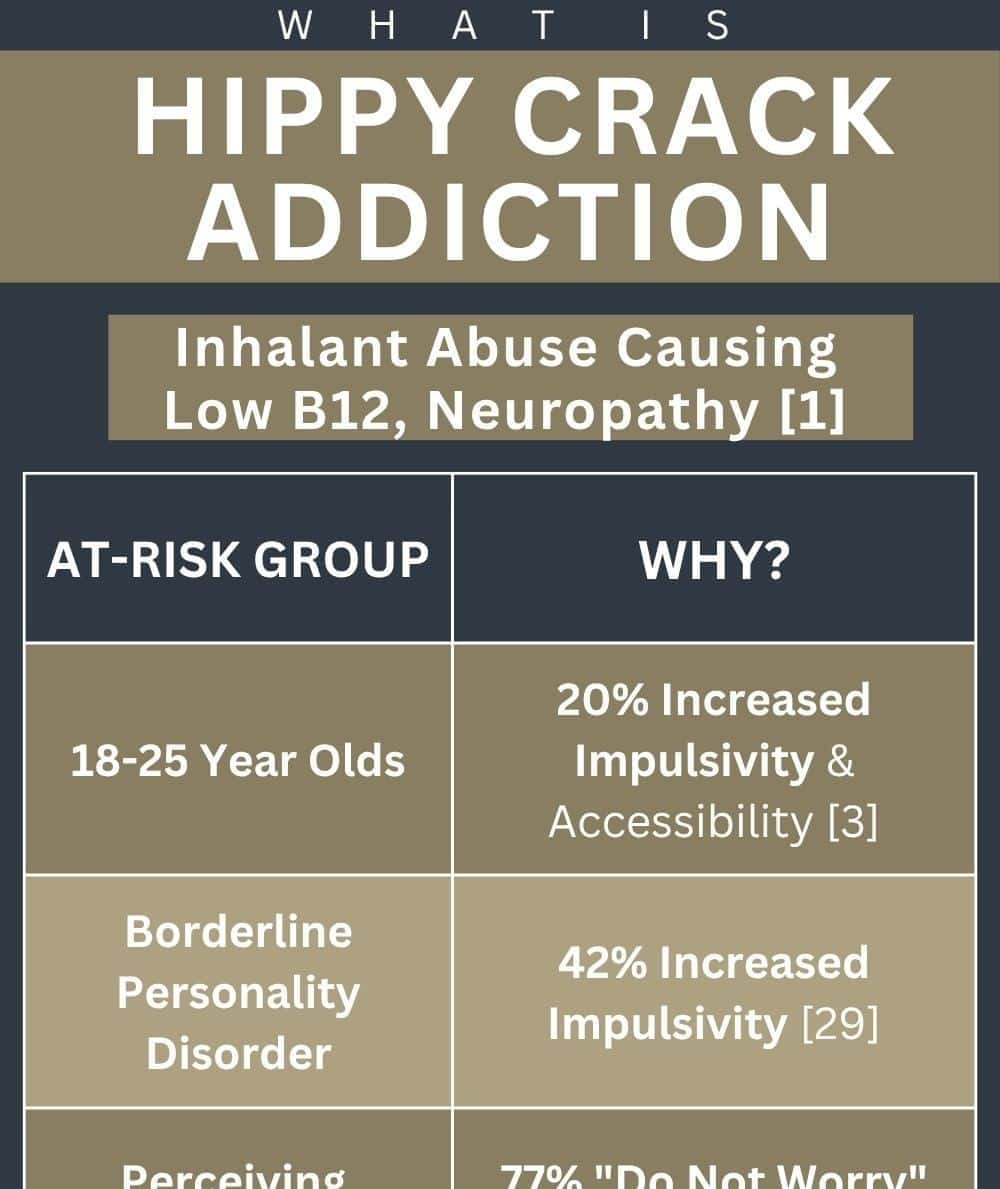
Who Is Most Likely To Become Addicted to Hippy Crack?
Demographics
Why?
18 - 25 Year Olds
3x more likely to use than over 25s due to a 20% increase in impulsivity + accessibility and affordability, as around 40% buy from friends, the internet, or a supermarket for £1.50 (individual ‘whippet’) or £15 - 20 for a box of 50 [3][22][27][28]
Borderline Personality Disorder
Impulsive behaviour is 42% higher than users without BPD, and 47% develop an SUD after seeking immediate gratification (an intense high within 10 - 20 seconds) [29]
High-Frequency Binge Inhalation
Around 10 ‘hits’ per session to maintain high = tolerance + psychological dependence develops = higher/more frequent doses (e.g. up to 50 ‘hits’) to achieve the same effect
Perceiving Hippy Crack Use As ‘Harmless’
Ongoing use with no safety precautions (e.g. using >5 balloons per session in poorly ventilated spaces) as 77% ‘do not worry’ about the effects on physical/mental health due to a lack of awareness of nerve damage, hypoxia, etc. [3]
Existing B12 Deficiency/Vegetarian Diet
Compulsive use to receive short (1-2 minute) euphoric bursts as a temporary relief for fatigue, low mood/anhedonia, or nerve pain caused by a 78% reduction in daily B12 intake (μg/day) and 35% lower serum B12 levels (pmol/l) compared to meat eaters [36]
Mixing Hippy Crack With Other Drugs
Polydrug Combination
How It Changes Euphoria
How It Changes Addiction Risk
Combined With MDMA
Intensified feelings of emotional warmth due to a 144% dopamine increase from N₂O + a 5-8-fold increase of DA + serotonin from MDMA [25][30][31]
Habitual use occurs after redosing during a ‘come-down’ from the 30 - 60 second rush + flattened effect of MDMA
Euphoric effects for up to 1 hour + may result in a ‘K-hole’ with intensified dissociation + sensory distortions (warped sounds or kaleidoscope vision)
Cross-tolerance and cravings occur after repeated ritualised party use alters the brain’s reward system via the NMDAR antagonist effect of both drugs
How Do Different Forms Of Nitrous Oxide Change Nitrous Oxide Addiction?
Form
Typical Units Of Nitrous Oxide
Impact On Addiction Risk
Cream Chargers
8 - 16g of 100% pure N₂O
Low cost and accessibility (boxes of 24 online or in supermarkets for £10) encourages regular use and binging patterns (e.g. 25 per session)
Catering Cannisters
Around 600g
Contain 100% N₂O and inhaled amounts are uncontrolled, leading to accidental consumption of high volumes and quicker tolerance development and cravings
Medical Grade Nitrous Oxide
900 to 18,000L
Mixed with at least 30% O₂ when administered, usually short-term and in controlled settings by medical professionals to prevent excessive use + tolerance build up
Balloons
Typically filled with 8g of N₂O from a ‘cracker’
Readily available at festivals or parties (e.g. pre-filled balloon costs £1.50) = habitual use in social settings + stacking to maintain the 60-second high
Entonox “Gas And Air”
700 - 3500L cylinders filled 50:50 with N₂O + oxygen
Low addiction potential as mixed with 50% O₂ to provide gradual pain relief rather than an instant high + supervision in hospitals/dental clinics to prevent abuse
Legal Status Of Nitrous Oxide
In 2023, nitrous oxide was classified as a Class C drug in the UK (under the Misuse of Drugs Act 1971) after previously being controlled under the Psychoactive Substances Act 2016, meaning that possession of the drug was legal (except in custodial settings) but is now illegal when intended for ‘wrongful inhalation’ (e.g. other than medical or dental purposes), resulting in:
An unlimited fine, a visible community punishment (e.g. wearing a high visibility orange vest to complete 40 to 300 hours of unpaid work, i.e. removing graffiti or clearing wasteland), or a caution that appears on the individual’s criminal record
A prison sentence of up to 2 years, an unlimited fine, or both if found in unlawful possession of nitrous oxide on more than one occasion [34][35]
Nitrous oxide is still available in the UK for catering purposes (e.g. as a propellant for dairy foam) and in healthcare settings (e.g. to provide mild-moderate sedation during dental treatment or as pain relief during labour).
Nitrous Oxide Misuse In The UK
The UK has the highest global prevalence of lifetime nitrous oxide use (39%), most commonly used by 24-year-olds and typically inhaled 3 – 10 times per session via balloon or whipped-cream dispenser at a festival or house party [3][22].
Mischa Ezekpo has a Bachelors degree in Psychology from Northumbria
University, and a Masters degree in Childhood Development and
Wellbeing, from Manchester Metropolitan University. Since 2018, Mischa
has written and published work on Addiction, Mental Health, Depression, and Eating Disorders. Content reviewed by Laura Morris (Clinical Lead).