Alcoholism is a disease characterised by continuous heavy drinking. Until people with alcohol use disorder admit to problems with alcohol and stop drinking, the risk of alcohol use disorder continues which affects both physical and mental health.
Alcohol starts to injure the brain once it reaches the bloodstream.
Excessive consumption can lead to Alcohol-Related Brain Damage, or ARBD, which is a type of brain disorder caused by alcohol consumption. Brain shrinkage caused by alcohol abuse is permanent, as alcohol kills brain cells and grey matter.
For more information and effects click ‘Learn More’.
Family Recovery Compass is a newsletter for friends and family members who feel trapped between supporting a loved one in addiction, and protecting their own wellbeing.
Every week, we tackle one specific situation in addiction family dynamics, and deliver practical decision-making frameworks and exact dialogue scripts – that help you respond with confidence instead of reaction.
Every month, we bring you an unfiltered recovery conversation with someone who’s either experienced addiction firsthand, or works closely with those in recovery.
No sanitised success stories – just practical insights on what actually works in recovery, that you can apply, in your life too.
Recovery capital is the internal and external resource used to begin the recovery process and maintain sobriety. This combines personal, social, and community support to provide a joined-up approach that supports the addict through recovery.
Do you or a loved one need addiction treatment for alcohol or drugs? Thousands blindly walk into addiction treatment in expensive rehab centres and find that the reality doesn’t meet expectations.
If you’re considering rehab treatment, first check our ultimate guide for complete instructions on how to find the right rehab centre for you.
Take-home Naloxone kits help families and loved ones respond quickly in an opioid overdose emergency, until emergency services arrive. Kits contain nasal or injectable forms of Naloxone.
Changes in legislation mean Naloxone kits are now more widely available from pharmacies and drug services, including Abbeycare.
For additional information, click ‘Learn More’ below.
Overcoming alcohol addiction means first ceasing alcohol intake, and taking care of physical and chemical withdrawal symptoms.
Detoxing from alcohol means undergoing withdrawal from alcohol, but with the assistance of prescribed medication and detox phase, to substitute in place of the alcohol itself.
Alcohol rehab focuses on tackling the problems underneath alcoholism, such as grief, trauma, depression, and emotional difficulties, in order to reduce continuing drinking after treatment.
Inpatient services at an alcohol rehab programme provides 24 hour access to specialist care.
Alcohol home detox provides a means of semi-supervised addiction treatment in the comfort of your home. It’s often suitable for those with inescapable practical commitments, or where a reduced budget for treatment is available.
An at-home detox is the most basic detox option available from Abbeycare, and assumes you have support available, post-detox, for the other important elements of long-term addiction recovery.
The term alcoholism refers to the consumption of alcohol to the extent that the person is unable to manage their own drinking habits or patterns, resulting in side-effects that are detrimental to the quality of life and health of the alcoholic, or those around them.
An alcoholic is someone who continues to compulsively abuse alcohol in this way, despite the negative consequences to their lives and health.
Immediately following treatment, the early stages of recovery and abstinence are most vulnerable to lapses.
At Abbeycare, a structured and peer-reviewed aftercare plan is usually prepared whilst still in treatment. This comprises social, peer, and therapeutic resources individuals draw upon, following a residential treatment programme for drug or alcohol misuse.
Clinically managed residential detoxification is:
– A structured detox that uses medication-assisted treatment and regular physical health observations
– Takes place in an inpatient rehabilitation unit or hospital
– Typically lasts from 7-10 days, but in Abbeycare, it is incorporated into a 28-day rehab programme
Family Therapy at Abbeycare Scotland or Gloucester is realistic, compassionate, and appropriate for families and loved ones of addicts.
Family therapeutic interventions in residential rehabilitation have been designed to support those living with or caring for participants entering the Abbeycare Programme.
Support for families in a group setting allows for a safe, constructive, and confidential place to listen and share common experiences.
Inpatient rehab is drug and/ or alcohol treatment in a rehab centre, where patients remain on-site for the duration of inpatient rehabilitation.
It includes detoxification from drugs, therapy (group work and 1-2-1 sessions), and aftercare planning. Inpatient rehabs typically last 28 days, but this varies on an individual basis.
Long-term treatment at Abbeycare has been developed for those suffering from alcohol or drug addiction. Completing a long-term drug and alcohol inpatient programme may be the solution to problematic substance use.
Motivational Enhancement Therapy can be used by trained addiction recovery therapists to elicit internal changes within and promote long-term recovery from substance use disorder.
All the answers to addiction can be found within with this comprehensive and successful therapy concept leads to behavioural changes, reflective listening, self-motivational statements, and a comprehensive recovery process.
Outpatient drug or alcohol rehab is daytime treatment as opposed to living in a treatment facility.
Outpatient treatment is similar to inpatient in terms of the methods used to treat substance abuse. Where they differ is in their approach to recovery.
Abbeycare’s prison to rehab is a 12-week structured rehab programme which involves direct transfer from prison. The suitability of the candidate is decided by prison staff.
Short-term residential treatment programmes are the chance to press the reset button and access a therapeutic programme designed to create recovery from the use of alcohol and drugs.
Feeling stuck in a rut. Want to stop but can’t seem to achieve sobriety?
Click below.
The 12-step programme was created by alcoholics anonymous (AA), and is specifically designed to aid addicts in achieving and maintaining abstinence.
The central ethos behind the programme is that participants must admit and surrender to a divine power to live happy lives. Ideas and experiences are shared in meetings, and help is sought in an attempt to achieve abstinence.
Abbeycare’s policy to respect your privacy and comply with any applicable law and regulation regarding any personal information we may collect about you, including across our website and other sites we own and operate.
Using recreationally when “going out”, developing into taking ketamine to “help with sleep” after a stressful day, is an early sign of addiction because [1]:
Ketamine is being used as a coping mechanism for stress after the brain begins to associate the drug with emotional/physical relief, rather than having “fun” in social environments
The brain’s reward system reinforces the behaviour, and it becomes habitual due to functional reliance, e.g. “I knew I had to be up early the next day, so… a little bit can’t harm me” [1]
Dillon et al. (2003) found that 1% of people continued using ketamine “to cope” after initially taking the drug for the “effects” (e.g. “euphoric rush”), to party, or out of curiosity [2].
Seeking environments where ketamine is socially acceptable (e.g. music festivals) is an early sign of addiction because:
The user is intentionally choosing to spend time in places (e.g. pub with friends) where ketamine is “very easy to get hold of”, and drug-taking is normalised as “people just offer it” [3]
Social groups and daily activities are modified to minimise judgement and maximise exposure, behaviour becomes “ritualistic”, and drug use continues with like-minded “mates” [4][6]
During the early stages of addiction, users are likely to prioritise settings where ketamine is commonly used (e.g. friend’s house = 97% vs dinner parties = 47%) because drug-taking is reinforced by peers [5].
Mild Defensiveness About Use
Being mildly defensive about using ketamine because “You can still wake up, function at your job, and all the rest of it” indicates early addiction because [7]:
Potential risks are downplayed to make continued use feel justified, believing “There’s not going to be a repercussion” falsely frames ketamine as a “harmless” or “fun” drug with no real consequences [8]
Claiming “I know I’m going to be okay the next day” minimises the long-term risks (e.g. renal failure) of regular ketamine use, and drug-taking continues after being perceived as a risk-free activity [8]
Early Cognitive Impairment
Feeling emotionally void and not having “anything to say” during conversations is an early sign of being addicted to ketamine as a result of [9]:
Impaired cognitive processing speed (SDMT = 66 vs non-users = 75) and verbal fluency (VFT = 37 vs non-users = 41) after consuming ketamine at least once a month in the early stages (< 2 years) [10]
Altered dopaminergic functioning in the dorsolateral prefrontal cortex, contributing to emotional flatness and cognitive disorganisation in up to 30% after misusing ketamine > 10 times [11]
Early cortical atrophy and lesions in the basal prefrontal gyrus rectus can develop within 6 months of weekly ketamine use, disrupting emotional and cognitive processing due to structural brain damage [12].
Mid-Stage Ketamine Addiction Signs
Emotional State Tied To Ketamine
Feeling “totally untroubled” almost immediately after ketamine consumption, but “low-spirited” in between doses, indicates mid-stage addiction because [13][14]:
Mood states fluctuate directly with usage patterns (e.g. abstinent = depressed vs intoxicated “super great”), and users take multiple doses of ketamine daily to regulate emotions (up to 5g/d) [13]
The brain has learned to associate ketamine with escapism and detachment (e.g. “another dimension entirely”), leading to compulsive drug-seeking when negative feelings arise [13]
Individuals in the mid-stage of addiction often have a noticeable “care-free” attitude directly after consuming ketamine, followed by a “depressing feeling” the day after using [14][15]:
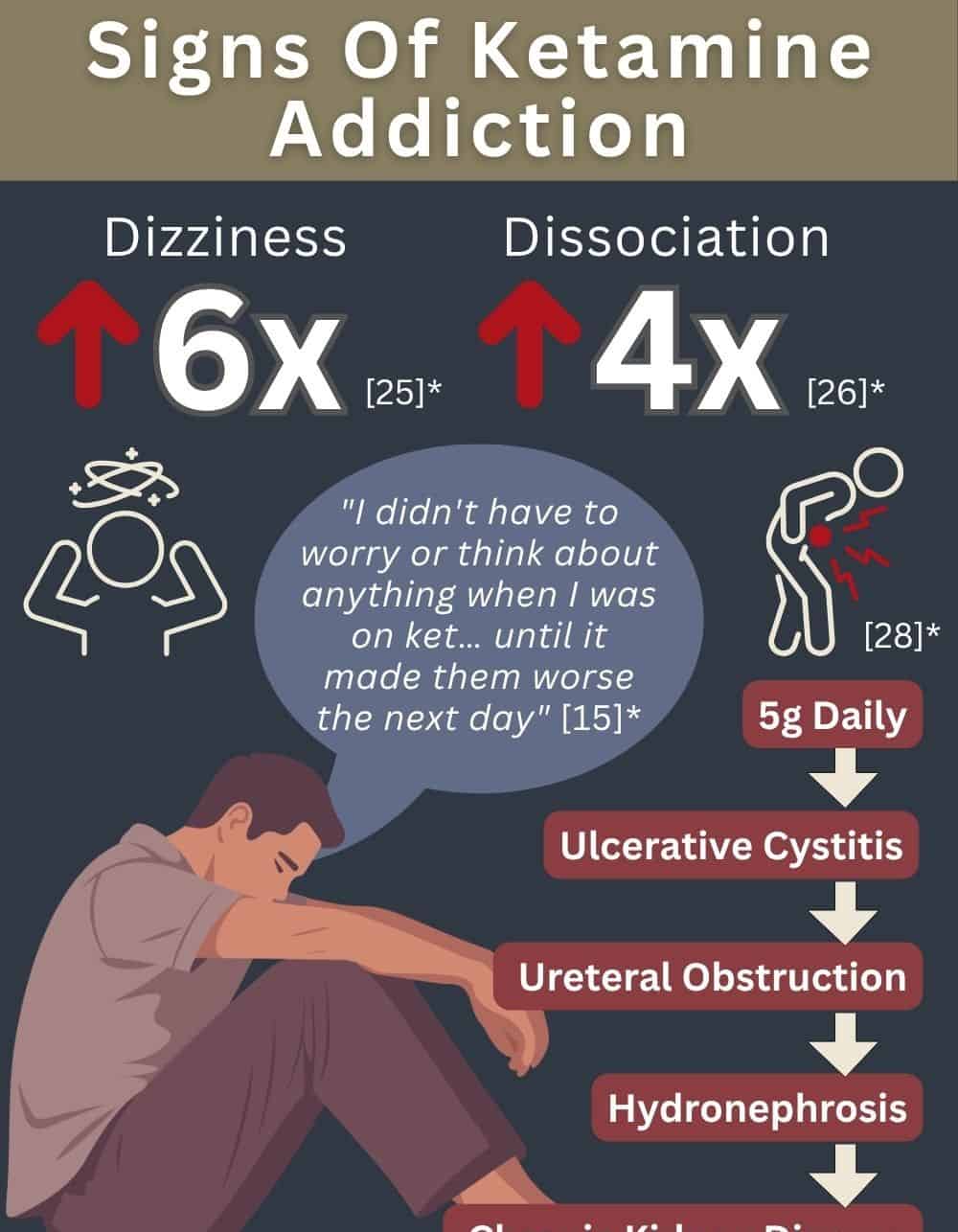
“I didn’t have to worry about or think about anything when I was on ket, it just solved all my problems, until it made them worse the next day” - 24-year-old male [15]
One 16-year-old male described feeling “less anxious, don’t care as much” after repeatedly using ketamine to induce “numbness” and suppress negative feelings [16]
Changing Social Circles
Changing social circles to spend more time with people involved in the “party scene” who promote ketamine use, rather than friends who are strictly drinkers, can occur in mid-stage addiction because [17]:
Settings where ketamine is widely accepted are deliberately chosen to maximise exposure and avoid judgement, whereas non-users disapprove and consider ketamine to be “worse” than cocaine [18]
Ketamine use is reinforced after developing certain relationships (e.g. drug-dealing friend) that help to establish a consistent drug supply and ongoing interaction with other users
Muetzelfeldt et al. (2008) studied a 24-year-old ex-ketamine user who highlighted how social circles change during active addiction: “A lot of friendships were based around the drug” [19].
Defensiveness Developing Into Lying
Defensiveness about ketamine use that develops into lying indicates mid-stage addiction because:
Users struggle to justify the negative consequences of compulsive use (e.g. “I’ve lost six or seven jobs because of it”), and lying begins to prevent anticipated conflict or external monitoring [20]
Self-concealment helps to preserve access to ketamine and delay/avoid medical intervention once physical deterioration becomes visible (e.g. “I weighed 40kg, … I wasn’t eating properly.”) [20]
Pavarin (2024) found that up to 73% of continuous users tried to keep ketamine consumption hidden from family, colleagues, or friends due to feared/unwanted consequences (e.g. labelling, legal troubles) [21].
Further Cognitive Impairment
Slowed reaction times (e.g. 83ms slower than non-users) are a symptom of ketamine abuse because [22]:
The brain struggles to interpret and respond to information due to semantic processing deficits after repeated drug exposure (e.g. 2g per session for ≤ 4 years) [23]
Ketamine is an NMDA antagonist that induces neuronal degeneration in cortical limbic areas (e.g. anterior cingulate cortex) involved in information processing and decision making
Appearing more clumsy than usual indicates mid-stage ketamine addiction because daily consumption of high doses (≥1 g) can damage the cerebellum, thalamus, and brainstem, leading to [24]:
Increased unsteadiness and a lack of coordination (5-6x higher scores than non-users) after abusing ketamine for 2 – 5 years [25]
Increased dizziness (6x higher than non-users) and drowsiness that persist for up to 3 days after the last use [25][26]
Late Stage Ketamine Addiction Signs
Negative Health Effects
Ulcerative cystitis indicates late-stage ketamine addiction because the urinary tract is repeatedly exposed to the drug’s active metabolites after long-term daily use (e.g. 5g/d for 2 years), leading to [27]:
Pain when urinating, blood in urine, and urgency due to inflammation and ulceration of the bladder wall, often extending to the ureters and kidneys
Ureteral obstruction and hydronephrosis that escalates to renal damage (e.g. eGFR = 28.3 mL/min/1.73 m2) in some cases, after bladder fibrosis progresses and impairs urine drainage [28]
Continuing to take 2g/d ketamine despite having bladder pain and knowing it’s “connected” to use, indicates late-stage addiction because compulsive drug-seeking persists regardless of consequences [29].
Ralphs et al. (2024) studied a 24-year-old who attempted to manage bladder symptoms (e.g. pain when urinating) by “drinking lots of water” while continuing to misuse ketamine in the late stages of addiction [30].
Acting "aggressive" and “out of character” indicates late-stage ketamine dependence because glutamate signalling is disrupted by repeated, heavy use (e.g. 1g/d for 4 yrs), leading to emotional dysregulation [31].
“Getting really paranoid” and feeling depressed for up to 3 days after using ketamine indicates late-stage addiction because repeated NMDA blockade alters prefrontal dopaminergic function, leading to [25][32]:
A 2x increase (vs nonusers) in depression and schizophrenic-like symptomatology (e.g. delusions, blunted affect) after abusing ketamine for 2-5 years [26]
Psychiatric comorbidities (e.g. anxiety, depression, psychosis) in up to 20% of chronic users (i.e. 5 years of use) whose symptoms persist for up to 12 weeks even after abstaining [33]
Extreme emotional instability is likely to be exacerbated in some chronic users (i.e. ≥1g/d ketamine for 6 years) who develop striatal lesions, a brain region involved in emotion and reward processing [24].
Isolation
Isolation indicates late-stage ketamine dependence because socio-occupational functioning deteriorates due to:
More time spent consuming ketamine (e.g. 6 – 7 doses per day) after repeated daily use rewires the brain’s reward system, and drug-taking becomes the primary focus [34]
Embarrassment and fears of attracting “unwanted attention” for having accidents in public due to urinary incontinence after long-term use (e.g. 10+ yrs) [35]
In the late stages of ketamine dependence, social withdrawal allows drug-taking to continue whilst avoiding judgment from others after the physical health impacts of prolonged use become apparent:
“I isolated for years, just using on my own. I looked awful, I weighed 40 kg” [20]
“I hid myself, … I couldn’t even go out because of my damaged bladder, … I was afraid of having urine on my clothes, leaving behind urine on the seat…” [35]
Dissociation
Dissociation indicates late-stage ketamine dependence because communication between the thalamo–neocortical and limbic system is repeatedly interrupted by ongoing daily use, leading to:
Out of body experiences and feeling like “everything was surreal, like in a daydream where nothing was very real” after continued heavy use (e.g. 3.8g ketamine per session) [36]
Altered perception of time, feeling of floating in the air, watching your own body from “outside” after doses rapidly escalate (e.g. 5x increase within 3 months) due to tolerance [34]
Morgan et al. (2004) found that after 2-5 years of use, individuals with KUD had 4x more dissociative experiences than non-users, with residual effects (e.g. distortion of sound) lasting up to 3 days after use [26].
Why Are Signs Of Ketamine Use Missed?
Reason Why Signs Of Ketamine Addiction Are Missed
Why?
Early signs attributed to stress or tiredness
Subtle, non-specific symptoms (e.g. low energy) dismissed as lifestyle-related
Used alongside other drugs/alcohol
Psychological signs (e.g. paranoia) masked by drugs (e.g. cannabis) with similar effects
Episodic use in specific environments (e.g. house parties) = appears functional/symptom-free between sessions
Pre-existing cognitive impairments
Being forgetful or socially disengaged is attributed to underlying condition = symptom progression overlooked
Thyroid disorders
Symptoms of hypothyroidism or hyperthyroidism (e.g. fatigue, mood changes) overlap = attributed to hormonal imbalances
Depression
Signs (e.g. social withdrawal, insomnia) mimic depression = assumed cause is mental illness
ADHD
Both associated with dopamine imbalances = poor focus, emotional dysregulation = attributed solely to ADHD by teachers, doctors, etc.
Why Do Signs Of Ketamine Misuse Change In Different Users?
Ketamine Temporarily Reducing Symptoms Of Depression
Ketamine temporarily reduces symptoms of depression, changing how signs of addiction present by creating a false impression that the user is emotionally stable for 2-3 hours after using [37].
Re-dosing ketamine (e.g. 10-12x daily) disguises psychological dependence by counteracting the “depressing feeling” or withdrawal symptoms (e.g. irritability) that surface in between doses [14][37].
Ketamine misusers with co-occurring depression may appear more “positive” to others due to the short-lived antidepressant effect prolonged by repeated, heavy use (e.g. 6-7g per session) [38].
Ketamine worsens underlying depression despite the temporary (e.g. 30 – 60 min) dissociative anaesthetic effect that makes things “more bearable” for users with persistent low mood [34][38].
Ketamine Abuse Amplifying Psychotic Disorders
Signs of being addicted to ketamine change in users with schizophrenia (SCZ) because the severity of psychiatric symptoms (e.g. hostility, emotional withdrawal) increases by up to 70% [39].
Ketamine dependence and schizophrenia are both linked to NMDA hypofunction, and further disruption of glutamatergic signalling amplifies positive (e.g. delusions) and negative (e.g. alogia) symptoms.
Signs of escalating ketamine use (e.g. irritability to extreme paranoia) may be misinterpreted as illness progression in users with psychotic disorders, delaying access to drug and alcohol treatment services.
Nonlinear Pharmacodynamics
Nonlinear pharmacodynamics of ketamine change signs of addiction because symptom severity does not reflect consumption patterns, leading to:
Higher rates of incoordination (70.5 vs 63.7), poor concentration (61.2 vs 57.2), and visual distortions (64.5 vs 60.0) in moderate users compared to heavy users, despite consuming 3x less ketamine [40]
Increased dissociation (ADDS score = 39.26 vs 34.83) and “out of body” experiences (35.8 vs 30.8) amongst infrequent vs frequent users who consume ketamine 13 days less per month [40]
Intensified depression (16.8 vs 10.8) after a shorter duration of use, compared to users who abused ketamine for twice as long (i.e. 1 vs 2 years) [40]
Chiang-Shan et al. (2017) found that depression rates were 2x higher in females with KUD compared to males with the same five-year history of use due to sex differences in brain functional connectivity [41].
About the author
Mischa Ezekpo
Mischa Ezekpo has a Bachelors degree in Psychology from Northumbria
University, and a Masters degree in Childhood Development and
Wellbeing, from Manchester Metropolitan University. Since 2018, Mischa
has written and published work on Addiction, Mental Health, Depression, and Eating Disorders. Content reviewed by Laura Morris (Clinical Lead).