


KEY TAKEAWAYS
At Abbeycare, behavioural addiction is not treated alone, but alongside primary substance addiction.
Behavioural rehab includes:

Below, we discuss possible approaches that meet the specific rehab needs around behavioural addiction. Not all treatment centres will provide these specific interventions.
For an overview of the Abbeycare programme contents for behavioural addiction rehab, click here.
Is There A Detox In A Behavioural Addiction Rehab Programme?
At Abbeycare, detox for the primary substance addiction is provided as part of behavioural addiction treatment.
There is no detox as part of a sole programme for behavioral addiction because there is no substance that needs reducing or replacing with medication-assisted treatment.
Unlike substance use disorders that entail both physical and psychological dependence, behavioural addictions occur primarily through psychological dependence, leading to psychological withdrawal symptoms:
Fluvoxamine is 24% more effective than a placebo at managing anxiety and behavioral cravings in the first 7 days of rehab, hence why psychological observations are made continuously by health professionals to gauge the need for symptom management [1].
Although not given directly for behavioural addiction, 50-150mg/day naltrexone (50-150mg/day) has been shown to reduce behavioural cravings by 27.6%, indicating its uses in opioid blocking and craving management for behavioural addiction [2].
Even though there is no direct medical treatment for behavioural addiction, withdrawal symptoms are monitored and appropriately managed where necessary.
27.1% of former game addicts do not experience any withdrawal symptoms in rehab, indicating a subjective nature to behavioural addiction withdrawal, and this is the reason why most rehabs tailor care plans to the individual [2].
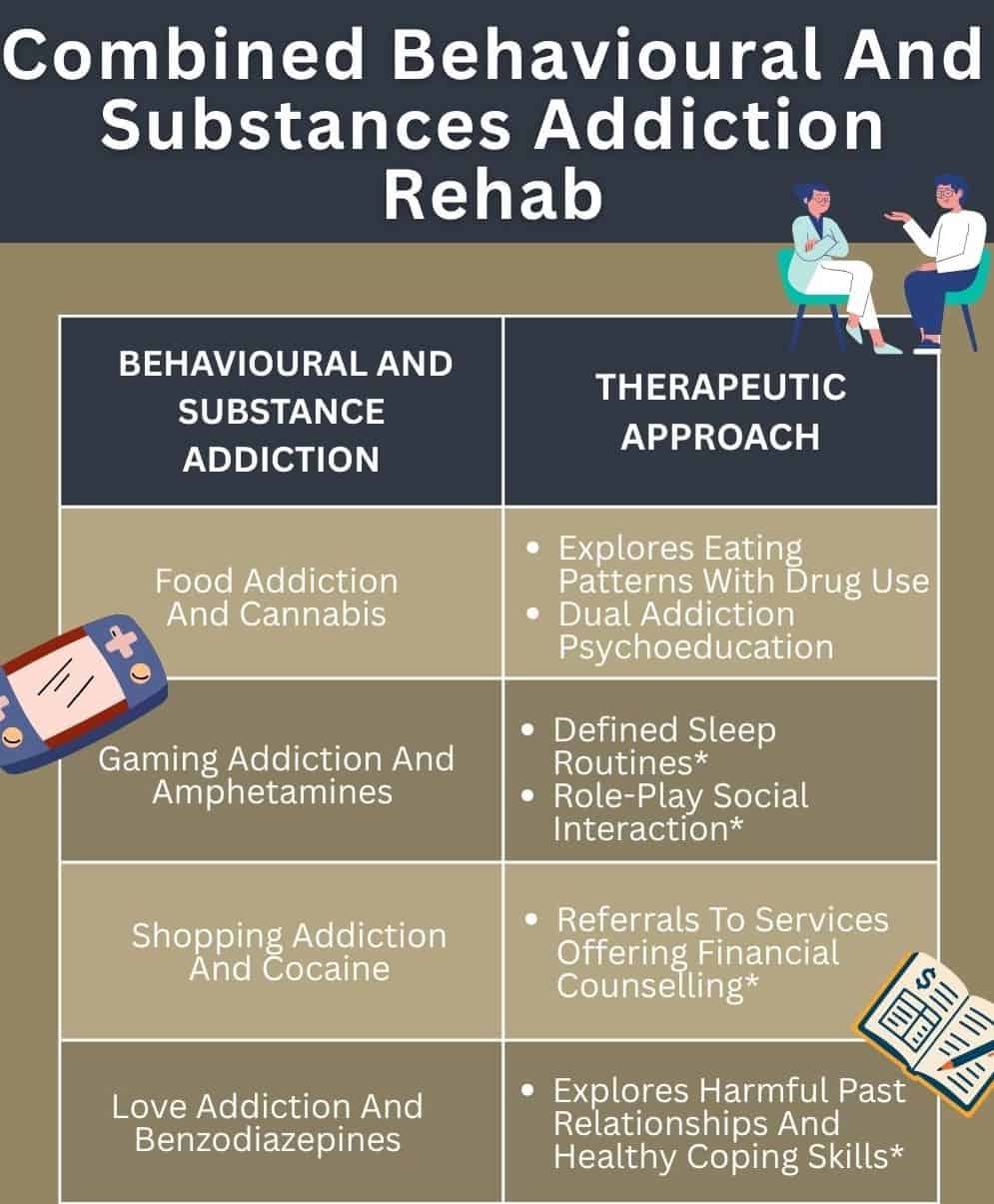
How Are Combined Substance And Behavioural Addictions Treated In A Rehab Setting?
Commonly combined substance and behavioural addiction | Detox process | Combined therapeutic approach |
|---|---|---|
Shopping and cocaine | Symptom-managed detox over 5-7 days SSRIs for depression and anxiety Beta blockers for anxiety and/or heart problems (e.g atrial fibrillation) Daily vital observations to examine changes in heart health | Focus on financial counselling, budgeting skills, and saving Motivational interviewing to explore reasons for compulsive shopping and cocaine use |
Body modifications and cannabis | Symptom-managed detox No specific medication treats cannabis detox Medically managed for nausea (e.g. metoclopramide) In cases of medical cannabis use, this may be tapered | CBT focuses on body dysmorphia and underlying depression Teaches healthy coping mechanisms for underlying stress (e.g. book reading) Tackles underlying sleeping disorders without the need to use cannabis |
Gaming addiction and amphetamines | No specific medication treats amphetamine detox Mood stabilisers (e.g. SSRIs) are used to treat short-term depression and anxiety Analgesics are provided for muscle aches Detox focuses on encouraging healthy sleep patterns to combat fatigue at 48 hours | Implements sleep/wake cycles Exploring healthy coping mechanisms for underlying stress or loneliness (e.g. making friends) Role-play helps teach real-world social interaction |
Love addiction and benzodiazepines | Focused on a gradual tapering of benzodiazepines Non-benzodiazepine anxiolytics are provided to calm short-term irritation and cravings for benzodiazepines and affection | Focused on setting boundaries Explores harmful past relationships (e.g. mother and son) that may be causing love addiction CBT explores the underlying core beliefs that trigger the need to use benzodiazepines or find loving relationships |
Porn/ sex addiction and cocaine | Similar to shopping and cocaine, with the focus on restricting the use of mobile and laptop devices Sleep patterns are carefully monitored and addressed (e.g.melatonin) | Implementing the use of blocking software Urge surfing of sexual cravings Group therapy to openly discuss and address shame and/or guilt Relationship building without the need for porn |
Exercise addiction and anabolic steroids | Activity throughout the day is strictly monitored, ensuring all patients get 8+ hours of sleep Hormone monitoring Steroids may be tapered (patient-dependent) Medical care for serious sporting injuries will need to be attended to before detox and rehab | CBT focuses on overcoming body dysmorphia and underlying depression Mindfulness-based practices focus on self-acceptance Teaches healthy coping mechanisms to accept oneself without the need for anabolic steroids or excessive exercise |
Food addiction and cannabis | Personalised nutrition plans are provided Meal times are structured and monitored strictly in the first 7 days Anxiolytics are prescribed for short-term anxiety Melatonin is prescribed for insomnia and poor sleep habits | Psychoeducation on reasons underlying food addiction and what triggers it (e.g. emotional eating) Practices intuitive eating around central meal times |
Plastic surgery addiction and prescription opioids | Buprenorphine or suboxone is used in detox for opioid addiction Analgesics are prescribed for muscle aches and ongoing fever/chills Mood stabilisers are prescribed for anxiety and depression | CBT focuses on body dysmorphia and underlying depression Cognitive restructuring is used when negative beliefs about the self are present Dialectical behavioural therapy is used to overcome impulse to change appearance or use opioids |
How Does Therapeutic Content Work For Behavioural Addictions?
Addressing Psychological Triggers
Rehab for behavioural addiction addresses shame cycles as Bilevicius et al. (2018) found that shame is a significant predictor of behavioural addiction outcomes, for example, a 1 standard deviation increase in shame predicts a 3.8% increase in behavioural addiction occurrence [3].
Psychologists utilise Socratic questioning (e.g. "why do you think you feel this way?") to challenge the reasons behind shame, as this is effective in reducing BDI-II depression scores by 1.51 [4].
By challenging underlying shame, this encourages the patient to explore the internal compensatory relationship between current mood state (e.g. depression) and addictive behaviour.
Patients suffering from loneliness have a 1.16 times increased rate of addiction to the virtual world (e.g. gaming addiction), so rehab focuses on encouraging healthy support networks in the physical environment through role-play in group therapy [5].
Trauma-informed therapy has been found to improve symptoms of trauma and stress in 75%, enabling patients to build emotional resilience to trauma-related triggers [6].

Finding Identity Outside Of Behavioural Addiction
Rehab for behavioural addiction helps patients find an alternative identity outside of behavioural addictions by exploring healthy coping mechanisms that replace the former addictive behaviours, such as reading or healthy levels of social connectivity.
Finding identity outside of addiction begins with thought challenging and cognitive restructuring of internalised beliefs:
Cognitive restructuring over 3+ weeks of therapy reduces the rate of behavioural addiction by 32%, indicating the effectiveness of reframing negative beliefs when developing a healthier self-perception [7].
After one month of group therapy, 76% of patients lost self-perceived identity as an addict, with 64% stating a shift in mindset as a recovering individual [8].
As 24% of patients have no changes in identity within the first month, this may be a reason for extended therapy in aftercare [8].
The use of 12-step groups in rehab for behavioural addiction at Abbeycare encourages patients to form a shared identity within the group through:
Aiming To Reduce Ritualistic Behaviours
Rehab for behavioural addiction aims to reduce ritualistic behavior through exposure therapy, resulting in a reduction in behaviour (− 1.087) and time spent engaging in it every session (− 2.136), as measured by standardised screening tests [9].
Exposure therapy remains effective at 6 and 12 months post-rehab (-1.010), making this an effective form of therapy for long-term abstinence [10].
Cognitive restructuring through CBT helps to reduce anxiety surrounding ritualistic actions by 53%, disenabling intrusive thoughts regarding not engaging in such actions [11].
CBT directly reduces connectivity between the ventral striatum and posterior insula by 32%, resulting in the regulation of behavioural cravings at a neural level [12].
Rehab aims to reduce repetitive computer checking in game addiction through the use of retrieval-extinction, a method of trigger breaking, to reduce cue-related craving by 35% and the subsequent compulsion to check the computer when close by [13].
How Does Behavioural Addiction Treatment Aim To Avoid Cross Addiction?
Original behavioural addiction | Cross addiction is most commonly developed | How therapeutic treatment avoids cross addiction |
|---|---|---|
Gaming | Gambling | Collaboratively creates schedules for technology use (e.g. screen time limits) Focus on teaching healthy coping mechanisms for stress (e.g. journalling) Financial counselling and budgeting skills |
Exercise | Orthorexia | Establishes a healthy relationship with food to cover a balanced diet Personalised, monitored meal and exercise plans Motivational interviewing to overcome body dysmorphia |
Porn | Dating apps | Establishes healthy relationship boundaries Mindfulness-based therapy encourages self-acceptance without the need for sexual activities and/or relationships Collaboratively creates schedules for technology use (e.g. screen time limits) |
Shopping | Compulsive budgeting | Financial planning Role-play to enact healthy spending habits CBT to overcome anxiety around spending money Establishes the difference between necessary, desirable, and compulsive spending |
Binge eating | Overworking | Daily structured routine planning (e.g. use of a timetable) ensures appropriate working hours Incorporated meal times establish specific times to eat to prevent deviation and binge eating Psychoeducation on the importance of talking about one’s emotions, instead of binge eating to compensate |
Cleaning | Hoarding | Therapy derived from OCD treatment, including exposure and response therapy Role-play helps teach normal cleaning habits CBT helps prevent hoarding habits through tackling underlying attachment concerns or fears of loss |
Aftercare Planning
Planning Real Life Interactions
Aftercare planning in rehab for behavioral addiction aims to use social interactions to replace isolation because it helps rebuild a real-life supportive network that replaces the need for the addictive habits.
Patients are typically encouraged to join in-person help groups, such as GA, as these explain 79% of the changes that occur in abstinence-related self-efficacy and enable the practice of real-world interactions both in and out of rehab [14].
Support groups and social reintegration practices also help mitigate perceived risk for behavioural relapse, as these explain 60% of the variance in perceived risk measures [15].
Group CBT for social media addiction that incorporates building social relationships outside of the virtual world results in 95% of patients reporting appropriate management of cravings to use social media over 12 weeks, with 78% sustaining this result over 6 months [16].
Inpatient treatment promotes the real-world application of social interaction skills learnt in inpatient treatment, as this forms part of social reintegration, for example, applying communication skills to attend job interviews in person.

Habit Tracking Journal
Aftercare planning in inpatient treatment for addictive behaviour prepares clients to document 3-5 different triggers every day to capture the temporal changes in triggers, depending on the current situation (e.g. being alone versus with others).
Triggers and subsequent urges are noted in the tracking journal, with what actions were done and/or what could be done differently next time (e.g. following a desire to game, the patient browses an online game shop, but wishes to read a novel instead).
Habit tracking is used to plan for new healthy habits as well as eliminate old behavioural addictions, for example:
Writing down personalised goals enables patients to have a protocol for what to do if a relapse occurs, such as handing a phone to a loved one for 7 days or more.
Krentzman et al. (2022) found strengths of journalling in rehabilitation, specifically pinpointing the positive aspects of recovery, purposeful short-term goals, and discovering pride in every milestone reached during inpatient treatment [17].
Outcomes
Abstinence Rates
64% of patients with porn addiction undergoing guided and non-guided mindfulness-based meditation in inpatient treatment had significant improvements in symptom severity over 12 weeks [18].
At three months post-rehab for porn addiction, there is an 8.4% increase in quality of life, with 83% demonstrating inhibition of sexual impulses [19].
Short-term CBT results in 70% of addicted gamers entering remission following inpatient treatment and outpatient care (12 weeks total) [20].
Research states that full remission status for behavioural addictions depends on the severity of the addiction. For example, after 16 weeks of treatment [21]:
Cognitive behavioural therapy with electroacupuncture is 32.2% more effective in maintaining abstinence compared to cognitive behavioural therapy alone in social media addiction; however, not every inpatient clinic has access to this treatment [22].
Behavioural addiction outcomes will depend on co-occurring behavioural and/or substance use disorders, particularly if one behaviour is a trigger itself for another behaviour.
Restoring Daily Routines
Inpatient treatment for addictive behaviour works by establishing a daily routine with:
Physical behaviours take 1.5 times longer than drink and meal habits to become automatic; hence, behaviours such as meditation are scheduled in inpatient treatment from the first week [23].
The time it takes to form a new daily routine varies depending on the patient; however, Arlinghaus and Johnston (2018) state that it takes, on average, 18 to 254 days, indicating the need to extend daily routine planning into post-treatment practices [24].
Building a structured routine both in and out of inpatient treatment helps ensure accountability, as well as aiming to combat boredom as a potential trigger for addictive behaviour.
At Abbeycare, an hour's walk is scheduled every week, as light exercise helps form healthy routines and has been found to reduce game addiction by 1.5-fold [25].
Rehab For Behavioural Addiction At Abbeycare
At Abbeycare, behavioural addiction is not treated alone, but alongside primary substance addiction.
The programme for behavioural addiction at Abbeycare is a 28-day programme comprising a 7-10 day detox for the co-occurring substance use disorder.
Key components of the behavioural addiction programme at Abbeycare include:

