



KEY TAKEAWAYS
At Abbeycare, social media addiction is not treated alone but alongside primary substance addiction.
Social media addiction is:

How Does Social Media Addiction Develop?
As social media usage becomes habitual through a series of intermittent rewards (e.g., receiving likes and comments), it triggers a dopamine rush that becomes addictive, thus encouraging further social media checking [2].
The sporadic nature of receiving likes and comments contributes to variable-ratio reinforcement, a method of operant conditioning that drives compulsive phone-checking [3].
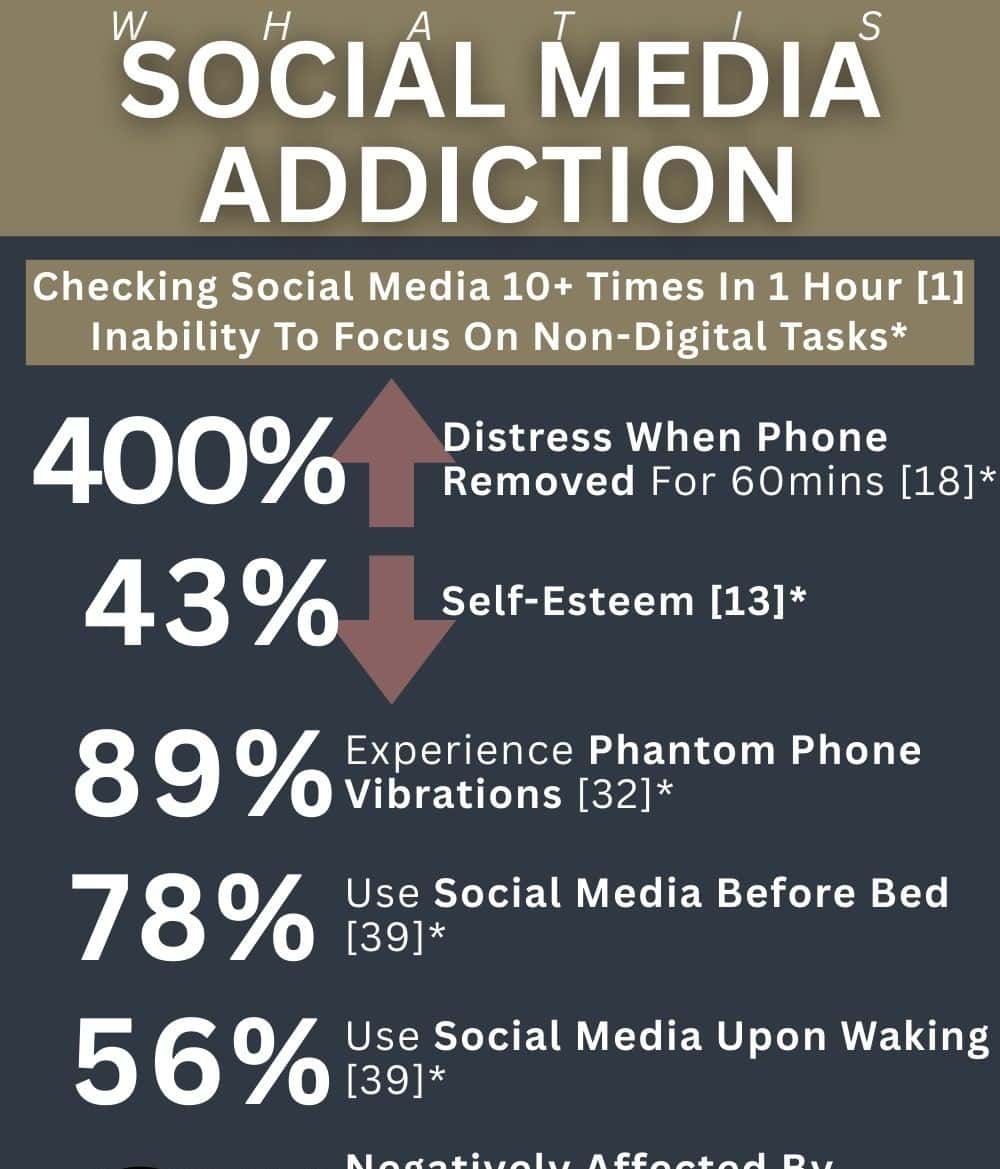
As social media checking transforms into compulsive use, dopamine receptors in the brain become desensitised to the same reward, prompting users to check phones 10+ times in one hour or branch out to other social media platforms to drive engagement [1].
In social media addiction, there is a 5.4% reduction in neural matter in the prefrontal cortex, resulting in poor impulse control to overcome urges to use social media, and the need for professional guidance to overcome this [4].
The striatum is 45% more effective than the insula at predicting harmful social media habits, as this area is primarily responsible for forming habits during reward processing [4].
Co-Occurring Social Media And Physical Substance Addictions
Behaviour | How Behaviour Looks In Social Media Addiction | Co-occurring Substance Abuse | Why Do These Co-Occur? |
|---|---|---|---|
Dopamine Seeking Behaviour | - Regular posting for likes and comments - Endless scrolling with no ultimate goal | - Stimulants (e.g. using cocaine or methamphetamine) | - Chasing short-term dopamine - Both compensate for low dopamine |
Emotional Avoidance | - Using social media to mask genuine emotions - Using social media as a way to escape real life (e.g. current trauma) | - Cannabis, benzodiazepines, and prescription opioids | - Central nervous system depressants numb emotions |
Seeking Euphoria | - Actively seeking relatable or exciting content on socials | - MDMA and hallucinogenics (e.g. 2cb) | - Short-term serotonin boosts provide a temporary high |
Identity Dissociation | - Creating a fake account with a pseudonym to deceive others - Pretending to be an idol to manipulate others | - Alcohol, using ketamine, and nitrous oxide (i.e. laughing gas) | - User wishes to escape self-identity through dissociative drugs and to conceal the true self |
Anticipation Of Rewards | - Continuous checking of social media to observe likes, sometimes checking every minute | - Stimulants, including nicotine, cocaine, MDMA | - Lack of delayed gratification shares the need for instant activation of reward circuits |
Sleep Disruption | - Prioritising social media use over healthy sleep patterns | - Both stimulants (e.g. cocaine) and depressants (e.g. alcohol) to self-regulate sleep/wake cycles | - Unhealthy sleeping patterns from late-night phone use |
Sharing Sensitive Information/ Inappropriate Content (Risky Behaviour) | - Sharing home address with others - Revealing personal details online to strangers or “online friends” - Sexting | - Alcohol, GHB, MDMA | - Lack of risk perception when taking drugs, and drugs perpetuate disinhibition of control |
Dependence On Validation | - Chasing validation through likes, comments, and follows - Deleting media that does not get validated enough | Alcohol and nicotine | These two drugs are socially accepted, resulting in more self-perceived validation |
Paranoia | - Paranoia around not receiving as many likes as planned - Comparing the self to other social media accounts | Hallucinogens, stimulants, ketamine | - Paranoia is heightened by psychedelic stimulation |
Signs Of Social Media Addiction
Inability To Reduce Social Media Use
Thematic analysis shows that 19.68% of those addicted to social media report increased usage for reasons such as [5]:
Those reporting problematic social media use have a 2.6 times increased rate of deactivating social media accounts in an attempt to cut back; however, this typically leads to using alternative platforms or creating new accounts [6].
Those with social media addiction receive 27.4% more notifications on average, driving the need to open the app and respond [7].
Using Social Media As A Coping Mechanism
Affective social media use, or using social media to mask loneliness or sadness, occurs 35% to 62% more than cognitive or behavioural social media use, respectively [8].
82% of social media addicts in Gao et al. (2020) have an increased rate of anxiety, due to consistent use of social media that enables its users to experience fear of missing out and peer comparison [9].
Moretta and Weggman (2025) outline a series of behavioural markers that differentiate social media dependence compared to average use:
Those at risk of social media dependence have, on average, a 6.2% increased rate of stress, meaning social media is used as a form of escapism [10].
Mood Swings Based On Online Engagement
Social media dependence causes an 8.2% reduction in grey matter in the nucleus accumbens, resulting in hyperactivation to social cues seen as overreaction and mood swings (e.g. from happy to visible anger) [11].
There is a 6.1% increase in amygdala volume in those with social media dependence, resulting in hyperactivity to social threats, observed as anxiety and withdrawal in social situations [11].
Conversely, in some users, a 6.1% increase in amygdala volume also causes a fear of missing out (i.e. FOMO), resulting in users attending events, followed by leaving such events early [11].
25.8% of those with social media dependency state getting negatively affected by others' posts, causing visible upset, anxiety, anger, or depression [12].
Mood swings in social media dependence are typically affected by the type of content consumed by the user (e.g. positive affirmations versus negative news).
Social media dependence causes a 43% reduction in self-esteem measures, resulting in social withdrawal and mood swings when comparing the self to others online [13].
Prioritising Social Media Interactions Over Real Life Connections
Prioritising messaging on social media over face-to-face connections indicates social media dependence, as it suggests the user does not believe social bonds are stronger in person than online.
Those with social media dependence send 62.7% more Facebook messages than those without problematic use, even though only 21.6% more time was spent using the app [14].
Farrugia (2013) found that using Facebook drives the moderation between self-disclosure and jealousy in 35% of cases, resulting in the breakdown of real-world relationships if jealousy does not get resolved [15].
56% of problematic social media users check in with friends at least once a day, and 12% check in every 2 hours, resulting in virtual check-ins replacing real-world connectedness [16].
Overuse of social media can be damaging when forming new friendships, as it presents a false image of personality, hobbies, and sometimes physical appearance.
A structural model of relationship quality on social media dependence shows that 25% of the variance is explained by internalising problems, demonstrating social media is used more during conflict with a relationship partner, yet this is not fully addressed in person [17].
Experiencing Withdrawal Symptoms When Not Using Social Media
Truzoli et al. (2021) state that those with social media dependence experience a 400% increase in distress levels when phone access is removed for 60 minutes [18].
In periods of Facebook abstinence, those with social media dependency typically focus on other social media networks, though this results in reversion to Facebook use in 44.7%, despite a desire to cut down usage [19].
Those aware of social media dependence are 37.8% more likely to experience cravings for social media and return to using the platform in periods of non-use [20].
Tullett-Prado et al. (2023) define social media withdrawal symptoms as becoming "restless or troubled if you are prohibited from using social media", and show these visible signs:
A qualitative study by Hryniszak on the experiences of social media withdrawal over 12 hours found common themes [21]:
Creating A False Online Persona/ Mimicking Influencer's Personality Traits
20% of social media addicts admit to lying on social media to appear more likable to peers and followers [22].
Similarly, a PEW survey (2020) found that 70% of social media users lie by posting or editing images to appear more attractive, perpetuating the cycle of addiction through the need for external validation [23].
The fear of negative evaluation explains 14.5% of the variance in social media usage, making social media addicts more prone to falsifying self-presentation due to the belief that strangers' opinions matter more than close friends or family [24].
Through editing posted photos, users take control of exactly what to post in order to achieve the ideal representation of the self, despite this not always being one's true identity [25].
Posting photos on Instagram occurs 80% more due to the need to conform to influencer posting patterns and likability, compared to the fear of missing out, as social media dependence is driven mostly by the need to 'fit in' to the self-perceived idea of perfection, though this imagery is often falsified itself [26].
Self Worth Becoming Dependent On Social Media Metrics
Social media explains 5.2% of the variation seen in self-esteem measures; however, this changes when disorders such as depression or anxiety were present before social media dependence began [27].
When self-esteem becomes dependent on social media usage in addiction, this affects the overall quality of life in 32.3% of cases [28].
In social media dependence, the user's self-worth often becomes dependent on the number of likes, comments, and followers, driven by the need for external validation.
In social media dependence, the relationship between low self-esteem and using social media stems from the idea that users wish to enhance self-image, or how the external world views the user, even if this is not a true perspective [29].
Bayraktar et al. (2023) found that for every unit change in the anxious/ambivalent attachment style where symptoms of poor self-esteem are shown, the prevalence of social media dependence increases by 2.1 times [30].
Although poor self-esteem is a trigger for social media dependence to begin, utilising social media itself can also perpetuate the cycle of addiction through continuous comparisons to others on social media, regardless of how real the images of comparison are.
Those using Instagram, a platform made to share videos and photos, have an 18% increase in anxiety compared to non-users and a subsequent 5% decrease in self-esteem measures [31].
Phantom Phone Vibrations
89% of undergraduates with social media dependence have experienced at least one phantom phone vibration in the past, with the average being once every two weeks [32].
The difference between those experiencing phantom phone vibrations with and without addiction is that 39% of those with phantom vibrations with addiction do not make attempts to stop these phantom vibrations, but will continue to check the phone as normal [33].
Feeling phantom phone vibrations occurring more than twice per week also indicates addiction as the phone is being continuously carried close to the body (e.g. in the front pocket of jeans), increasing the rate of phone checking by 49.3% [34].
Regularly using vibration mode increases the rate of experiencing phantom phone vibrations in addiction by 2.9-fold, indicating addiction through the inability to disengage from social media notifications [34].
When a user with social media dependence experiences phantom phone vibrations, this may appear to an observer as:
Persistent Thoughts
Persistent thought patterns about social media, along with anxiety and psychological well-being, account for 24.4% of the variance seen in social media dependence outcomes [35].
When anxiety and psychological well-being are controlled for, unhelpful thought patterns (e.g. "I can't miss the latest Instagram") account for 21% of the variance seen in the onset of social media dependence, indicating unhelpful thought patterns form a significant factor in social media dependence [36].
A lack of premeditation (e.g. forward thinking of the reasons needing to utilise social media) explains 14% of the variance seen in social media dependence, indicating that users act on impulses without thinking about the intent of actions in addiction [37].
Verbal perseveration, or the involuntary return to talking about words and phrases related to social media, explains 9.6% of the variation observed in addiction, suggesting that those with dependence struggle to shift thought patterns away from social media [38].
In social media dependence, 77.5% of users utilise social media as the last action before sleeping, and 55.6% of users state it is the first thing that is done when waking up, indicating addiction through pre-occupied thinking [39].
Altering Physical Appearance Due To Instagram's Idealised Body Standards
In social media dependence, 33.8% of users hold a neutral to extremely dissatisfied perspective on personal body imagery, making this group particularly vulnerable to comparing body images on social media [40].
There is a 5-fold increase in severe social media dependence in those with a negative body image, compared to a 50% increase in mild social media dependence with negative body image [41].
Having a positive body image results in severe social media dependence in 1.2% of cases, showing that, while those with negative body image are most at risk of addiction, addiction can still occur without body dissatisfaction [41].
14.6% of those with social media dependence become underweight according to BMI measurements, indicating social media's influence on maintaining a 'perfect' body type [42].
70% of young adult women (18-25) with social media dependency show body dissatisfaction and have considered at least one surgical procedure to modify the body to fit beauty standards, compared to 60% of men [43].
Those with social media dependency are more prone to seeing advertisements for cosmetic procedures, such as lip filler and liposuction, as this is a platform utilised for marketing in 70.6% [44].
Factors That Increase Risk Of Developing Social Media Addiction
Demographic | Why Is This Risk Increased? |
|---|---|
20-29 Year Olds | - 61% of social media users are aged 18 to 43 [45] - This age group utilises social media primarily for communication compared to other age groups - A majority of personal life typically involves the use of a phone, from work to social life |
Males | - 1.2 times increased rate of social media addiction due to impulsivity [46] |
Low Self-Esteem | - Those with low self-esteem utilise social media for external validation - Alternative identities may be created on social media |
Anxiety, Depression, ADHD, Or BPD Sufferers | - Those with depression have a 2.5 times increased rate of social media addiction [46] - Those with severe anxiety have a 5.2 times increased rate of social media addiction [46] - Hyperfixation on social media and the need to use socials to escape reality (e.g. ongoing trauma) |
Isolated Individuals | - Social media may be the primary tool used to communicate with the outside world - Social media substitutes real-world interaction |
History Of Other Substance Addictions | - Addiction to substances may develop into social media due to seeking instant gratification and dopamine rushes |
From Social Media Use To Social Media Addiction
Behaviour | Description | Signs Of Behaviour |
|---|---|---|
Initial Use | - Irregular and casual use of social media | - Downloading social media apps |
Becoming A Coping Mechanism | - Patterns of usage revolve around current emotions - Usage becomes more frequent at night | - Using social media when bored, stressed, or upset |
Compulsive Use | - Inability to stop using social media despite wanting to - Patterns of use become habitual and form a large part of daily life | - Frequent checking of social media, sometimes in inappropriate places (e.g. the workplace) |
Escalating Use | - Social media is used increasingly - Social media usage is prioritised over life responsibilities | - Setting up new profiles to surpass spam blocks - Falling behind in work due to using social media at work |
Withdrawal | - Experiencing agitation and irritation when social media can’t be used | - Short temper - Actively seeking access to social media when not allowed (e.g. logging into social media on work computers) |
Addiction | - Complete lack of control over social media use, despite using screen time limits | - Addiction fully takes over all responsibilities - Leads to job and relationship losses due to a lack of in-person engagement |
Trolling As Part Of Social Media Addiction
Males exhibit a 50% higher prevalence of trolling behaviour in social media dependence compared to females, due to using social networking as a platform for unsocial behaviour [47].
Those engaging in trolling behaviour with social media dependence have, on average [48]:
Those engaging in trolling with social media dependence have an 8.4% increased self-reported need to utilise social media, demonstrating trolling as a way of communicating with others, even with ill-intent of actions (e.g., cyberbullying) [49].
Revenge trolling is a theme scene in cyberbullying and social media dependence, where users feel the need to respond with hate as a way to self-defend, for example, one male (27) said he "would definitely troll back" when provoked on social media [50].
According to qualitative data outlined by Mao et al. (2023), one reason for trolling is wanting "to seek fun and make other people feel annoyed and obey him", demonstrating the need for thrill-seeking in addiction [51].
What Does Social Media Addiction Look Like Per Platform?
Platform | What Social Media Addiction Looks Like |
|---|---|
- Scrolling through Facebook feed endlessly - Friending strangers to view more posts, and have others view personal posts | |
- Regular posting of photos, reels, and stories for a continuous stream of likes and comments - Deleting posts when not receiving enough likes/comments - Liking and resharing others’ posts - Scrolling and engaging in the explore page - Short form content - Automatic scrolling through videos on reels | |
X (Twitter) | - Scrolling and reposting others’ content - Commenting and liking on others’ posts - Posting regularly to seek validation and connection with others - Verification marks can be bought by anyone, providing influencers with false credibility to large audiences (e.g. spreading misinformation) |
TikTok | - Videos are made to hook the audience within the first 5 seconds - Endless scrolling and watching videos - Posting videos, photos, and stories for validation - ~3-minute-long videos - Videos automatically replay to keep users watching |
Snapchat | - Subscriptions to influencers enable continuous watching of stories - ‘Streaks’ on Snapchat promote the continuous use of messaging to increase the Snapchat score - Streaks may be used as competition, or to observe how frequently peers are using the app - Unlimited number of story posts promotes continuous posting for engagement (usually in the form of story replies) |
YouTube | - Watching videos in a binge cycle, often at night and prioritised over sleep - Continuous commenting on videos - Obsessive towards YouTube creators - Watching videos instead of socially interacting with others |

