Alcoholism is a disease characterised by continuous heavy drinking. Until people with alcohol use disorder admit to problems with alcohol and stop drinking, the risk of alcohol use disorder continues which affects both physical and mental health.
Alcohol starts to injure the brain once it reaches the bloodstream.
Excessive consumption can lead to Alcohol-Related Brain Damage, or ARBD, which is a type of brain disorder caused by alcohol consumption. Brain shrinkage caused by alcohol abuse is permanent, as alcohol kills brain cells and grey matter.
For more information and effects click ‘Learn More’.
Family Recovery Compass is a newsletter for friends and family members who feel trapped between supporting a loved one in addiction, and protecting their own wellbeing.
Every week, we tackle one specific situation in addiction family dynamics, and deliver practical decision-making frameworks and exact dialogue scripts – that help you respond with confidence instead of reaction.
Every month, we bring you an unfiltered recovery conversation with someone who’s either experienced addiction firsthand, or works closely with those in recovery.
No sanitised success stories – just practical insights on what actually works in recovery, that you can apply, in your life too.
Recovery capital is the internal and external resource used to begin the recovery process and maintain sobriety. This combines personal, social, and community support to provide a joined-up approach that supports the addict through recovery.
Do you or a loved one need addiction treatment for alcohol or drugs? Thousands blindly walk into addiction treatment in expensive rehab centres and find that the reality doesn’t meet expectations.
If you’re considering rehab treatment, first check our ultimate guide for complete instructions on how to find the right rehab centre for you.
Take-home Naloxone kits help families and loved ones respond quickly in an opioid overdose emergency, until emergency services arrive. Kits contain nasal or injectable forms of Naloxone.
Changes in legislation mean Naloxone kits are now more widely available from pharmacies and drug services, including Abbeycare.
For additional information, click ‘Learn More’ below.
Overcoming alcohol addiction means first ceasing alcohol intake, and taking care of physical and chemical withdrawal symptoms.
Detoxing from alcohol means undergoing withdrawal from alcohol, but with the assistance of prescribed medication and detox phase, to substitute in place of the alcohol itself.
Alcohol rehab focuses on tackling the problems underneath alcoholism, such as grief, trauma, depression, and emotional difficulties, in order to reduce continuing drinking after treatment.
Inpatient services at an alcohol rehab programme provides 24 hour access to specialist care.
Alcohol home detox provides a means of semi-supervised addiction treatment in the comfort of your home. It’s often suitable for those with inescapable practical commitments, or where a reduced budget for treatment is available.
An at-home detox is the most basic detox option available from Abbeycare, and assumes you have support available, post-detox, for the other important elements of long-term addiction recovery.
The term alcoholism refers to the consumption of alcohol to the extent that the person is unable to manage their own drinking habits or patterns, resulting in side-effects that are detrimental to the quality of life and health of the alcoholic, or those around them.
An alcoholic is someone who continues to compulsively abuse alcohol in this way, despite the negative consequences to their lives and health.
Immediately following treatment, the early stages of recovery and abstinence are most vulnerable to lapses.
At Abbeycare, a structured and peer-reviewed aftercare plan is usually prepared whilst still in treatment. This comprises social, peer, and therapeutic resources individuals draw upon, following a residential treatment programme for drug or alcohol misuse.
Clinically managed residential detoxification is:
– A structured detox that uses medication-assisted treatment and regular physical health observations
– Takes place in an inpatient rehabilitation unit or hospital
– Typically lasts from 7-10 days, but in Abbeycare, it is incorporated into a 28-day rehab programme
Family Therapy at Abbeycare Scotland or Gloucester is realistic, compassionate, and appropriate for families and loved ones of addicts.
Family therapeutic interventions in residential rehabilitation have been designed to support those living with or caring for participants entering the Abbeycare Programme.
Support for families in a group setting allows for a safe, constructive, and confidential place to listen and share common experiences.
Inpatient rehab is drug and/ or alcohol treatment in a rehab centre, where patients remain on-site for the duration of inpatient rehabilitation.
It includes detoxification from drugs, therapy (group work and 1-2-1 sessions), and aftercare planning. Inpatient rehabs typically last 28 days, but this varies on an individual basis.
Long-term treatment at Abbeycare has been developed for those suffering from alcohol or drug addiction. Completing a long-term drug and alcohol inpatient programme may be the solution to problematic substance use.
Motivational Enhancement Therapy can be used by trained addiction recovery therapists to elicit internal changes within and promote long-term recovery from substance use disorder.
All the answers to addiction can be found within with this comprehensive and successful therapy concept leads to behavioural changes, reflective listening, self-motivational statements, and a comprehensive recovery process.
Outpatient drug or alcohol rehab is daytime treatment as opposed to living in a treatment facility.
Outpatient treatment is similar to inpatient in terms of the methods used to treat substance abuse. Where they differ is in their approach to recovery.
Abbeycare’s prison to rehab is a 12-week structured rehab programme which involves direct transfer from prison. The suitability of the candidate is decided by prison staff.
Short-term residential treatment programmes are the chance to press the reset button and access a therapeutic programme designed to create recovery from the use of alcohol and drugs.
Feeling stuck in a rut. Want to stop but can’t seem to achieve sobriety?
Click below.
The 12-step programme was created by alcoholics anonymous (AA), and is specifically designed to aid addicts in achieving and maintaining abstinence.
The central ethos behind the programme is that participants must admit and surrender to a divine power to live happy lives. Ideas and experiences are shared in meetings, and help is sought in an attempt to achieve abstinence.
Abbeycare’s policy to respect your privacy and comply with any applicable law and regulation regarding any personal information we may collect about you, including across our website and other sites we own and operate.
CBT techniques (e.g. cognitive restructuring, psychoeducation) to address hazardous drug use (e.g. snorting 400mg OxyContin tablets for the “best high”) [1]
Pain management strategies during rehab (e.g. 200mg ibuprofen, mindfulness, GP liaison) and continuing care for 12-18 months post-discharge
IMPORTANT: Below, we discuss possible approaches that meet the specific rehab needs around OxyContin. Not all treatment centres will provide these specific interventions.
For an overview of the Abbeycare programme contents for OxyContin rehab, click here.
When Is Rehab For OxyContin Required?
Attempting To Bypass OxyContin's Extended-Release
Attempting to bypass OxyContin’s 12-hour extended-release mechanism means rehab is required because 69% of daily users crush and snort up to 400g of extended-release tablets to produce an “intense, numbing high”, despite 33% unintentionally overdosing [1][2]:
2-hour psychoeducational sessions discuss “tricky brain loops” to help patients overcome rumination, negativity bias, self-criticism, and irrational thoughts (e.g. “Without it I can't get out of bed.”) after abusing prescription drugs for up to 10 years [3][4]
Progressive muscle relaxation and rectangular breathing exercises are incorporated into counselling sessions to help patients cope with unpleasant emotions (e.g. fear) rather than abusing ≥ 60mg OxyContin tablets to induce a “strong, long-lasting high” [1]
Daily mindfulness practice in a controlled environment helps to prevent patients from spending £175 on a day’s supply (5x 80mg) of OxyContin to “feel normal” by heightening sensory awareness and monitoring thoughts, feelings, and behaviours [3][4]
Counsellors host group “health care issues” sessions to address the 3-fold increased risk of testing HCV-positive in 17% of patients who injected crushed OxyContin tablets ≥ 3 times weekly to bypass the drug's 12-hour mechanism before rehab [5][6]
Reduced Natural Pain-Management Capacity
A 31% reduction in pain tolerance within 1 – 2 weeks of discontinuing OxyContin after prolonged use of high doses (e.g. 1250mg) means OxyContin rehabilitation is required because [7]:
Opioid substitution therapy (OST) (e.g. 20mg suboxone or methadone) and symptomatic medications (e.g. 1000mg paracetamol) are provided alongside counselling to decrease the intensity of diffuse body pain by 33% within 6 weeks [8][9]
Patients are encouraged to partake in 20 minutes of aerobic exercise ≥ 3 times per week (e.g. jogging) to restore baseline pain tolerance by increasing β-endorphin levels by 5-fold and reducing cortisol by 43% within 4 weeks of cessation [10]
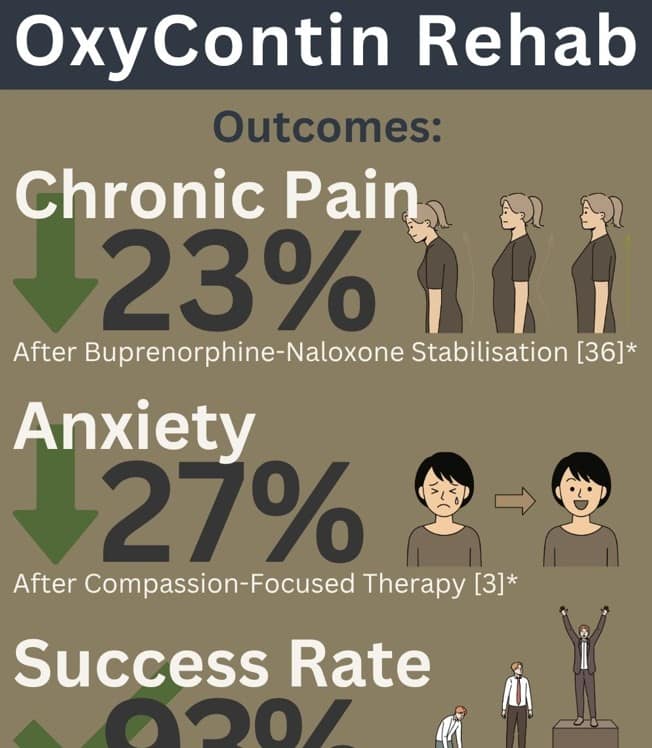
Counsellors incorporate guided imagery, mindfulness, and soothing rhythm breathing exercises into weekly sessions to manage opioid-induced hyperalgesia by reducing anxiety and stress levels by up to 28% within 3 weeks of treatment [3]
Belkin et al. (2017) found that 90% of patients noticed an improvement in pain tolerance after abstaining from oxycodone-based drugs for 1 month and receiving a medical detox with 1 – 2 weekly sessions of transference-focused psychotherapy (TFP) during rehab [11].
Psychological Dependence For Pain Management
Psychological dependence on OxyContin for pain management means rehab is required, as some users believe that “the pain legitimises the addiction” and feel “terrified to come off opiates” after 4 years of use due to anxiety about pain returning during abstinence [12].
30-45-minute weekly Cognitive Behavioural Therapy (CBT) sessions are provided in OxyContin rehabilitation to help patients cope with withdrawal-associated injury site pain (intensity rating = 8/10) during the first 30 days of abstinence by [12][13]:
Providing coping skills, relaxation, and resilience training to help patients manage pain ‘flare-ups’ and OxyContin cravings by creating an “All-Purpose Coping Plan”, and practising diaphragmatic breathing and distraction techniques (e.g. painting) [13]
Using a psychoeducational approach to inform patients about how developing self-management strategies (e.g. daily walks) can reduce pain interference and intensity by ≥ 2 points on the BPI within 16 weeks after long-term use (e.g. 10 years) [13]
Non-opioid analgesics (e.g. 1g paracetamol) are provided alongside therapy to manage "sharp" abdominal/bone pain (intensity rating = 6/10) during OxyContin rehabilitation, and patients with any remaining pain are referred to GPs and/or physiotherapists if needed [8].
Mixing OxyContin With Benzodiazepines And/ Or Alcohol
Mixing OxyContin with benzodiazepines and/or alcohol means rehab is required because individualised treatment plans are created to address the 47% of patients who abuse sedatives and alcohol alongside OxyContin ≥ 3x weekly for 1 – 9 years by [5]:
Gauging the severity of OxyContin (e.g. diarrhoea, chills), benzodiazepine (e.g. insomnia), and alcohol (e.g. tremors) withdrawal symptoms with 1 – 6-hourly monitoring protocols using clinical assessment tools (e.g. COWS, AWS, CIWA-B) [14]
Stabilising patients using OST (e.g. 12mg Buprenorphine), a fixed-dose diazepam regimen (e.g. 80mg/d diazepam), or a 2-weekly 10% benzodiazepine taper, alongside symptomatic treatment (e.g. 2mg loperamide) as needed [14]
Aiding emotion regulation using visualisation and deep breathing during 2-hour relaxation training sessions in patients who binge on benzodiazepines alongside OxyContin to achieve a state of oblivion and escape untreated health conditions or trauma [3]
Addressing the 2-fold increased risk of mortality after abusing benzodiazepines or alcohol with prescription medications using psychoeducation and affirmations for positive change (e.g. “You are capable of change.") during therapy [15][16]
SSRIs (e.g. 40mg fluoxetine) may be provided alongside counselling for rehab patients with a history of concomitant opioid and benzodiazepine use due to being 5 times more likely to engage in intentional self-harm compared to opioid-only patients [17].
Detox In OxyContin Rehabilitation
Detox in Abbeycare’s OxyContin rehabilitation programme is typically done using Buprenorphine or Suboxone (Buprenorphine/Naloxone), although Abbeycare's medical team personalises each patient’s treatment plan.
Detoxification protocols in OxyContin rehabilitation typically include:
A buprenorphine induction (2 – 8mg) for 1 – 2 days, a 10 – 14-day stabilisation phase with 12 – 24mg Buprenorphine or 12/3 - 16/4mg Suboxone daily until COWS < 5, and a dose reduction phase using a 2 – 4mg daily taper until discontinued [14][18]
Methadone maintenance treatment (e.g. 60 - 120mg daily) for patients addicted to ER Oxycodone and other drugs (e.g. heroin) experiencing severe withdrawal (COWS > 36), typically lasting 180 days until the dose is reduced by 1 – 2.5mg daily [19]
An OxyContin taper to reduce the daily dose by 5 – 20% on a 4-weekly basis, typically used for patients previously taking high doses (e.g. 1200mg) of ER oxycodone for pain with no polydrug use or co-occurring mental health issues (e.g. depression) [20]
Symptomatic treatment (e.g. 100μg Clonidine, 8mg Ondansetron or Loperamide) as needed for up to 28 days to manage anxiety, restlessness, nausea, or diarrhoea developing within 24 – 72 hours of OxyContin detox [14]
Abbeycare does not provide methadone during ER Oxycodone detox.
Therapy In OxyContin Rehabilitation
Confronting Addiction
Therapy in OxyContin rehabilitation aims to address denial patterns in 61% of patients who develop a prescription opioid use disorder (OUD) after receiving a legitimate medical prescription for extended-release Oxycodone by [21]:
Using non-stigmatising language (e.g. “disagrees with diagnosis" vs "denial") and avoiding terms such as “addict” to minimise negative bias whilst discussing harmful behaviours (e.g. crushing up to 400mg of tablets per session for intranasal use) [1]
Combining mindfulness, meditation, and cognitive-behavioural approaches to reduce shame and self-criticism by up to 53% after 8 sessions due to the emphasis on non-judgmental awareness for patients who become addicted to prescribed OxyContin [22]
Creating a structured dialogue between the therapist and patient to provide insight into addictive behaviours for 33% of patients who abuse extended-release Oxycodone tablets ≥ 3x weekly to “get high" after initially receiving a prescription [5]
Using thought restructuring to challenge cognitive distortions (e.g. minimising, emotional reasoning) because those who initially use ER Oxycodone for pain are 2x more likely to deny drug abuse than those who initially use ER oxycodone for euphoria [21]
Addressing Loss Of Trust In Medical Professionals
Although not directly provided in Abbeycare’s programme, therapy in some OxyContin rehabilitation programmes aims to address the 21% of patients who do not trust a doctor’s judgment after taking prescription pain relievers for 12+ months by [23]:
Using a non-judgmental interview style, facilitating patient discussion by “echoing” or using affirmative gestures (e.g. nodding), and providing appropriate medical information to 14% of patients who feel misinformed by primary care providers [23]
Using patient-centred care principles (e.g. shared decision-making) to develop treatment plans collaboratively (e.g. 5% weekly taper + daily counselling) for patients who feel “dismissed” or “unheard” during the ER oxycodone rehab process [24]
Strengthening the therapeutic alliance by adopting an individualised and holistic approach (e.g. support for ER oxycodone addiction + pain + anxiety) as some patients believe that treatment planning is “overly generic” and has a “very set algorithm” [24]
King et al. (2021) found that trust scores increased by 23% within 30-90 days of completing a 2-week stay in a hospital-based OUD addiction programme due to “caring” physicians who used a non-judgmental, non-discriminatory, and compassionate approach [25].
Aftercare Planning In OxyContin Rehabilitation
Liaising With GPs To Avoid Opioid-Based Pain Prescriptions
Aftercare planning in OxyContin rehabilitation liaises with GPs to prevent the use of opioid-based pain medications because, without coordinated care, up to 75% of patients obtain opiates from doctors after creating fake allergies or injuries in recovery [26].
Rehab liaises with GPs to discuss the possibility of deception during OUD recovery, as some patients claim, “I told the doctor I was allergic to ibuprofen just so I would get pain pills,” and “I would drop bricks on my foot. All kinds of crazy stuff just to get pain medication.” [26]
Rehab centres liaise with GPs to provide patients in recovery from ER oxycodone addiction with appropriate medical advice about non-opioid treatments (e.g. NSAIDs) to manage chronic conditions (e.g. fibromyalgia, degenerative disk disease) after abstaining because:
Although baseline pain intensity decreases by 58% after discharge, patients typically experience pain rated 3/10 on the numerical rating scale (NRS) after 6 months of abstinence (0 = no pain vs 10 = worst pain imaginable) [27]
Taking 200mg Ibuprofen as needed (up to 6 doses daily) reduces pain intensity by 47%, as average pain scores decrease from 7 to 4 in patients who take ibuprofen for pain relief whilst abstaining from heavy use (e.g. 720 – 1200mg daily) of ER Oxycodone [27]
Chronic Pain Management Strategies
OxyContin rehabilitation addresses remaining pain management needs because 43% of patients who relapse claim persistent pain is the primary cause, and 3 – 10% return to prescription drugs due to a lack of treatment and/or support for pain during rehab [28].
Ellis et al. (2021) found that 66% of OUD patients did not receive pain management during a substance abuse treatment programme, although aftercare planning in OxyContin rehabilitation addresses this by [28]:
Educating patients about the use of over-the-counter medications (e.g. ibuprofen, paracetamol) and liaising with GPs to address the 20% of long-term pain (> 3 months) patients who plan on using opiates again to manage pain after treatment [28]
Initiating referrals to a pain specialist and/or physical therapist to provide ongoing counselling, recommendations/advice, and structured exercise or medication regimes (e.g. yoga + 5mg baclofen) to manage pain that persists after treatment [28]
Developing “Pain Treatment Plans” with patients and primary care providers (e.g. 90mg duloxetine + 15 min walk daily, weekly pain management groups + acupuncture) to manage recurring pain whilst aiding recovery from ER oxycodone addiction [29]
How Are OxyContin Rehabilitation Protocols Modified For Gastrointestinal Disorder Patients?
OxyContin rehabilitation is modified for patients with gastrointestinal disorders because those with pre-existing Crohn’s disease experience a 3-fold increase in disease activity (e.g abdominal pain, liquid stools) after daily use of prescription painkillers [30].
Patients with inflammatory bowel disease (IBD) require a slow taper (e.g. daily ER Oxycodone dose reduced by 5 - 20% monthly) rather than abrupt cessation to minimise severe diarrhoea (>10 watery stools in 24 hours) during detox [20]
Higher doses of Loperamide (e.g. 2mg vs 16mg daily) may be required to delay bowel movements in Crohn’s patients who experience “uncontrollable bloody diarrhoea” and abdominal pain within 2 – 5 days of abstaining from Oxycodone [31]
μ-receptor antagonists (e.g. 25mg Naltrexone) may be used rather than μ-receptor agonist/partial agonists (e.g. 8mg Buprenorphine) for patients with pre-existing gastrointestinal disorders in OxyContin rehabilitation because:
Although buprenorphine can reduce the severity of loose stools and abdominal cramping by 48% within 1 hour, μ-receptor agonists disrupt gastrointestinal functioning via opioid receptor activation, unlike Naltrexone, which has no narcotic effect [8]
Taking 4.5mg Naltrexone daily reduces Crohn's disease activity by 55%, bodily pain by 65%, and blood inflammatory markers (C-reactive protein + ESR) by 23 – 65% within 8-12 weeks due to the upregulation of endorphins after administration [32]
OxyContin Rehabilitation Outcomes
Success Rate Of OxyContin Rehabilitation
The success rate for OxyContin rehabilitation is 93%, as Nunes et al. (2018) found that 27 out of 29 patients diagnosed with prescription OUD were abstinent 5 weeks after discharge from a 28-day inpatient treatment programme [33]:
Rehab typically provides 12-18 months of continuing care because ≥ 6 months of aftercare attendance (e.g. weekly check-ins with addiction counsellor) after discharge increases the odds of abstinence by 8-fold 3.5 years after treatment [34]
2 – 32mg Buprenorphine is provided, and clinicians encourage attendance at peer support groups because treatment with μ-receptor agonists and regular mutual-help group attendance increases the odds of 18-month abstinence by 2-5-fold [35]
Potter et al. (2015) found that the number of patients who met the DSM-IV criteria for prescription OUD decreased by 84% within 18 months after a medical detox using buprenorphine and individual counselling sessions were provided during treatment [36].
Pain Management
Pain intensity reduces by 63% within 6 months of OxyContin addiction treatment because chronic conditions (e.g. fibromyalgia) are managed using 12mg Buprenorphine and 200mg ibuprofen as needed to replace high doses of ER oxycodone (e.g. 240-1200mg/d) [27].
OxyContin rehab offers 45-minute CBT sessions incorporated with cognitive restructuring, psychoeducation, resilience training, and mindfulness, and clinicians encourage patients to engage in 20 minutes of exercise at least 3 times weekly during treatment to [10][13]:
Reduce pain interference and intensity scores by ≥ 2 points on the Brief Pain Inventory (BPI) within 4 months of treatment after focusing on coping skill acquisition, progressive muscular relaxation, and deep breathing [13]
Aid pain regulation with regular engagement in aerobic (e.g. jogging), breathing, and stretching exercises during treatment to reduce cortisol levels by 43% and increase β-endorphin levels by 5-fold within 4 weeks [10]
Mitigate pain hypersensitivity by regulating the sympathetic nervous system and reducing stress levels by up to 28% within 3 weeks of receiving 2-hour psychoeducational and relaxation training sessions during treatment [3]
Belkin et al. (2017) found that pain tolerance improved after 1 month of Oxycodone abstinence in 18/20 pain patients who had an initial cold pressor time of 48 secs (controls = 102 secs) before receiving psychotherapy, buprenorphine, and NSAIDs during rehab [11].
OxyContin Rehabilitation At Abbeycare
OxyContin Rehabilitation at Abbeycare is a 28-day inpatient programme that typically includes:
A 10 – 14-day detox using Buprenorphine or Suboxone to manage muscle aches, hot flashes, chills, diffuse body pain, and diarrhoea, although doses depend on the severity of each patient’s symptoms (e.g. COWS > 36 = 32mg/d Buprenorphine)
Symptomatic treatment (e.g. 40mg propranolol, 75µg clonidine) if required to manage anxiety, heart palpitations, and chest pains triggered by excessive worrying/fear about original pain returning after abstaining from oxycodone-based drugs
Daily 90-minute “Feelings Check-In" sessions during days 1 - 7 of treatment to aid emotion regulation and awareness while detoxing from ER oxycodone using reflective questions (e.g. “What was your overriding emotional state today?")
60-minute group CBT and psychoanalytic therapy sessions, alongside morning mindfulness and process groups during stages 2 - 3 of the programme to heighten sensory awareness, develop coping skills, and address denial patterns
A 12-month aftercare programme that includes outpatient counselling, telephone check-ins, family therapy, and liaison with GPs about long-term strategies (e.g. duloxetine, physiotherapy) for managing any recurring pain after treatment
About the author
Mischa Ezekpo
Mischa Ezekpo has a Bachelors degree in Psychology from Northumbria
University, and a Masters degree in Childhood Development and
Wellbeing, from Manchester Metropolitan University. Since 2018, Mischa
has written and published work on Addiction, Mental Health, Depression, and Eating Disorders. Content reviewed by Laura Morris (Clinical Lead).