Alcoholism is a disease characterised by continuous heavy drinking. Until people with alcohol use disorder admit to problems with alcohol and stop drinking, the risk of alcohol use disorder continues which affects both physical and mental health.
Alcohol starts to injure the brain once it reaches the bloodstream.
Excessive consumption can lead to Alcohol-Related Brain Damage, or ARBD, which is a type of brain disorder caused by alcohol consumption. Brain shrinkage caused by alcohol abuse is permanent, as alcohol kills brain cells and grey matter.
For more information and effects click ‘Learn More’.
Family Recovery Compass is a newsletter for friends and family members who feel trapped between supporting a loved one in addiction, and protecting their own wellbeing.
Every week, we tackle one specific situation in addiction family dynamics, and deliver practical decision-making frameworks and exact dialogue scripts – that help you respond with confidence instead of reaction.
Every month, we bring you an unfiltered recovery conversation with someone who’s either experienced addiction firsthand, or works closely with those in recovery.
No sanitised success stories – just practical insights on what actually works in recovery, that you can apply, in your life too.
Recovery capital is the internal and external resource used to begin the recovery process and maintain sobriety. This combines personal, social, and community support to provide a joined-up approach that supports the addict through recovery.
Do you or a loved one need addiction treatment for alcohol or drugs? Thousands blindly walk into addiction treatment in expensive rehab centres and find that the reality doesn’t meet expectations.
If you’re considering rehab treatment, first check our ultimate guide for complete instructions on how to find the right rehab centre for you.
Take-home Naloxone kits help families and loved ones respond quickly in an opioid overdose emergency, until emergency services arrive. Kits contain nasal or injectable forms of Naloxone.
Changes in legislation mean Naloxone kits are now more widely available from pharmacies and drug services, including Abbeycare.
For additional information, click ‘Learn More’ below.
Overcoming alcohol addiction means first ceasing alcohol intake, and taking care of physical and chemical withdrawal symptoms.
Detoxing from alcohol means undergoing withdrawal from alcohol, but with the assistance of prescribed medication and detox phase, to substitute in place of the alcohol itself.
Alcohol rehab focuses on tackling the problems underneath alcoholism, such as grief, trauma, depression, and emotional difficulties, in order to reduce continuing drinking after treatment.
Inpatient services at an alcohol rehab programme provides 24 hour access to specialist care.
Alcohol home detox provides a means of semi-supervised addiction treatment in the comfort of your home. It’s often suitable for those with inescapable practical commitments, or where a reduced budget for treatment is available.
An at-home detox is the most basic detox option available from Abbeycare, and assumes you have support available, post-detox, for the other important elements of long-term addiction recovery.
The term alcoholism refers to the consumption of alcohol to the extent that the person is unable to manage their own drinking habits or patterns, resulting in side-effects that are detrimental to the quality of life and health of the alcoholic, or those around them.
An alcoholic is someone who continues to compulsively abuse alcohol in this way, despite the negative consequences to their lives and health.
Immediately following treatment, the early stages of recovery and abstinence are most vulnerable to lapses.
At Abbeycare, a structured and peer-reviewed aftercare plan is usually prepared whilst still in treatment. This comprises social, peer, and therapeutic resources individuals draw upon, following a residential treatment programme for drug or alcohol misuse.
Clinically managed residential detoxification is:
– A structured detox that uses medication-assisted treatment and regular physical health observations
– Takes place in an inpatient rehabilitation unit or hospital
– Typically lasts from 7-10 days, but in Abbeycare, it is incorporated into a 28-day rehab programme
Family Therapy at Abbeycare Scotland or Gloucester is realistic, compassionate, and appropriate for families and loved ones of addicts.
Family therapeutic interventions in residential rehabilitation have been designed to support those living with or caring for participants entering the Abbeycare Programme.
Support for families in a group setting allows for a safe, constructive, and confidential place to listen and share common experiences.
Inpatient rehab is drug and/ or alcohol treatment in a rehab centre, where patients remain on-site for the duration of inpatient rehabilitation.
It includes detoxification from drugs, therapy (group work and 1-2-1 sessions), and aftercare planning. Inpatient rehabs typically last 28 days, but this varies on an individual basis.
Long-term treatment at Abbeycare has been developed for those suffering from alcohol or drug addiction. Completing a long-term drug and alcohol inpatient programme may be the solution to problematic substance use.
Motivational Enhancement Therapy can be used by trained addiction recovery therapists to elicit internal changes within and promote long-term recovery from substance use disorder.
All the answers to addiction can be found within with this comprehensive and successful therapy concept leads to behavioural changes, reflective listening, self-motivational statements, and a comprehensive recovery process.
Outpatient drug or alcohol rehab is daytime treatment as opposed to living in a treatment facility.
Outpatient treatment is similar to inpatient in terms of the methods used to treat substance abuse. Where they differ is in their approach to recovery.
Abbeycare’s prison to rehab is a 12-week structured rehab programme which involves direct transfer from prison. The suitability of the candidate is decided by prison staff.
Short-term residential treatment programmes are the chance to press the reset button and access a therapeutic programme designed to create recovery from the use of alcohol and drugs.
Feeling stuck in a rut. Want to stop but can’t seem to achieve sobriety?
Click below.
The 12-step programme was created by alcoholics anonymous (AA), and is specifically designed to aid addicts in achieving and maintaining abstinence.
The central ethos behind the programme is that participants must admit and surrender to a divine power to live happy lives. Ideas and experiences are shared in meetings, and help is sought in an attempt to achieve abstinence.
Abbeycare’s policy to respect your privacy and comply with any applicable law and regulation regarding any personal information we may collect about you, including across our website and other sites we own and operate.
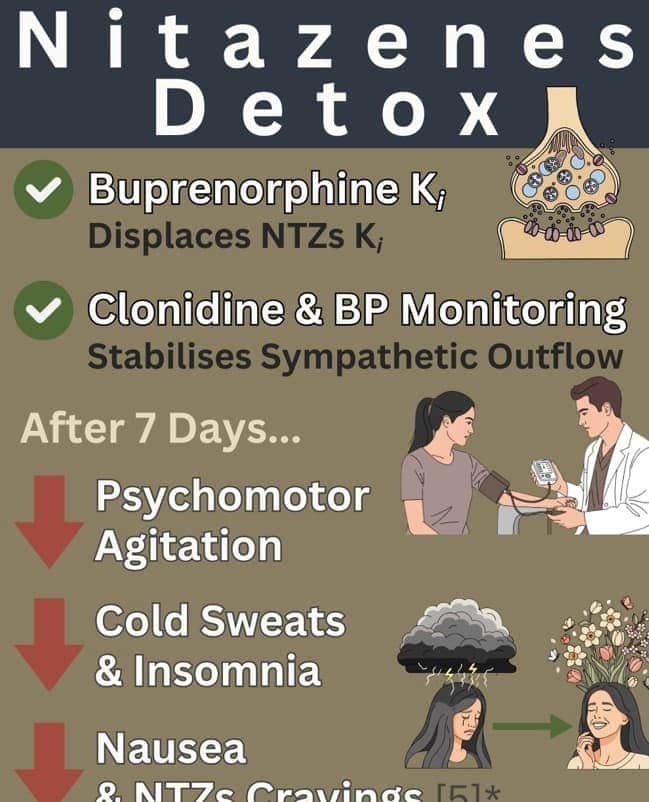
Displacing nitazenes from the µ-receptor using buprenorphine’s higher binding affinity (Ki = 0.22 vs 1.09 nM) to mitigate severe withdrawal (COWS>36) [1][2]
Below, we discuss possible approaches that meet the specific detox needs around nitazenes. Not all treatment centres will provide these specific interventions.
For an overview of the Abbeycare programme contents for nitazenes detox, click here.
How Is Nitazenes Detox Done?
Nitazenes detox is done by displacing nitazene analogues (e.g. Protonitazene) from the µ-receptor using a partial µ-opioid agonist (buprenorphine) with a higher binding affinity (Ki = 0.22 vs 1.09 nM) to mitigate severe symptoms (COWS >36) [1][2]:
Induction (1 – 2 days): An initial 4/1 mg buprenorphine to naloxone (suboxone) dose is administered around 12 – 24 hours after the last NTZ use, followed by a second 4/1mg dose around 2 – 4 hours later if required [3]
Stabilisation (around 1 week): Patients are maintained on a standard daily dose of 16/4–24/6 mg (max 32/8mg) and progress is evaluated regularly (e.g. every 2 - 6 hours) using COWS [3][4]
Dose reduction (3 days): After the detoxification symptoms settle (e.g. 0 = no report of chills or flushing), the daily suboxone dose is typically reduced by 2-4 mg every 1-2 days until discontinued [3]
Alpha-adrenergic agonists (e.g., 75 µg clonidine) are used in nitazenes detox to manage psychomotor agitation and episodes of cold sweating by inhibiting norepinephrine release and controlling autonomic hyperactivity after 1g per month [4][5].
Physical Symptoms Of Nitazenes Detox
Excessive Sweating
Diaphoresis (i.e. score of 3 on CINA = drenching sweats over face and chest) is a physical symptom of nitazenes detox because sweat glands become overactive due to the rebound of norepinephrine within 24 hours of cessation [3].
Nitazene users begin to sweat excessively around 7 hours after taking the last pill because sympathetic activity is no longer suppressed by µ-receptor agonism after the drug’s strong effect (42x greater than morphine) subsides [1].
Mueller et al. (2021) studied an isotonitazene user who had cold sweats during the first week of abstinence after previously consuming around 1g per month for the relaxant and euphoric effects, despite experiencing “intense psychic stress” during active use [5].
COWS is used to assess the severity of sweating during NTZs detox (e.g. 3 = beads of sweat on brow or face), and 75 - 150 µg clonidine is provided every 6 – 8 hours (or as needed) to control sympathetic outflow [4].
Uncontrollable Limb Movements
Frequent shifting or extraneous movements of legs/arms (i.e. score = 3 on the restlessness component of COWS) is a physical symptom of nitazenes detox triggered by the loss of μ-opioid receptor suppression of excitatory neural pathways [3].
Uncontrollable limb movements typically begin within 8 – 24 hours of last using nitazenes, although some users report severe leg restlessness 7 hours after taking the last pill due to imbalances in excitatory (glutamate) and inhibitory (GABA) signalling [1][3].
Tremulousness (score of 2 on CINA = moderate with patient’s arm extended) is a physical symptom of detoxing from NTZs due to dopaminergic instability after dopamine levels spike (+253%) within 20 minutes of use and decline around 3 hours after drug-taking [3][6].
World Health Organisation (2023) studied an etonitazepyne user who started shaking around 7 – 9 hours after cessation due to rebound hyperexcitability and dopamine dysregulation following the loss of potent μ-opioid receptor agonism (Ki = 1.09 nM) [1].
Cardiovascular Instability
Tachycardia (e.g. pulse = 108 beats per minute) and hypertension (e.g. blood pressure = 152/92 mmHg) are physical symptoms of nitazenes detox because the autonomic nervous system becomes hyperactive after being suppressed during intoxication [7].
Cardiovascular instability typically occurs within 24 hours of discontinuing NTZs because the drug’s inhibitory effects (e.g. hypotension < 90/60 mmHg + bradycardia < 60 BPM) on sympathetic outflow are reversed by the deactivation of μ-receptors in the brainstem [4].
Assessment scales are regularly used (e.g. COWS every 6 hours) during detox to establish the severity of cardiovascular instability by measuring the patient's pulse rate after sitting or lying for 1 minute (e.g. 0 < 80 BPM vs 4 > 120 BPM) [3][4].
NTZ detox centres offer symptomatic medication (e.g. 75μg clonidine) with regular BP monitoring in a quiet and calm environment to mitigate severe cardiovascular symptoms (e.g. BP > 80/120 mmHg) during treatment [4].
Gastrointestinal Irregularities
Acid reflux is a physical symptom of nitazenes detox that occurs around 9 hours after taking the last pill due to gut hypermotility and excessive acid secretion following the loss of μ-receptor inhibition in the enteric nervous system (ENS) during abstinence [1].
Mueller et al. (2021) studied a patient who experienced nausea during the first week of isotonitazene detox after becoming addicted within 1 month of smoking 1g through a vaporisation pipe for “recreational purposes” [5].
SOWS is used during NTZs detox to evaluate the intensity of gastrointestinal symptoms by asking patients to rate 16 statements (e.g. “I feel like vomiting”) on a scale of 0 – 4 (0 = not at all vs 4 = extremely) [3].
Diarrhoea and abdominal cramps typically develop between 6 – 24 hours after last taking NTZs, peak during days 1 – 2, and last up to 10 days, although medications (e.g. 2mg loperamide) are provided in detox (as required) to control gut hypermotility [4].
Visual And Auditory Distortions
Photophobia (sensitivity to light) is a physical symptom of nitazenes detox that typically develops around 72 hours after cessation due to mydriasis (e.g. pupils so dilated that only the rim of the iris is visible) triggered by an overactive sympathetic nervous system [8].
Pupillary dilation (>5mm) occurs for up to 10 days after abstaining from NTZs, allowing excess light into the eyes, overstimulating the retinas, and contributing to photophobia following periods of pupillary constriction (≤ 2mm) during active use [4][9].
Clinicians use assessment tools (e.g. CIWA) during NTZs detox to evaluate the severity of visual disturbances (e.g. 3 = moderate sensitivity) by making observations and asking questions like “Does the light appear to be too bright, ... does it hurt your eyes?" [3].
Psychological Symptoms Of Nitazenes Detox
Surges Of Panic
Surges of panic are a psychological symptom of nitazenes detox because cortisol levels spike within 72 hours of abstaining after the inhibition of the HPA Axis is reversed by the deactivation of μ-receptors [3].
Mueller et al. (2021) studied a detox patient who experienced “intense psychic stress” and psycho-motor agitation during the first 7 days of abstinence after becoming addicted to Isotonitazene within 4 weeks of taking the drug to “relax” [5].
Surges of panic are likely to be exacerbated in nitazene detox patients due to NTZs being up to 20x stronger than other synthetic opioids (e.g. fentanyl) that increase the likelihood of having panic disorder by 2-fold after misusing the substance ≥12 times [1][10].
Medications (e.g. 40mg propranolol, 5mg olanzapine) may be provided to relieve panic attacks during NTZs detox after symptoms (e.g. CIWA score of 7 = equivalent to acute panic states as seen in severe delirium) are evaluated by the facility's medical team [3][4].
Paranoia
Hypervigilance is a psychological symptom of nitazenes detox caused by central noradrenergic hyperactivity and declining dopamine levels within 3 hours of last use, following a rapid spike (e.g. + 253%) in the striatum within 20 mins of drug-taking [6].
NTZ discontinuation syndrome often mimics PTSD symptomology (e.g. hypervigilance) as both conditions result from an overactive locus coeruleus–norepinephrine system, although unlike PTSD symptoms, NTZ symptoms typically subside within 10 days [4].
NTZs detox manages low-level psychotic symptoms (e.g. paranoia) by minimising environmental stressors (e.g. loud noises, interpersonal touch) and providing atypical antipsychotics (e.g. 25mg quetiapine as needed) in a calm and supportive environment [4].
Aggression
Irritability within 24 hours of last taking nitazenes is a psychological symptom of detox that often progresses to agitation and aggressive behaviour (e.g. CINA score of 3 = constantly thrashes about) within 72 hours of cessation due to [3][11]:
The impairment of the dopaminergic system and overactivity of noradrenaline in the locus coeruleus because NTZs no longer bind to μ-receptors with a 31x greater agonism than fentanyl, to suppress the body’s fight-or-flight stress response [1]
NTZ analogues (e.g. etonitazene) being 500x stronger than heroin, with similar pharmacological effects to the semi-synthetic opioid that increases the likelihood of violent behaviour at treatment entry by 3-fold [12][13]
Tang (1982) studied 3 adult male rhesus monkeys who became tolerant to etonitazene and displayed aggressive discontinuation signs 6 – 12 hours after the last dose, including irritability, stressful vocalisation, and bearing of teeth [14].
Abel-Ollo et al (2025) studied NTZs users who claimed “There are also episodes of depression and anger at yourself" during periods of abstinence after heavy use (e.g. taking NTZs every 2 – 3 hours) [15].
Hallucinations And Delirium During Sleep
Hallucinations/delirium during sleep is a psychological symptom of nitazenes detox because:
REM features (e.g. vivid dreams) intrude into the sleep onset period (SOP) as the brain attempts to compensate for the loss of REM sleep experienced during periods of heavy use (e.g. smoking NTZs every 60 mins) [15]
Opioid misuse increases the likelihood of experiencing hypnagogic (at sleep onset) and hypnopompic (upon awakening) hallucinations ≥ 1x p/wk by 2-fold, and NTZs are 130x stronger than other traditional opioids, e.g. morphine [1][16]
Hallucinations and delirium are 20 – 30% more likely to occur in NTZs detox patients who experience insomnia during the first 7 days of abstinence, particularly those with short sleep durations (e.g. 4 – 6 hours) after abusing 1g per month [5][16].
Antipsychotics (e.g. 2.5mg olanzapine) and sleep aids (e.g. 20mg Zolpidem) are provided for ≤ 7 days (as needed) to manage hallucinations and nighttime awakenings by balancing GABA and glutamate levels in the brain during detox from a potent synthetic opioid [4].
Positive Effects Of Nitazenes Detox
The resolution of nausea, psycho-motor agitation, insomnia, cold sweating, jaw tension, and cravings after 7 days of detoxing from isotonitazene is a positive marker of nitazenes addiction treatment because [5]:
Supportive care protocols (e.g. minimising loud noises) and symptomatic medications (e.g. 75 µg clonidine) are used to manage “intense psychic stress” by stabilising the autonomic nervous system after a period of hyperactivity [4][5]
Patients no longer “twitch" and "shake”, feel angry or cold after 5 – 10 days of abstaining from a synthetic opioid 500x stronger than heroin, in a controlled, quiet, and calm environment with ongoing monitoring [4][15]
Buprenorphine (2 – 32mg) is administered daily to mitigate severe symptoms (COWS > 36) by partially activating µ-receptors after displacing NTZs from the binding site (Ki = 0.22 vs 1.09 nM) [1][2]
Tremors, depressive episodes, and “strong desires to redose” 10x daily gradually subside due to the stabilisation of dopamine levels in the brain after fluctuating repeatedly (e.g. +227% within 20 mins vs crash after 3 hours) during active use [1][6]
Mueller et al. (2021) found that cravings subsided, mood stabilised, and preserved judgment skills were present after 1 week of detoxing from Isotonitazene in an inpatient setting, leading to the discharge of a patient who previously abused NTZs for euphoria [5].
How Do Endocrine Disorders Alter Nitazenes Detox?
Hypothyroidism alters nitazenes detox because the metabolism of NTZ analogues (e.g. butonitazene = 99% depletion within 30 mins) by cytochrome P450 enzymes (e.g. CYP2D6) is delayed due to a deficiency in T3 and T4 thyroid hormones, leading to [17]:
A delay in the onset of cessation symptoms (e.g. diaphoresis after 7 vs 24 hours), lasting for a longer duration (e.g. 5 vs 10 days) due to slower intrinsic clearance rates (e.g. 108 to 31 µL/min/100 pmol) after last taking NTZs [17]
An intense discontinuation syndrome due to pre-existing fatigue, muscle weakness, “brain fog”, and mood irregularities exacerbated by insomnia, restless legs, and “intense psychic stress” experienced during the first 7 days of NTZ abstinence [5]
Nitazenes + hypothyroidism patients may be admitted to the hospital to receive 24-hour monitoring during or after detox due to:
Additional blood tests and medication requirements, including levothyroxine (LT4) 1.6 μg/kg of body weight every morning on an empty stomach to compensate for T4 deficiencies, regulate the body’s metabolism, and alleviate fatigue during detox [18]
Higher rates of hypertension (27% vs 18%) in hypothyroidism patients compared to euthyroid patients, exacerbating cardiovascular instability (e.g. BP =152/92 mmHg) caused by autonomic dysregulation after detoxing from NTZs [7][19]
A 63% increase in diabetes mellitus in hypothyroidism patients who may be unable to take clonidine to manage severe autonomic symptoms (e.g. HR > 120 BPM) because the release of insulin is suppressed by α2 receptor stimulation [19]
How Does Malnutrition Alter Nitazenes Detox?
Malnutrition alters nitazenes detox because when protein intake falls below ~50 g/day, the typical onset of abstinence symptoms (e.g. acid reflux 9 hours after last taking Etonitazepyne) is delayed due to [1]:
The accumulation of NTZ analogues (e.g. Isotonitazene) in liver tissue and blood, as CYP450 production is disrupted by a lack of dietary amino acids, preventing the drug from being cleared efficiently (e.g. 153 µL/min/100 pmol) [17]
The liver struggling to produce major hepatic enzymes needed to metabolise the drug normally (e.g. 72% depletion within 30 mins by CYP2D6), resulting in the toxic drug effects (e.g. respiratory depression) overlapping into the abstinence period [17]
Supportive care protocols for NTZs detox patients with malnutrition-induced protein deficits may include the provision of balanced meals to encourage a protein intake of 1.2 – 1.5g per kg/bodyweight daily to restore CYP450 enzyme production and muscle tissue [20].
How Does Low Gut Flora Alter Nitazene Withdrawal?
Crohn’s disease alters nitazenes detox because the metabolism of NTZ analogues (e.g. Protonitazene = 99% depletion in 30 min) is disrupted by a 78 - 86% reduction of bacterial genera (e.g. Roseburia, Lachnospira) in the gut microbiome of patients with IBD [17][21].
The elimination rate of NTZs (e.g. clearance = 31µL/min/100 pmol + T½ = 44 min) and onset of cessation symptoms are likely to be delayed by the 5-fold reduction in short-chain fatty acid (SCFA) producing bacteria in patients with Crohn’s disease because [17][21]:
Hepatic CYP450 enzymes (e.g. CYP2D6) become downregulated after endotoxins (LPS) from gut bacteria enter the bloodstream due to an average 50% reduction in SCFAs (e.g. Propionate) responsible for anti-inflammatory signalling [21]
Concentrations of Butyrate are significantly reduced (e.g. 1 vs 5 μg/g) in IBD vs non-IBD patients, a SCFA that acts as a histone deacetylase (HDAC) inhibitor to support liver enzyme (CYP450) expression via epigenetic regulation [21]
Medical staff in NTZs detox may administer buprenorphine around 48 hours after the last use in Crohn’s disease patients with altered gut microbial composition rather than the standard 12 – 24 hour time frame to ensure the drug has been completely metabolised by the liver [4].
Nitazenes Detox At Abbeycare
Nitazenes detox at Abbeycare is typically a 1 – 2-week process conducted by medical professionals who help to minimise episodes of cold sweats, surges of panic, paranoia, and cardiovascular instability by:
Using opioid substitution therapy (e.g. 16mg buprenorphine daily) to partially activate the µ-receptor after NTZ analogues (e.g. protonitazene) are removed from the binding site during detoxification
Providing symptomatic medication (e.g. 75μg clonidine) as needed to control signs of autonomic hyperactivity (e.g. excessive sweating, shaking, tachycardia) whilst monitoring vital signs regularly (e.g. every 30 minutes)
Minimising environmental stressors (e.g. loud noises) throughout the facility and offering each patient a private bedroom for the 7-day stay in the detox wing to mitigate insomnia and agitation after discontinuing a potent synthetic opioid
Abbeycare’s medically managed nitazenes detox is established on an individual basis depending on the type, potency, and duration of the NTZ abused, severity of presenting symptoms, and co-occurring mental or physical health conditions (e.g. IBD).
About the author
Mischa Ezekpo
Mischa Ezekpo has a Bachelors degree in Psychology from Northumbria
University, and a Masters degree in Childhood Development and
Wellbeing, from Manchester Metropolitan University. Since 2018, Mischa
has written and published work on Addiction, Mental Health, Depression, and Eating Disorders. Content reviewed by Laura Morris (Clinical Lead).