Alcoholism is a disease characterised by continuous heavy drinking. Until people with alcohol use disorder admit to problems with alcohol and stop drinking, the risk of alcohol use disorder continues which affects both physical and mental health.
Alcohol starts to injure the brain once it reaches the bloodstream.
Excessive consumption can lead to Alcohol-Related Brain Damage, or ARBD, which is a type of brain disorder caused by alcohol consumption. Brain shrinkage caused by alcohol abuse is permanent, as alcohol kills brain cells and grey matter.
For more information and effects click ‘Learn More’.
Family Recovery Compass is a newsletter for friends and family members who feel trapped between supporting a loved one in addiction, and protecting their own wellbeing.
Every week, we tackle one specific situation in addiction family dynamics, and deliver practical decision-making frameworks and exact dialogue scripts – that help you respond with confidence instead of reaction.
Every month, we bring you an unfiltered recovery conversation with someone who’s either experienced addiction firsthand, or works closely with those in recovery.
No sanitised success stories – just practical insights on what actually works in recovery, that you can apply, in your life too.
Recovery capital is the internal and external resource used to begin the recovery process and maintain sobriety. This combines personal, social, and community support to provide a joined-up approach that supports the addict through recovery.
Do you or a loved one need addiction treatment for alcohol or drugs? Thousands blindly walk into addiction treatment in expensive rehab centres and find that the reality doesn’t meet expectations.
If you’re considering rehab treatment, first check our ultimate guide for complete instructions on how to find the right rehab centre for you.
Take-home Naloxone kits help families and loved ones respond quickly in an opioid overdose emergency, until emergency services arrive. Kits contain nasal or injectable forms of Naloxone.
Changes in legislation mean Naloxone kits are now more widely available from pharmacies and drug services, including Abbeycare.
For additional information, click ‘Learn More’ below.
Overcoming alcohol addiction means first ceasing alcohol intake, and taking care of physical and chemical withdrawal symptoms.
Detoxing from alcohol means undergoing withdrawal from alcohol, but with the assistance of prescribed medication and detox phase, to substitute in place of the alcohol itself.
Alcohol rehab focuses on tackling the problems underneath alcoholism, such as grief, trauma, depression, and emotional difficulties, in order to reduce continuing drinking after treatment.
Inpatient services at an alcohol rehab programme provides 24 hour access to specialist care.
Alcohol home detox provides a means of semi-supervised addiction treatment in the comfort of your home. It’s often suitable for those with inescapable practical commitments, or where a reduced budget for treatment is available.
An at-home detox is the most basic detox option available from Abbeycare, and assumes you have support available, post-detox, for the other important elements of long-term addiction recovery.
The term alcoholism refers to the consumption of alcohol to the extent that the person is unable to manage their own drinking habits or patterns, resulting in side-effects that are detrimental to the quality of life and health of the alcoholic, or those around them.
An alcoholic is someone who continues to compulsively abuse alcohol in this way, despite the negative consequences to their lives and health.
Immediately following treatment, the early stages of recovery and abstinence are most vulnerable to lapses.
At Abbeycare, a structured and peer-reviewed aftercare plan is usually prepared whilst still in treatment. This comprises social, peer, and therapeutic resources individuals draw upon, following a residential treatment programme for drug or alcohol misuse.
Clinically managed residential detoxification is:
– A structured detox that uses medication-assisted treatment and regular physical health observations
– Takes place in an inpatient rehabilitation unit or hospital
– Typically lasts from 7-10 days, but in Abbeycare, it is incorporated into a 28-day rehab programme
Family Therapy at Abbeycare Scotland or Gloucester is realistic, compassionate, and appropriate for families and loved ones of addicts.
Family therapeutic interventions in residential rehabilitation have been designed to support those living with or caring for participants entering the Abbeycare Programme.
Support for families in a group setting allows for a safe, constructive, and confidential place to listen and share common experiences.
Inpatient rehab is drug and/ or alcohol treatment in a rehab centre, where patients remain on-site for the duration of inpatient rehabilitation.
It includes detoxification from drugs, therapy (group work and 1-2-1 sessions), and aftercare planning. Inpatient rehabs typically last 28 days, but this varies on an individual basis.
Long-term treatment at Abbeycare has been developed for those suffering from alcohol or drug addiction. Completing a long-term drug and alcohol inpatient programme may be the solution to problematic substance use.
Motivational Enhancement Therapy can be used by trained addiction recovery therapists to elicit internal changes within and promote long-term recovery from substance use disorder.
All the answers to addiction can be found within with this comprehensive and successful therapy concept leads to behavioural changes, reflective listening, self-motivational statements, and a comprehensive recovery process.
Outpatient drug or alcohol rehab is daytime treatment as opposed to living in a treatment facility.
Outpatient treatment is similar to inpatient in terms of the methods used to treat substance abuse. Where they differ is in their approach to recovery.
Abbeycare’s prison to rehab is a 12-week structured rehab programme which involves direct transfer from prison. The suitability of the candidate is decided by prison staff.
Short-term residential treatment programmes are the chance to press the reset button and access a therapeutic programme designed to create recovery from the use of alcohol and drugs.
Feeling stuck in a rut. Want to stop but can’t seem to achieve sobriety?
Click below.
The 12-step programme was created by alcoholics anonymous (AA), and is specifically designed to aid addicts in achieving and maintaining abstinence.
The central ethos behind the programme is that participants must admit and surrender to a divine power to live happy lives. Ideas and experiences are shared in meetings, and help is sought in an attempt to achieve abstinence.
Abbeycare’s policy to respect your privacy and comply with any applicable law and regulation regarding any personal information we may collect about you, including across our website and other sites we own and operate.
Administering 2 – 32mg Buprenorphine for 10 – 14 days to mitigate aching muscles, hot flashes, and rebound emotional sensitivity developing within 24 – 72 hours of cessation
Symptomatically treating restless legs and diarrhoea with medication (e.g. 75µg clonidine or 8mg loperamide) as needed
Abbeycare does not use Methadone to treat opioid use disorder (OUD), and withdrawal symptoms (e.g. nausea, sweating, anxiety) are managed with Buprenorphine or Suboxone and symptomatic medications (e.g. 40mg propranolol, 8mg Ondansetron) as needed.
IMPORTANT: Below, we discuss possible approaches that meet the specific detox needs around OxyContin. Not all treatment centres will provide these specific interventions.
For an overview of the Abbeycare programme contents for OxyContin detox, click here.
How Is OxyContin Detox Done?
Using Buprenorphine/Suboxone
Buprenorphine or a 4:1 ratio of Buprenorphine to Naloxone (Suboxone) is used in OxyContin detox because:
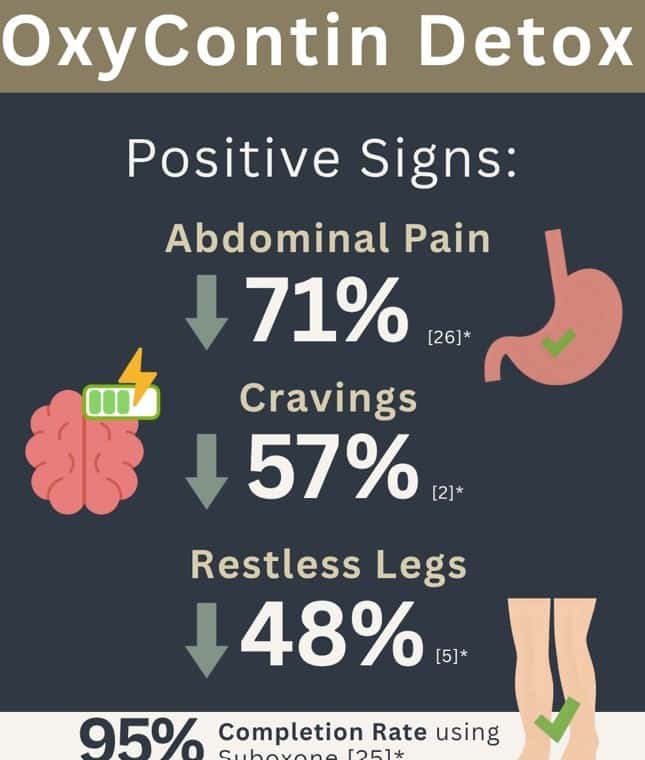
Cravings are reduced by 57% within 8 weeks after Buprenorphine displaces full opioid agonists from the mu (μ) receptor due to a binding affinity 120 times higher than Oxycodone’s [1][2]
Administering 2/0.5mg of Suboxone reduces the severity of abdominal cramps, sweating, and piloerection by 48% within 1 hour in patients who withdraw after abusing up to 60mg of tablets daily [5]
Patients are typically inducted using 2 – 8mg Buprenorphine monotherapy 48 hours after last using a long-acting opioid, and then stabilised with up to 32/8 mg Suboxone for 10 – 14 days [3][4].
The Clinical Opiate Withdrawal Scale (COWS) is typically administered every 6 hours during detox, and once symptoms stabilise (COWS score < 5), the current Buprenorphine dose is reduced by 2 - 4 mg daily until discontinued [3][4].
Using Methadone
Methadone may be used to detox from OxyContin as an alternative to Buprenorphine or Suboxone because:
92% of patients also abuse other opioids (e.g. heroin), and a full μ agonist (methadone) is required over a partial μ agonist (buprenorphine) to mitigate severe withdrawal symptoms (COWS > 36) [6]
Methadone can be administered on a short-term (< 30 days) or long-term (30 - 180 days) basis using an initial daily dose (e.g. 20 – 40mg), followed by a maintenance dose (e.g. 60 – 120mg) to suppress drug cravings for 24 - 36 hours at a time [7]
Methadone doses are reduced by 5 –10% every 1–2 weeks once opioid withdrawal symptoms are stabilised, although some patients may be transferred to Buprenorphine once the daily dose reaches 30mg [4][7].
Symptom Management
Symptom management protocols used in OxyContin detoxification include:
75 – 150 μg Clonidine every 6 – 8 hours to manage anxiety and hypertension (BP = 140/90 mmHg) as needed by decreasing systolic and diastolic blood pressure by 21 - 24 mmHg and nervousness by 47% within 2 hours [4][8]
2 - 8mg Loperamide and Ondansetron daily to treat diarrhoea and nausea during the first 1 - 3 days of cessation, alongside 6-hourly COWS assessments to establish the severity of gastrointestinal symptoms (e.g. 2 = nausea or loose stools) [3][4]
OxyContin Detoxification Timeline
Buprenorphine /Suboxone
Methadone
Timeframe of first use
48 hours after last use
8+ hours after last use
Dose
2 - 32mg or 2/0.5 - 32/8mg daily
20 - 120mg
Dosing Schedule
Day 1: 2mg + 6mg if symptoms persist after 1 hour
Typically stabilised on 12-24mg or 12/3 - 16/4mg daily until COWS score < 5 [4]
Day 1: 20 – 30mg + 5 - 10mg if symptoms persist after 2 - 4 hours
Maintenance dose = 60 - 120mg daily [7].
Detox Duration
10 - 14 days + 3 - 6 days for Buprenorphine taper [4]
30 - 180 days
Effective in treating withdrawal symptoms?
Yes, 2mg reduces sweating, chills, and stomach cramps by 48% within 60 mins [5]
Yes, daily treatment reduces anxiety and dysphoria by 25 - 33% within 14 days [9]
Fast taper (< 3 months use) = reduced by 10 - 25% weekly [10]
Detox Duration
6+ months (depending on starting dose)
Effective in treating withdrawal symptoms?
No, requires symptomatic medication (e.g. 8mg loperamide) and ongoing monitoring
Ideal patient for this medication
Taking OxyContin as prescribed, no polydrug use or mental instability
Physical Symptoms Of OxyContin Withdrawal
Prolonged Withdrawal Duration
Prolonged withdrawal duration is a physical symptom of detoxing from OxyContin because the drug's 12-hour extended release mechanism and elimination half-life (t½) of 6.5 hours lead to [11]:
A delay in the onset of withdrawal symptoms (e.g. dilated pupils) to 24 – 72 hours after last use, compared to 6 – 12 hours for immediate release (IR) oxycodone due to a shorter duration of action (4 – 6 hours) and elimination half-life (t½ = 3 hours) [4][11]
A peak in symptom severity during days 3 – 8 of detox and a 2-3-week average withdrawal duration, whereas symptoms (e.g. diarrhoea) peak after 36 – 72 hours of cessation from short-acting opioids (e.g. heroin) and typically last 5 – 10 days [4][11]
Deep Muscle Aches
Deep muscle aches are a physical symptom of discontinuing OxyContin because:
Somatic pain originating from the skin and deeper tissues (e.g. joints, muscles) is no longer suppressed due to the deactivation of μ receptors during abstinence, leading to diffuse body pain within 24 - 72 hours of cessation [4].
OxyContin reduces pain intensity by 39% for up to 12 hours at a time, whereas Oxycodone has a weaker effect (e.g. 21% for 4 - 6 hours), leading to a stronger rebound of previously inhibited pain signals that exacerbate aching muscles during cessation [12]
Quattlebaum et al. (2021) studied a woman with "pain all over” (intensity rating = 6/10) during a medically supervised OxyContin withdrawal after initially receiving a prescription and abusing pills bought from friends to manage chronic shoulder and neck pain [5].
COWS is used daily to evaluate the severity of muscle pain during detox (e.g. 4 = rubbing muscles/joints + unable to sit still due to discomfort) because somatic pain is exacerbated by a 31% reduction in pain tolerance within 7 - 14 days of opioid cessation [13].
Alternating Chills And Hot Flashes
Alternating chills and hot flashes are a physical symptom of detoxing from OxyContin because the deactivation of μ receptors induces hyperthermia (> 38°C) during cessation to compensate for periods of hypothermia (< 35°C) during intoxication, leading to:
Impaired thermoregulatory responses (e.g. sweating, shivering) due to autonomic hyperactivity during withdrawal as the hypothalamus attempts to restore the body’s core temperature (37°C)
Sweating, piloerection, and up to 1 week of chills “from head to toe”, as some patients claim “Your body cannot regulate its body temperature at all. It’s impossible going hot to cold.” [4][14]
Lying in bed whilst shaking due to cold chills and sweating, applying ice and heat packs for 1 – 2 hours at a time, and having 3 – 4 hot showers a day to cope with impaired thermoregulation after abstaining from heavy use (e.g. 320mg daily) [14]
The Subjective Opioid Withdrawal Scale (SOWS) is used to gauge the severity of thermoregulatory dysfunction by asking OUD patients to score statements (e.g. “I have goose flesh” or “I am perspiring”) using a 5-point scale (e.g. 0 = not at all vs 4 = extremely) [4].
Psychological Symptoms Of OxyContin Withdrawal
Anxiety, Depression, And Mood Fluctuations
Depression is a psychological symptom that occurs in up to 66% of patients during OxyContin cessation after 12 months of daily use because dopamine is no longer increased by 88% after the μ receptors are deactivated by abstinence [15][16].
Anxiety and depression typically emerge within 3 days of discontinuing controlled-release OXY HCI tablets and are likely to be intensified in 51% of patients who have pre-existing symptoms (e.g. low mood) before entering treatment because [4][6]:
10 - 80mg tablets are typically abused ≥ 3 times weekly for 1 – 9 years, and using prescription opioids for > 180 days increases the risk of depression by 50% due to striatal dopamine imbalances [6][17]
OXY HCI CR users are more likely to experience anxiety (14% vs 8%) or a major depressive episode (22% vs 16%), and require mental health treatment (23% vs 18%) within 12 months compared to users of IR opioid analgesics (e.g. codeine) [18]
Quattlebaum et al. (2021) found that the severity of anxiety symptoms (e.g. intermittent chest pains, irritability, restlessness) decreased by 48% within 24 hours of receiving clonidine and 20mg Buprenorphine during addiction treatment for OXY-HCI CR dependence [5].
Rebound Emotional Sensitivity
Rebound emotional sensitivity is a psychological symptom that occurs during the detox process for OxyContin because:
Glutamate receptors (e.g. GluA1-3, GluN2a-c) are upregulated for around 31 days after abstaining from Oxycodone-based drugs due to the loss of μ-receptor stimulation [19]
Irritability and anxiety are heightened within the first 72 hours of withdrawal because excitatory neurotransmission in brain regions (e.g. amygdala) responsible for emotional processing is no longer suppressed by taking 60mg tablets every day [4][5]
Psychological withdrawal symptoms (e.g. extreme restlessness) are exacerbated by a 60% increase in emotional distress after abusing oxycodone-based drugs daily for up to 9 years [20]
Obsessive Fear Of Original Pain Returning
Obsessive fear of original pain returning is a psychological symptom of detoxing from oxycodone hydrochloride CR caused by anxiety sensitivity (ASI-3 score = 39) and catastrophic thinking in relation to pain (PCS score = 43) after abstaining, resulting in [21]:
Some patients feeling unable to cope without taking a daily dose of 80 - 400mg that was initially prescribed to reduce the intensity of lower back pain by 39% within 10 days of administration [12]
Excessive worrying, rumination, magnification, and helplessness, e.g. “I worry that something serious may happen” or “When I feel pain in my chest, I worry that I’m going to have a heart attack.”
22% of patients addicted to OXY HCI CR are initially prescribed the drug for chronic pain and typically experience more anxiety during withdrawal than patients without pain (e.g. STAI scores = 37 vs 35) due to fear of initial pain returning after discontinuation [6][22]:
“It terrified me to come off opiates, and that fear would stop people from getting off of it because it’s almost unfathomable to think that the pain could even go away because it’s so chronic.”
“I thought it was arthritis, I thought it was degenerative something or other that had come on and come on strong.” - a 34-year-old whose “throbbing” and “aching” deep tissue pain in the right knee returned after detoxing from Oxycodone [23]
Positive Signs Of Detoxing From Oxycodone Hydrochloride Controlled-Release
Reduction In Pain Sensitivity
A 58% decrease in pain scores is a positive sign of OXY HCI CR recovery because opioid-induced hyperalgesia gradually resolves within 9 days of abstaining from taking 1200mg tablets daily due to the recovery of the endogenous opioid system [13][24].
Rieb et al. (2018) found that a 34-year-old woman who previously abused 150mg OXY-HCI tablets daily was pain-free 7 months after initially experiencing intense pain (8/10) during the first 30 days of cessation, and moderate pain (4/10) in the following 14 days [23].
Mall (2018) found that ex-OxyContin users experienced pain sensitivity for around 2 weeks after the last heavy use (320mg), and some patients felt that taking NSAIDs every 4 - 6 hours provided relief for body pains, aches, and inflammation during withdrawal:
“You hurt so bad you can feel your hair hurting, so bad that initially, the first couple of days, I'll throw up. My bones would hurt in my legs, and if I put a shirt on or something, it would hurt”
“The first like three days would be the worst, and then it would subside a little bit. The lower back is where it always hurts, and the legs are the worst. All of your joints hurt”
“I had not been feeling any normal aches and pains, and so those were going to seem worse. You can take ibuprofen to make your joints feel better. You are going to feel bad, but sticking it out is so worth it.” [14]
Stabilisation Of Late Onset Withdrawal Symptoms
A 48% decrease in diffuse body pain, restless legs, sweating, chills, and abdominal cramping is a positive sign of OXY HCI CR recovery because 2mg Buprenorphine is used to change COWS scores from 25 (moderately severe) to 13 (moderate) within 24 hours [5].
Late onset symptoms of withdrawal (e.g. nasal stuffiness or unusually moist eyes, frequent shifting or extraneous movements of legs/arms) typically stabilise within 2 weeks of receiving up to 32/8 Suboxone daily during OUD addiction treatment [4]:
“You kind of start feeling achy and have a runny nose. The restlessness doesn't let you sit still. The only thing that really has helped was the Suboxone”
“Really intense withdrawals lasted about a week, and then getting my appetite back, not having diarrhoea, not throwing up, leg cramps probably lasted about 10 days to two weeks. About two weeks to get where you feel okay.” [14]
Murata et al. (2021) found that one patient no longer had dilated pupils (5mm), tearfulness, loose stools, and chest pains within 48 hours of taking 20/5mg Suboxone during treatment after previously abusing 60mg of extended-release oxycodone tablets daily [5].
Reduction In Anxiety
A 48% reduction in emotional distress within 8 weeks is a positive sign of OXY HCI CR recovery because anxiety and excessive worrying diminish once GluA1-3 and GluN2a-c activity stabilise after being upregulated during the first 30 days of abstinence [2][19].
Katt et al. (2012) found that symptoms of anxiety (e.g. restlessness, irritability) decreased by 48% within 1 month of receiving 4 – 16mg Suboxone during treatment in patients who previously abused up to 240mg of OXY HCI CR tablets daily for 4 years [25].
Catastrophic thinking decreases by 18% within 11 days of abstaining from prescription painkillers because0.4mg clonidine is administered daily during treatment to control anxiety, shakiness, and chest pains experienced by up to 51% after 5 years of use [26].
Alcohol And OxyContin Addiction Altering Detox Protocols
Being addicted to alcohol and Oxycodone hydrochloride controlled-release tablets changes addiction treatment because:
Alcohol withdrawal symptoms (e.g. tremors, hallucinations) begin 6 – 24 hours after last drinking, compared to 24 – 72 hours for OXY HCI CR and typically peak after 1 – 2 days rather than 3 – 8 days of cessation [3]
300mg daily doses of thiamine may be required for 1 – 2 weeks to mitigate the 14-fold increased risk of developing Wernicke’s Encephalopathy in 69% of patients who abuse CR oxycodone ≥ 3 times weekly and heavily drink (e.g. >6 drinks daily) [3][6][27]
The Clinical Institute Withdrawal Assessment for Alcohol is required alongside COWS to assess withdrawal severity (e.g. severe = CIWA-Ar > 20 vs COWS > 36) and adjust monitoring frequencies accordingly (e.g. severe = hourly vs mild = 4 – 6 hourly) [3]
Medication regimes are developed on a case-by-case basis for patients addicted to prescription painkillers and alcohol because taking benzodiazepines (e.g. diazepam) and opioids (e.g. buprenorphine) increases the risk of respiratory depression by 4-fold [28]:
Buprenorphine is administered 48 hours after the last use of opioids to manage overlapping symptoms (e.g. stomach cramps) when a fixed-dose tapering or symptom-triggered diazepam regimen is not required for mild alcohol withdrawal (AWS < 4) [3][4]
Up to 80mg of Diazepam (max 7 days) is provided as an alternative to opioid substitution therapy (e.g. buprenorphine, methadone) to prevent/treat delirium tremens within the first 5 days of moderate to severe alcohol withdrawal (e.g. AWS > 4) [3]
Both are administered at the lowest dose for the shortest duration of time possible (e.g. 2mg Buprenorphine + 2mg Diazepam for 5 days) with up to 14 days of ongoing monitoring for signs of respiratory depression when AWS > 14 and COWS > 36) [29]
Neuropathic pain changes treatment protocols because OXY HCI CR doses are rapidly titrated (e.g. +50% in 12-hour intervals) because the desensitisation of dorsal horn μ-opioid receptors after nerve injury reduces opioid efficacy (e.g. < 20% reduction in pain intensity), leading to [30][31]:
Higher doses (e.g. 1200mg vs 320mg daily) of OXY HCI CR compared to non-nerve pain patients, requiring a 5 – 20% 4-weekly taper to mitigate severe symptoms of withdrawal (COWS > 36), lasting up to 6 months rather than 14 days [24][14][10]
Assessments using the Neuropathic Pain Questionnaire (NPQ) to establish the severity of burning, stabbing, or electric shock-like sensations whilst liaising with GPs or neurologists about the use of non-opioid medications for pain relief (e.g. venlafaxine)
Neuropathic pain patients have higher rates (67% vs 58%) of moderate to severe pain (intensity ≥4/10) compared to nociceptive pain patients, and the rebound of numbness, tingling, or throbbing during cessation changes OUD treatment because [32]:
Intense pain during recovery is associated with a 4-fold increase in opioid cravings and a 3-fold increased risk of relapse within 6 weeks, requiring higher buprenorphine doses (e.g. 32mg) to reduce cravings by up to 57% in 2 months [2][22]
Antidepressants (e.g. 50mg sertraline) are required in some cases to address the 33% increase in depressive symptoms (e.g. hopelessness, low energy, suicidal ideation) experienced by patients with pain (>4/10) during opioid withdrawal [22]
OxyContin Detox At Abbeycare
A detox for OxyContin at Abbeycare is:
Typically, a 14-day process that involves medically managing withdrawal symptoms (e.g. chills) using Buprenorphine or Suboxone during a 4-week rehab programme, although medication schedules are established on a case-by-case basis
Conducted by medical professionals (nurses, physicians, addiction specialists) in a calm environment, as patients reside in the detox wing for the first 7 days of treatment to be regularly monitored (e.g. every 30 minutes) during the first stage of recovery
All medication regimens are prescribed by medical professionals
Symptomatically treated using medications such as 100 µg clonidine, 8mg ondansetron, or 16mg loperamide as needed to manage restlessness, sweating, nausea, and diarrhoea developing 1 – 3 days after discontinuing Oxycodone hydrochloride CR
About the author
Mischa Ezekpo
Mischa Ezekpo has a Bachelors degree in Psychology from Northumbria
University, and a Masters degree in Childhood Development and
Wellbeing, from Manchester Metropolitan University. Since 2018, Mischa
has written and published work on Addiction, Mental Health, Depression, and Eating Disorders. Content reviewed by Laura Morris (Clinical Lead).