Alcoholism is a disease characterised by continuous heavy drinking. Until people with alcohol use disorder admit to problems with alcohol and stop drinking, the risk of alcohol use disorder continues which affects both physical and mental health.
Alcohol starts to injure the brain once it reaches the bloodstream.
Excessive consumption can lead to Alcohol-Related Brain Damage, or ARBD, which is a type of brain disorder caused by alcohol consumption. Brain shrinkage caused by alcohol abuse is permanent, as alcohol kills brain cells and grey matter.
For more information and effects click ‘Learn More’.
Family Recovery Compass is a newsletter for friends and family members who feel trapped between supporting a loved one in addiction, and protecting their own wellbeing.
Every week, we tackle one specific situation in addiction family dynamics, and deliver practical decision-making frameworks and exact dialogue scripts – that help you respond with confidence instead of reaction.
Every month, we bring you an unfiltered recovery conversation with someone who’s either experienced addiction firsthand, or works closely with those in recovery.
No sanitised success stories – just practical insights on what actually works in recovery, that you can apply, in your life too.
Recovery capital is the internal and external resource used to begin the recovery process and maintain sobriety. This combines personal, social, and community support to provide a joined-up approach that supports the addict through recovery.
Do you or a loved one need addiction treatment for alcohol or drugs? Thousands blindly walk into addiction treatment in expensive rehab centres and find that the reality doesn’t meet expectations.
If you’re considering rehab treatment, first check our ultimate guide for complete instructions on how to find the right rehab centre for you.
Take-home Naloxone kits help families and loved ones respond quickly in an opioid overdose emergency, until emergency services arrive. Kits contain nasal or injectable forms of Naloxone.
Changes in legislation mean Naloxone kits are now more widely available from pharmacies and drug services, including Abbeycare.
For additional information, click ‘Learn More’ below.
Overcoming alcohol addiction means first ceasing alcohol intake, and taking care of physical and chemical withdrawal symptoms.
Detoxing from alcohol means undergoing withdrawal from alcohol, but with the assistance of prescribed medication and detox phase, to substitute in place of the alcohol itself.
Alcohol rehab focuses on tackling the problems underneath alcoholism, such as grief, trauma, depression, and emotional difficulties, in order to reduce continuing drinking after treatment.
Inpatient services at an alcohol rehab programme provides 24 hour access to specialist care.
Alcohol home detox provides a means of semi-supervised addiction treatment in the comfort of your home. It’s often suitable for those with inescapable practical commitments, or where a reduced budget for treatment is available.
An at-home detox is the most basic detox option available from Abbeycare, and assumes you have support available, post-detox, for the other important elements of long-term addiction recovery.
The term alcoholism refers to the consumption of alcohol to the extent that the person is unable to manage their own drinking habits or patterns, resulting in side-effects that are detrimental to the quality of life and health of the alcoholic, or those around them.
An alcoholic is someone who continues to compulsively abuse alcohol in this way, despite the negative consequences to their lives and health.
Immediately following treatment, the early stages of recovery and abstinence are most vulnerable to lapses.
At Abbeycare, a structured and peer-reviewed aftercare plan is usually prepared whilst still in treatment. This comprises social, peer, and therapeutic resources individuals draw upon, following a residential treatment programme for drug or alcohol misuse.
Clinically managed residential detoxification is:
– A structured detox that uses medication-assisted treatment and regular physical health observations
– Takes place in an inpatient rehabilitation unit or hospital
– Typically lasts from 7-10 days, but in Abbeycare, it is incorporated into a 28-day rehab programme
Family Therapy at Abbeycare Scotland or Gloucester is realistic, compassionate, and appropriate for families and loved ones of addicts.
Family therapeutic interventions in residential rehabilitation have been designed to support those living with or caring for participants entering the Abbeycare Programme.
Support for families in a group setting allows for a safe, constructive, and confidential place to listen and share common experiences.
Inpatient rehab is drug and/ or alcohol treatment in a rehab centre, where patients remain on-site for the duration of inpatient rehabilitation.
It includes detoxification from drugs, therapy (group work and 1-2-1 sessions), and aftercare planning. Inpatient rehabs typically last 28 days, but this varies on an individual basis.
Long-term treatment at Abbeycare has been developed for those suffering from alcohol or drug addiction. Completing a long-term drug and alcohol inpatient programme may be the solution to problematic substance use.
Motivational Enhancement Therapy can be used by trained addiction recovery therapists to elicit internal changes within and promote long-term recovery from substance use disorder.
All the answers to addiction can be found within with this comprehensive and successful therapy concept leads to behavioural changes, reflective listening, self-motivational statements, and a comprehensive recovery process.
Outpatient drug or alcohol rehab is daytime treatment as opposed to living in a treatment facility.
Outpatient treatment is similar to inpatient in terms of the methods used to treat substance abuse. Where they differ is in their approach to recovery.
Abbeycare’s prison to rehab is a 12-week structured rehab programme which involves direct transfer from prison. The suitability of the candidate is decided by prison staff.
Short-term residential treatment programmes are the chance to press the reset button and access a therapeutic programme designed to create recovery from the use of alcohol and drugs.
Feeling stuck in a rut. Want to stop but can’t seem to achieve sobriety?
Click below.
The 12-step programme was created by alcoholics anonymous (AA), and is specifically designed to aid addicts in achieving and maintaining abstinence.
The central ethos behind the programme is that participants must admit and surrender to a divine power to live happy lives. Ideas and experiences are shared in meetings, and help is sought in an attempt to achieve abstinence.
Abbeycare’s policy to respect your privacy and comply with any applicable law and regulation regarding any personal information we may collect about you, including across our website and other sites we own and operate.
Having a “strong desire" to re-dose after consuming 500 µg etazene intranasally and taking 1.5mg every 30 minutes until falling asleep due to the development of tolerance and cravings within 2 weeks of heavy use (e.g. 5 - 10 doses daily) [1]
Taking 1 pill every 7 hours to avoid NTZs withdrawal symptoms (e.g. sweating, leg restlessness) or waking up early to “dose” to prevent acid reflux and shakiness from developing within 9 hours of the last use [1]
NTZs addiction develops after users continue to take benzimidazole-derived synthetic opioids to recapture the initial “euphoric glow” and drowsy sensation experienced within 30 minutes of taking a 1mg dose because [1]:
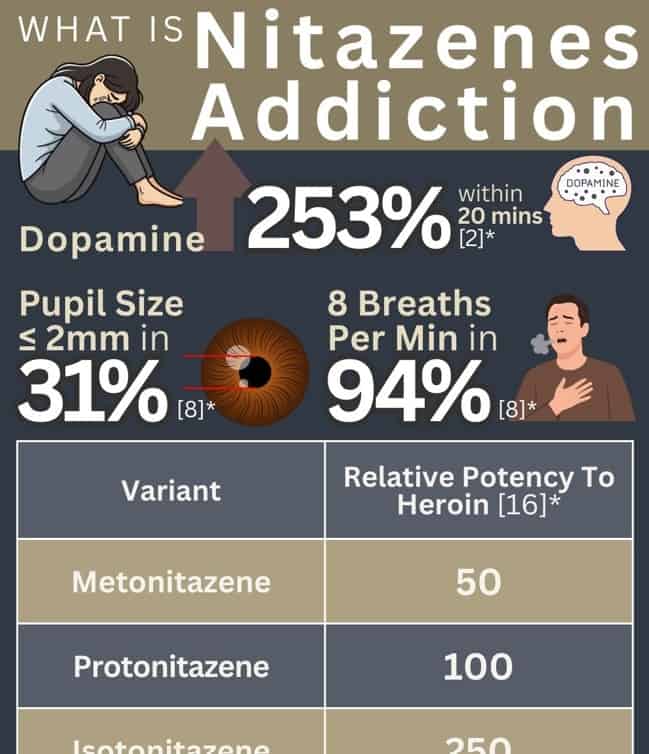
NTZs are 130x more potent than morphine (MOR) and 20x more potent than fentanyl (FEN), with a stronger binding affinity (Ki = 1.09 nM) at the mu (μ) receptor in comparison to both substances (Ki = 2.17 + 3.04 nM) [1]
Dopamine (DA) increases by 227 – 253% in the nucleus accumbens within 20 minutes of taking metonitazine and flunitazene, lasting up to 3 hours after consumption [2]
Physical Indicators Of Nitazenes Addiction
Rapid Weight Loss
Rapid weight loss (e.g. > 5% body weight in 1 month) is a physical indicator of nitazenes addiction because [3]:
NTZs bind to μ-receptors (Ki = 1.09 nM) in the hypothalamus and inhibit the release of neuropeptides (e.g. NPY/AgRP neurons) responsible for appetite stimulation [1]
The motivation to eat is diminished after the brain’s reward system becomes desensitised to natural rewards due to a 253% increase in dopamine after taking NTZs vs ~ 50% increase after eating ‘pleasurable’ foods (e.g. chocolate) [2][4]
Prolonged μ-receptor activation after some users re-dose 5 – 10 times a day, interferes with ghrelin and leptin signalling due to NTZs being rapidly metabolised (72 – 100% depletion within 30 mins) by cytochrome P450 enzymes (CYPs) [1][5]
NTZs addiction is likely to trigger weight loss at a faster rate than fentanyl (e.g. 39% of daily users lose >5% of body weight in 3 months) due to NTZ analogues (e.g. etonitazepyne) being 20 times stronger [1][3].
Skin Discolouration
Skin discolouration is a physical indicator of nitazenes addiction caused by bradypnea (e.g. 6 breaths/min) and hypoxemia (i.e. oxygen saturation = 65%), leading to a bluish-purple discolouration of the skin and mucous membranes within 90 minutes of use [6].
Skin discolouration occurs because NTZs are respiratory depressants, often causing breathing difficulties, blue lips or fingertips, and cold or clammy skin, although cases are typically associated with high blood concentrations (e.g. 286 ± 556 ng/mL) [1].
Schumann et al. (2022) studied a woman who was hospitalised due to cyanosis and an oxygen saturation of 50% after regularly taking protonitazene, although after 20 hours of supportive care (e.g. BVM), the patient was discharged [6].
Dehydration
Dry mouth is a physical indicator of nitazenes addiction caused by a 42 times greater agonism at μ-receptors than other opioids (e.g. morphine) that reduce salivary flow rates by 20 -27% after inhibiting parasympathetic nervous system (PNS) activity [1][7].
Xerostomia is likely to be exacerbated in 41% of protonitazene users who inhale the drug using a vape because the salivary flow rate of e-cigarette users is typically 2x lower than non-users (0.94 vs 1.92 mL/min), leading to hyposalivation (<1.0 mL/min) [8][9].
Dehydration is likely to be intensified in etonitazepyne users who experience “severe” sweating and vomiting around 7 hours after taking the last dose and etazene users who may forget to drink fluids during a 6-hour binge episode (e.g. taking 1.5mg every 30 mins) [1].
Oedema
Pulmonary oedema (right lung = 1260g + left lung = 900g vs normal weight = 675 – 720g) after abusing around 1g isotonitazene per month is a physical indicator of nitazenes addiction because fluid accumulates in the alveolar tissue due to [11]:
Excessive release of antidiuretic hormone (ADH) from the pituitary gland after NTZ analogues bind to μ-receptors (Ki = 1.09 nM) in the hypothalamus with a 31 - 42x greater agonism than other μ-receptor agonists (e.g. FEN, MOR) [1]
A damaged alveolar-capillary barrier caused by low levels of oxygen (e.g. 55%) and high levels of carbon dioxide (i.e. hypercapnia = arterial PCO2 6.49 kPa [48.7 mmHg]) in the blood after NTZs misuse [10]
Losing Consciousness
Losing consciousness within 1 hour of consuming 4 protonitazene doses for “relaxation purposes” is a physical indicator of NTZs addiction caused by low oxygen (e.g. O₂ = 50%) in the blood and tissues due to [6][12]:
Bradypnoea (i.e. respiratory rate = 6 breaths/min) after abusing NTZs purchased from the internet, leading to inadequate oxygenation of the brain (cerebral hypoxia) [6]
Hypotension (e.g. blood pressure = 87/32 mmHg) and bradycardia (e.g. heart rate < 60 BPM), resulting in some users becoming totally unresponsive (GCS = 3/15) due to cerebral hypoperfusion [10][13]
Presyncope symptoms (e.g. dizziness) can occur immediately after consuming NTZs, followed by drowsiness within 30 minutes of use after neuronal activity is suppressed by a CNS depressant 3 – 10x stronger than other synthetic opioids (e.g. fentanyl) [1][12][14].
Abu-Rumeileh et al. (2024) studied a 19-year-old male who was found unconscious after taking metonitazene, although the patient’s level of consciousness improved (GCS = 3 to 15) within 4 hours of being intubated in hospital [13].
Gasping For Breath
Gasping for breath (indicated by RR = 6 breaths/min) is a physical indicator of synthetic opioid addiction because the normal inhalation-exhalation rhythm (12–20 breaths/min) is disrupted by the overstimulation of μ-receptors in the medulla and pons [8].
Hypoventilation (< 8 breaths/min) occurs in up to 94% of NTZ users due to the suppression of the brainstem respiratory centre during intoxication, leading to hypoxemia (SpO < 90%) and hypercapnia (e.g. PaCO2 >6.0 kPa /45 mmHg) [8].
The brainstem triggers agonal respirations to compensate for critically low O₂ (e.g. 55%) levels and high CO₂ (e.g. arterial PCO2 6.49 kPa [48.7 mmHg]) levels in the blood caused by persistent shallow breathing (e.g. 4 breaths/min) after abusing isotonitazene [10].
Burow et al. (2024) studied a 19-year-old who developed type 2 respiratory failure (hypoxemia + hypercapnia) after abusing NTZs, although after 2 days in ICU, oxygen levels (O₂ = 98.5%) and respiratory rate (20 breaths/min) normalised [13].
Psychological Indicators Of Nitazenes Addiction
Emotional Dysregulation
Feeling euphoric and drowsy for around 30 minutes after taking NTZs, and then becoming hypervigilant around 4 – 5 hours later, is a psychological indicator of being addicted to 2-benzyl benzimidazole opioids because [1][13]:
The brain struggles to regulate mood after dopamine levels begin to decline around 3 hours post-use, following a 227 – 253% spike in the mesolimbic pathway within 20 minutes of consuming nitazene analogues [2]
Heart rate (+10 BPM), body temperature (+1.5°C), and blood pressure (+26/32 mmHg) rise around 4 hours after taking the last dose, resulting in sweating, shakiness, and restlessness [1][13]
Mueller et al. (2021) studied an isotonitazene user who experienced cycles of euphoria and relaxation followed by “intense psychic stress", psycho-motor agitation, and episodes of cold sweating after using a vaporising pipe to consume around 1g per month [11].
Intrusive Images Of Nitazenes Use
Intrusive images of 2-benzyl benzimidazole opioid use are a psychological indicator of NTZs addiction because:
After repeated use (e.g. 5 – 10 doses daily for 2+ weeks), the brain associates drug administration methods (e.g. injecting, vaping) with euphoria and relaxation due to the 253% increase in dopamine within 20 minutes of drug-taking [1][2]
Vivid “flashbacks” are triggered by drug paraphernalia (e.g. e-cigarette devices) due to classical conditioning after 41% frequently vape and 19% inject or ingest NTZs to facilitate sleep or suppress withdrawal symptoms (e.g. sweating) [1][8]
Cravings and “strong desires" to re-dose provoke mental images of the drug-taking process (e.g. swallowing 1 pill), as users ruminate about the initial drowsy sensation experienced within 30 minutes of consumption [1]
Memories of drug-use patterns are encoded and rehearsed after taking NTZs daily and may be retrieved automatically due to the reactivation of hippocampal networks during and after binge episodes (e.g. taking 1.5mg every 30 mins) [1]
Hypnagogic Hallucinations
Hypnagogic hallucinations are a psychological indicator of NTZs dependence caused by the rebound of REM sleep during periods of withdrawal (e.g. 7 – 9 hrs after the last dose) after being suppressed for around 6 hours whilst intoxicated [1].
Hypnagogic hallucinations typically occur during the transitional period from wake to sleep due to the intrusion of REM features (e.g. dreams) at sleep onset after taking 1 - 1.5mg etazene every 10 – 30 minutes until falling asleep [1].
Ohayon (2000) found that opioid use increases the odds of having hypnagogic hallucinations ≥ 1x weekly by 2-fold, and visual, auditory, or haptic disturbances are likely to be exacerbated in those who abuse NTZs rather than traditional opioids due to [15]:
Stronger binding affinities (Ki = 1.09 nM) at the μ-receptor in comparison to MOR (Ki = 3.04 nM) and FEN (Ki = 2.17 nM), leading to the feeling of “falling down an abyss” or “being caught in a fire” due to sleep-wake irregularities and REM intrusion [1][15]
A 20x greater in vivo effect than fentanyl and a 130x greater antinociceptive effect than MOR, leading to a “dream-like state” and CNS depression with experiences of seeing and hearing imaginary people or objects [1][15]
Risks Of Nitazenes Addiction
Naloxone Not Working During Overdose
Naloxone (NLX) not working during drug overdose poses risks during addiction, as multiple high doses (e.g. 3x 400 µg IM/IV doses + 600 µg/h infusion for up to 10 hours) are required to block the toxic effects of NTZs (e.g. GCS = 3/15 + sO2 = 55%) because [10]:
Some patients remain unresponsive and bradypnoeic after receiving 2 intramuscular 400 µg NLX injections following an isotonitazene overdose due to the drug being 250 times more potent than heroin [10][16]
3 NLX doses (0.8mg IV + 0.8mg IM + 0.4mg IM) plus 25 minutes of cardiopulmonary resuscitation are needed to reverse respiratory arrest during protonitazene overdose due to the drug’s high affinity (Ki = 1.09 nM) for mu-opioid receptors [1][12]
Around 36% of patients who are hospitalised after overdosing on 2-benzyl benzimidazole opioids require NLX infusions following the initial 800µg dose due to severe, persisting symptoms (e.g. 4 breaths/min) caused by NTZs up to 500x stronger than heroin [10][16].
Roberts et al. (2025) found that 45% of protonitazene and isotonitazene overdose cases required repeated parenteral or intranasal NLX doses after the initial 400μg dose failed to reverse hypoventilation (8 breaths/min) and miosis (pupil diameter ≤ 2mm) [8].
Unknown Potency Levels
Unknown potency levels pose risks during addiction because varying amounts (e.g. 3.7 – 4.0 mg) of NTZ analogues (e.g. protonitazene) are found in the tablets taken daily by users who purchase the illicit drugs from the "darknet" or phone-based "dealers" [17].
Schumann et al. (2023) studied a woman who overdosed due to butonitazene being mixed into the same formulation as tablets listed as 'protonitazene' online, resulting in 20 hours of hospitalisation after receiving CPR, bag-valve-mask ventilation, and 2mg IV NLX [6].
Dugues et al. (2025) investigated the strength of NTZ tablets manufactured without dosage control and found that the metonitazene content ranged from 3.2% to 6.0%, equivalent to approximately 23mg fentanyl (10x the lethal dose) [17].
Polydrug Use
Mixing stimulants with NTZs poses risks during addiction because oxygen levels become dangerously low (e.g. 50%) after the body demands more O₂ than can be supplied to compensate for an overactive sympathetic nervous system (SNS) [6].
Greene et al. (2023) studied two hospitalised females who lost consciousness (GCS 3/15) after consuming etodesnitazene and protonitazene with stimulants (amphetamine + methylamphetamine) due to:
Low oxygen levels (O₂ saturation = 50 – 65% vs normal levels = 95 – 100%) and respiratory depression (e.g. RR = 6 breaths/min), requiring CPR followed by the provision of oxygen and ventilation via bag-valve-mask at 15 L/min
Cardiac complications (e.g. hypotension = 90/50 mmHg) and cyanosis, although patients were discharged 8 - 20 hours later after O₂ levels (98%) and respiratory rates (17 breaths/min) normalised [6]
Roberts et al. (2025) investigated 20 cases of acute NTZ poisoning and found that 90% of biological samples (e.g. urine, blood) tested positive for codetections, including cocaine, MDMA, and amphetamines, resulting in:
Sedation in 100% of cases, hypoventilation (< 8 breaths/min), miosis (pupil size ≤2 mm), serotonin toxicity, ventricular tachycardia (HR > 100 BPM), rhabdomyolysis (peak creatine kinase = 18,500 U/L), and type 2 non-ST-elevated myocardial infarction
Extracorporeal membrane oxygenation (ECMO), CPR, and repeated NLX doses due to the recurrence of sedation and hypoventilation between 30 minutes and 4 hours after the initial 400 μg reversal dose failed [8]
Who Is More Likely To Develop Nitazenes Addiction?
Demographic More Likely
Why?
Heroin/Fentanyl Addicts
Taken as a “step up” after tolerance develops to a weaker opioid
Dual-dependence & intensified physical symptoms (e.g. sweating after 7hrs) [1]
Antihistamines
Ritualised behaviour & psychological addiction after initial relaxant effect
Antibiotics
Initial “high” indirectly reinforces use despite risks
Corticosteroids
Weakened effect = re-dosing 10x p/d to achieve euphoria [1]
Antipsychotics
Falls/accidents after dose escalation (e.g. 1.5mg every 30 mins) [1]
About the author
Mischa Ezekpo
Mischa Ezekpo has a Bachelors degree in Psychology from Northumbria
University, and a Masters degree in Childhood Development and
Wellbeing, from Manchester Metropolitan University. Since 2018, Mischa
has written and published work on Addiction, Mental Health, Depression, and Eating Disorders. Content reviewed by Laura Morris (Clinical Lead).