Alcoholism is a disease characterised by continuous heavy drinking. Until people with alcohol use disorder admit to problems with alcohol and stop drinking, the risk of alcohol use disorder continues which affects both physical and mental health.
Alcohol starts to injure the brain once it reaches the bloodstream.
Excessive consumption can lead to Alcohol-Related Brain Damage, or ARBD, which is a type of brain disorder caused by alcohol consumption. Brain shrinkage caused by alcohol abuse is permanent, as alcohol kills brain cells and grey matter.
For more information and effects click ‘Learn More’.
Family Recovery Compass is a newsletter for friends and family members who feel trapped between supporting a loved one in addiction, and protecting their own wellbeing.
Every week, we tackle one specific situation in addiction family dynamics, and deliver practical decision-making frameworks and exact dialogue scripts – that help you respond with confidence instead of reaction.
Every month, we bring you an unfiltered recovery conversation with someone who’s either experienced addiction firsthand, or works closely with those in recovery.
No sanitised success stories – just practical insights on what actually works in recovery, that you can apply, in your life too.
Recovery capital is the internal and external resource used to begin the recovery process and maintain sobriety. This combines personal, social, and community support to provide a joined-up approach that supports the addict through recovery.
Do you or a loved one need addiction treatment for alcohol or drugs? Thousands blindly walk into addiction treatment in expensive rehab centres and find that the reality doesn’t meet expectations.
If you’re considering rehab treatment, first check our ultimate guide for complete instructions on how to find the right rehab centre for you.
Take-home Naloxone kits help families and loved ones respond quickly in an opioid overdose emergency, until emergency services arrive. Kits contain nasal or injectable forms of Naloxone.
Changes in legislation mean Naloxone kits are now more widely available from pharmacies and drug services, including Abbeycare.
For additional information, click ‘Learn More’ below.
Overcoming alcohol addiction means first ceasing alcohol intake, and taking care of physical and chemical withdrawal symptoms.
Detoxing from alcohol means undergoing withdrawal from alcohol, but with the assistance of prescribed medication and detox phase, to substitute in place of the alcohol itself.
Alcohol rehab focuses on tackling the problems underneath alcoholism, such as grief, trauma, depression, and emotional difficulties, in order to reduce continuing drinking after treatment.
Inpatient services at an alcohol rehab programme provides 24 hour access to specialist care.
Alcohol home detox provides a means of semi-supervised addiction treatment in the comfort of your home. It’s often suitable for those with inescapable practical commitments, or where a reduced budget for treatment is available.
An at-home detox is the most basic detox option available from Abbeycare, and assumes you have support available, post-detox, for the other important elements of long-term addiction recovery.
The term alcoholism refers to the consumption of alcohol to the extent that the person is unable to manage their own drinking habits or patterns, resulting in side-effects that are detrimental to the quality of life and health of the alcoholic, or those around them.
An alcoholic is someone who continues to compulsively abuse alcohol in this way, despite the negative consequences to their lives and health.
Immediately following treatment, the early stages of recovery and abstinence are most vulnerable to lapses.
At Abbeycare, a structured and peer-reviewed aftercare plan is usually prepared whilst still in treatment. This comprises social, peer, and therapeutic resources individuals draw upon, following a residential treatment programme for drug or alcohol misuse.
Clinically managed residential detoxification is:
– A structured detox that uses medication-assisted treatment and regular physical health observations
– Takes place in an inpatient rehabilitation unit or hospital
– Typically lasts from 7-10 days, but in Abbeycare, it is incorporated into a 28-day rehab programme
Family Therapy at Abbeycare Scotland or Gloucester is realistic, compassionate, and appropriate for families and loved ones of addicts.
Family therapeutic interventions in residential rehabilitation have been designed to support those living with or caring for participants entering the Abbeycare Programme.
Support for families in a group setting allows for a safe, constructive, and confidential place to listen and share common experiences.
Inpatient rehab is drug and/ or alcohol treatment in a rehab centre, where patients remain on-site for the duration of inpatient rehabilitation.
It includes detoxification from drugs, therapy (group work and 1-2-1 sessions), and aftercare planning. Inpatient rehabs typically last 28 days, but this varies on an individual basis.
Long-term treatment at Abbeycare has been developed for those suffering from alcohol or drug addiction. Completing a long-term drug and alcohol inpatient programme may be the solution to problematic substance use.
Motivational Enhancement Therapy can be used by trained addiction recovery therapists to elicit internal changes within and promote long-term recovery from substance use disorder.
All the answers to addiction can be found within with this comprehensive and successful therapy concept leads to behavioural changes, reflective listening, self-motivational statements, and a comprehensive recovery process.
Outpatient drug or alcohol rehab is daytime treatment as opposed to living in a treatment facility.
Outpatient treatment is similar to inpatient in terms of the methods used to treat substance abuse. Where they differ is in their approach to recovery.
Abbeycare’s prison to rehab is a 12-week structured rehab programme which involves direct transfer from prison. The suitability of the candidate is decided by prison staff.
Short-term residential treatment programmes are the chance to press the reset button and access a therapeutic programme designed to create recovery from the use of alcohol and drugs.
Feeling stuck in a rut. Want to stop but can’t seem to achieve sobriety?
Click below.
The 12-step programme was created by alcoholics anonymous (AA), and is specifically designed to aid addicts in achieving and maintaining abstinence.
The central ethos behind the programme is that participants must admit and surrender to a divine power to live happy lives. Ideas and experiences are shared in meetings, and help is sought in an attempt to achieve abstinence.
Abbeycare’s policy to respect your privacy and comply with any applicable law and regulation regarding any personal information we may collect about you, including across our website and other sites we own and operate.
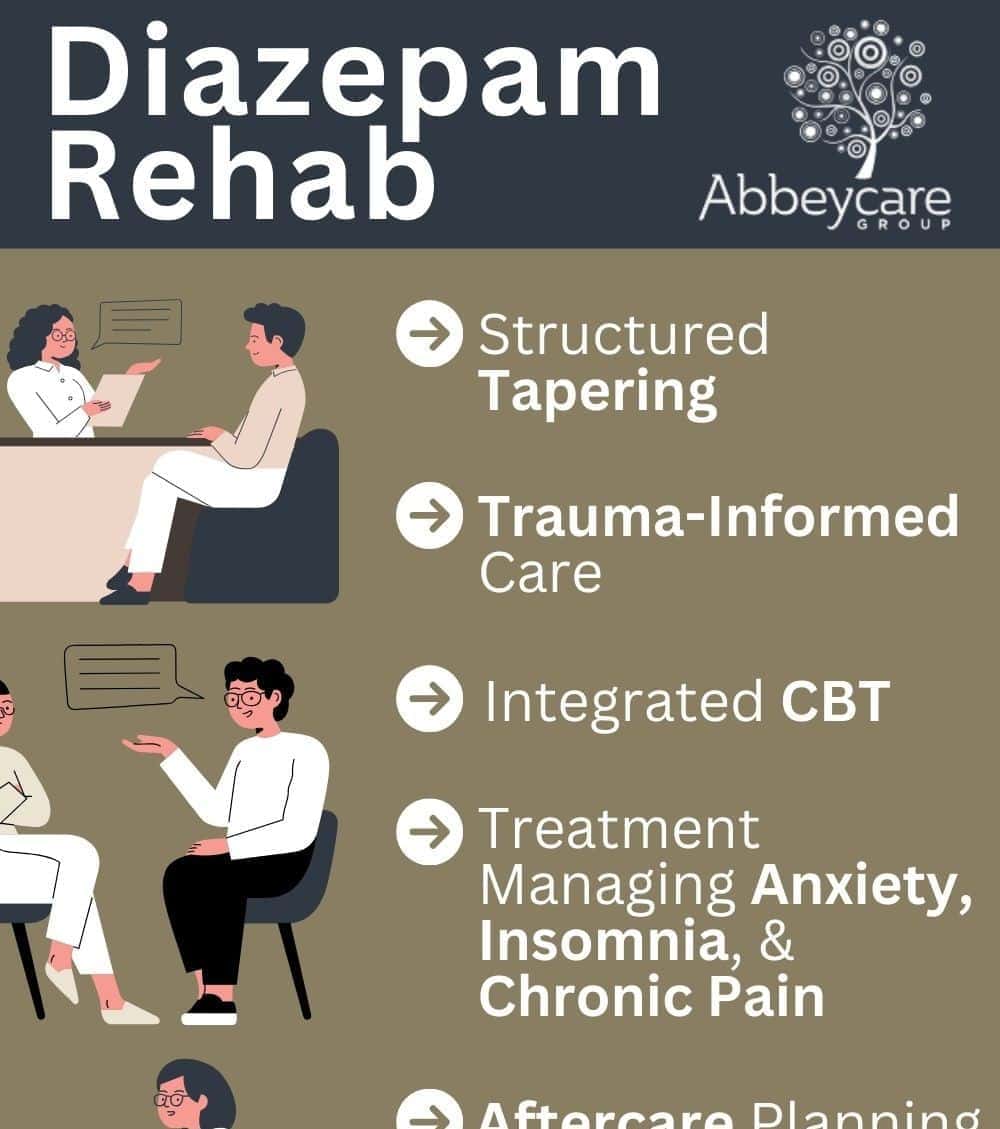
Below, we discuss possible approaches that meet the specific rehab needs around diazepam. Not all treatment centres will provide these specific interventions.
For an overview of the Abbeycare programme contents for diazepam rehab, click here.
When Is Diazepam Rehab Necessary?
Concurrent Anxiety
Concurrent anxiety necessitates diazepam rehab as 30.8% relapse within 3 months of detoxification due to returning anxiety [1]:
64.1% of chronic users (average = 10 years of use) are initially prescribed diazepam for anxiety, and 21.9% become dependent due to the drug’s ‘calming effect’ [2]
Rehab provides weekly CBT to address the underlying causes and triggers of both conditions, whereas detox addresses physical dependence only
Mindfulness (e.g. meditation/deep breathing) is provided to manage physical and emotional anxiety symptoms e.g. palpitations in 64.9% and preoccupation in 48.6% of diazepam users [2]
Selective serotonin reuptake inhibitors (SSRIs) or beta-blockers may be provided to treat anxiety if symptoms prevent the patient from engaging in treatment
Patients are more likely to be diazepam-free (64.5% vs 30%) and experience less anxiety (PSWQ score = 44.9 vs 52.8) 12 months after a structured rehab therapeutic programme compared to detox alone [3].
Polysubstance Abuse
Polysubstance abuse necessitates diazepam rehab as 24.4% of chronic diazepam users abuse other drugs, and are 5 times more likely to overdose compared to single-drug users [2] [4]:
Rehab addresses concurrent drug use with up to 20 weeks of integrated therapy (e.g. CBT, MET); detox alone provides simultaneous or subsequent withdrawal processes
Integrated CBT addresses depression that occurs in 72.7% of polydrug users with coping skills training and cognitive restructuring [5]
Drug use decreases by 79% within 6 months as patients are 18.9% less likely to use drugs as a coping mechanism following 10 sessions of individual CBT with motivational interviewing [6].
Pre-Existing Sleep Issues
Pre-existing insomnia necessitates diazepam rehab as 38.5% relapse within 3 months of detoxification due to returning insomnia [1]:
36.6% of chronic users (10 years of use) are initially prescribed diazepam for insomnia, and 24.4% are reliant on the drug to cope with sleeping difficulties [2]
Rehab provides CBT with sleep hygiene education to address and modify irrational beliefs (e.g. self-blame, perfectionism) and harmful sleep routines (e.g. replacing caffeine before bed with daily exercise)
Rehabs may treat insomnia with melatonin or 75 – 200mg of Trazodone during treatment [7]
Patients are more likely to be diazepam-free at 3 months after a structured rehab therapeutic programme compared to detox alone (83% vs 65%), due to reduced insomnia (ISI scores = 16.7 to 11.1) [8]
3 weeks of psychoeducation and relaxation training led to complete cessation in 41.4% and self-reported improved sleep quality in 34.3% of diazepam users after 6 months [9].
Diazepam Rehab Process
Detox
Detox occurs in diazepam rehab by reducing the patient’s daily dose by 5 – 10% every 1 – 2 weeks until 0mg is reached [10].
Therapy
Therapy sessions are shorter in diazepam rehab due to impaired episodic memory in 18.5% of patients, leading to a 30 – 50% reduction in immediate and delayed recall ability [11] [12]:
10 – 15-minute individual counselling sessions rather than 60-minute sessions are provided to educate patients about harmful drug use; counsellors encourage note-taking to aid recall [13]
Group sessions are 55 minutes or less, rather than 60 – 90 minutes and begin with reviews of previous topics; written or visual self-help materials are provided for goal-setting [14]
Therapy during diazepam addiction treatment addresses withdrawal vs baseline anxiety by:
Focusing on mindfulness-based stress reduction methods for withdrawal anxiety e.g. 20 – 40 minute sessions focusing on breath work and attention to physical sensations [15]
Anti-anxiety medication is provided alongside therapy if needed, e.g. propranolol/ clonidine during withdrawal or SSRI treatment for persisting anxiety
EMDR/specific trauma-informed care is used differently in diazepam rehab by focusing on emotion regulation to replace drug use for coping with sleep disturbances, muscle tension and flashbacks:
10-minute mindfulness exercises using the leaf and stream metaphor teach patients how to identify and tolerate emotional discomfort caused by trauma [16]
EMDR, cognitive nightmare rehearsals, and grounding techniques use exposure and relaxation to process traumatic experiences and alleviate related symptoms [16]
Aftercare Planning
Aftercare planning extends monitoring periods for diazepam rehab patients because withdrawal symptoms may peak in severity between 8 – 20 weeks after discontinuation [17]:
Post-acute withdrawal syndrome typically lasts 5 – 28 days and peaks in severity around 2 weeks post-withdrawal, although symptoms persist for 6 - 12 months in some patients [17]
Ongoing weekly in-person and telephone monitoring is provided to assess psychological and physical status until symptoms return to pre-withdrawal levels
Aftercare planning involves creating a sleep hygiene/anxiety reduction plan because 30.8% relapse due to anxiety and 38.5% relapse due to insomnia within 3 months of detoxification [1]:
Anxiety and Insomnia may last up to 12 months after withdrawal in some cases, due to a 15% reduction of GABA activity in the brain [17] [18]
Patients who develop anxiety-management plans experience less anxiety (29% vs 60%) and are more likely to abstain after 12 months (74% vs 37%) [19]
Patients who engage in sleep hygiene practices are more likely to be diazepam-free at 12 months (59% vs 52%) [8]
Aftercare planning requires liaising with medical professionals to prescribe a non-benzodiazepine anxiety medication because:
21.9% of anxiety patients become addicted to diazepam’s ‘calming effect’, whereas beta blockers like propranolol are found to be “non-addictive” [2]
SSRIs such as sertraline or fluoxetine reduce anxiety in 42 – 77%, and decrease the risk of recurrent drug use by up to 23% within 4.5 years [20] [21]
Diazepam Rehab Vs Rehab For Other Prescription Drugs
Weekly open or closed meetings to share experiences
Relapse Management
Coping and life-skills training
Encourages 12-step attendance
Encourages ongoing participation to aid recovery
Duration
Up to 12 months
Ongoing
Public Or Private Treatment
Both
Public
Peer-Led?
No
Yes
How Does Addiction Timeframe Change Diazepam Rehab?
Addiction timeframe changes diazepam rehab programmes because long-term users (>6 months) are more likely to have:
Diabetes (50.5% vs 24.2%) compared to short-term users (<3 months), preventing the use of clonidine due to a 14.29% increase in incremental glucose AUC [27] [28]
Reduced physical functioning (78.3 vs 85.8), requiring 2 – 3 weekly physical therapy sessions for more than 8 – 12 weeks depending on objective improvement [27] [29] (not currently available at Abbeycare)
Increased withdrawal symptoms (43% vs 5%) due to older age (57 vs 49 years), higher rates of alcohol abuse (35.8% vs 14.7%) and psychotropic prescriptions (32.6% vs 13.7%) [27] [30]
A longer tapering schedule (up to 60 weeks) with a 5 – 10% dose reduction every 1 – 2 weeks, whereas doses are reduced by up to 25% per week for short-term users [10]
90% believe that using drugs positively impacts their physical condition, requiring use of the “Importance Ruler” to evoke change talk and address avoidance-orientated coping methods (e.g. denial) [31] [32]
80% of MS patients experience muscle spasms/cramps at least once a day and may require 0.5g oral methylprednisolone to ease spasticity during withdrawal [33] [34]
MS patients are more likely to use diazepam continuously for >6 months compared to non-MS patients (30% vs 10%), requiring a tapering schedule lasting 8 weeks or longer [35]
Arteriosclerosis
Arteriosclerosis changes Valium Rehab because doses are halved or quartered and tapered by 0.5mg - 2mg every 1 – 4 weeks due to [36]:
A higher renal resistive index (RI) compared to patients without arteriosclerosis (0.73 vs 0.61), leading to a decrease in eGFR by at least 5 mL/min/1.73 m 2/year [37]
An average 3.1-fold prolongation in half-life and a 30% drug clearance in renal impaired patients [38]
Valium rehab programmes for Arteriosclerosis patients include:
Hourly monitoring for blood pressure, pulse, temperature, potential sedation or confusion; medication is administered as needed (e.g. 0.2mg Clonidine for Blood Pressure > 140/90) [7]
Ongoing medical evaluations using ECGs, Cardiac telemetry monitoring, serum electrolytes and urinalysis tests [7]
Diazepam Rehab Outcomes
83% of diazepam rehab patients remain abstinent after 3 months and 70% are diazepam-free after 12 months [8].
71% of diazepam rehab patients experience a reduction in anxiety from pre-treatment to 12 months post-treatment, as GABAergic neurotransmission returns to normal after being reduced by 15% during withdrawal [3][18].
Diazepam rehab patients are 19% less likely to use drugs as a coping mechanism at 10 months post-treatment, as cognitive avoidance decreases by 32% after receiving 90-minute CBT sessions with coping skills training and cognitive restructuring [3][6].
Diazepam Rehab At Abbeycare
The Diazepam detox programme at Abbeycare is provided as part of a full rehab programme to mitigate withdrawal symptoms by:
Tapering the patient’s daily diazepam dose (or equivalent e.g. Chlordiazepoxide or Oxazepam) by up to 25%, every 1 – 2 weeks [2][3]
Monitoring patient progress and administering medication on an hourly basis for up to 10 days, to ease physical symptoms (e.g. muscle cramps) that develop within 24 hours of cessation [40]
Addressing anxiety, depression, and insomnia with beta-blockers, SSRIs and melatonin, if necessary, followed by CBT and mindfulness once physical dependence is addressed [40]
About the author
Mischa Ezekpo
Mischa Ezekpo has a Bachelors degree in Psychology from Northumbria
University, and a Masters degree in Childhood Development and
Wellbeing, from Manchester Metropolitan University. Since 2018, Mischa
has written and published work on Addiction, Mental Health, Depression, and Eating Disorders. Content reviewed by Laura Morris (Clinical Lead).