Alcoholism is a disease characterised by continuous heavy drinking. Until people with alcohol use disorder admit to problems with alcohol and stop drinking, the risk of alcohol use disorder continues which affects both physical and mental health.
Alcohol starts to injure the brain once it reaches the bloodstream.
Excessive consumption can lead to Alcohol-Related Brain Damage, or ARBD, which is a type of brain disorder caused by alcohol consumption. Brain shrinkage caused by alcohol abuse is permanent, as alcohol kills brain cells and grey matter.
For more information and effects click ‘Learn More’.
Family Recovery Compass is a newsletter for friends and family members who feel trapped between supporting a loved one in addiction, and protecting their own wellbeing.
Every week, we tackle one specific situation in addiction family dynamics, and deliver practical decision-making frameworks and exact dialogue scripts – that help you respond with confidence instead of reaction.
Every month, we bring you an unfiltered recovery conversation with someone who’s either experienced addiction firsthand, or works closely with those in recovery.
No sanitised success stories – just practical insights on what actually works in recovery, that you can apply, in your life too.
Recovery capital is the internal and external resource used to begin the recovery process and maintain sobriety. This combines personal, social, and community support to provide a joined-up approach that supports the addict through recovery.
Do you or a loved one need addiction treatment for alcohol or drugs? Thousands blindly walk into addiction treatment in expensive rehab centres and find that the reality doesn’t meet expectations.
If you’re considering rehab treatment, first check our ultimate guide for complete instructions on how to find the right rehab centre for you.
Take-home Naloxone kits help families and loved ones respond quickly in an opioid overdose emergency, until emergency services arrive. Kits contain nasal or injectable forms of Naloxone.
Changes in legislation mean Naloxone kits are now more widely available from pharmacies and drug services, including Abbeycare.
For additional information, click ‘Learn More’ below.
Overcoming alcohol addiction means first ceasing alcohol intake, and taking care of physical and chemical withdrawal symptoms.
Detoxing from alcohol means undergoing withdrawal from alcohol, but with the assistance of prescribed medication and detox phase, to substitute in place of the alcohol itself.
Alcohol rehab focuses on tackling the problems underneath alcoholism, such as grief, trauma, depression, and emotional difficulties, in order to reduce continuing drinking after treatment.
Inpatient services at an alcohol rehab programme provides 24 hour access to specialist care.
Alcohol home detox provides a means of semi-supervised addiction treatment in the comfort of your home. It’s often suitable for those with inescapable practical commitments, or where a reduced budget for treatment is available.
An at-home detox is the most basic detox option available from Abbeycare, and assumes you have support available, post-detox, for the other important elements of long-term addiction recovery.
The term alcoholism refers to the consumption of alcohol to the extent that the person is unable to manage their own drinking habits or patterns, resulting in side-effects that are detrimental to the quality of life and health of the alcoholic, or those around them.
An alcoholic is someone who continues to compulsively abuse alcohol in this way, despite the negative consequences to their lives and health.
Immediately following treatment, the early stages of recovery and abstinence are most vulnerable to lapses.
At Abbeycare, a structured and peer-reviewed aftercare plan is usually prepared whilst still in treatment. This comprises social, peer, and therapeutic resources individuals draw upon, following a residential treatment programme for drug or alcohol misuse.
Clinically managed residential detoxification is:
– A structured detox that uses medication-assisted treatment and regular physical health observations
– Takes place in an inpatient rehabilitation unit or hospital
– Typically lasts from 7-10 days, but in Abbeycare, it is incorporated into a 28-day rehab programme
Family Therapy at Abbeycare Scotland or Gloucester is realistic, compassionate, and appropriate for families and loved ones of addicts.
Family therapeutic interventions in residential rehabilitation have been designed to support those living with or caring for participants entering the Abbeycare Programme.
Support for families in a group setting allows for a safe, constructive, and confidential place to listen and share common experiences.
Inpatient rehab is drug and/ or alcohol treatment in a rehab centre, where patients remain on-site for the duration of inpatient rehabilitation.
It includes detoxification from drugs, therapy (group work and 1-2-1 sessions), and aftercare planning. Inpatient rehabs typically last 28 days, but this varies on an individual basis.
Long-term treatment at Abbeycare has been developed for those suffering from alcohol or drug addiction. Completing a long-term drug and alcohol inpatient programme may be the solution to problematic substance use.
Motivational Enhancement Therapy can be used by trained addiction recovery therapists to elicit internal changes within and promote long-term recovery from substance use disorder.
All the answers to addiction can be found within with this comprehensive and successful therapy concept leads to behavioural changes, reflective listening, self-motivational statements, and a comprehensive recovery process.
Outpatient drug or alcohol rehab is daytime treatment as opposed to living in a treatment facility.
Outpatient treatment is similar to inpatient in terms of the methods used to treat substance abuse. Where they differ is in their approach to recovery.
Abbeycare’s prison to rehab is a 12-week structured rehab programme which involves direct transfer from prison. The suitability of the candidate is decided by prison staff.
Short-term residential treatment programmes are the chance to press the reset button and access a therapeutic programme designed to create recovery from the use of alcohol and drugs.
Feeling stuck in a rut. Want to stop but can’t seem to achieve sobriety?
Click below.
The 12-step programme was created by alcoholics anonymous (AA), and is specifically designed to aid addicts in achieving and maintaining abstinence.
The central ethos behind the programme is that participants must admit and surrender to a divine power to live happy lives. Ideas and experiences are shared in meetings, and help is sought in an attempt to achieve abstinence.
Abbeycare’s policy to respect your privacy and comply with any applicable law and regulation regarding any personal information we may collect about you, including across our website and other sites we own and operate.
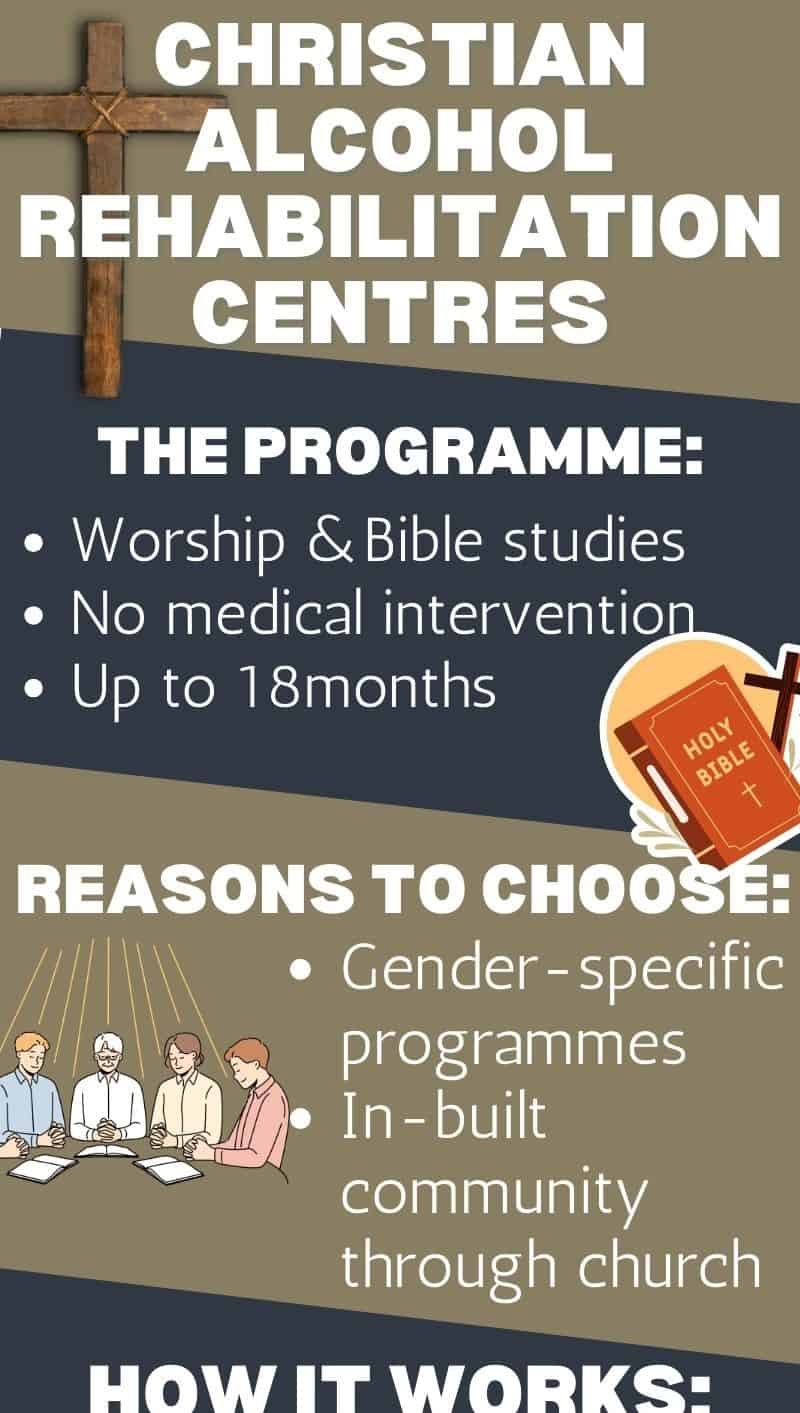
Length of programme - up to 18 months vs 28 days in traditional rehab
No medical intervention provided
Patients are expected to have previously detoxed before entering treatment
Christian worship and bible studies - mandatory Christian studies unlike traditional rehab [1]
UK Christian Addiction Recovery Programmes
Teen Challenge UK
Teen Challenge UK has a 12-18 month initiative that contains:
Courses in managing finances and budgeting
Functional skills courses in English, Maths, Science and IT
Assigned time for personal reflection
Group therapy based on a bible proverb or story - run by on-site staff not trained in therapy
Work duties - gardening or housework tasks [2]
Sunnybrae
Sunnybrae has a male-only, 12-month rehab treatment that contains:
Compulsory chapel attendance every morning
Bible classes teaching Christian values
Participation in on-site window cleaning and gardening businesses [3]
Whitchester House
Whitchester House has an 18 month Christian based rehab initiative that contains:
English and Maths skills (not accredited courses)
Gardening, cooking, joinery and household maintenance
Walks and trips around the community
Daily church service and religious meetings [4]
Betel
Betel has a 12-18 month Christian plan that contains:
Christian worship every morning
Bible-focused, peer-led discussion groups - no formal therapy offered
Assigned work - flyer distribution, furniture collection and delivery and charity shop sales
Music and creative arts lessons [5]
Reach Out Ministries
Reach Out Ministries has an 18-month faith-based plan that contains:
A personalised recovery plan - covering goals to achieve during treatment and follow-up care including organising housing, finances and access to employment
GCSE or A-level qualifications, with the opportunity to enrol in university courses during rehab
Sessions on self-worth and spiritual growth [6]
Gloucester House
Gloucester House is a Salvation Army-run centre that has a 6-month initiative, containing:
Peer mentor for the first two weeks
One-to-one counselling with accredited counsellors
Counsellor-led group therapy
Craft sessions
IT training
Cooking and budgeting lessons
Secondary care is available for independence in the later stages of treatment
The Carpenter's Arms
The Carpenter's Arms has a male-only 6-12 month Christian faith initiative that contains:
Individual and group therapy by either trained or training therapists about trauma, triggers and underlying causes for addiction
Assigned household tasks around the centre
Courses relevant to employment goals such as bricklaying or accountancy
Anger management and taking responsibility sessions
A common perception around worship and study in a Christian approach is that religious ideas are forced upon patients and the rehab aims to convert patients to Christianity.
Whereas religion in Christian recovery approaches is used to accept defects in character, and assistance from God to maintain abstinence.
Taking Responsibility Courses
The perception of taking responsibility courses from a Christian recovery approach is that there is a sense of blame and judgement placed on the individual.
However, Christian-led and other rehabs ask the person to take responsibility for past actions and let go of guilt and shame felt to move forward in recovery.
Assigned Work Tasks
The misconception about assigned work tasks is that they are used to make money from the residents of the rehab.
In fact, any money gained from work tasks is used to provide care for patients and to recycle skills into training courses in the future.
Why Attend A Christian Treatment Centre?
Beyond Christian beliefs, clients may attend Christian centres because:
Free treatment - many Christian recovery approaches are charity or government funded
Only able to access the detoxification element of treatment privately or through the NHS
Wanting to reconnect with Christianity - being religious prior to alcoholism
Emphasis on family involvement - Sunday prayer sessions with family, time set aside to spend with spouses/ children
Community-focused work - useful for those who have been isolated due to addiction
The key differences between typical rehabs and Christian recovery approaches are:
The length of the treatment is typically 12-18 months, whereas traditional rehabs are 28 days
Work and physical labour - not expected in traditional rehabs
Working towards a Christian lifestyle - prayer, bible teachings and bible related discussion groups
Personal responsibility - Christian approaches provide secondary care, whereas traditional rehabs provide primary care, so responsibility for abstinence is placed on the individual
Elements Found In Christian Rehab Centres, But Not Elsewhere
Length Of Treatment
Unlike 28-day treatments in traditional rehabs, Christian recovery approaches typically last between 12-18 months, allowing the patient to explore:
Content that is spiritual-based, rather than evidence-based
Asking God to remove shortcomings and deficits of character
Making amends to those that have been harmed by acting out during active substance dependence
Using prayer and meditation to develop contact with God
Learning to take accountability for wrongdoings
The development of academic and/or practical skills
Developing the ability to live independently without addiction using third-party support
Work And Physical Labour
In contrast to traditional rehabs, most Christian-based rehabs are self-sustaining communities, requiring residents to take part in manual labour in order to increase self-sufficiency and responsibility.
Examples of work tasks include:
Maintenance of the facility
Farming and agricultural work to supply food for the rehab
Work in the local community - gardening, window cleaning or domestic tasks
Working Towards A Christian Lifestyle
Whilst all rehabs have discussions of religion, Christian initiatives base therapy groups on a section of either the bible or the big book of Alcoholics Anonymous.
Christian recovery approaches encourage either Christian or other forms of spirituality as part of the recovery journey around the belief that creating a relationship with God assists in maintaining abstinence.
Personal Responsibility
In a Christian initiative, care is mostly secondary, placing personal responsibility for abstinence with the individual.
If an individual lapses in a Christian-based approach, they are likely to be asked to leave the facility.
In traditional rehabs, the individual's responsibility to maintain abstinence is supported by doctors and detoxification medication.
Is Detox Provided In Christian Centres?
Detoxification is usually not provided in Christian centres, meaning medical detoxification must be completed externally and proof must be provided at the point of admission to a Christian programme.
A Christian recovery centre does not undertake any medical risk as there are usually no medically trained staff present.
Some Christian rehabs receive referrals from NHS or private rehabs after patients have completed a detox at the facility.
Therapeutic Progress On Triggers, Beliefs, And Patterns Of Addiction In Christian Centres
Unlike traditional rehabs, Christian rehab's therapeutic content and delivery:
Uses faith as an underlying fundamental of recovery
Contains counselling or therapy led by members of the church
Looks at addiction through the view of the bible - as a deficit to be overcome
Uses a relationship with a higher power to increase feelings of fulfilment and meaning without coping mechanisms or dependencies
Uses helping others in own recovery journey as a way to achieve fulfilment
How Do Elements Of Christian Recovery Programmes Translate Into The Community, After Treatment? (Aftercare)
The key differences between aftercare in Christian recovery programmes and traditional rehab options are:
Traditional rehabs guarantee individualised professionally led therapeutic content - unlike peer or church led in Christian approaches
Traditional rehab stays include detox - Christian approaches expect clients to arrive after going through detox
Traditional rehabs create a structured plan that includes future pacing - Christian approaches typically only include third-party referrals
Standard Rehab Programme Elements
Christian-Based Rehab Equivalent
Creating an individualised care plan to accommodate patients’ needs
Following a religion that may prohibit living with the opposite gender
Those who have experienced specific traumas around the opposite gender
Those who have experienced domestic violence
Those with co-occurring sex addictions
Those Requiring Housing
Christian rehab is suitable for:
The homeless or those in temporary accommodation
Those who are long-term unemployed
Those who have emigrated to the UK - some Christian rehabs offer scholarships for international patients
Those wanting to be away from their previous environment due to past crimes or relapses
Those Wanting To Leave Enabling Environments
Christian rehabs may be suitable for those who:
Are enabled to drink when returning home after a 28-day rehab - particularly if this has happened multiple times
Have not been helped by future pacing in a 28-day facility - longer times away can help remove dependency on enablers
Those Following Other Religions
While rehabs following other religions exist, they are limited across the UK.
Christian rehabs offer an alternative as:
There is still an emphasis on faith and spirituality that is open to personal interpretation
There is flexibility in not attending strictly Christian worship
Christian programmes are respectful of the requirements of other religions - such as times of prayer or dietary requirements
Those Requiring Further Education
If dependence issues have been detrimental to education, young adults in their late teens can seek academic skills and qualifications in a Christian rehab, leading to future employment.
Those Requiring Longer Rehab Stays
Some patients may benefit from a longer stay provided in a Christian initiative, such as:
Those who have had many failed attempts in a 28-day rehab - particularly if returning to the same environment after rehab is causing relapse
Those who have no intention of becoming sober and are waiting for 28 days to be over to continue drinking - having to commit to a longer time could lead to long-term sobriety
What Christian Rehab Is NOT
Only Focused On Prayer/ Religious Teaching
Christian programmes do not believe religion is the only solution to addiction and use therapy in recovery.
More Religious Than Other Rehabs
Whilst Christian rehabs may use more religious ideology than other forms of rehab, the end goal is primarily focused on addiction treatment.
Forces Religion Onto Patients
Unlike common perceptions, Christian rehabs do not force patients to follow Christianity.
It is common practice for Christian approaches to encourage patients to replace a higher power with their chosen religion/ spiritual beliefs or family and loved ones instead.
Judgemental
However, one of the main tenants of Christian rehab is a lack of judgement or stigma for past actions.
Instead, they focus on taking accountability moving forwards.
Long-Term Effects Of Christian Addiction Recovery Programmes
Christian programmes are longer than traditional rehabs (18 months vs 28 days), enabling long-term lifestyle changes to improve quality of life, including:
Having an in-built community through the church - to support through future complications that may have resulted in relapsing
Mentoring others through the initiative -gaining responsibility and avoiding selfishness that can hinder own recovery journey
Christianity encourages taking care of the body given by God (by exercise, a healthy diet and maintaining good mental health) - all beneficial to maintaining long-term sobriety
About the author
Harriet Garfoot
Harriet Garfoot BA, MA has an Undergraduate degree in Education Studies and English, and a Master's degree in English Literature, from Bishop Grosseteste University. Harriet writes on stress & mental health, and is a member of the Burney Society. Content reviewed by Laura Morris (Clinical Lead).