


KEY TAKEAWAYS
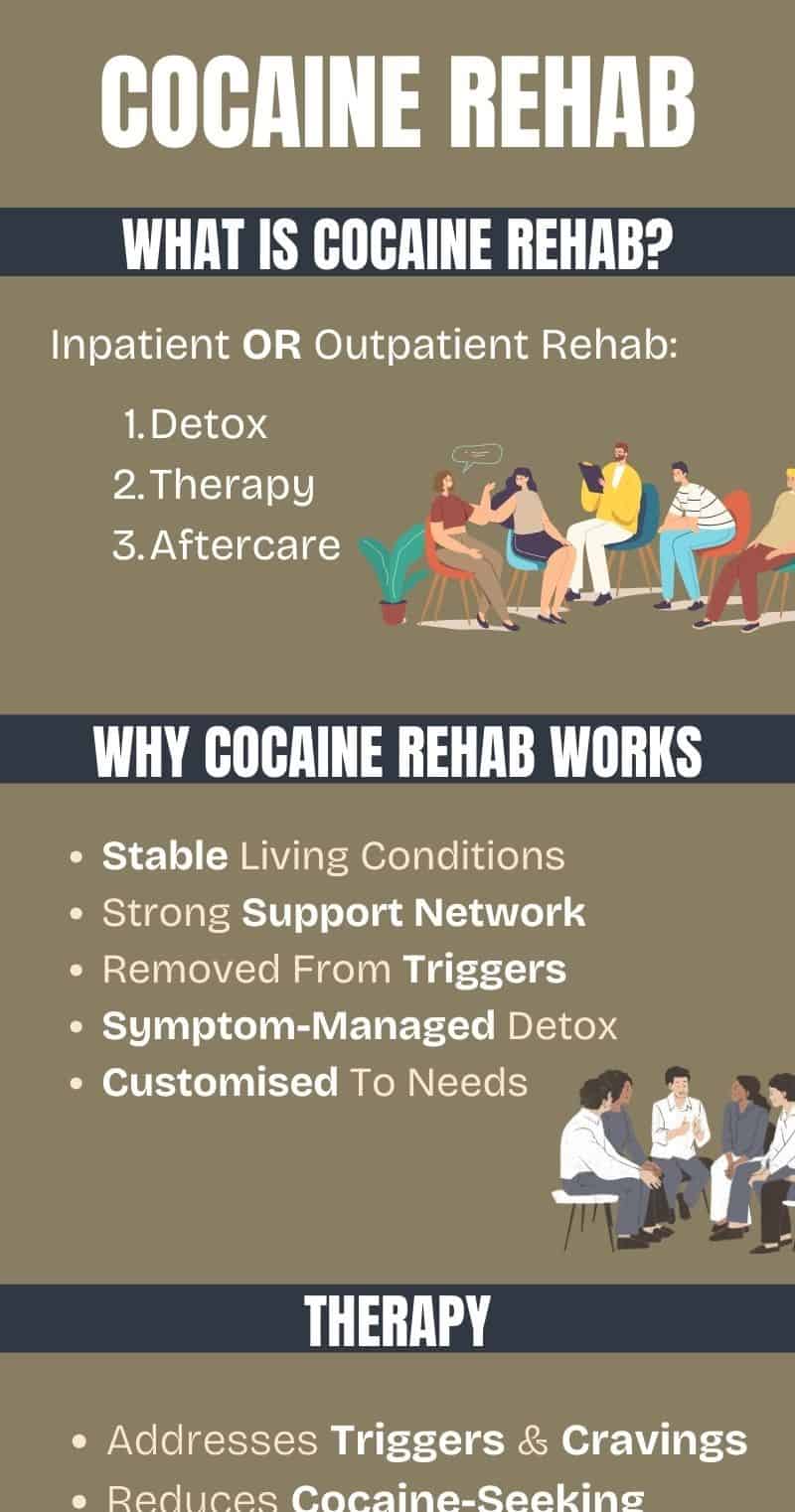
Cocaine rehab is:

Below, we discuss possible approaches that meet the specific rehab needs around cocaine. Not all treatment centres will provide these specific interventions.
For an overview of the Abbeycare programme contents for cocaine rehab, click here.
Cocaine Rehab Process Overview
Pre-Admission
56% of users present with cardiovascular abnormalities, so physical health screening determines if medical treatment is required [2].
34% of cases have co-occurring borderline personality disorder, so behavioural screening determines the need for mood stabilisers before a cocaine treatment plan begins [3].
The Addiction Severity Index in pre-admission detects impulsivity, found in 4.5% more cocaine than alcohol users, helping healthcare workers assess the need for impulse control management [4].
Cognitive tests during pre-assessment help to determine the presence of cocaine-induced attentional deficits and the suitability of cognitive behavioural therapy.
Setting expectations for symptom-managed as opposed to medicated detox enables the client to prepare mentally and physically for the process of cocaine recovery.
Cocaine addiction is combined with cannabis use in 64% of cases, so assessing this usage in pre-admission determines the need for polysubstance detox [5].
Detox
There is no specific medical treatment for cocaine addiction, so the focus is primarily on symptom management while the body detoxes from cocaine over 1-4 weeks.
Symptom-managed detox focuses on nutritious food and hydration as vomiting causes loss of fluids and electrolytes.
Melatonin supplements are given to overcome decreased slow-wave sleep in cocaine detoxification [6].
Anxiety occurs in 24% of cocaine-detoxifying patients, so gabapentin is often prescribed to relieve symptoms and enable patients to engage in the therapeutic programme [7].
Therapy
A 2001 study by Moeller and colleagues evidenced that curbing impulsivity leads to cocaine therapy retention [8].
Cocaine, as a primarily psychological addiction, requires cognitive behavioural therapy so that triggers and cravings are identified to reduce cocaine-seeking behaviour.
Relapse prevention therapy reduces cocaine consumption 25% more than drug counselling [9].
The combined use of therapy and symptom-managed detox addresses both psychological and physical side effects.
Stronger therapeutic alliances between the service user and therapist in cocaine rehab centres are associated with less frequent cocaine use [10].
Aftercare planning
Due to a longer timeframe for relapse to occur, aftercare may extend to 18 months compared to 12 months for medication-assisted rehab.
The unemployment rate is 26.8% greater among users than for non-users, meaning that longer aftercare durations may include assistance with employment [11].
Aftercare planning involves analysing environmental triggers to ensure cocaine is not used as a coping mechanism in stressful situations.
Family support helps to identify triggers in the aftercare planning stage of treatment.
Cocaine Rehab Duration
1 Week | 28 Days | 12 Weeks | |
|---|---|---|---|
Length Of Detox | 1 week | 1 week | 4 weeks |
Therapy Sessions | 3-4 times/week , possibly during detox | 3-4 times/week following detox | 3-4 times/week, then weekly, as rehab progresses |
Aftercare Planning Provided? | Reduced aftercare provision | Therapy & aftercare more personalised | Less planning - coping mechanisms now known |
Integration Of Holistic Therapies Into Treatment | Holistic treatment not prioritised | Some (e.g.) meditation | Longer timeframe for meditation, reiki, reflexology, yoga, etc |
Suitable For Dual Diagnosis Treatment/ Co-occurring Mental Health Concerns? | No | Yes - individualised | Yes - individualised |

Cocaine Rehab Vs...
Detox Only Programme | Cocaine Anonymous | |
|---|---|---|
Type Of User | Stable living conditions Good physical and mental health Good support network | Early-stage users Committed to recovery Good support network |
Detox Included? | Yes - symptom managed | No |
Customised to needs? | Yes | No |
Costs | ~£1000 | Hope Faith & Courage Vol. I £10.00 + other books |
Flexible? | No | No |
Removed From Triggers? | Yes | No |
NHS Or Public Healthcare Rehab | Outpatient Treatment | |
|---|---|---|
Type Of User | High risk of relapse High dependency Long-term addiction | Low risk of relapse Low dependency Minimal support network |
Detox Included? | Yes - symptom managed | Yes - symptom managed |
Customised to needs? | No | Yes |
Costs | Free | ~£1,500 / private programme Free on NHS |
Flexible? | No | No |
Removed From Triggers? | Yes | No |
Detox At Home | |
|---|---|
Type Of User | Low risk of relapse Low dependency Good support network |
Detox Included? | Yes - symptom managed |
Customised to needs? | Yes |
Costs | Free |
Flexible? | Yes |
Removed From Triggers? | No |
What Changes Cocaine Rehab?
Holistic And Alternative Therapies Integration
Supplementing a 12-week programme with yoga practice leads to a 7.37% increase in Stroop word scores, a measure of executive functioning [12].
Meditation and yoga enhance self-awareness, aiding in identifying triggers outside therapy sessions.
2 months of consistent yoga and meditation significantly improves self-reported "Perceived Stress Scale" and reduces the need for CBT [13].
33.6% of cocaine use results from past traumas; therefore using only holistic treatment fails to address the root causes of cocaine addiction [14].
Compared to traditional dialectical behavioural therapy for cocaine addiction, alternative therapies lack scientific evidence, so they are primarily used to supplement evidence-based methods.
Co-Occurring Mental Health Disorders
Paranoia occurs in 68-84% of cocaine addiction cases, so dual-diagnosis treatment may be required to assess schizophrenia [15].
Treating cocaine addiction alongside co-occurring mental health disorders requires custom care plans to meet individual needs.
Eye Movement Desensitisation Reprocessing (EMDR) in the treatment of trauma in cocaine addiction results in a significant improvement in PTSD outcomes, allowing recovery to become treatment-led [16].
Treating cocaine addiction in combination with a co-occurring disorder requires diversified treatment schedules to fit personal requirements.
Combined EMDR with Schema Therapy significantly decreases addiction severity and PTSD symptoms, helping to resolve trauma [17].
High Risk Of Relapse
Those with a previous history of relapse require more therapy sessions to explore underlying trauma.
Having a high risk of cocaine relapse warrants extended residential stays, typically greater than 28 days.
Since 24% relapse within a year of receiving treatment, cocaine addiction programmes focus heavily on aftercare planning, involving appropriate signposting and resources [18].
Addressing positive/negative anchors of cocaine addiction helps identify triggers and prevent relapse in high-risk cases [19].
Individuals with a high risk of relapse may receive employment counselling [20].
The use of the Health-Related Quality of Life questionnaire in rehab predicts future relapse behaviours for those with a history of cocaine relapse [21].

When Cocaine Rehab Is NOT Appropriate
Serious concurrent conditions such as Ischemic bowel disease require immediate medical attention in a hospital environment, so patients' medical healthcare problems are prioritised before rehab.
Zidovudine causes headaches in 15 to 38%, making rehab unsuitable for newly diagnosed HIV patients, as it exacerbates headaches associated with cocaine withdrawal [22].
Cocaine addiction with co-occurring untreated schizophrenia may not be suitable for traditional rehab clinics and first requires specialised treatment for behaviour to become stable.
Cocaine addiction treatment takes up to 12 weeks, making it unsuitable for those without paid leave or financial stability.
How To Pay For Cocaine Rehab
Pricing
Rehab costs between £1,000 and £5,000 per week, depending on the rehab institution and what is provided in care.
Outpatient programmes cost around £1,000, but this varies on the facility, location, provider, and whether medical treatment is required.
Health Insurance
Most insurance providers cover part of cocaine detox costs, depending on policy and medical necessity.
Insurance policies typically only cover the detox phase of cocaine treatment, and patients themselves fund any longer rehab period.
With a relapse rate of 24%, sometimes multiple treatments are needed that are not covered by insurance claims, leading to personal costs [23].
Any CBT during symptom-managed detox will be covered by health insurance, policy-dependent.
Although there are no approved medications for cocaine detox itself, SSRIs are covered by insurance for cases of cocaine-induced depression.
Cocaine Rehab Outcomes
Spending 90+ days in cocaine rehab leads to a 24% lowered rate of weekly cocaine use compared to short-term rehab of 25 days [24].
Cocaine users are more likely to drop out of rehab (58%) compared to those in rehab for alcohol addiction (35%) [25] [26].
44% are readmitted to cocaine rehab within 2.6 years of completing treatment [27].
9.5% more people who used cocaine intranasally rather than smoking show 3+weeks of continued cocaine abstinence following rehab [28]
Active participation in a 12-step programme in therapy is more critical for cocaine abstinence than attendance at meetings [29].
A 89.1% retention rate for inpatient cocaine rehabilitation leads to improvements in psychosocial functioning and reduced cocaine use 7 months post-treatment [30].
Abstinence rates for cocaine addiction combined with alcohol dependence following polysubstance rehabilitation are 35% [31].
Only 10-30% of people who do not utilise a cocaine addiction treatment programme remain abstinent for 6+ months [32].
Cocaine Rehab At Abbeycare
The cocaine rehab programme at Abbeycare is a 28+ day treatment that involves detox and rehabilitation for cocaine addiction.
The programme includes cognitive behavioural therapy, group therapy, family support, and aftercare practices.
For an initial assessment or to enquire about treatment options, call 01603 513091.

