Alcoholism is a disease characterised by continuous heavy drinking. Until people with alcohol use disorder admit to problems with alcohol and stop drinking, the risk of alcohol use disorder continues which affects both physical and mental health.
Alcohol starts to injure the brain once it reaches the bloodstream.
Excessive consumption can lead to Alcohol-Related Brain Damage, or ARBD, which is a type of brain disorder caused by alcohol consumption. Brain shrinkage caused by alcohol abuse is permanent, as alcohol kills brain cells and grey matter.
For more information and effects click ‘Learn More’.
Family Recovery Compass is a newsletter for friends and family members who feel trapped between supporting a loved one in addiction, and protecting their own wellbeing.
Every week, we tackle one specific situation in addiction family dynamics, and deliver practical decision-making frameworks and exact dialogue scripts – that help you respond with confidence instead of reaction.
Every month, we bring you an unfiltered recovery conversation with someone who’s either experienced addiction firsthand, or works closely with those in recovery.
No sanitised success stories – just practical insights on what actually works in recovery, that you can apply, in your life too.
Recovery capital is the internal and external resource used to begin the recovery process and maintain sobriety. This combines personal, social, and community support to provide a joined-up approach that supports the addict through recovery.
Do you or a loved one need addiction treatment for alcohol or drugs? Thousands blindly walk into addiction treatment in expensive rehab centres and find that the reality doesn’t meet expectations.
If you’re considering rehab treatment, first check our ultimate guide for complete instructions on how to find the right rehab centre for you.
Take-home Naloxone kits help families and loved ones respond quickly in an opioid overdose emergency, until emergency services arrive. Kits contain nasal or injectable forms of Naloxone.
Changes in legislation mean Naloxone kits are now more widely available from pharmacies and drug services, including Abbeycare.
For additional information, click ‘Learn More’ below.
Overcoming alcohol addiction means first ceasing alcohol intake, and taking care of physical and chemical withdrawal symptoms.
Detoxing from alcohol means undergoing withdrawal from alcohol, but with the assistance of prescribed medication and detox phase, to substitute in place of the alcohol itself.
Alcohol rehab focuses on tackling the problems underneath alcoholism, such as grief, trauma, depression, and emotional difficulties, in order to reduce continuing drinking after treatment.
Inpatient services at an alcohol rehab programme provides 24 hour access to specialist care.
Alcohol home detox provides a means of semi-supervised addiction treatment in the comfort of your home. It’s often suitable for those with inescapable practical commitments, or where a reduced budget for treatment is available.
An at-home detox is the most basic detox option available from Abbeycare, and assumes you have support available, post-detox, for the other important elements of long-term addiction recovery.
The term alcoholism refers to the consumption of alcohol to the extent that the person is unable to manage their own drinking habits or patterns, resulting in side-effects that are detrimental to the quality of life and health of the alcoholic, or those around them.
An alcoholic is someone who continues to compulsively abuse alcohol in this way, despite the negative consequences to their lives and health.
Immediately following treatment, the early stages of recovery and abstinence are most vulnerable to lapses.
At Abbeycare, a structured and peer-reviewed aftercare plan is usually prepared whilst still in treatment. This comprises social, peer, and therapeutic resources individuals draw upon, following a residential treatment programme for drug or alcohol misuse.
Clinically managed residential detoxification is:
– A structured detox that uses medication-assisted treatment and regular physical health observations
– Takes place in an inpatient rehabilitation unit or hospital
– Typically lasts from 7-10 days, but in Abbeycare, it is incorporated into a 28-day rehab programme
Family Therapy at Abbeycare Scotland or Gloucester is realistic, compassionate, and appropriate for families and loved ones of addicts.
Family therapeutic interventions in residential rehabilitation have been designed to support those living with or caring for participants entering the Abbeycare Programme.
Support for families in a group setting allows for a safe, constructive, and confidential place to listen and share common experiences.
Inpatient rehab is drug and/ or alcohol treatment in a rehab centre, where patients remain on-site for the duration of inpatient rehabilitation.
It includes detoxification from drugs, therapy (group work and 1-2-1 sessions), and aftercare planning. Inpatient rehabs typically last 28 days, but this varies on an individual basis.
Long-term treatment at Abbeycare has been developed for those suffering from alcohol or drug addiction. Completing a long-term drug and alcohol inpatient programme may be the solution to problematic substance use.
Motivational Enhancement Therapy can be used by trained addiction recovery therapists to elicit internal changes within and promote long-term recovery from substance use disorder.
All the answers to addiction can be found within with this comprehensive and successful therapy concept leads to behavioural changes, reflective listening, self-motivational statements, and a comprehensive recovery process.
Outpatient drug or alcohol rehab is daytime treatment as opposed to living in a treatment facility.
Outpatient treatment is similar to inpatient in terms of the methods used to treat substance abuse. Where they differ is in their approach to recovery.
Abbeycare’s prison to rehab is a 12-week structured rehab programme which involves direct transfer from prison. The suitability of the candidate is decided by prison staff.
Short-term residential treatment programmes are the chance to press the reset button and access a therapeutic programme designed to create recovery from the use of alcohol and drugs.
Feeling stuck in a rut. Want to stop but can’t seem to achieve sobriety?
Click below.
The 12-step programme was created by alcoholics anonymous (AA), and is specifically designed to aid addicts in achieving and maintaining abstinence.
The central ethos behind the programme is that participants must admit and surrender to a divine power to live happy lives. Ideas and experiences are shared in meetings, and help is sought in an attempt to achieve abstinence.
Abbeycare’s policy to respect your privacy and comply with any applicable law and regulation regarding any personal information we may collect about you, including across our website and other sites we own and operate.
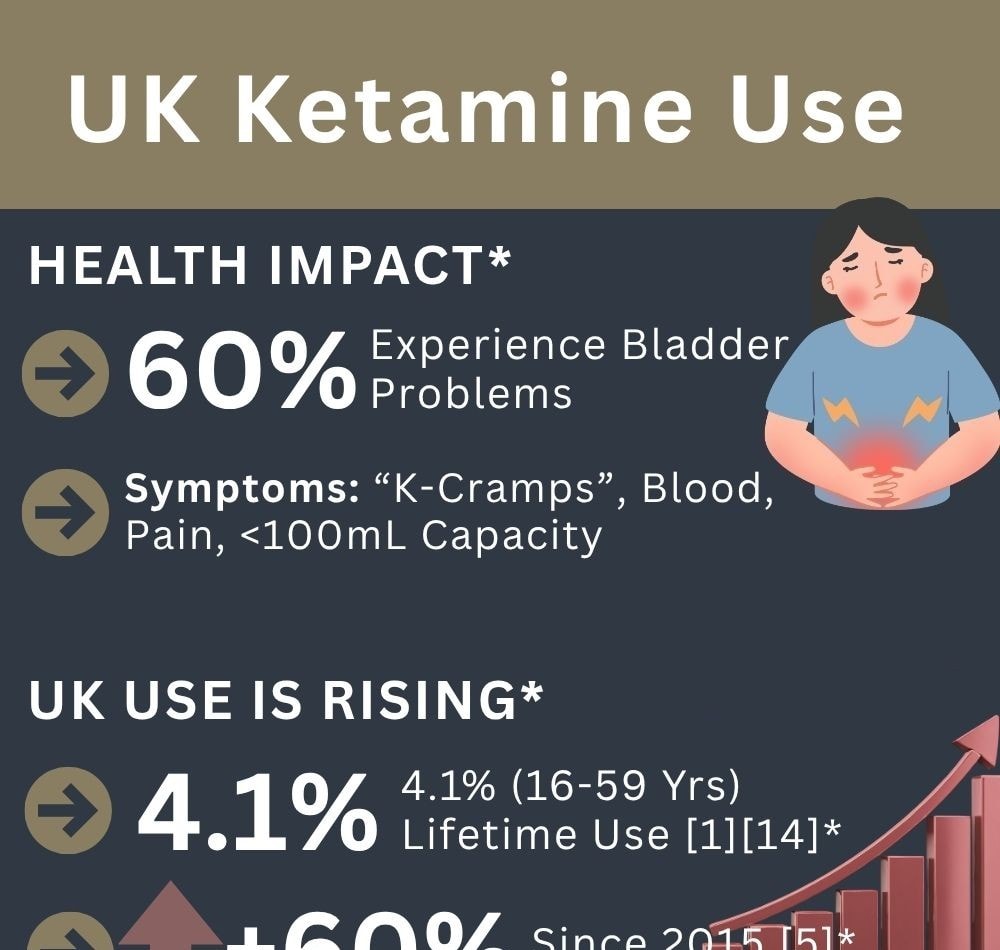
Rising annually, with 4.1% of people aged 16–59 reporting lifetime use in 2025, the highest level recorded [1]
Linked to ketamine bladder syndrome, “K-Cramps”, acute kidney injury, and cognitive impairment in up to 60% of regular users (e.g. 5x p/wk) [2]
Legal Classification Of UK Ketamine Use
Since 2014, ketamine has been a Class B drug in the UK under the Misuse of Drugs Act 1971, after the ACMD 2013 review highlighted the harmful consequences (e.g. biliary sepsis) of chronic ketamine use [3].
The maximum penalty for possessing ketamine is up to 5 years in prison, an unlimited fine, or both, and the maximum penalty for supplying ketamine is up to 14 years in prison, an unlimited fine, or both [4].
Legal penalties for possessing and supplying ketamine depend on the quantity found and other aggravating (e.g. previous crimes) or mitigating factors (e.g. cooperation with UK police).
Why Is Ketamine Use Rising In The UK?
UK ketamine use has risen by 60% since 2015 because [5]:
Ketamine, which is legally manufactured and distributed for veterinary medicine, is diverted into illicit markets, and users believe “A little bit can’t harm me that much” because “It’s a tranquiliser” [6]
32% consider ketamine “easier” to buy: “It is just very available, isn’t it?” compared to other drugs (e.g. heroin, cocaine) due to global supply chain issues leading to shortages in the UK [7]
Ketamine is cheaper (£10–30/g) than other “club" drugs (e.g. cocaine > £40/g), increasing access for people with limited disposable income and encouraging users to “just get a bit more” for the price [8]
Drug dealers discreetly advertise the drug on popular social media apps (e.g., Snapchat), reaching large, mainly younger audiences who arrange purchases privately through direct messaging
Widespread clinical use of esketamine therapies has contributed to the destigmatisation of ketamine, encouraging individuals to use the drug inappropriately to manage “thoughts and feelings” [9]
Ketamine is commonly linked to party settings (e.g. festivals), where experimentation with dissociative anaesthetic drugs is often encouraged among 16-24 year olds in attendance
In May 2025, the UK’s first NHS Ketamine Clinic for Children and Young People (CYP) opened in response to:
The growing demand for specialist treatment services needed to address persistent bladder issues (e.g. incontinence) in CYP who report taking ketamine every weekend as a “ritual” with “mates” [10]
The rise of ketamine misuse among young people (e.g. +38% 11-15 y/o in 2 years), as one substance misuse advocacy worker explained, “They're using it at half ten in the morning in the toilets” [11][12]
A 56% increase (from year ending March 2023 to March 2025) in the number of young people (< 18 y/o) accessing drug and alcohol services after abusing ketamine in the past year [13]
Geographical Areas Affecting UK Ketamine Use
England and Wales have the highest number of people using ketamine, with 4.1% of 16–59 y/o reporting lifetime use in 2025, compared to 2.6% of 15-64 y/o in Northern Ireland, and 1.2% of over-16s in Scotland [1][14][15].
Geographical variations in ketamine consumption across the UK can be attributed to:
England's growing population (approx 54 million vs Scotland = 5.5 million) and extensive nightlife scenes in large metropolitan cities (e.g. London), increasing exposure and cultural normalisation
Less extensive club scenes, weaker distribution networks, and preferences for class A “club" drugs in Northern Ireland (i.e., 3 – 4x higher rates of cocaine and ecstasy use) [14]
Restricted access in Scotland, a predominantly rural country, with a drug market dominated by cannabis, heroin, and cocaine (e.g. past-year use = 5.6% for cannabis vs 0.3% for ketamine) [15]
The Home Office Wastewater Analysis for Narcotics Detection programme (phase 3) highlighted the geographical variations in ketamine consumption between August 2024 and July 2025:
Areas with high estimated consumption were Liverpool, Brighton, Portsmouth, Norfolk, and Bristol
Areas with low estimated consumption were the West Midlands, the East Midlands, and Scotland
Urban areas like London, Manchester, Liverpool, and Brighton are generally considered “notable hotspots” for "party" drug use (including ketamine, MDMA, and cocaine) [16].
UK Ketamine Consumption Vs The Rest Of The World
Country
Ketamine Use Statistics
Why?
UK
0.8% of 16 - 59 y/o in 2025 [1]
Lifetime use = 6.5% of 16 - 24 y/o [1]
Big nightlife/festival culture = normalised by young people
Cheap (£10-30/g) and “easy” to buy [5]
US
Illicit use = 0.3% Vs prescribed use = 1.2% of over 18s in 2024 [17]
Mainly associated with clinical use due to perceived mental health benefits
Stronger focus on other drug types (e.g. opioids)
Australia
1.4% of over 14s between 2022 - 2023 [18]
Similar festival/club scene to the UK + commonly used (4.2%) by 20-29 y/o [18]
Hong Kong
11.2% of over 21s in 2024 [19]
Considered a “major global hotspot” & 4x lower retail price than other party drugs (e.g. cocaine) [20]
China
29,733 registered users in 2024 (<0.5% general population) [21]
Declining use for 6 consecutive years [22]
Strict drug laws + penalties deter widespread use
2 tonnes seized in 2024 (2x increase from 2023) [22]
0% addiction rate found in the general population in 2015 [25]
Considered “probably impossible” to get by 7% of 12-65 y/o [26]
Less culturally embedded + drug market dominated by cocaine and crack cocaine
Prevalence Of Ketamine-Related Medical Issues In The UK
In the UK, around 25% of ketamine users experience chronic abdominal pain, often associated with nausea/vomiting and referred to as “K-cramps” [27]:
“It’s like someone has both their hands on your kidneys, twisting them and squeezing them, and someone else has their hands in your stomach, twisting and squeezing”
“I couldn’t get off the floor, first week I had them. And I got them quite a lot.” - 24-year-old male, Stockport, UK [28]
Ketamine-induced bladder damage occurs in up to 60% after chronic use (i.e. 5x p/wk), leading to urinary frequency, urgency, pain when urinating, blood in urine, and reduced capacity (e.g., <100 mL) [2].
Structured ketamine detox can help manage withdrawal symptoms safely, before focusing on longer term recovery.
In the UK, mental health conditions are common (21%) in 14 - 24-year-olds who use ketamine, as one individual explained, “It destroyed my mental health. I was a wreck, paranoia, anxious, depressed.” [29][30]
Around 55% of people seeking treatment for ketamine addiction have a diagnosed mental health disorder, alongside other physical and psychological symptoms (e.g. headaches, brain fog) linked to heavy use (e.g. 10g/d) [31].
About the author
Mischa Ezekpo
Mischa Ezekpo has a Bachelors degree in Psychology from Northumbria
University, and a Masters degree in Childhood Development and
Wellbeing, from Manchester Metropolitan University. Since 2018, Mischa
has written and published work on Addiction, Mental Health, Depression, and Eating Disorders. Content reviewed by Laura Morris (Clinical Lead).