


KEY TAKEAWAY
Stop assimilating and over-accommodating - use facts and evidence to challenge self-doubt and validate your experience.
My therapist asked me to describe the worst night.
I started talking, and then stopped.
"She's going to think I'm overreacting...
...Am I?"
***
The worst moments often happen behind closed doors.
And your loved one doesn't remember, or shifts quickly into denial it ever happened.
We're left wondering, *was it even that bad... or am I overreacting?*

When we feel like this, we can fall into the trap of either:
- Assimilating: changing a memory to fit how someone else has interpreted it - "maybe I'm remembering it wrong"
- Over-accommodating: doubting ability to recall events correctly - "I can't trust myself to remember things properly"
But what if there was a way to stop doing this, and be sure how to respond in future?
Think of an event that happened with your loved one.
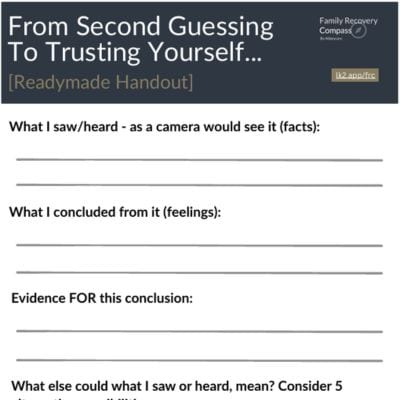
What event(s) did you see in the outside world? **Without** any meaning attached.
i.e. What did you see and hear?
Hint:
- "they were aggressive" = a conclusion you arrived at
- "they said the words "a, b, c"" = what you saw in the outside world, that everyone else would also see = no meaning attached.
***
What conclusion(s) did you draw from these events?
How did it make you feel?
Write it down.
***

Now:
- What is the evidence FOR this conclusion?
What did they say in the moment (that happened in the outside world), that led you to this conclusion?
- What different conclusions could you draw from their words?
Could there be another meaning from their words? What else could it possibly mean?
- What would I say to a friend who told me this same story?
We tend to be kinder and more understanding to our friends than ourselves... What would you tell your friend if they told you about this situation?
###

e.g. they said "you're the reason I drink". I brought it up the next morning and they told me it was only a joke. I'm still hurt. Am I the reason they drink?
- Evidence FOR the conclusion: They said "no wonder I drink with you around".
- Evidence AGAINST the conclusion: I have taken them to appointments, helped them research treatment options, and allowed natural consequences to happen. If they make me the reason for their drinking, then the addiction is allowed to continue.
- What would I say to a friend who told me this story: I would feel hurt too by what they've said, but you know they wouldn't have said this if they weren't being triggered by guilt and shame.
****
You can do this for as many events as you need to.
Will doing this stop you from wondering if you're overreacting, when they react to an event disproportionately?
Sadly no.
But with practice, you will start to see shifts in how you respond, and feel less triggered, over time.
Take care of yourself.