Alcoholism is a disease characterised by continuous heavy drinking. Until people with alcohol use disorder admit to problems with alcohol and stop drinking, the risk of alcohol use disorder continues which affects both physical and mental health.
Alcohol starts to injure the brain once it reaches the bloodstream.
Excessive consumption can lead to Alcohol-Related Brain Damage, or ARBD, which is a type of brain disorder caused by alcohol consumption. Brain shrinkage caused by alcohol abuse is permanent, as alcohol kills brain cells and grey matter.
For more information and effects click ‘Learn More’.
Family Recovery Compass is a newsletter for friends and family members who feel trapped between supporting a loved one in addiction, and protecting their own wellbeing.
Every week, we tackle one specific situation in addiction family dynamics, and deliver practical decision-making frameworks and exact dialogue scripts – that help you respond with confidence instead of reaction.
Every month, we bring you an unfiltered recovery conversation with someone who’s either experienced addiction firsthand, or works closely with those in recovery.
No sanitised success stories – just practical insights on what actually works in recovery, that you can apply, in your life too.
Recovery capital is the internal and external resource used to begin the recovery process and maintain sobriety. This combines personal, social, and community support to provide a joined-up approach that supports the addict through recovery.
Do you or a loved one need addiction treatment for alcohol or drugs? Thousands blindly walk into addiction treatment in expensive rehab centres and find that the reality doesn’t meet expectations.
If you’re considering rehab treatment, first check our ultimate guide for complete instructions on how to find the right rehab centre for you.
Take-home Naloxone kits help families and loved ones respond quickly in an opioid overdose emergency, until emergency services arrive. Kits contain nasal or injectable forms of Naloxone.
Changes in legislation mean Naloxone kits are now more widely available from pharmacies and drug services, including Abbeycare.
For additional information, click ‘Learn More’ below.
Overcoming alcohol addiction means first ceasing alcohol intake, and taking care of physical and chemical withdrawal symptoms.
Detoxing from alcohol means undergoing withdrawal from alcohol, but with the assistance of prescribed medication and detox phase, to substitute in place of the alcohol itself.
Alcohol rehab focuses on tackling the problems underneath alcoholism, such as grief, trauma, depression, and emotional difficulties, in order to reduce continuing drinking after treatment.
Inpatient services at an alcohol rehab programme provides 24 hour access to specialist care.
Alcohol home detox provides a means of semi-supervised addiction treatment in the comfort of your home. It’s often suitable for those with inescapable practical commitments, or where a reduced budget for treatment is available.
An at-home detox is the most basic detox option available from Abbeycare, and assumes you have support available, post-detox, for the other important elements of long-term addiction recovery.
The term alcoholism refers to the consumption of alcohol to the extent that the person is unable to manage their own drinking habits or patterns, resulting in side-effects that are detrimental to the quality of life and health of the alcoholic, or those around them.
An alcoholic is someone who continues to compulsively abuse alcohol in this way, despite the negative consequences to their lives and health.
Immediately following treatment, the early stages of recovery and abstinence are most vulnerable to lapses.
At Abbeycare, a structured and peer-reviewed aftercare plan is usually prepared whilst still in treatment. This comprises social, peer, and therapeutic resources individuals draw upon, following a residential treatment programme for drug or alcohol misuse.
Clinically managed residential detoxification is:
– A structured detox that uses medication-assisted treatment and regular physical health observations
– Takes place in an inpatient rehabilitation unit or hospital
– Typically lasts from 7-10 days, but in Abbeycare, it is incorporated into a 28-day rehab programme
Family Therapy at Abbeycare Scotland or Gloucester is realistic, compassionate, and appropriate for families and loved ones of addicts.
Family therapeutic interventions in residential rehabilitation have been designed to support those living with or caring for participants entering the Abbeycare Programme.
Support for families in a group setting allows for a safe, constructive, and confidential place to listen and share common experiences.
Inpatient rehab is drug and/ or alcohol treatment in a rehab centre, where patients remain on-site for the duration of inpatient rehabilitation.
It includes detoxification from drugs, therapy (group work and 1-2-1 sessions), and aftercare planning. Inpatient rehabs typically last 28 days, but this varies on an individual basis.
Long-term treatment at Abbeycare has been developed for those suffering from alcohol or drug addiction. Completing a long-term drug and alcohol inpatient programme may be the solution to problematic substance use.
Motivational Enhancement Therapy can be used by trained addiction recovery therapists to elicit internal changes within and promote long-term recovery from substance use disorder.
All the answers to addiction can be found within with this comprehensive and successful therapy concept leads to behavioural changes, reflective listening, self-motivational statements, and a comprehensive recovery process.
Outpatient drug or alcohol rehab is daytime treatment as opposed to living in a treatment facility.
Outpatient treatment is similar to inpatient in terms of the methods used to treat substance abuse. Where they differ is in their approach to recovery.
Abbeycare’s prison to rehab is a 12-week structured rehab programme which involves direct transfer from prison. The suitability of the candidate is decided by prison staff.
Short-term residential treatment programmes are the chance to press the reset button and access a therapeutic programme designed to create recovery from the use of alcohol and drugs.
Feeling stuck in a rut. Want to stop but can’t seem to achieve sobriety?
Click below.
The 12-step programme was created by alcoholics anonymous (AA), and is specifically designed to aid addicts in achieving and maintaining abstinence.
The central ethos behind the programme is that participants must admit and surrender to a divine power to live happy lives. Ideas and experiences are shared in meetings, and help is sought in an attempt to achieve abstinence.
Abbeycare’s policy to respect your privacy and comply with any applicable law and regulation regarding any personal information we may collect about you, including across our website and other sites we own and operate.
Address diazepam abuse in alcohol use disorder sufferers, elderly patients, and CYP2C19 gene carriers.
IMPORTANT: Below, we discuss possible approaches that meet the specific detox needs around Diazepam. Not all treatment centres will provide these specific interventions.
For an overview of the Abbeycare programme contents for Diazepam detox, click here.
The recommended tapering schedule for 40mg diazepam daily or less is:
Reduction of 2 - 4mg every 1 – 2 weeks until dose is 20mg daily
Reduction of 1 - 2mg every 1 – 2 weeks until dose is 10mg daily
Reduction of 1mg every 1 – 2 weeks until dose is 5mg daily
Reduction of 0.5 - 1mg every 1 – 2 weeks until completely stopped [2]
A substitution of 12.5mg Chlordiazepoxide for every 5mg of Diazepam may be provided as doses can be reduced by up to 50% within 4 days, compared to around 5 weeks for a 50% reduction of diazepam [3] [4].
Physical Symptoms Of Diazepam Detox
The following symptoms are mitigated with an inpatient diazepam detox, as medical staff carefully manage dosages to alleviate the severity of physical withdrawal symptoms.
GABA Rebound Symptoms
A 15% reduction of GABA receptor activity is a physical symptom of diazepam withdrawal due to restricted GABA–induced signal transmission in the central nervous system, resulting in [1]:
Heightened sensitivity to light, sound, touch, taste and smell
Sore tongue and metallic taste
Hypersensitivity to sensory stimuli and paresthesia typically stop within 4 - 6 weeks; tinnitus and burning sensations in fingers, feet and legs may last for up to 12 months [5].
Ataxia
Ataxia is a physical diazepam withdrawal symptom due to:
A 15% reduction in GABA receptor activity and inhibited excitatory neurotransmission during cessation of use, caused by continual loss and degeneration of nerve cells in the cerebellum responsible for muscle coordination and balance [1] [6]
Central nervous system toxicity during sudden cessation diminishes the muscle relaxant properties provided by starting doses of 2 – 10mg oral diazepam [7]
One study found that ataxia lasted for over 3 weeks in 50% of patients that stopped taking 60 – 120mg diazepam daily [8].
Vestibular Hypersensitivity
Vestibular hypersensitivity is a physical valium withdrawal symptom due to a 75% reduction of neuron activity in the medial vestibular nucleus, caused by valium’s agonist effect on GABA receptors; leading to [9] [10]:
Dizziness, falling, loss of balance and spinning sensations
Blurred vision, disorientation and clumsiness
Difficulties when turning around or standing up too quickly
Anxiety, frustration and avoidance towards activities requiring postural control [11]
Within 48 hours of cessation, vestibular function returns to baseline levels after taking 10mg valium daily for 2 weeks; although dizziness may persist for up to 8 weeks after withdrawal [12].
Psychological Symptoms Of Diazepam Detox
The following symptoms are minimised during an inpatient valium detoxification due to ongoing medical supervision and specialised protocols designed to safely manage psychological withdrawal symptoms.
Static Visual Changes
Static visual changes are psychological withdrawal symptoms that occur during valium discontinuation, due to a 37% increase of glutamic acid decarboxylase (GAD) occurring within 12 hours of withdrawal, resulting in [13]:
Blurred vision, flashes of light and sensitivity to brightness
Self-reported visual hallucinations including tilting floors, inwardly sloping walls and insects crawling on skin [14]
One study found that vision returned to normal within 1 year of valium discontinuation:
A 71-year-old woman consuming 100mg valium daily experienced visual field loss due to GABAergic inhibition in the retina and visual cortex
Visual fields improved at 6 months whilst taking a reduced dose (morning = 2.5mg and night = 10mg), and vision reverted to normal during a 1-year follow-up examination and cessation of use [15]
One study found that visual disturbances persisted for up to 27 weeks after 12 patients detoxed from valium:
25% experienced visual hallucinations and reported seeing disembodied faces and coats hanging on doors appearing as people; 2 patients hallucinated 2 weeks after the onset of withdrawal and 1 patient after 13 - 27 weeks
75% experienced blurry and double vision, had difficulty reading and reported seeing the world through a mist for up to 2 weeks after the onset of withdrawal, as did 1 patient after 13 – 27 weeks [16]
Intrusive Memories
Intrusive memories are a psychological valium withdrawal symptom due to reduced total sleep time (380 to 287 minutes) and increased waking after sleep onset (15.4% to 32.1%) during withdrawals, resulting in [17]:
Reduced REM sleep in detoxing patients (18.1%) compared to controls (21.3%); for each additional 4% of average REM sleep, individuals reported 27% fewer intrusive memories [17] [18]
Patients experience vivid thoughts of someone that has not been seen or thought about in years and may see the face of the person in the mirror [14]
Intrusive memories typically occur one week after valium withdrawal begins, as sleep efficiency is lowest at this time (64%) [14] [17].
Memory Improvements
Memory improvement is a psychological withdrawal symptom that occurs during valium detoxification due to:
A 30 – 50% reduction of immediate and delayed recall performance for valium patients compared to controls, as transfer and consolidation of new information from short – term to long term memory is prevented [19]
27- 33% of valium detox patients have impaired processing speed and sustained attention; non-verbal and verbal memory improve around 6 months after the cessation of use [20] [21]
Cognitive and psychomotor performance (digit span/map location tasks) improves by up to 22% after one year of valium discontinuation, whereas performance declines by 5% in patients continuing to take valium [22]
Return Of Pre-Existing Anxiety
Return of pre-existing anxiety is a psychological symptom of valium detox due to the 15% diminution of GABA receptors in the dentate gyrus, resulting in a 10% increase in anxiety during withdrawal [1] [23].
Pre-existing anxiety typically returns within 1 – 5 days of valium discontinuation and lasts for around 2 weeks; symptoms depend on initial anxiety severity and the presence of co-occurring depression or alcohol use disorders [24].
One study found that 25% of patients experienced rebound anxiety after abruptly withdrawing from taking 15mg valium daily for 4 weeks:
All patients had pre-existing generalised anxiety disorder and used valium for around 9 – 18 months previously
Scores increased by over 10% on the Hamilton Rating scale for anxiety and the self-rating symptom scale [23]
Returning anxiety symptoms may persist for up to 6 – 24 months after cessation in patients struggling to develop stress management strategies to replace the role of valium [25].
Diazepam Detox Vs Other Benzodiazepines
Diazepam
Alprazolam
Half-life
20 – 80 hours
12 – 15 hours
Does Rebound Anxiety Occur?
Yes, in 23% [26]
Yes, up to 35% experience rebound anxiety and panic attacks [27]
Seizure Risk Timeframe
Day 7-14
Day 2 - 5
Memory/Cognitive Recovery Timeframe
Around 6 – 18 months
Around 6 months for episodic memory [29]
Clonazepam
Lorazepam
Half-life
18 - 50 hours
10 – 20 hours
Does Rebound Anxiety Occur?
Yes, in 29% [28]
Yes, in 63% [26]
Seizure Risk Timeframe
Day 7 - 21
Day 2 - 4
Memory/Cognitive Recovery Timeframe
Up to 2 months for synaptic development and functioning of GABA receptors [30]
Around 2 - 8 weeks
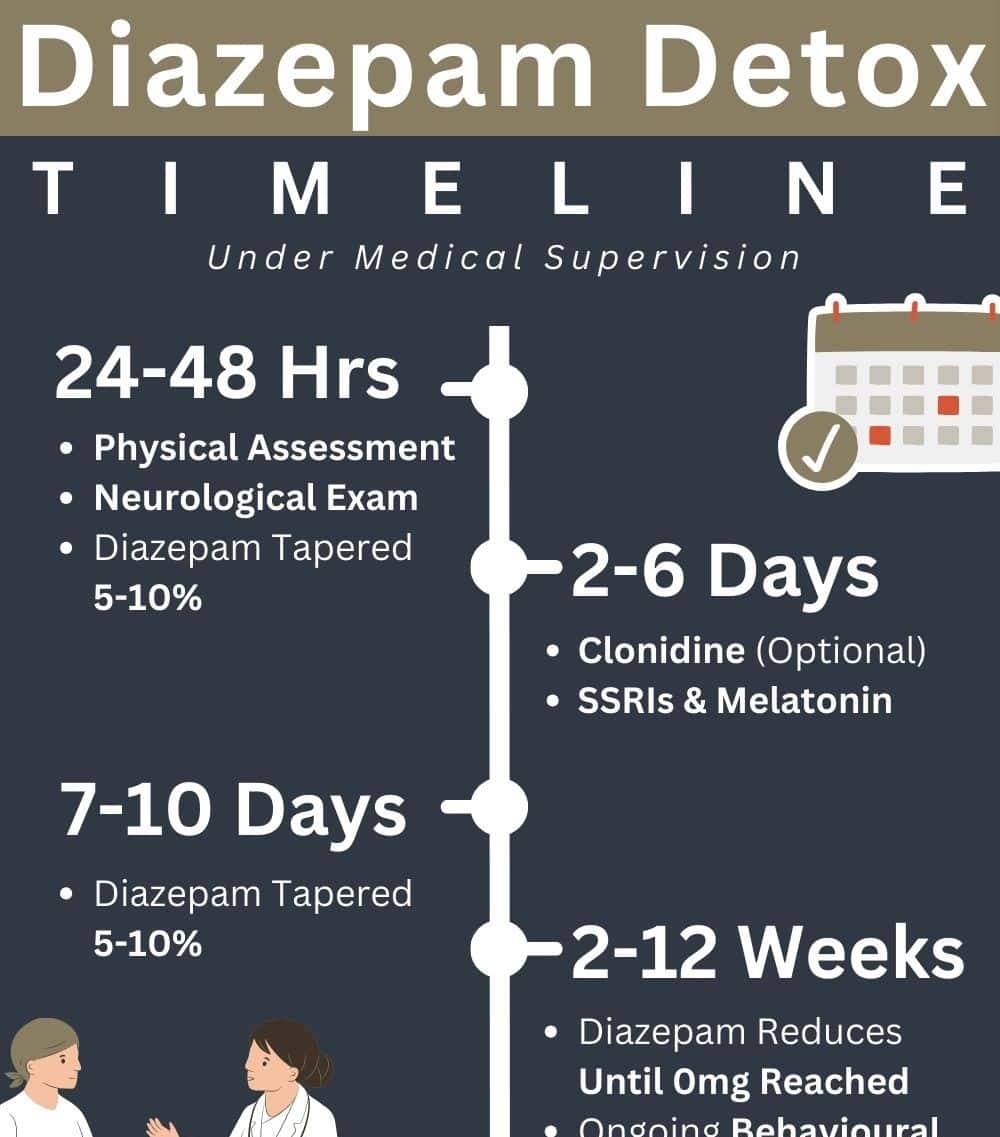
Diazepam Detox Timeline
Diazepam Detox Time Period
Patient Presentation
Medical Interventions
24 – 48 hours
Rebound anxiety, low mood, irritability, headache
Physical assessment with neurological exam
Diazepam tapered by 5 - 10% or equivalent chlordiazepoxide/clonazepam doses [2]
2 – 6 days
Cravings, fever, nausea, muscle cramps, tremors, insomnia and hypertension
Diazepam or equivalent dose with clonidine, SSRIs and melatonin if necessary
7 – 10 days
Physical symptoms begin to subside, anxiety and low mood remain
Diazepam is reduced by another 5 – 10% and symptom management medications are adjusted as needed [2]
2 – 12 weeks
Gradual physical and cognitive improvement, irritability, insomnia, anxiety and low mood persist
Diazepam reduces by 5 - 10% every 1 - 2 weeks until 0mg is reached [2]
Behavioural and pharmacological interventions are discussed to address persisting psychological symptoms
What Changes Diazepam Detox?
GABRA-2 Gene Variants
CYP2C19 poor metabolisers change valium detox by extending dose reduction schedules to around 20 – 40 weeks from 12 weeks due to [2]:
A 40% reduction of oral clearance (CL/F) compared to normal metabolisers, a 5 – 10% reduction every 2 – 4 weeks rather than 1 – 2 weeks may be required [2] [31]
An increased valium elimination half-life compared to normal metabolisers (92 vs 56 hours); a dose reduction of 25–50% may be required to prevent oversedation [31]
Rapid CYP2C19 metabolisers change valium detox due to:
Reduced elimination half-lives compared to normal metabolisers (40 hours vs 56 hours), increasing the severity of valium withdrawal symptoms (9.5 vs 7.0 = scores on the UKU side effect rating scale) [31] [32]
Anxiety, insomnia and depression may last for up to 12 weeks and antidepressants, beta-blockers and melatonin may be prescribed [2]
Elderly Patients
The extended half-life of valium in 61 – 78-year-olds compared to 21 – 33-year-olds (86 hours vs 31 hours) changes valium detox by increasing the dose reduction schedule to around 4 – 5 months due to [33] [34]:
10% dose reductions every 2 weeks until 20mg is reached, then by 5% every 2 weeks until 0mg is reached; doses may be maintained for 1 – 2 weeks before the next reduction if severe withdrawal symptoms persist [35]
10mg oxazepam replacement for every 5mg Valium or Chlordiazepoxide, preventing oversedation and falls to mitigate the 80% increased risk of hip fractures in over 65s using >3mg valium for 28 days or more [36] [37]
Withdrawal symptoms are monitored for up to 4 weeks with follow-up appointments every 2 weeks, either in-person or over the phone, until symptoms resolve [2] [35]
0.1mg clonidine to prevent tremors and seizures with blood pressure and heart rate checks 1 hour after administration; clonidine is withdrawn if dizziness occurs, blood pressure <90/50 mmHg and heart rate <50 [35]
Co-Occurring Alcohol Addiction
Co-occurring alcohol addiction changes valium detox due to:
16 – 29% of cognitive impairment in 59–88-year-olds is caused by consuming >5mg Diazepam with > 40mg alcohol daily, leading to drowsiness, dizziness and difficulty breathing which may require hospitalisation with 24-hour medical care [38] [39]
Requirements for trained staff to treat possible apnea with assisted ventilation to mitigate the 15 – 20% risk of fatal delirium caused by respiratory or cardiovascular collapse [40] [41]
Up to 800mg Carbamazepine or 60–180 mg phenobarbital daily may be prescribed to prevent withdrawal seizures in patients abusing alcohol and benzodiazepines [40] [42]
Abbeycare uses Chlordiazepoxide tapering schedules to detox over 2 – 3 weeks simultaneously; initial 15 – 40mg doses are required 4 times daily for alcohol plus 12.5mg for every 5mg of patients' current valium dose [4] [43]
Outpatient detoxification addresses co-occurring addiction with subsequent withdrawals, e.g. reducing valium dose by 5 – 10% every week until 0mg followed by Chlordiazepoxide for 5 – 10 days [2] [4]
Diazepam Detox At Abbeycare
The diazepam rehab programme at Abbeycare is typically either 4 or 12 weeks long. Alternative treatment lengths can be discussed with the Abbeycare admissions team on 01603 513091.
Diazepam doses are tapered until 0mg is reached within the first 4 weeks at Abbeycare, and then integrated CBT and mindfulness practices are provided to address pre-existing or rebound anxiety and insomnia.
About the author
Mischa Ezekpo
Mischa Ezekpo has a Bachelors degree in Psychology from Northumbria
University, and a Masters degree in Childhood Development and
Wellbeing, from Manchester Metropolitan University. Since 2018, Mischa
has written and published work on Addiction, Mental Health, Depression, and Eating Disorders. Content reviewed by Laura Morris (Clinical Lead).