



KEY TAKEAWAYS
Cognitive behavioural therapy helps to manage addiction by:

How Does CBT Work In Practice?
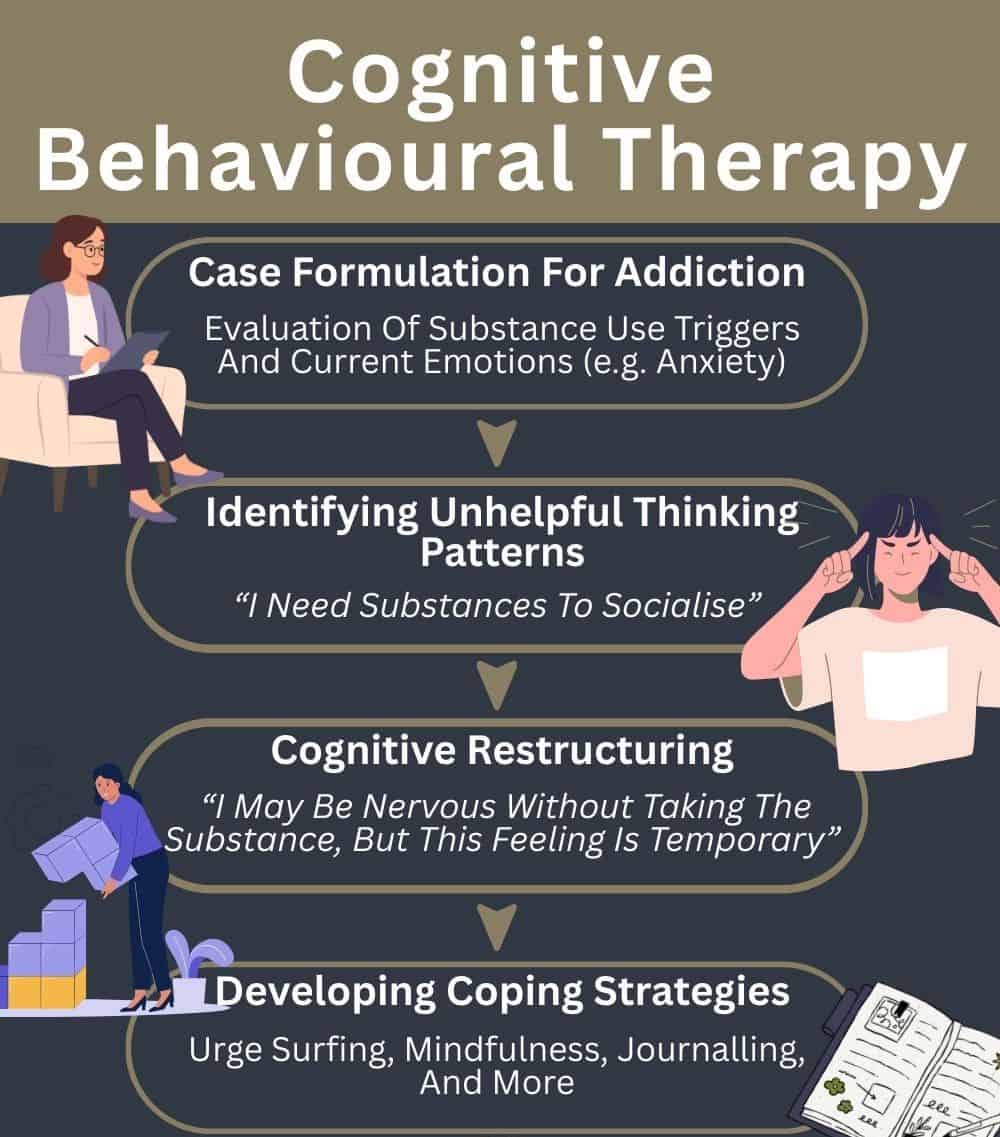
First, the therapist encourages the patient to identify a negative thought surrounding drug use, such as "I can't be sociable if I don't take [insert drug]".
Secondly, therapists teach patients "mental noting", a CBT technique used to label thoughts and experiences as helpful/protective or unhelpful/unprotective, as in the example above.
The therapist guides patients to seek evidence to counteract negative thoughts actively, for example, remembering times when the patient has been in social situations without using a substance.
Using cognitive restructuring, the therapist guides the patient to restructure the original thought to one that encompasses all feelings and possibilities, for example, "I might feel nervous when I socialise without [insert drug], but I am good at smiling at others and connecting in that way."
The therapist helps to address underlying mental health disorders that might be driving negative thoughts, including depression and anxiety disorders.
In later CBT appointments, the therapist explores patients' history and past traumas to unravel "core beliefs", the strong beliefs we hold about ourselves, others, and the world.
The therapist focuses on exploring negative core beliefs, for example, "I am unlovable", and reshaping these into positive ones using experience-based evidence, leading to positive behavioural changes.
How Does CBT Help Overcome Addiction?
Addiction | Mental Health Disorders Linked To Addiction | |
|---|---|---|
CBT Technique | Craving management Trigger identification Cognitive restructuring for addiction | Journalling Exposure therapy Cognitive restructuring for mental health |
Application In Addiction Treatment | Urge surfing to overcome cravings Trigger avoidance Reframing beliefs | Tracking negative thought patterns Gently exposes patients to fearful stimuli that maintain drug use |
How This Helps | Urge surfing reduces drug use by 15% [1] Breaks the addiction cycle | Helps users understand what negative thoughts lead to drug use Allows users to cope in stressful situations without the need for drugs |
How Is Cognitive Behavioural Therapy Delivered In A Rehab Environment?
Benefits | Limitations | |
|---|---|---|
Face To Face In Rehab | Therapy is tailored to personal needs and goals Feedback can be given in real-time | Overwhelming if patients are not ready for therapy Limited sessions per week Not suitable for every mental health condition |
Group Therapy | Provides peer support A good way to share learning experiences Share motivation between peers for accountability Great way to learn coping strategies in a social way | Group dynamics may not work Does not always provide enough individual support Not the preferred style of therapy for shy/anxious patients |
Self Help Worksheets | Individually led and can be done in personal time Encourages self-awareness | Feedback is delayed Requires self-motivation to complete tasks |

Who Benefits From Cognitive Behavioural Therapy In Rehab?
Condition | Benefits of CBT |
|---|---|
Patients early in recovery | Identifies high-risk triggers(e.g., deleting drug dealers’ numbers) Allows a therapeutic relationship to develop |
Patients who have previously relapsed | Addresses negative thoughts and triggers that led to relapse Addresses the relapse as an opportunity for learning and growth for long-term and sustainable recovery Relapse prevention strategies (e.g., HALT strategy) CBT teaches patients how to say “no” |
Patients with high-stress levels | Teaches stress management and mindfulness techniques as coping mechanisms without the need for drugs or alcohol Is done individually or in a group depending on stress levels/anxiety Group CBT normalises stress and anxiety Emotional regulation training to cope with high-stress situations |
CBT psychologists and therapists are trained in mental health disorders and addiction Mental health therapy is integrated into addiction recovery Overcoming mental health disorders when these are the primary driver of addiction |
CBT Vs...
Core Approach to Addiction Treatment | Strengths | Limitations | |
|---|---|---|---|
Cognitive Behavioural Therapy | Identifies negative thinking patterns and challenges core beliefs underlying addictions | Up to 26% more effective than no treatment [2] Can be done individually or in a group | CBT in rehab may not be long enough to resolve underlying trauma Requires personal homework that patients might not be motivated to do |
Individual Counselling | A person-centred approach to goal setting Counsellor abides by the three conditions: empathy, congruence, and unconditional positive regard | The programme is tailored to personal needs and goals More time spent on the patient Focuses on a wide range of needs (co-occurring disorders) | No peer support, so less accountability for maintaining sobriety |
Motivational Interviewing | Enables patients to find and utilise intrinsic motivation to overcome sobriety barriers | Allows the patient to drive recovery from personal motivation | The patient determines progress May be unsuitable for those with depression or low motivation |
12 Step Groups | Surrendering to a higher power and following a set of guided principles to maintain recovery | Uses peer sponsors Group meetings provide community and accountability | Not run by trained mental health professionals |
Dialectical Behavioural Therapy | Comprises a CBT approach with mindfulness, acceptance, and distress tolerance | Focused on building resilience Enables the patient to become own therapist | Not suitable at the start of rehab as it requires attention for mindfulness-based practices |
Medication Assisted Treatment | Symptom management is controlled through medication (e.g., suboxone, benzodiazepines, etc.) | Reduces cravings Reduces withdrawal symptoms Allows mental and physical stabilisation | Does not directly manage underlying traumas Takes 3-4 days to find suitable doses Counterintuitive if addictive substances are used (e.g., benzodiazepines) Not suitable for every type of addiction |
Holistic Therapies | Focuses on physical, mental, and spiritual recovery simultaneously | Can be used in conjunction with other therapies Mindfulness practices learnt for long-term wellbeing | Limited evidence base Does not form part of standardised treatment in rehab Rehab offering holistic therapies are often more expensive Not widely available |

How Long Does CBT Take?
Dependent On Patient Need
The first therapy session includes a psychiatric assessment looking at mental health history, current and past addictions, and relapse history - this typically takes up to 90 minutes.
2-3 therapy appointments occur every week during addiction rehab; however, sessions drop to one a week or one every two weeks in aftercare.
Patients with learning difficulties may require extended therapy sessions to ensure tasks are understood and can be completed.
Patients with mild addiction only require therapy for the initial 4-week rehab period, given there are no long-term symptoms.
Patients with severe addiction to opioids, alcohol, or stimulants require medication-assisted treatment and stabilisation before treatment can begin.
Patients with co-occurring schizophrenia, bipolar disorder, and other complex mental health disorders may require therapists simultaneously trained in mental health and addiction recovery.
For cases where there is a delayed onset of depression or anxiety following rehab, patients may restart CBT as symptoms arise; however, this is subject to waiting list times.
Dependent On Setbacks
In case of relapse, patients' sessions are increased from 1 to 2 per week, and sessions focus on relapse prevention and craving management.
Being admitted to the hospital for any reason during rehab means that sessions are stopped until physical health has stabilised.
For addiction recovery patients in hospitals, some inpatient wards provide on-ward CBT or counselling for addiction recovery; however, this depends on availability.
Patients experiencing additional stress outside of psychotherapy require craving management strategies, for example, urge surfing, as stress significantly predicts craving intensity [3].
Side Effects Of Cognitive Behavioural Therapy
Emotional Distress
Emotional distress occurs during CBT for addiction as patients are instructed to recount history, including childhood experiences, that have been traumatic.
CBT aims to explore patients' suppressed negative memories and core beliefs that may be driving addiction, and although this is temporarily disturbing, it is helpful in long-term recovery.
Examples of triggers that cause emotional distress in CBT are past traumas, experiencing domestic violence in childhood, or a history of family and friends abusing drugs or alcohol.
Psychotherapy and all forms of cognitive therapy continue to monitor emotional distress as shown by patients' reactions, feelings, and feedback - any task that is too distressing will be addressed and put on hold until the patient feels comfortable.
Stress predicts craving and relapse in addiction recovery, so CBT therapists prioritise patient-led discoveries and disclosed emotions, pausing sessions as and when the patients require [4].
Increased Awareness Of Triggers
An increased awareness of triggers occurs during CBT for addiction as patients are taught how to self-monitor emotions, making the patient aware of the connection between these emotions and substance misuse.
When patients become aware of triggers, the realisation about past patterns of behaviour sets in, causing patients to doubt the capability of coping mechanisms to overcome underlying anxiety disorder, post-traumatic stress disorder and depression.
An increased awareness of triggers causing self-doubt about recovery is mitigated in CBT through normalising negative emotions, cognitive restructuring, and positive reinforcement by focusing on small achievable goals for the next session.
Cognitive reappraisal in CBT increases self-reported self-esteem and emotional regulation by 10% in patients in 8 sessions [5].
Although patients become more aware of triggers in sessions, CBT works to increase self-efficacy, as seen in 66.7% of patients and directly prevents relapse [6].
Therapy Fatigue
Fatigue occurs during CBT due to cognitive restructuring and reframing thoughts, as this requires focus and constant motivation during sessions.
64.1% of patients experience emotional exhaustion in CBT, so therapists make informed decisions about the number of sessions a patient has, ensuring patients do not burn out from psychotherapy [7].
CBT requires written worksheets and journalling activities in between sessions, but if psychotherapy fatigue is evident, clinicians may opt out of these tasks until patients show a willingness to complete tasks independently.

