Alcoholism is a disease characterised by continuous heavy drinking. Until people with alcohol use disorder admit to problems with alcohol and stop drinking, the risk of alcohol use disorder continues which affects both physical and mental health.
Alcohol starts to injure the brain once it reaches the bloodstream.
Excessive consumption can lead to Alcohol-Related Brain Damage, or ARBD, which is a type of brain disorder caused by alcohol consumption. Brain shrinkage caused by alcohol abuse is permanent, as alcohol kills brain cells and grey matter.
For more information and effects click ‘Learn More’.
Family Recovery Compass is a newsletter for friends and family members who feel trapped between supporting a loved one in addiction, and protecting their own wellbeing.
Every week, we tackle one specific situation in addiction family dynamics, and deliver practical decision-making frameworks and exact dialogue scripts – that help you respond with confidence instead of reaction.
Every month, we bring you an unfiltered recovery conversation with someone who’s either experienced addiction firsthand, or works closely with those in recovery.
No sanitised success stories – just practical insights on what actually works in recovery, that you can apply, in your life too.
Recovery capital is the internal and external resource used to begin the recovery process and maintain sobriety. This combines personal, social, and community support to provide a joined-up approach that supports the addict through recovery.
Do you or a loved one need addiction treatment for alcohol or drugs? Thousands blindly walk into addiction treatment in expensive rehab centres and find that the reality doesn’t meet expectations.
If you’re considering rehab treatment, first check our ultimate guide for complete instructions on how to find the right rehab centre for you.
Take-home Naloxone kits help families and loved ones respond quickly in an opioid overdose emergency, until emergency services arrive. Kits contain nasal or injectable forms of Naloxone.
Changes in legislation mean Naloxone kits are now more widely available from pharmacies and drug services, including Abbeycare.
For additional information, click ‘Learn More’ below.
Overcoming alcohol addiction means first ceasing alcohol intake, and taking care of physical and chemical withdrawal symptoms.
Detoxing from alcohol means undergoing withdrawal from alcohol, but with the assistance of prescribed medication and detox phase, to substitute in place of the alcohol itself.
Alcohol rehab focuses on tackling the problems underneath alcoholism, such as grief, trauma, depression, and emotional difficulties, in order to reduce continuing drinking after treatment.
Inpatient services at an alcohol rehab programme provides 24 hour access to specialist care.
Alcohol home detox provides a means of semi-supervised addiction treatment in the comfort of your home. It’s often suitable for those with inescapable practical commitments, or where a reduced budget for treatment is available.
An at-home detox is the most basic detox option available from Abbeycare, and assumes you have support available, post-detox, for the other important elements of long-term addiction recovery.
The term alcoholism refers to the consumption of alcohol to the extent that the person is unable to manage their own drinking habits or patterns, resulting in side-effects that are detrimental to the quality of life and health of the alcoholic, or those around them.
An alcoholic is someone who continues to compulsively abuse alcohol in this way, despite the negative consequences to their lives and health.
Immediately following treatment, the early stages of recovery and abstinence are most vulnerable to lapses.
At Abbeycare, a structured and peer-reviewed aftercare plan is usually prepared whilst still in treatment. This comprises social, peer, and therapeutic resources individuals draw upon, following a residential treatment programme for drug or alcohol misuse.
Clinically managed residential detoxification is:
– A structured detox that uses medication-assisted treatment and regular physical health observations
– Takes place in an inpatient rehabilitation unit or hospital
– Typically lasts from 7-10 days, but in Abbeycare, it is incorporated into a 28-day rehab programme
Family Therapy at Abbeycare Scotland or Gloucester is realistic, compassionate, and appropriate for families and loved ones of addicts.
Family therapeutic interventions in residential rehabilitation have been designed to support those living with or caring for participants entering the Abbeycare Programme.
Support for families in a group setting allows for a safe, constructive, and confidential place to listen and share common experiences.
Inpatient rehab is drug and/ or alcohol treatment in a rehab centre, where patients remain on-site for the duration of inpatient rehabilitation.
It includes detoxification from drugs, therapy (group work and 1-2-1 sessions), and aftercare planning. Inpatient rehabs typically last 28 days, but this varies on an individual basis.
Long-term treatment at Abbeycare has been developed for those suffering from alcohol or drug addiction. Completing a long-term drug and alcohol inpatient programme may be the solution to problematic substance use.
Motivational Enhancement Therapy can be used by trained addiction recovery therapists to elicit internal changes within and promote long-term recovery from substance use disorder.
All the answers to addiction can be found within with this comprehensive and successful therapy concept leads to behavioural changes, reflective listening, self-motivational statements, and a comprehensive recovery process.
Outpatient drug or alcohol rehab is daytime treatment as opposed to living in a treatment facility.
Outpatient treatment is similar to inpatient in terms of the methods used to treat substance abuse. Where they differ is in their approach to recovery.
Abbeycare’s prison to rehab is a 12-week structured rehab programme which involves direct transfer from prison. The suitability of the candidate is decided by prison staff.
Short-term residential treatment programmes are the chance to press the reset button and access a therapeutic programme designed to create recovery from the use of alcohol and drugs.
Feeling stuck in a rut. Want to stop but can’t seem to achieve sobriety?
Click below.
The 12-step programme was created by alcoholics anonymous (AA), and is specifically designed to aid addicts in achieving and maintaining abstinence.
The central ethos behind the programme is that participants must admit and surrender to a divine power to live happy lives. Ideas and experiences are shared in meetings, and help is sought in an attempt to achieve abstinence.
Abbeycare’s policy to respect your privacy and comply with any applicable law and regulation regarding any personal information we may collect about you, including across our website and other sites we own and operate.
How Do Different Types Of Music Therapy Work In Addiction Treatment?
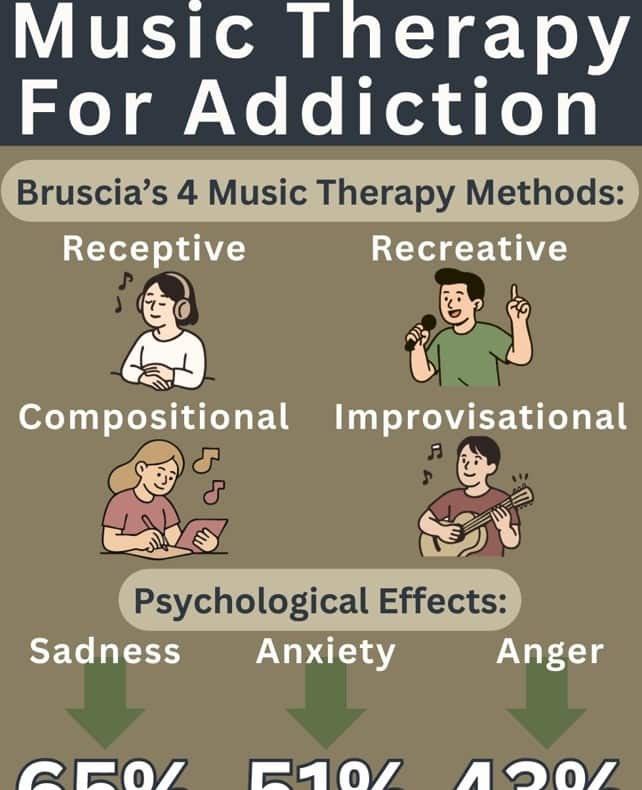
Compositional Music Therapy
Compositional music therapy works as part of addiction treatment because it acts as an intervention for externalising internal thoughts (e.g. addiction motivators) into a creative outlet through:
Writing lyrics
Forming beats, rhythmic patterns, and symphonies
Writing melodies
Forming whole music compositions individually or in a group
Compositional music therapy enables those in recovery to create and perform original music during 60-90 minute sessions, mostly in group sessions.
89% of studies demonstrate positive effects of compositional music therapy on anxiety, coping mechanisms, and stress management [2].
Group compositional music therapy remains effective in abstaining from drugs and promoting individual confidence about future abstinence 3+ months following treatment [3].
One study exploring the effects of motivational-educational songwriting found that this music therapy reduces cravings and improves withdrawal symptoms, with effect sizes of 0.244 to 0.456 [4].
Through creating music, patients are able to showcase personal stories surrounding addiction and creatively communicate these through lyrics, melodies, and emotion through performance.
Improvisational Music Therapy
Improvisational music therapy works as part of addiction treatment because it encourages patients to create spontaneous music over 60-90 minute sessions, allowing rehab patients to utilise current emotions in the creative process.
Improvisational music therapy results in a mean average of 4.3 and 4.0 out of 5 for enjoyment and motivation ratings for both music therapy and concurrent use of CBT [5].
46% state that improvisational music therapy helps members feel part of the group; these groups are typically conducted with the same group as CBT sessions in rehab, enhancing community support [6].
Improvisational music therapy works alongside CBT as both improve symptoms of [7]:
Trait anxiety
State anxiety
Depression
Substance craving
Both improvisational music therapy and CBT work by addressing negative thoughts and emotions, concurrently reducing symptoms of addiction-related depression by 26% [8].
Qualitative research reveals 6 Cs are utilised in improvisational music [9]:
Contact - meeting others within the group and building connections
Cognition - figuring out how to create music in the moment, in collaboration with the group
Co-pathy - emotions within the group become homogenous, and negative emotions are lowered differently in every group member
Communication - sharing thoughts and emotions through music and language simultaneously
Coordination - working together to fit different elements of a song together at the same time
Cooperation - helping others in creating music together in the moment
The 6 Cs in improvisational music making are transferrable skills used in traditional group therapies (e.g. CBT) and post-rehab settings, making for a beneficial starting point for re-socialisation.
Over 50% of members remain in recovery one year following the use of improvisational music therapy classes when combined with modern psychotherapeutic approaches [10].
Receptive Music Therapy
Receptive music therapy entails listening to pre-recorded or live music under therapist guidance, and is used as part of addiction rehab as it helps to elicit specific emotional responses and memories that support the rehabilitation process.
Receptive music therapy reduces self-reported fear by 40% and worry by 36%, showing that this type of music therapy is used to lower current anxieties surrounding addiction treatment [1].
83% state that receptive music therapy allows participants to find healthier ways to deal with emotional distress and general stress linked to addiction recovery, such as overcoming depression [11].
Receptive music therapy works as part of a rehab programme because it reduces symptoms of anxiety in 84.6%, even though 11% of those participants did not report pre-session anxiety [12].
Typical receptive music therapy sessions last between 30 and 60 minutes and take place 2-5 times per week during the inpatient period, depending on the rehab facility.
As Abbeycare does not offer music therapy, such courses should be self-managed following the rehab programme, though staff will help signpost to licensed therapists in your area.
Recreative Music Therapy
Recreative music therapy is a form of learning and adapting songs to reflect current personal experiences in addiction recovery.
Positive therapeutic outcomes from recreational music therapy have been found in the following areas [13]:
Contemplation - contemplating recovery and its potential outcomes
Action - acting on thoughts to make a positive difference in recovery (e.g. utilising taught coping mechanisms)
Total readiness to change - being fully prepared and willing to act and make the changes necessary to achieve sobriety both in rehab and beyond
Recreative music therapy is a beneficial tool when used in the earlier stage of psychotherapy (week 2) following detox, as it prepares participants for group CBT.
Positive group differences are seen in those with educational and recreative music therapy regarding motivation to achieve and maintain sobriety throughout rehab and post-rehab settings [14].
Silverman (2009) showed that recreative music therapy in rehabilitation also improves self-reported perceptions of therapeutic alliance building, as well as eagerness/readiness to change and achieve sobriety [15].
Chege et al. (2022) showed that intervention motivation increases by 25% compared to treatment as usual when using recreative music therapy, indicating it is an engaging and motivating tool throughout all rehab process stages [16].
How Does Music Therapy Help During Addiction Treatment?
Reducing Cravings
Music therapy reduces substance-related cravings by 20% following two weeks of treatment, and this occurs due to regulating emotion through activating the limbic pathways responsible for craving and memory [17].
Farahmand et al. (2020) found a 26% decrease in cravings when 8 sessions of music therapy are completed over the course of rehabilitation [18].
As drug-related cues cause a 7.3% increase in metabolic activity in limbic regions responsible for memory, music therapy aims to avoid direct drug-related cues in order to provoke positive music-evoked autobiographical memories, as these also work as a distraction in rehab [19].
Silverman (2022) studied the effects of music therapy on craving management and found effect sizes up to 0.456, showing there is a medium to strong effect of this intervention [20].
Music therapy also improves sleep ratings by 31%, positively affecting cravings by lowering physiological stress on the body [21].
Triggering Emotional Responses And Autobiographical Memories
Pasqualitto et al. (2023) showed that music's ability to manifest strong emotions is caused by varying levels of metabolic activity in brain areas responsible for autobiographical memory retrieval [22].
Hasanah et al. (2020) showed that music therapy reduces cortisol levels by 16%, resulting in physiological benefits on stress management [23].
Mean serum dopamine levels increase by 15.5% following receptive music therapy [24].
Animal studies on rats suggest that music therapy increases intracellular dopamine concentrations by 24.1% and serotonin concentration by 29.9%, indicating benefits of music on positive emotional responses in the brain [25].
What Type Of Music Is Beneficial In Addiction Treatment?
Type Of Music
Beneficial To Addiction Treatment?
Why?
Binaural Beats
Yes
Linked to restful sleep & relaxation [26]
60-80bpm
Yes
Promotes relaxation through slowed breathing, heart rate & contemplation
Used for meditating
160-200bpm
Sometimes
Upbeat music helps with motivation when doing activities
Fast-paced music may result in overstimulation
Aggressive High-Intense Music
No
Promotes aggressive behaviour
Depressive Music
No
Poses a risk of relapse through temporary sadness & rumination
Music With Drug And Alcohol References
No
Triggers drug use, cravings, & might result in relapse
A non-verbal tool to promote self-awareness in addiction recovery
Co-occurring Chronic Pain
Used as a distraction technique so patients can focus on therapy
How Does Music Therapy Work As A Supplementary Element In A Traditional Rehab Programme?
Music therapy is used in a rehab programme to help increase engagement in group cognitive behaviour therapy sessions, as 46% of participants state that it helps create group connectivity through nonverbal communication [27].
One to two sessions a week supplement a traditional programme by teaching music as a method of distraction—a technique not typically used in CBT, though CBT concurrently promotes the importance of distraction in stress management.
As a supplementary element to traditional rehab, music therapy replaces the harmful behaviours of drug use with a rewarding activity of creating music, listening to music, and using music therapy sessions as a break from traditional CBT sessions.
Music therapy increases positive cognitive emotional regulation by 13.4%, supplementing CBT by practising creatively reframing negative beliefs about the self and others [18].
Music Therapy In Addiction Rehab Results
Lesiuk (2010) suggests that continued use of music therapy post-rehab helps to prevent relapse, either through self-guided listening or through attending classes in aftercare [28].
65% of those using addiction music therapy rehab report a decrease in sadness, and 51% report an anxiety reduction, suggesting improvements in mental health and reductions in relapse triggers [29].
Farahmand et al. (2020) demonstrated a positive impact of music therapy on overall self-reported quality of life, increasing by 8%, suggesting music therapy offers broader benefits on overall well-being [18].
Negative cognitive emotional regulation decreases by 15.9% following a course of music therapy in rehab [18].
87% of music therapy participants continue to use music as a form of therapy personally after rehab has finished, indicating that it is a sustainable and self-driven tool used in aftercare [30].
When used in rehab, music therapy can help to subside cravings and urges within 15 to 30 minutes of playing [31].
About the author
Philippa Scammell
Philippa Scammell MSci holds an integrated Master's degree in Psychology
from the University of York and has completed undergraduate statistical studies at Harvard University. Philippa has substantial experience in inpatient psychiatric care (Foss Park Hospital York), Research in Psychology at University of York, and group therapy facilitation (Kyra Women's Project). Philippa writes on clinical psychology and addiction recovery. Content reviewed by Laura Morris (Clinical Lead).