Alcoholism is a disease characterised by continuous heavy drinking. Until people with alcohol use disorder admit to problems with alcohol and stop drinking, the risk of alcohol use disorder continues which affects both physical and mental health.
Alcohol starts to injure the brain once it reaches the bloodstream.
Excessive consumption can lead to Alcohol-Related Brain Damage, or ARBD, which is a type of brain disorder caused by alcohol consumption. Brain shrinkage caused by alcohol abuse is permanent, as alcohol kills brain cells and grey matter.
For more information and effects click ‘Learn More’.
Family Recovery Compass is a newsletter for friends and family members who feel trapped between supporting a loved one in addiction, and protecting their own wellbeing.
Every week, we tackle one specific situation in addiction family dynamics, and deliver practical decision-making frameworks and exact dialogue scripts – that help you respond with confidence instead of reaction.
Every month, we bring you an unfiltered recovery conversation with someone who’s either experienced addiction firsthand, or works closely with those in recovery.
No sanitised success stories – just practical insights on what actually works in recovery, that you can apply, in your life too.
Recovery capital is the internal and external resource used to begin the recovery process and maintain sobriety. This combines personal, social, and community support to provide a joined-up approach that supports the addict through recovery.
Do you or a loved one need addiction treatment for alcohol or drugs? Thousands blindly walk into addiction treatment in expensive rehab centres and find that the reality doesn’t meet expectations.
If you’re considering rehab treatment, first check our ultimate guide for complete instructions on how to find the right rehab centre for you.
Take-home Naloxone kits help families and loved ones respond quickly in an opioid overdose emergency, until emergency services arrive. Kits contain nasal or injectable forms of Naloxone.
Changes in legislation mean Naloxone kits are now more widely available from pharmacies and drug services, including Abbeycare.
For additional information, click ‘Learn More’ below.
Overcoming alcohol addiction means first ceasing alcohol intake, and taking care of physical and chemical withdrawal symptoms.
Detoxing from alcohol means undergoing withdrawal from alcohol, but with the assistance of prescribed medication and detox phase, to substitute in place of the alcohol itself.
Alcohol rehab focuses on tackling the problems underneath alcoholism, such as grief, trauma, depression, and emotional difficulties, in order to reduce continuing drinking after treatment.
Inpatient services at an alcohol rehab programme provides 24 hour access to specialist care.
Alcohol home detox provides a means of semi-supervised addiction treatment in the comfort of your home. It’s often suitable for those with inescapable practical commitments, or where a reduced budget for treatment is available.
An at-home detox is the most basic detox option available from Abbeycare, and assumes you have support available, post-detox, for the other important elements of long-term addiction recovery.
The term alcoholism refers to the consumption of alcohol to the extent that the person is unable to manage their own drinking habits or patterns, resulting in side-effects that are detrimental to the quality of life and health of the alcoholic, or those around them.
An alcoholic is someone who continues to compulsively abuse alcohol in this way, despite the negative consequences to their lives and health.
Immediately following treatment, the early stages of recovery and abstinence are most vulnerable to lapses.
At Abbeycare, a structured and peer-reviewed aftercare plan is usually prepared whilst still in treatment. This comprises social, peer, and therapeutic resources individuals draw upon, following a residential treatment programme for drug or alcohol misuse.
Clinically managed residential detoxification is:
– A structured detox that uses medication-assisted treatment and regular physical health observations
– Takes place in an inpatient rehabilitation unit or hospital
– Typically lasts from 7-10 days, but in Abbeycare, it is incorporated into a 28-day rehab programme
Family Therapy at Abbeycare Scotland or Gloucester is realistic, compassionate, and appropriate for families and loved ones of addicts.
Family therapeutic interventions in residential rehabilitation have been designed to support those living with or caring for participants entering the Abbeycare Programme.
Support for families in a group setting allows for a safe, constructive, and confidential place to listen and share common experiences.
Inpatient rehab is drug and/ or alcohol treatment in a rehab centre, where patients remain on-site for the duration of inpatient rehabilitation.
It includes detoxification from drugs, therapy (group work and 1-2-1 sessions), and aftercare planning. Inpatient rehabs typically last 28 days, but this varies on an individual basis.
Long-term treatment at Abbeycare has been developed for those suffering from alcohol or drug addiction. Completing a long-term drug and alcohol inpatient programme may be the solution to problematic substance use.
Motivational Enhancement Therapy can be used by trained addiction recovery therapists to elicit internal changes within and promote long-term recovery from substance use disorder.
All the answers to addiction can be found within with this comprehensive and successful therapy concept leads to behavioural changes, reflective listening, self-motivational statements, and a comprehensive recovery process.
Outpatient drug or alcohol rehab is daytime treatment as opposed to living in a treatment facility.
Outpatient treatment is similar to inpatient in terms of the methods used to treat substance abuse. Where they differ is in their approach to recovery.
Abbeycare’s prison to rehab is a 12-week structured rehab programme which involves direct transfer from prison. The suitability of the candidate is decided by prison staff.
Short-term residential treatment programmes are the chance to press the reset button and access a therapeutic programme designed to create recovery from the use of alcohol and drugs.
Feeling stuck in a rut. Want to stop but can’t seem to achieve sobriety?
Click below.
The 12-step programme was created by alcoholics anonymous (AA), and is specifically designed to aid addicts in achieving and maintaining abstinence.
The central ethos behind the programme is that participants must admit and surrender to a divine power to live happy lives. Ideas and experiences are shared in meetings, and help is sought in an attempt to achieve abstinence.
Abbeycare’s policy to respect your privacy and comply with any applicable law and regulation regarding any personal information we may collect about you, including across our website and other sites we own and operate.
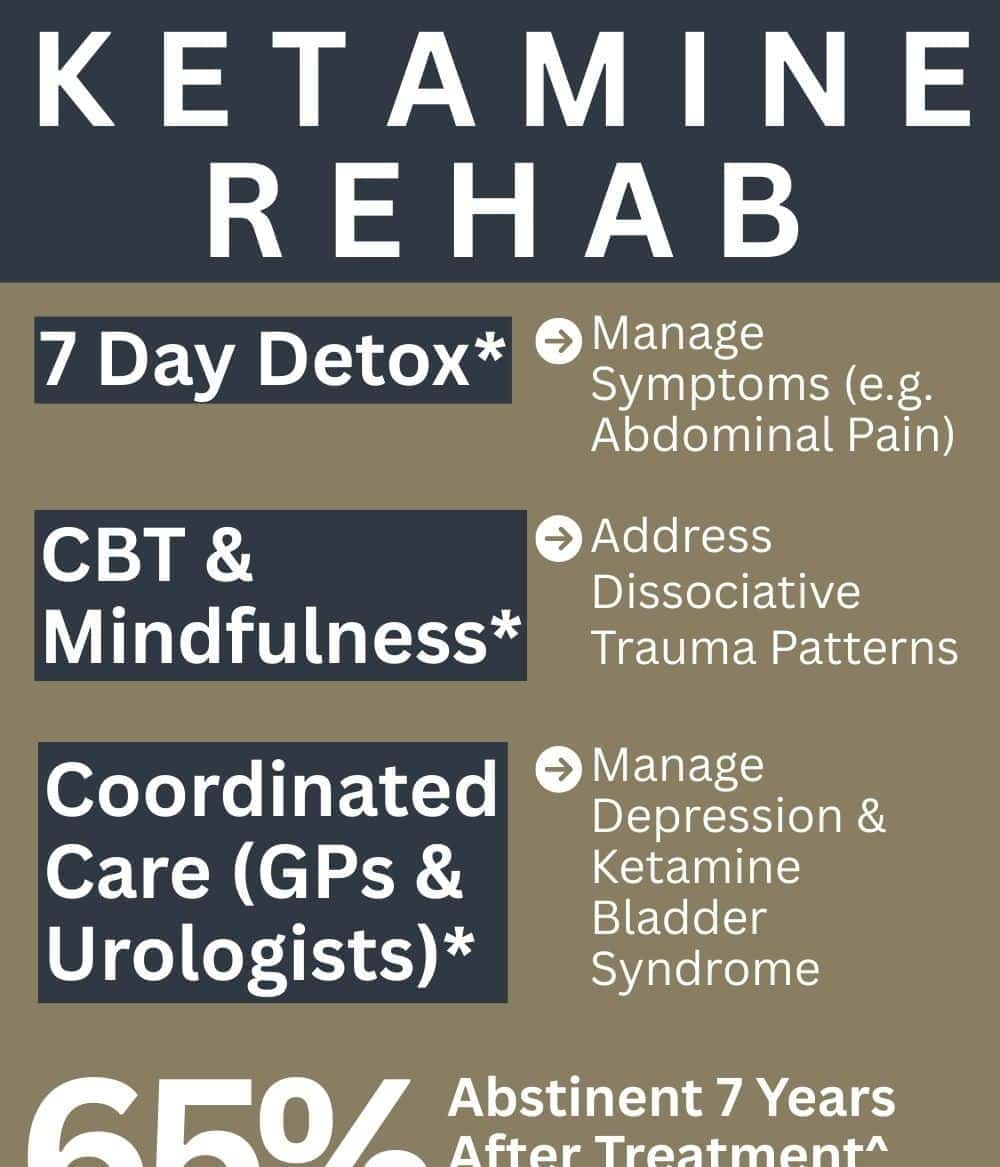
CBT and mindfulness to regulate mood and develop healthy coping skills (e.g. warm bath for relaxation vs ketamine to dissociate)
Coordinated care with GPs and urologists to manage depression and ketamine bladder syndrome
Below, we discuss possible approaches that meet the specific rehab needs around ketamine. Not all treatment centres will provide these specific interventions.
For an overview of the Abbeycare programme contents for ketamine rehab, click here.
When Is Ketamine Rehab Necessary?
Using Ketamine For Its Dissociative Effects
Using ketamine for dissociative effects necessitates ketamine rehab because some users consume up to 20g daily (lethal dose = 4.2g for a 70kg human) due to a high tolerance after frequent use (≥4 times per week) and relying on the drug to “escape reality” [1][2][3]:
Clinicians administer the Evaluation of Lifetime Stressors (ELS) questionnaire and conduct 1 – 3-hour-long interviews during admission to develop individual treatment plans that address underlying trauma (e.g. sexual abuse) [4]
90-minute exposure therapy sessions use imagery and real-life scenarios to manage intrusive thoughts and flashbacks by processing trauma-related cues (e.g. darkness) as an alternative to using 150mg of ketamine to induce a ‘K-hole’ [3][4]
60-minute skills training sessions challenge distorted thinking and encourage practice of distraction techniques (e.g. reading) to manage intense cravings lasting up to 3 weeks after consuming 4g of ketamine hourly to “Take the edge off everything” [3][5][6]
Garg, Amit, et al. (2014) researched a man that was abstinent 1 year after engaging in relaxation and distraction techniques whilst receiving 25mg of naltrexone daily during a 3-week stay in ketamine rehab, after previously injecting 1 – 4g daily and relying on ketamine's ‘numbing’ effect [6].
Onset Of Ketamine Bladder Syndrome
The onset of ketamine bladder syndrome (KBS) requires addiction treatment because symptoms (e.g. dysuria) develop within 24 months of heavy use (e.g. 8g daily) and may lead to permanent urological damage, as only 10% of symptomatic users seek medical help [1]:
Psychoeducation informs patients about the negative consequences of heavy ketamine use (e.g. developing KBS after using up to 20g daily), treatment options (e.g. 5mg Oxybutynin daily), and the benefits of recovery (e.g. avoiding permanent bladder damage)
Rehab liaises with GPs and urologists for the management of KBS and arranges hospital care (if needed) during or after treatment for specialised procedures (e.g. bladder augmentation) to improve bladder capacity and prevent further complications
Up to 300mg of Pentosan Polysulfate is administered daily alongside therapy to ease abdominal pain and inflammation, as one study found that a patient with KBS relapsed within 7 months after claiming "Ketamine is the only thing that manages the pain"[1]
Abbeycare cannot provide medical treatment for ketamine bladder syndrome, although we may coordinate with GPs to discuss appropriate care strategies during or after treatment.
Self-Medication For Depression
Using ketamine to self-medicate depression requires addiction treatment because up to 80% “Use K without stopping, until it’s all gone” to relieve depressive symptoms (e.g. worthlessness), although depression increases by 51% within 1 year of frequent use (>4 times per week) [3][9]:
SSRIs (e.g 40mg citalopram daily) are administered as an alternative to ketamine due to low abuse potential and the ability to reduce depressive symptoms (e.g. suicidal ideation) by 38% in drug users with major depressive disorder (MDD) [10]
45-minute counsellor-led discussions using the ‘Coping With Feelings and Depression’ handout help patients to identify symptoms (e.g. low energy, crying spells) and develop strategies to alleviate low mood (e.g. 10 - 20 minutes of exercise daily) [7]
Weekly CBT sessions incorporate cognitive restructuring and skills training to modify harmful thoughts and behaviours associated with hazardous ketamine use (e.g. consuming ketamine when depressed because it “takes sadness away in a bubble”) [3].
Schak, Kathryn M., et al. (2016) studied a 52-year-old man with a ketamine addiction and a 30-year history of depression who experienced a 78% reduction in depressive symptoms (e.g. low mood) after receiving 7 sessions of Electroconvulsive therapy (ECT) and 18 days of mirtazapine monotherapy during rehab (ECT is not currently available at Abbeycare) [8].
Hallucinations And Delusional Thinking
Hallucinations and delusions require ketamine addiction treatment because 30% develop psychosis after 9 years of use, resulting in 6-day-long psychotic episodes and a 2-fold increase in violence, often leading to arrests due to inappropriate behaviour in public [11][12][13]:
A 15 – 30-minute interview takes place during admission to establish the severity of psychotic symptoms and the patient's level of functioning using the Mental Health Screening Form-III or the Modified Mini Screen to develop an appropriate treatment plan [14]
Antipsychotics (e.g. 5mg Haloperidol) are administered daily to control auditory hallucinations (e.g. commands from a ‘demon’) and paranoia caused by glutamate and dopamine imbalances in the brain after heavy ketamine use (e.g. 4g per day) [13]
Clinicians help to minimise shame and guilt by using the iceberg analogy (e.g. behaviour = tip of the iceberg vs delusions = hidden under water), implying that beliefs aren’t permanent and can be ‘chipped away’ by behaviour change (e.g. abstinence) [15]
Lim, D. K (2003) examined a man in his 30s who required a residential rehabilitation programme for his severe ketamine addiction (used 4g a day and spent >£2000 a month) because:
Physical restraint was initially required by staff trained in de-escalation techniques (e.g. AGRO+ method) due to the safety risk he posed to himself and others, insisting that “People were trying to catch his soul”
4.5mg Haloperidol was provided daily in a quiet/calm environment to encourage feelings of safety, diminish agitation, and manage persistent tactile hallucinations (e.g. feeling like his ear was being moved) and delusions about his mother trying to harm him
The patient claimed to 'sniff' ketamine as a distraction for low self-esteem, unresolved grief, guilt, and frustration about losing sense of smell after constantly snorting the drug, requiring counselling to enhance self-esteem and minimise shame [13]
Abbeycare may use screening tools (e.g. BPAQ) during admission to assess individual aggression levels and tendencies, training staff in methods to de-escalate anger, and arranging onward referral for psychiatric care, for patient protection, if required.
How Is Detox Done In Ketamine Rehab?
A ketamine detox in rehab works by:
Treating physical (e.g. abdominal cramps) and psychological (e.g. hallucinations) symptoms of withdrawal on a case-by-case basis using chlordiazepoxide for 7 - 10 days and/or symptomatic medication (e.g. 400mg Mebeverine daily) for up to 28 days
Placing patients in the detox wing for the first 7 days to closely monitor progress with observations every 15 – 30 minutes and regular mental status assessments to develop a personalised treatment plan, including a medication and therapy schedule
How Is Therapy Done In Ketamine Rehab?
Therapy in ketamine addiction treatment addresses dissociative trauma patterns and anaesthetic-seeking behaviours (e.g. consuming 3.8g of ketamine per session to "take the edge off everything" or have a "whole new world inside your head") by [3]:
Using the 8-phases of EMDR (e.g. body scan, desensitisation) to process trauma that previously led to frequent use (>4 times per week), as some users rely on up to 20g of ketamine a day to induce a temporary loss of consciousness [1][3][4]
Incorporating 10-minute mindfulness exercises to teach patients how to tolerate painful emotions (e.g. grief) by placing thoughts onto leaves and allowing the thoughts to flow down a stream, rather than using 150mg of ketamine to ‘escape’ from reality [3][4]
Building comprehensive self-care plans that aim to improve mood and overall well-being by engaging in drug-free activities, including reading for relaxation rather than using ketamine to create a “Lovely wave of relaxation that washes all over you” [3]
Delivering group skills sessions for 6 – 10 patients to practice disrupting the trigger–thought–craving–use sequence using ‘thought-stopping’ techniques (e.g. visualisation: Imagining moving an on/off switch to stop thoughts about using ketamine when sad) [7]
Siu, Andrew, et al. (2018) found that 16 to 30-year-old ketamine abusers experienced a 25 – 30% reduction in depression, anxiety, and stress within 2 weeks of receiving therapy that incorporated skills training, mindfulness, and self-care practices [16].
Abbeycare does not provide dissociative trauma care as part of a standard 28-day treatment programme; please speak to the admissions team for more information about the specific therapeutic approaches used for patients with ketamine dependency.
How Is Aftercare Planning Done In Ketamine Rehab?
Further Cognitive Recovery
Aftercare planning in rehab for ketamine addiction is required to address the 14 - 30% reduction in neurocognitive abilities (e.g. executive function and verbal memory) caused by 3 – 4 years of ketamine misuse by (e.g.) [17]:
Providing a structured routine for up to 18 months post-treatment, including weekly telephone check-ins and therapy to strengthen decision-making and planning abilities in up to 39% of users who feel demotivated and ‘slowed’ down after cessation [18]
Liaising with mental health services to provide CBT for up to 6 months after treatment as counsellors repeat information, provide a journal, and encourage patients to recall past experiences (e.g. "Explain a time that a negative emotion caused you to consume ketamine”) to aid memory consolidation [7]
Encouraging mindfulness (e.g. leaf and stream metaphor) to promote neuroplasticity by integrating various brain regions/networks (e.g. the prefrontal cortex) required to focus attention on breathing, bodily sensations, and the present environment [4]
Providing 20-minute guided meditations, advice about healthy sleep habits (e.g. turning the TV off 30 minutes before bed), and relaxation training using diaphragmatic breathing or guided imagery to regulate glutamatergic signalling and encourage synaptic repair [5]
Abbeycare's aftercare planning will be custom to each individual, as agreed between keyworker and client, consulting with our medical and clinical teams as needed.
Follow Up Care
Aftercare planning in ketamine addiction treatment addresses lower urinary tract symptoms (e.g. nocturia, urgency, hesitancy, urinating with interrupted flow) in 20 – 30% of patients by working with urologists to [1]:
Develop a pain-management plan that includes continued abstinence from ketamine and oral medication (e.g. pentosan polysulphate, NSAIDs), as some users relapse within 7 months after claiming “It’s the only thing that’s getting rid of the pain” [1]
Conduct regular abdominal and pelvic examinations, blood count, renal and liver function tests on a 3-monthly basis, followed by a 6-monthly renal tract ultrasonography to screen for hydronephrosis and refer patients to a hepatologist if necessary [20]
Offer Intravesical instillations (e.g. Parson’s cocktail) to patients with ongoing symptoms after 1 month of ketamine cessation, requiring weekly instillations for 4 to 6 weeks and then monthly instillations in the following 6 months [20]
Refer patients to a tertiary unit after 6 months of cessation if reconstructive surgery is required for end-stage ketamine bladder, requiring life-long follow-up appointments to prevent leaks or infections [20]
Aftercare planning in ketamine rehab may liaise with GPs to:
Prevent patient access to therapeutic ketamine because, without coordinated care, intranasal ketamine may be prescribed, leading to relapse and hazardous drug use (e.g. using a ketamine nasal spray 12 times daily rather than every 4 hours) [8]
Provide monitoring guidelines for signs of relapse (e.g. tremor, dissociation, hallucinations) and regular check-ins to assess mood, cravings, and overall stability
Initiate referrals to psychiatrists or trauma-specialists for ketamine-induced psychosis, dissociative disorders, or persistent symptoms of anxiety or depression (e.g. low mood, restlessness)
Implement a prescription monitoring programme to ensure medication compliance by allowing doctors and nurses to track the use of controlled substances and offer alternative treatments to avoid ketamine use (e.g. 25 - 50mg naltrexone daily)
How Does Pre-Existing Depression Alter Ketamine Rehab?
Pre-existing depression changes ketamine recovery because patients often believe that ketamine is “Needed to relieve depressive symptoms” due to the drug’s temporary therapeutic effect (e.g. 2 – 3 hours), requiring up to 10 sessions of 1-1 psychoeducation to [5][8]:
Learn that frequent ketamine use (>4 times per week) actually increases depression by 51% after 12 months, despite intranasal use (e.g. 150 mg/ml, 0.5–1 ml 4 times daily) initially providing an antidepressant benefit for 4 - 5 days at a time [8][9]
Educate patients about alternative medications with low abuse potential used to treat depression, including antidepressants (e.g. mirtazapine or citalopram), resulting in a 38 – 78% reduction in depressive symptoms (e.g. suicidal ideation) within 3 weeks [8][10]
Inform patients about how engaging in 2 – 3 hours of aerobic exercise (e.g. cycling, walking, swimming) or muscle strengthening activities (e.g. lifting weights, push-ups) per week can reduce depression and anxiety by up to 30% within 2 weeks [5][16]
Ketamine Rehab Outcomes
Ketamine use decreases by 78% within 3 months of receiving psychoeducation, motivational interviewing, coping skills training, and mindfulness during inpatient treatment because:
Scores increase by 29% on the contemplation ladder (0 = “I cannot live without Ketamine” vs 10 = “I will never consume Ketamine again”), as patients move from the pre-contemplation stage to the stages of preparation, action, and maintenance
Depression and anxiety decrease by 26 – 30%, and patients engage in 25% more healthy lifestyle behaviours (e.g. eating a balanced diet, exercising 30 minutes per day) in comparison to pre-treatment [16]
Wang, Liang-Jen, et al. (2018) found that 65% of ketamine users were abstinent 7 years after attending a 10-week outpatient programme that included weekly 2-hour therapy sessions focused on relapse prevention and concepts of motivational enhancement (e.g. feedback, reflection) [21].
Executive functioning and memory abilities (e.g. delayed recall) increase by up to 21% within 3 months of completing 15 60-minute cognitive training sessions focused on problem solving during inpatient treatment for severe ketamine dependence (daily use for 6 years) [19].
Siu, Andrew M. H., et al. (2018) found that ketamine rehab patients no longer showed signs of cognitive impairment (MoCA score <26) at 13 weeks, as scores increased by 6% from baseline after practising mindfulness, self-care, and healthy sleep habits to restore executive function [16].
Providing a 7-day detox to treat symptoms of withdrawal (e.g. abdominal pain) using Chlordiazepoxide and/or symptomatic medication (e.g. ibuprofen), subject to our medical team's decision making
Delivering 90-minute CBT sessions, 60-minute mindfulness sessions, and daily feelings check-ins to identify, process, and reflect on positive (e.g. gratitude) and negative (e.g. existential anxiety)
Liaising with GPs and urologists, where appropriate, to develop pain-management plans, conduct regular tests (e.g. LFT every 3 months), and administer medication (e.g. Citalopram) to prevent patients from self-medicating depression or bladder pain with ketamine
About the author
Mischa Ezekpo
Mischa Ezekpo has a Bachelors degree in Psychology from Northumbria
University, and a Masters degree in Childhood Development and
Wellbeing, from Manchester Metropolitan University. Since 2018, Mischa
has written and published work on Addiction, Mental Health, Depression, and Eating Disorders. Content reviewed by Laura Morris (Clinical Lead).