


KEY TAKEAWAY
Understand how your “help” drains you and protects addiction - and regain clarity to choose healthier boundaries.
If you’re exhausted from trying to help your addicted loved one, it’s not just their behaviour that’s burning you out.
It’s the invisible contracts you’ve taken on: fixing, smoothing over, paying for, covering up, and holding everything together so the family unit doesn’t collapse.
On the surface, it looks like love.
Underneath, a lot of what you’re doing may be protecting the addiction itself.

How To Know When To Step Back
Most family members ask some version of:
- “If I don’t help, aren’t I abandoning them?”
- “If I *do* help, am I enabling?”
- “How am I supposed to know the difference?”
You can’t answer that in your head.
You need to see it on paper.
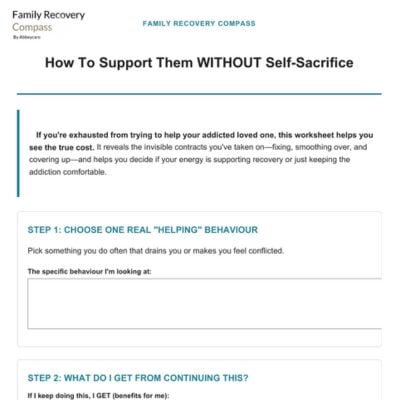
Step 1: Choose One Real “Helping” Behaviour
Pick something you do often for your loved one that:
- Drains you
-You feel conflicted about
- You suspect might be enabling
Examples:
- Sending money to “get them through”
- Phoning in sick for them at work
- Covering up for them with kids, family, neighbours
- Cleaning up after binges
- Spending hours trying to convince them to stop addiction
Write it down:
The behaviour I’m looking at:
____________________________________
(honest, specific, behaviour – not a feeling)
You’re not promising to stop it.
You’re just agreeing to look at it with clear eyes.

Step 2: What Do I Get From Continuing This?
This is where most family members have their first “oh…” moment.
Answer these honestly; no one else has to see it:
Short-term benefits for ME if I keep doing this:
- I avoid a row / shouting / drama
- I feel like I’m doing something
- I don’t have to sit with the fear of “what if"...
- I feel like a good parent/partner/child
Write yours:
If I keep doing this, I get:____________________________________ ________________________________________________________________________
You are allowed to have needs.
This is about being honest, not shaming yourself.

Step 3: What Is This Costing Me – And Them?
Now we flip the lens.
Costs to ME when I keep doing this:
- My stress / sleep / health
- My finances / work / other relationships
- Resentment building up inside me
Costs to THEM when I keep doing this:
- They don’t have to face consequences
- They don’t feel the full weight of their choices
- They get to delay making any real change
Write it down:
Cost to me:
________________________________________________________________________
Cost to them / their recovery:
________________________________________________________________________
This is the first time you might see, in black and white:
“My ‘help’ is actually removing the discomfort that would push them toward change”.

Step 4: What Happens If I Stop?
Now imagine you stopped doing this one behaviour.
You’re not committing to a decision yet; you’re mapping it.
Possible benefits if I stop:
- I protect my energy, money, health
- I stop lying, covering, or betraying my own values
- They feel more of the natural consequences of addiction
Possible fears / costs if I stop:
- They might get angry, blame me, or escalate
- Things might get worse before they get better
- I will have to sit with guilt and fear instead of fixing
Write yours:
If I stop, I might gain:
________________________________________________________________________
If I stop, I’m afraid:
________________________________________________________________________
This is the most important part:
seeing that every option has both pain and relief.
Continuing is painful.
Stopping is painful.
The question becomes:
Which pain is more honest and more likely to lead somewhere different?
Step 5: If This Was Someone Else, What Would I Advise?
Step outside your own story for a moment.
Imagine a close friend showed you this worksheet with their loved one.
They tell you:
- “This is what I do”.
- “This is what I get”.
- “This is what it costs".
What would you gently advise them to do?
Write that down:
If this was my friend, I’d say:
________________________________________________________________________
Often, this final step reveals the gap between how you treat yourself and how you’d treat anyone else you care about.
Now you've done this exercise, how different do you feel about your situation?