Alcoholism is a disease characterised by continuous heavy drinking. Until people with alcohol use disorder admit to problems with alcohol and stop drinking, the risk of alcohol use disorder continues which affects both physical and mental health.
Alcohol starts to injure the brain once it reaches the bloodstream.
Excessive consumption can lead to Alcohol-Related Brain Damage, or ARBD, which is a type of brain disorder caused by alcohol consumption. Brain shrinkage caused by alcohol abuse is permanent, as alcohol kills brain cells and grey matter.
For more information and effects click ‘Learn More’.
Family Recovery Compass is a newsletter for friends and family members who feel trapped between supporting a loved one in addiction, and protecting their own wellbeing.
Every week, we tackle one specific situation in addiction family dynamics, and deliver practical decision-making frameworks and exact dialogue scripts – that help you respond with confidence instead of reaction.
Every month, we bring you an unfiltered recovery conversation with someone who’s either experienced addiction firsthand, or works closely with those in recovery.
No sanitised success stories – just practical insights on what actually works in recovery, that you can apply, in your life too.
Recovery capital is the internal and external resource used to begin the recovery process and maintain sobriety. This combines personal, social, and community support to provide a joined-up approach that supports the addict through recovery.
Do you or a loved one need addiction treatment for alcohol or drugs? Thousands blindly walk into addiction treatment in expensive rehab centres and find that the reality doesn’t meet expectations.
If you’re considering rehab treatment, first check our ultimate guide for complete instructions on how to find the right rehab centre for you.
Take-home Naloxone kits help families and loved ones respond quickly in an opioid overdose emergency, until emergency services arrive. Kits contain nasal or injectable forms of Naloxone.
Changes in legislation mean Naloxone kits are now more widely available from pharmacies and drug services, including Abbeycare.
For additional information, click ‘Learn More’ below.
Overcoming alcohol addiction means first ceasing alcohol intake, and taking care of physical and chemical withdrawal symptoms.
Detoxing from alcohol means undergoing withdrawal from alcohol, but with the assistance of prescribed medication and detox phase, to substitute in place of the alcohol itself.
Alcohol rehab focuses on tackling the problems underneath alcoholism, such as grief, trauma, depression, and emotional difficulties, in order to reduce continuing drinking after treatment.
Inpatient services at an alcohol rehab programme provides 24 hour access to specialist care.
Alcohol home detox provides a means of semi-supervised addiction treatment in the comfort of your home. It’s often suitable for those with inescapable practical commitments, or where a reduced budget for treatment is available.
An at-home detox is the most basic detox option available from Abbeycare, and assumes you have support available, post-detox, for the other important elements of long-term addiction recovery.
The term alcoholism refers to the consumption of alcohol to the extent that the person is unable to manage their own drinking habits or patterns, resulting in side-effects that are detrimental to the quality of life and health of the alcoholic, or those around them.
An alcoholic is someone who continues to compulsively abuse alcohol in this way, despite the negative consequences to their lives and health.
Immediately following treatment, the early stages of recovery and abstinence are most vulnerable to lapses.
At Abbeycare, a structured and peer-reviewed aftercare plan is usually prepared whilst still in treatment. This comprises social, peer, and therapeutic resources individuals draw upon, following a residential treatment programme for drug or alcohol misuse.
Clinically managed residential detoxification is:
– A structured detox that uses medication-assisted treatment and regular physical health observations
– Takes place in an inpatient rehabilitation unit or hospital
– Typically lasts from 7-10 days, but in Abbeycare, it is incorporated into a 28-day rehab programme
Family Therapy at Abbeycare Scotland or Gloucester is realistic, compassionate, and appropriate for families and loved ones of addicts.
Family therapeutic interventions in residential rehabilitation have been designed to support those living with or caring for participants entering the Abbeycare Programme.
Support for families in a group setting allows for a safe, constructive, and confidential place to listen and share common experiences.
Inpatient rehab is drug and/ or alcohol treatment in a rehab centre, where patients remain on-site for the duration of inpatient rehabilitation.
It includes detoxification from drugs, therapy (group work and 1-2-1 sessions), and aftercare planning. Inpatient rehabs typically last 28 days, but this varies on an individual basis.
Long-term treatment at Abbeycare has been developed for those suffering from alcohol or drug addiction. Completing a long-term drug and alcohol inpatient programme may be the solution to problematic substance use.
Motivational Enhancement Therapy can be used by trained addiction recovery therapists to elicit internal changes within and promote long-term recovery from substance use disorder.
All the answers to addiction can be found within with this comprehensive and successful therapy concept leads to behavioural changes, reflective listening, self-motivational statements, and a comprehensive recovery process.
Outpatient drug or alcohol rehab is daytime treatment as opposed to living in a treatment facility.
Outpatient treatment is similar to inpatient in terms of the methods used to treat substance abuse. Where they differ is in their approach to recovery.
Abbeycare’s prison to rehab is a 12-week structured rehab programme which involves direct transfer from prison. The suitability of the candidate is decided by prison staff.
Short-term residential treatment programmes are the chance to press the reset button and access a therapeutic programme designed to create recovery from the use of alcohol and drugs.
Feeling stuck in a rut. Want to stop but can’t seem to achieve sobriety?
Click below.
The 12-step programme was created by alcoholics anonymous (AA), and is specifically designed to aid addicts in achieving and maintaining abstinence.
The central ethos behind the programme is that participants must admit and surrender to a divine power to live happy lives. Ideas and experiences are shared in meetings, and help is sought in an attempt to achieve abstinence.
Abbeycare’s policy to respect your privacy and comply with any applicable law and regulation regarding any personal information we may collect about you, including across our website and other sites we own and operate.
Depression caused by a 46% reduction in serotonergic activity in the cerebral cortex after consuming ecstasy for 3 months [1]
Mouth ulcers and occlusal tooth wear caused by excessive chewing and teeth grinding for up to 48 hours after use of ecstasy
Physical Consequences Of Ecstasy Addiction
Teeth Grinding And Jaw Clenching
Teeth grinding and jaw clenching are physical consequences of ecstasy addiction due to an 8-fold increase of serotonergic activity within 40 minutes of consuming 3mg/kg ecstasy [2].
Serotonin (5-HT) levels remain 3 times higher for up to 2 hours after taking ecstasy and stay elevated by 20% in the occipital-parietal and temporal brain regions for up to 90 days, leading to [3] [4]:
Jaw clenching and teeth grinding in 89% of users, typically lasting until the morning after drug-taking [5]
Bruxism, hypersensitive teeth, and mouth ulcers from excessive chewing in 44%, lasting up to 48 hours after taking ecstasy [6]
Occlusal tooth wear in 60% and enamel loss exposing dentine and pulp 2 - 4 mm under the surface [5] [7]
Blurred Vision And Eye Twitching
Blurred vision and eye twitching are physical consequences of ecstasy addiction due to a 5-fold increase in dopamine and an 8-fold increase in serotonin in the brain [2] [8].
Ecstasy-induced damage to the serotonergic and dopaminergic neurons causes blurred vision and eye twitching for around 1 hour after drug-taking in 69% of chronic users (mean use duration = 3.6 years) [6]:
In a case study, a 17-year-old man experienced diplopia (double vision) for 5 days after taking 80 – 160mg ecstasy tablets at least once a week for up 2 months [9]
In a case study, a 31-year-old man experienced acute vision loss (visual field index = 0) triggered by a 10-second flickering sensation after using ecstasy sporadically [10]
Rhabdomyolysis
Rhabdomyolysis is a physical effect of ecstasy addiction caused by dehydration and hyperthermia (>38.0 °C) in up to 85% of ecstasy misusers [11].
In a case study, a 20-year-old man experienced rhabdomyolysis within 38 hours of consuming ecstasy during a music event after consuming ecstasy once every 1 – 2 months for over 2 years:
The man experienced hyperpyrexia immediately (41.4°C) and became stiff and unresponsive; after 24 hours, he experienced hyperthermia (38.6°C) that lasted for 5 days
Bilateral 5–7 cm posterior arm bruises and swelling developed within 24 hours, and platelet count dropped to 22,000 platelets/μL (normal value = 150,000 - 450, 000 μL)
Plasma creatine kinase (CK) increased to 409,440 U/L (normal value = 40–320 U/L) and took 10 days to return to baseline levels [12]
Ecstasy misuse increases the likelihood of developing rhabdomyolysis by 19.9% in comparison to 3.0% for alcohol, as up to 2500 mL/h water is lost from sweating compared to 900ml for every 2 hours of drinking alcohol [13] [14].
Muscle Cramps
Muscle cramps are a physical consequence of addiction to ecstasy because of Hyponatremia (sodium < 130 mmol/L) in 38.8% and dehydration in 85% of users [11] [15].
A 20 – 30% sweat-induced loss of sodium leads to muscle cramping and is likely to be exacerbated after misusing ecstasy due to [16]:
Profuse sweating in up to 85% of ecstasy addicts whilst intoxicated, for up to 3 hours after consumption [6] [11]
Up to 1500mg of sodium is lost per litre of sweat, and ecstasy takers have an average sweat rate of 2500 mL/hr whilst in a hot environment (e.g. rave/nightclub) [13] [17]
57.6% of ecstasy addicts experience muscle aches, and 33.4% experience joint pain/stiffness during a ‘come down’, lasting up 3 days after intoxication [6].
Psychological Consequences Of Ecstasy Addiction
Loneliness
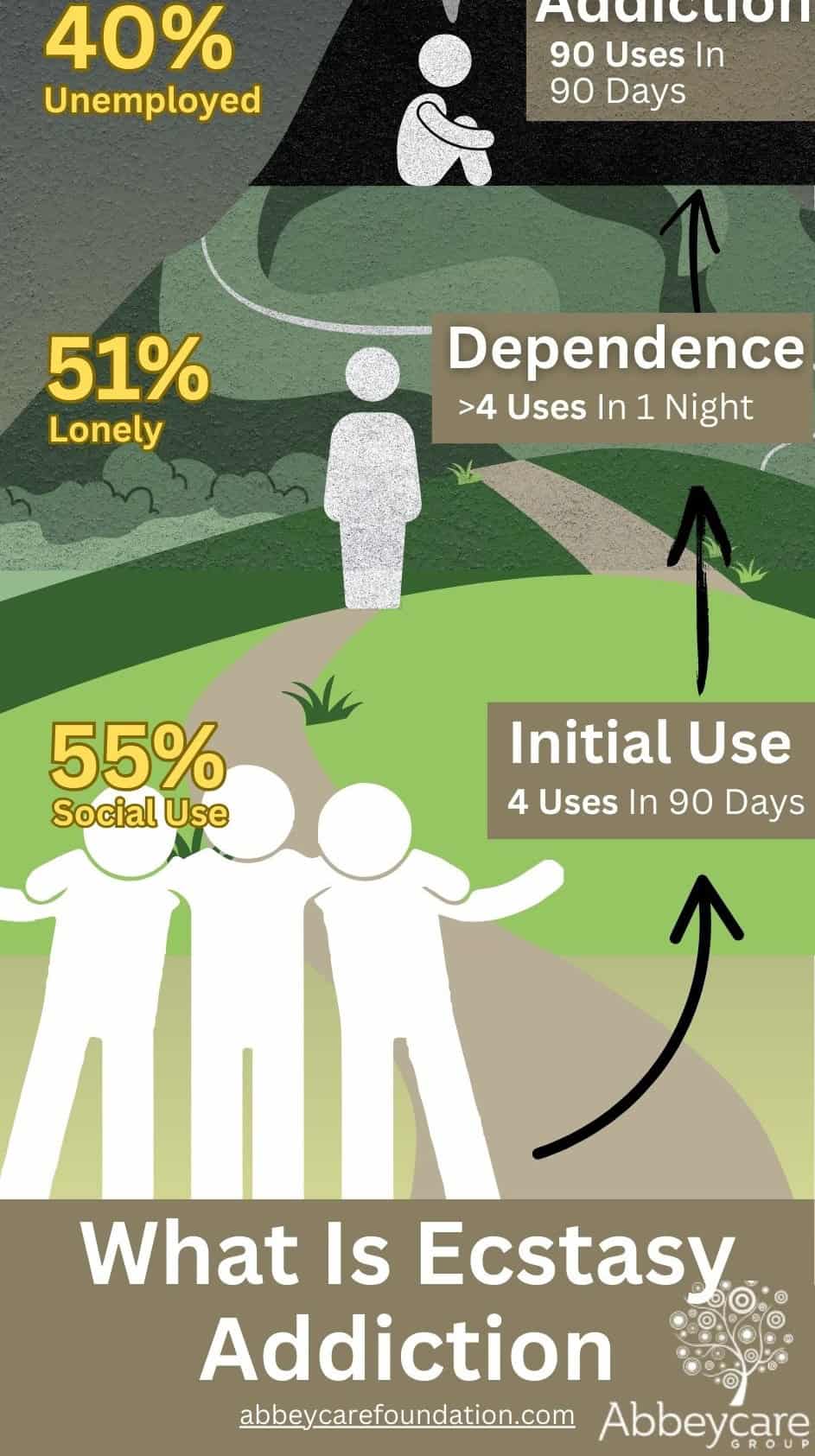
Loneliness in 51.5% of ecstasy misusers is a psychological consequence of ecstasy abuse caused by disruptions in serotonergic neurotransmission and oxytocin release, leading to [18]:
Enhanced feelings of compassion and deep emotional connection in 69% for around 3 hours, as oxytocin increases by up to 150 pg/ml within 120 minutes of drug-taking [19] [20]
Low mood and depression in 55.6% caused by a 90% depletion of 5-HT in the frontal cortex after chronic ecstasy use, increasing the likelihood of loneliness by up to 51% [3] [6] [21]
Ecstasy-induced emotional dysregulation results in 80 - 100% feeling happy, warm, friendly, and talkative whilst intoxicated, whereas 55 – 90% feel depressed, irritable, and lethargic after using [11]
Feelings of loneliness during ecstasy dependence are likely to be exacerbated by a lack of social support in 82.4% and damaged relationships with friends/family in over 40% caused by drug-induced arguments, anxiety, or mistrust [6].
Socialising Addiction
A co-occurring behavioural addiction to socialising occurs during ecstasy dependence because a 5-fold increase in dopamine (DA) leads to long-term potentiation and habit formation based on motivational arousal [8].
54.8% of ecstasy addicts use the drug for sociability as over 40% believe that ecstasy improves social confidence and friendship quality [20]:
Ecstasy addicts are more likely to consume ecstasy with friends in a club, rave, or festival setting compared to at home in private (54.4 vs 4.97%) [20]
Exposure to ecstasy-related cues (e.g. electronic dance music) exacerbates drug cravings in over 50% of chronic users (>30 uses during lifetime) [22]
DA release reinforces addictive behaviour by strengthening the association between an action (using ecstasy for sociability) and positive experiences (gaining social confidence)
Ecstasy-Induced Psychosis
Ecstasy-induced psychosis occurs as a result of ecstasy misuse because serotonergic and dopaminergic neurotransmission is increased by up to 501% and remains disrupted for up to 7 years [8]:
Chronic ecstasy users (used an average of 371 times) are more likely to experience paranoia (9.0 vs 7.4), hostility (9.7 vs 6.4) and psychoticism (12.7 vs 9.0) in comparison to occasional users (used an average of 7 times) [23]
Ecstasy-induced psychosis increases aggression and violence by 47.2%, resulting in hospitalisation for up to 3 weeks in some cases [24]
In a case study, a 28-year-old man experienced psychosis and had obsessive delusions about partner infidelity for around 7 months, following an increase in ecstasy use (2 to 10 tablets a night) after taking the drug weekly for 18 months [25].
One study found that 100% of ecstasy addicts used cannabis simultaneously, and were 271% more likely to develop drug-induced psychosis[23] [26].
Amotivational Syndrome
Amotivational syndrome occurs during MDMA addiction because prolonged hyperstimulation of the serotonergic and dopaminergic system replaces the hedonistic-euphoric state with anhedonia and hypophoria [27]:
65% experience a lack of energy and feel unmotivated after taking MDMA, resulting in 11 - 25% taking sick leave, quitting or being dismissed from a job within 6 months of drug-taking [6]
Up to 80% experience low mood and impaired concentration between drug-taking sessions due to serotonergic neurotoxicity in the brain caused by taking MDMA 2 – 3 times monthly for up to 12 years [28]
A qualitative study found that up to 17% of MDMA users (>6 months of use) felt that the drug dampened aesthetic experiences, feelings of positivity and worsened friendship quality:
“MDMA has dulled my ability to appreciate listening to music or being in nature, even when I am not on the drug”
“MDMA has caused me to have more blunted and shallower emotional experiences in my daily life, even when not on the drug” [20]
How MDMA Addiction Develops
Stage
Indicators Of This Stage
Initial Recreational Use
Around 4 days of use within 90 days [29]
Used on weekends, holidays or special occasions (e.g. birthdays) to relax and connect with others
No withdrawals, cravings or negative effects on health/social status (e.g. remains in full-time employment)
Habitual Use
Taken at least once monthly; user believes drug use is controlled and still used for recreational purposes [29]
Depression, anxiety, fatigue, intense ecstasy cravings, and insomnia within 24 - 72 hours of last use
Who Is Most At Risk Of Developing An MDMA Addiction?
Who Is Most At Risk?
Why?
18 - 25 Year Olds
25% more impulsive than over 65s due to an undeveloped prefrontal cortex; impulsiveness is positively correlated with heavy ecstasy use (>20 times) (rs = 0.29, n = 46,P = 0.049) [30][31]
Ecstasy is mostly used at clubs, raves or parties (85.1%) and 70.4% of frequent clubbers are under 30 [32][33]
Social Anxiety
55% use ecstasy for sociability, fitting in and coping and 47% feel more socially confident whilst intoxicated [20]
Trauma Sufferers
123% more likely to use ecstasy to cope with sexual abuse or domestic violence, for more days per month (4 vs 1) compared to those with no trauma history [34]
Cravings for multiple drugs increase by up to 60% on ‘non-using’ days, requiring higher/more frequent doses due to tolerance (>4 vs 1-2 pills daily) [36]
Chronic Stress Sufferers
Used by up to 80% to cope with chronic stress, and less than 25% feel in control of their drug-taking [37]
Habitual use is reinforced as ecstasy increases cortisol levels by up to 800%, remaining elevated for up to 3 months after using [38]
MDMA Addiction Risks And Dangers
Contaminated Ecstasy
Contaminated ecstasy causes hepatic, cardiovascular, cerebral, and hyperpyrexic toxicity due to blood levels (0.5mg/L - 10mg/L) up to 40 times higher than the typical recreational range [39]:
Different batches of ecstasy pills vary 70-fold or more, as some contain mixtures of para-methoxyamphetamine (PMMA), 3,4-methylenedioxy-phenyl-N-methylbutanamine, and ephedrine [39]
Ecstasy mixed with PMMA causes hyperthermia (39.4° C), and serotonin syndrome in up to 94%, requiring hospitalisation for neuromuscular paralysis, orotracheal intubation, and rapid cooling [40]
PMMA in ecstasy has contributed to 50 deaths, as users are typically unaware of the contamination and take an average of 6 hours to seek medical care after exposure [40]
In a case study, 12 users overdosed after unintentionally consuming MDMA pills containing 18% xenobiotics (e.g. pesticides) or double the standard MDMA dose (270mg):
58% experienced severe hyperthermia (40.9-43° C) for around 3 hours, 50% experienced hypotension (90/60mmHg) and 67% required emergent endotracheal intubation
2 patients died, and 4 users had permanent neurologic, musculoskeletal and renal sequelae after experiencing hyperkalemia, acute kidney injury, and rhabdomyolysis [41]
Overdose
Ecstasy overdose risks are exacerbated in addicts because addicts are more likely to:
Have depression (65% vs 33%) and higher levels of impulsivity (32% vs 18%) in comparison to casual users, increasing the risk of intentional overdose by 260% [42] [43]
Have anxiety disorders (60% vs 32%) caused by disruptions in serotonergic activity and use MDMA to gain social confidence, increasing the chances of unintentional overdose by 82% [42] [43]
Take up to 10 pills on one occasion compared to a maximum of 3 for occasional users due to a higher tolerance; only 19% of pills contain pure ecstasy and ingesting unknown substances causes 25% of overdoses [42] [43] [44]
Use multiple drugs like cocaine (75% vs 56%), LSD (83% vs 69%) and benzodiazepines (33% vs 12%) in comparison to casual users; increasing the overdose risk by 3-fold [23] [43]
In a case study, 35% reported increasing their MDMA dose to achieve the desired effect after developing a drug tolerance:
A 30-year-old man took around 10 pills every weekend for 8 years and started to 'cook down' and inject 250mg of powder up to 4 times daily; intravenous drug use heightens the risk of unintentional overdose by 185% [42] [43]
“My tolerance has increased, so I now take 3 or 4 at once and if I can’t get that much, then I’ll snort one and a half, chop them up and do them both at once, I’ve eaten up to 8 at once.” - an 18-year-old girl who had taken MDMA over 50 times [42]
How Do Different Forms Change MDMA Addiction?
Pills
Powder
Description
Resemble colourful sweets stamped with logos (e.g. butterfly)
Addicts take 500+ pills during lifetime; 1 in 340 pills cause an overdose [42][45]
Mixed with other white highly-potent drugs e.g. fentanyl
Rapid onset vs 30 - 45 minutes for pills
How Does This Form Change Addiction?
Easily accessible as 40% of addicts are unemployed [47]
Long-term nasal damage e.g, loss of smell, nasal septum destruction
Capsules
Crystal
Description
Clear capsule shells coated with gelatine, filled with 100mg powder or crystal
White or grey crystals, resembling rough quartz crystal
Route Of Administration
Oral ingestion (95%)
Oral ingestion (85%) or smoked (9%)
Cost
Around £12 per capsule
Up to £100 per gram
Average Use Per Session
3 capsules
0.8g
Risks
Only 34% contain pure ecstasy
30% take capsules with unknown contents [44]
Increases overdose risk by 47%, although some believe crystals are “safer or purer” than powder [46]
How Does This Form Change Addiction?
Used at a younger age (18 vs 20) compared to pure crystal [44]
Contributes to financial problems in 38% of addicts [6]
How Does Taking SSRIs Change MDMA Addiction?
Taking SSRIs (e.g. citalopram, sertraline) alongside MDMA changes MDMA addiction because the risk of mortality is increased by 182% due to [48]:
Serotonin syndrome (SS) in up to 16% is caused by an 8-fold increase in serotonergic activity within 40 minutes of consuming 3mg/kg ecstasy and a 2-4-fold increase within 6 hours of taking SSRIs [2] [49]
Simultaneous fluoxetine use in 16% of ecstasy addicts increases the metabolisation of ecstasy by up to 30% and may lead to SS within 24 hours of initiation with symptoms such as myoclonus and delirium [44] [50]
Early signs of SS (e.g. sweating, agitation) develop within 6 hours of drug-taking and are often perceived by ecstasy addicts to be ‘normal’ drug reactions, therefore medical care is unlikely to be initiated
About the author
Mischa Ezekpo
Mischa Ezekpo has a Bachelors degree in Psychology from Northumbria
University, and a Masters degree in Childhood Development and
Wellbeing, from Manchester Metropolitan University. Since 2018, Mischa
has written and published work on Addiction, Mental Health, Depression, and Eating Disorders. Content reviewed by Laura Morris (Clinical Lead).