Alcoholism is a disease characterised by continuous heavy drinking. Until people with alcohol use disorder admit to problems with alcohol and stop drinking, the risk of alcohol use disorder continues which affects both physical and mental health.
Alcohol starts to injure the brain once it reaches the bloodstream.
Excessive consumption can lead to Alcohol-Related Brain Damage, or ARBD, which is a type of brain disorder caused by alcohol consumption. Brain shrinkage caused by alcohol abuse is permanent, as alcohol kills brain cells and grey matter.
For more information and effects click ‘Learn More’.
Family Recovery Compass is a newsletter for friends and family members who feel trapped between supporting a loved one in addiction, and protecting their own wellbeing.
Every week, we tackle one specific situation in addiction family dynamics, and deliver practical decision-making frameworks and exact dialogue scripts – that help you respond with confidence instead of reaction.
Every month, we bring you an unfiltered recovery conversation with someone who’s either experienced addiction firsthand, or works closely with those in recovery.
No sanitised success stories – just practical insights on what actually works in recovery, that you can apply, in your life too.
Recovery capital is the internal and external resource used to begin the recovery process and maintain sobriety. This combines personal, social, and community support to provide a joined-up approach that supports the addict through recovery.
Do you or a loved one need addiction treatment for alcohol or drugs? Thousands blindly walk into addiction treatment in expensive rehab centres and find that the reality doesn’t meet expectations.
If you’re considering rehab treatment, first check our ultimate guide for complete instructions on how to find the right rehab centre for you.
Take-home Naloxone kits help families and loved ones respond quickly in an opioid overdose emergency, until emergency services arrive. Kits contain nasal or injectable forms of Naloxone.
Changes in legislation mean Naloxone kits are now more widely available from pharmacies and drug services, including Abbeycare.
For additional information, click ‘Learn More’ below.
Overcoming alcohol addiction means first ceasing alcohol intake, and taking care of physical and chemical withdrawal symptoms.
Detoxing from alcohol means undergoing withdrawal from alcohol, but with the assistance of prescribed medication and detox phase, to substitute in place of the alcohol itself.
Alcohol rehab focuses on tackling the problems underneath alcoholism, such as grief, trauma, depression, and emotional difficulties, in order to reduce continuing drinking after treatment.
Inpatient services at an alcohol rehab programme provides 24 hour access to specialist care.
Alcohol home detox provides a means of semi-supervised addiction treatment in the comfort of your home. It’s often suitable for those with inescapable practical commitments, or where a reduced budget for treatment is available.
An at-home detox is the most basic detox option available from Abbeycare, and assumes you have support available, post-detox, for the other important elements of long-term addiction recovery.
The term alcoholism refers to the consumption of alcohol to the extent that the person is unable to manage their own drinking habits or patterns, resulting in side-effects that are detrimental to the quality of life and health of the alcoholic, or those around them.
An alcoholic is someone who continues to compulsively abuse alcohol in this way, despite the negative consequences to their lives and health.
Immediately following treatment, the early stages of recovery and abstinence are most vulnerable to lapses.
At Abbeycare, a structured and peer-reviewed aftercare plan is usually prepared whilst still in treatment. This comprises social, peer, and therapeutic resources individuals draw upon, following a residential treatment programme for drug or alcohol misuse.
Clinically managed residential detoxification is:
– A structured detox that uses medication-assisted treatment and regular physical health observations
– Takes place in an inpatient rehabilitation unit or hospital
– Typically lasts from 7-10 days, but in Abbeycare, it is incorporated into a 28-day rehab programme
Family Therapy at Abbeycare Scotland or Gloucester is realistic, compassionate, and appropriate for families and loved ones of addicts.
Family therapeutic interventions in residential rehabilitation have been designed to support those living with or caring for participants entering the Abbeycare Programme.
Support for families in a group setting allows for a safe, constructive, and confidential place to listen and share common experiences.
Inpatient rehab is drug and/ or alcohol treatment in a rehab centre, where patients remain on-site for the duration of inpatient rehabilitation.
It includes detoxification from drugs, therapy (group work and 1-2-1 sessions), and aftercare planning. Inpatient rehabs typically last 28 days, but this varies on an individual basis.
Long-term treatment at Abbeycare has been developed for those suffering from alcohol or drug addiction. Completing a long-term drug and alcohol inpatient programme may be the solution to problematic substance use.
Motivational Enhancement Therapy can be used by trained addiction recovery therapists to elicit internal changes within and promote long-term recovery from substance use disorder.
All the answers to addiction can be found within with this comprehensive and successful therapy concept leads to behavioural changes, reflective listening, self-motivational statements, and a comprehensive recovery process.
Outpatient drug or alcohol rehab is daytime treatment as opposed to living in a treatment facility.
Outpatient treatment is similar to inpatient in terms of the methods used to treat substance abuse. Where they differ is in their approach to recovery.
Abbeycare’s prison to rehab is a 12-week structured rehab programme which involves direct transfer from prison. The suitability of the candidate is decided by prison staff.
Short-term residential treatment programmes are the chance to press the reset button and access a therapeutic programme designed to create recovery from the use of alcohol and drugs.
Feeling stuck in a rut. Want to stop but can’t seem to achieve sobriety?
Click below.
The 12-step programme was created by alcoholics anonymous (AA), and is specifically designed to aid addicts in achieving and maintaining abstinence.
The central ethos behind the programme is that participants must admit and surrender to a divine power to live happy lives. Ideas and experiences are shared in meetings, and help is sought in an attempt to achieve abstinence.
Abbeycare’s policy to respect your privacy and comply with any applicable law and regulation regarding any personal information we may collect about you, including across our website and other sites we own and operate.
IMPORTANT: Below, we discuss possible approaches that meet the specific detox needs around amphetamines. Not all treatment centres will provide these specific interventions.
For an overview of the Abbeycare programme contents for amphetamine detox, click here.
How Is Amphetamines Detox Done For Each Amphetamine Type?
There is no medical detox for amphetamines, although medication (e.g. Diphenhydramine) is provided for up to 4 weeks to relieve withdrawal symptoms (e.g. skin itching).
Dextroamphetamine
Lisdexamfetamine
Methamphetamine
Withdrawal Onset
Within 24 hours
24 - 36 hours, peaking during days 3 - 5
Around 48 hours after cessation
Withdrawal Length
Around 1 week
Up to 2 weeks
3 - 4 weeks
Neurotransmitter Impact
Causes a 19 - 26% downregulation of D2-receptor density for 7-14 days [2]
Reduces extracellular dopamine by 75% [4]
90% reduction of dopamine in the striatum [6]
Detox Risks
Elevated creatine kinase (e.g, 10,335 U/L), AST (856 U/L) and ALT (285 U/L) levels [3]
53% increased risk of coronary heart disease or cerebrovascular disease [5]
Users may have been awake for up to 10 days = severe hallucinations, delirium, or delusions [7]
65% increased risk of developing abscesses [8]
Symptom Management Adjustments
Fluid resuscitation + intravenous hydration to prevent rhabdomyolysis/ transaminitis within 3 - 4 days [3]
Aspirin, Atenolol or 20 - 80 mg atorvastatin once daily to restore adequate coronary blood flow
Wound assessment and care + 45mg Mirtazapine rather than 15 - 30mg for low mood and hypersensitive skin
Higher doses of antipsychotics, e.g. 25 vs 12.5mg Quetiapine
Physical Symptoms Of Amphetamine Detox
Hypersomnia
Hypersomnia is a physical symptom of amphetamine detox because dopamine (DA) levels decrease by up to 90% and remain depressed by 18% for up to 1 month after withdrawal, leading to [6] [9]:
A ‘crash’ within 12 – 24 hours, including exhaustion, fatigue, and sleeping excessively for 24 – 48 hours [10] [11]
Fatigue lasting up to 4 weeks after the onset of withdrawal, as some users are awake for 10 days at a time, having ‘binged’ on amphetamines 2 -3 days prior [7] [11]
An average of 11 hours sleep per day during the first 5 days of withdrawal, followed by an average of 9 hours after 1 – 2 weeks, after sleeping for an average of 4 hours a day whilst actively using [12] [13]
Mahoney, et al (2014) found that 34% of methamphetamine users had mild excessive daytime sleepiness, and 13% had severe daytime sleepiness within 72 hours of cessation:
66% of 18 - 55-year-old users were poor sleepers (PSQI score > 5) after previously consuming around 1 gram per day for 12 years
During withdrawal, 51% had elevated daytime sleepiness (ESS score > 9) and reported falling asleep whilst sitting and talking to someone or watching TV [14]
Bruxism
Bruxism is a physical symptom of amphetamine detoxification because serotonin (5-HT) levels increase by 5-fold during active use and remain 19.7% higher in the occipital lobe for up to 90 days [15] [16].
Bruxism in 81% of chronic methamphetamine users (>1g weekly for 7 years) typically eases within 48 hours of withdrawal, although 22.3% experience teeth grinding for up to 6 years after abstaining, and 8% of cases develop into Temporomandibular Joint disorders (TMD) [17] [18].
Intravenous amphetamine use increases the risk of persistent teeth grinding by 49% compared to smoking and intranasal use due to quicker transportation into the brain (9 vs 18 minutes) and a longer elimination half-life (11.4 vs 10.7 hours) [18] [19] [20].
Uncontrollable Limb Movements
Uncontrollable arm and leg movements are physical withdrawal symptoms of amphetamines as a result of neuroexcitation and a 20 - 25% dopaminergic cell loss after chronic use, although recovery of DA terminals in the striatum begins within 7 - 30 days [21].
56% experience tremors and 44% experience Bradykinesia or Dyskinesia for up to 2 hours each episode after misusing amphetamines weekly for ≥ 1 year, resulting in muscular aches, pains, and stiffness in 35 - 60% for up to 48 hours after the onset of withdrawal [22] [23].
Involuntary muscle contractions begin within 2 – 4 days of amphetamine discontinuation and typically persist for 1 - 2 weeks, although tremors last 1 - 3 years in some cases due to DA receptor activity levels within the Parkinsonian range (up to a 97% loss) in the caudate nucleus [11] [21].
Peripheral Vasoconstriction
Peripheral vasoconstriction is a physical withdrawal symptom of amphetamine misuse due to a 110 - 210% increase of acetylcholine release, leading to restricted blood flow, tissue loss/death, and damage to the peripheral nerves and vessels [24].
15% experience numbness/tingling in the hands for around 1 hour at a time during amphetamine recovery due to elevated troponin I (2.22 ng/mL vs normal values = <0.4ng/mL) and myoglobin (467 ng/mL vs normal values = 25 – 75 ng/mL) [23] [25].
Pins and Needles typically ease within 2 days of amphetamine withdrawal, although burning and electric sensations may persist due to nerve damage or compression caused by repeated intravenous use (>4 times within 30 days) [11] [18].
Rebound Hunger
Rebound hunger is a physical withdrawal symptom of amphetamine dependence caused by a 40 - 90% reduction of dopaminergic and serotonergic activity in all brain regions, following a 5-fold increase during active use [6] [15] [26].
Increased appetite emerges during days 1 – 3 of amphetamine addiction treatment and peaks around days 3 – 5, as 5-HT no longer inhibits hunger signals from the hypothalamus and D1 and D2 receptors are unable to regulate appetite and cravings, resulting in [10]:
A 15 kg - 25 kg weight gain after ceasing methamphetamine use, as one user claims “My appetite would be very good, I could eat a lot, I ate almost everything; even the things I didn’t like to eat before were delicious to me.”
“Endless Eating”, and urges to consume high-fat/sugar foods after going 3 – 4 days at a time without eating during active use, leading to a 15kg weight loss within 10 days [27]
Cowan and Devine (2008) found that some users gain up to 80 pounds within the first 36 months of amphetamine recovery by using sweets and ‘junk’ food as a drug substitute, mood regulator, or to alleviate boredom and satisfy cravings:
1 – 6 months: “I snack more frequently, I choose more instantly gratifying foods like sugary foods, that’s sweet maybe not so healthy.”
7 – 13 months “I can eat like a whole pizza, I’m full and still eat, I could sit and eat it until I get sick.” and “All the food was comfort food, the first thing I do is go to the kitchen.”
14 – 36 months: “Mostly, I’d say my food is grease. It’s high carbs and I eat a lot of sugar.” and ‘I try and eat pretty healthy, it’s just I think I overeat at times, ‘til you feel like you’re about to burst. I eat ‘til I become miserable.’’ [28]
Regular balanced meals are provided and individualised nutrition plans are developed during amphetamine inpatient treatment to regulate food intake and prevent patients from developing a secondary addiction to food in the absence of amphetamines.
Psychological Symptoms Of Amphetamine Detox
Anhedonia
Anhedonia is a psychological symptom of amphetamine discontinuation as a result of a 50 – 61% reduction of dopaminergic activity in the caudate and putamen within 3 days of drug termination [6] [10].
Anhedonia (a loss of interest in pleasurable activities e.g. listening to music) caused by catecholamine dysregulation occurs within 24 – 72 hours of amphetamine discontinuation, peaks between days 3 – 5, and typically lasts 90 – 120 days [10] [11].
Leventhal, et al (2008) found that anhedonia lasted over 2 months in 56.9% as patients experienced diminished interest or pleasure in activities nearly every day, for at least two weeks, although this was likely to be exacerbated by co-occurring major depressive disorder in 70.6% [29].
Amphetamine Induced Psychosis
Amphetamine-induced psychotic episodes are psychological withdrawal symptoms of amphetamine discontinuation caused by cortical GABAergic dysfunction, leading to paranoid delusions and hallucinations within 24 – 72 hours [10].
Psychotic episodes are most prominent during days 3 – 5 of amphetamine withdrawal and typically subside within 1 – 3 weeks, although 10 – 28% experience symptoms for 6 months or more because [10] [30]:
Around 30% of cases develop into primary psychotic disorders after patients experience symptoms (e.g. false beliefs about being harmed) for more than 1 month after the onset of withdrawal [31]
Delusions and hallucinations are likely to be exacerbated in the 3% of patients with pre-existing psychotic disorders and the 7 – 10% of those with bipolar disorder (I and II) [29]
Patients experience confusion about whether memories (e.g. partner infidelity) were real or imagined, leading to overwhelming feelings of being unsafe, remorse or dread as psychotic symptoms subside during week 2 of amphetamine abstinence [11].
Antipsychotic medications (e.g. 12.5 - 25mg Quetiapine) are administered and environmental overstimulation (e.g. bright lights, loud noises) is minimised to manage hallucinations and delusions during the amphetamine withdrawal period.
Compulsive Skin Scratching
Compulsive picking/scratching of the skin is a psychological symptom of amphetamine cleansing caused by overstimulated D1 and D2 receptors in the striatum, exacerbated by skin disorders and infections (e.g. lesions, hives) in up to 46% of users [8].
Compulsive skin scratching occurs for around 2 – 3 hours at a time during withdrawal from amphetamines, as up to 25% experience tactile hallucinations with feelings of bugs crawling under the skin [32].
Fisher and Stanciu (2017) documented a 55-year-old man who had abused drugs for 26 years, began to feel worms under his skin within 24 hours of smoking 2mg methamphetamine:
The patient was agitated, had excoriations on the dorsum of the hands, and picked off pieces of skin and scabs whilst screaming at medical staff “See these are the worms, this isn’t skin, I know skin!”
Compulsive skin scratching eased by day 2 as no tactile or visual hallucinations were present after a single dose of 400mg albendazole and 2mg risperidone was administered twice daily [33]
Intrusive Obsessive Thoughts
Intrusive obsessive thoughts are a psychological amphetamine withdrawal symptom caused by a 5.2% decrease of cerebral blood flow in the right anterior cingulate cortex within 6 months of discontinuation [34].
Amphetamine users experience a 25% increase in perseverative responses (uncontrollable repetition of a particular thought or action e.g. a previous car crash or asking the same question multiple times) after 16 years of drug use [35]:
Intrusive obsessive thoughts emerge during days 1 – 3 of detox, and typically ease within 1 week, although 6.9% of cases result in a diagnosis of amphetamine-induced OCD [10] [36]
Perseverative responses decrease by 20% after 1 year of abstinence, although symptoms may be exacerbated in the 3.3% of patients with OCD before substance abuse [35] [36]
Social Interaction Overwhelm
Social interaction overwhelm is a psychological symptom of amphetamine discontinuation as a result of a 90% reduction in dopaminergic activity, causing anxiety, sweating, palpitations, and shortness of breath during social situations for over 2 months after the onset of withdrawal [6].
34% feel anxious/nervous and 9% feel as though people are watching or talking about them within 24 hours of methamphetamine withdrawal, following 11 years of drug abuse [37]
Social overwhelm is likely to be exacerbated in 70.3% of patients with co-occurring social anxiety disorder after misusing methamphetamines for around 10 years, as 56.4% initially take drugs aged 18 to relieve social anxiety that developed 5 - 6 years before [38] [39]
Williams (2000) documented a 26-year-old woman who became overwhelmed with social interactions within 8 weeks of withdrawal after consuming 1.5g of amphetamines daily for 6 years:
The first episode involved an anxiety attack, feeling embarrassed, and like people were staring, resulting in social avoidance out of fear of reexperiencing similar feelings
Anxiety attacks only occurred during social situations and the patient had no psychiatric history, claiming to be confident and extroverted before substance abuse [40]
Positive Markers Of Amphetamines Detox
Stabilising Heart Rate And Blood Pressure
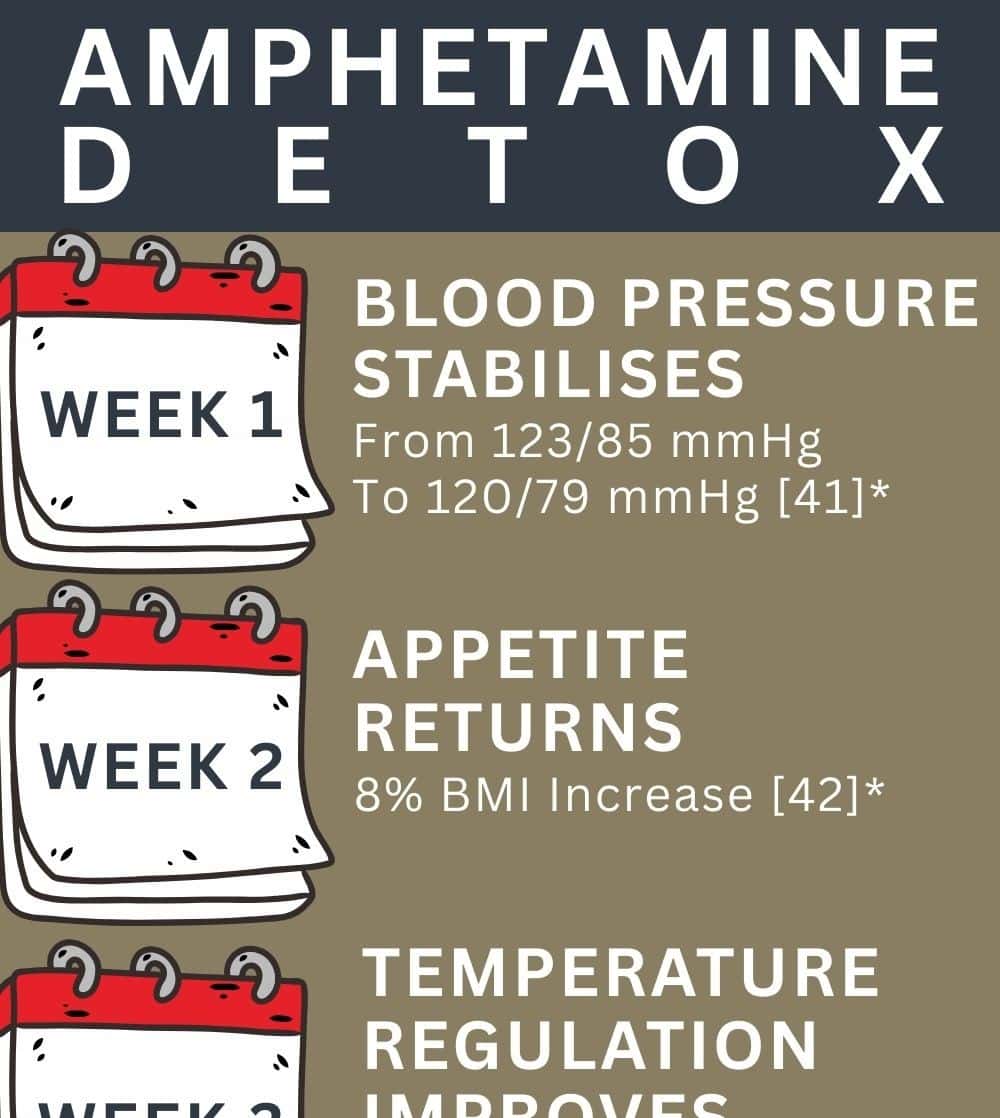
Methamphetamine detox reduces heart rate by 2 beats per minute, systolic blood pressure by 3 mmHg, and diastolic blood pressure by 6 mmHg within 1 week because beta-blockers (e.g. propranolol, atenolol) are administered to control irregular heart rhythms and encourage steady blood flow [41].
Within 7 days of methamphetamine rehabilitation, standing blood pressure measurements are reduced from 123/85 mmHg to 120/79 mmHg (normal values = <120/80 mm/Hg) in patients previously consuming 1g per day, 5 – 6 days a week for 11 – 13 years [41].
Vital signs are monitored regularly for up to 2 weeks during amphetamine addiction treatment, and quiet, cool environments are provided to diminish agitation/hypersensitivity to external stimuli for patients with persisting hypertension(>140/90 mmHg) or tachycardia (> 100 beats/min) [11].
Improving Appetite And Causing Weight Gain
Detoxing from amphetamines improves appetite in 63% and leads to an average 8% increase in BMI within 2 - 3 weeks of treatment by addressing the 5% loss of D2 and D3 receptors in the striatum and the 40 – 67% reduction of 5-HT to [37] [26] [42]:
Regulate appetite following the inhibition of hunger signals from the hypothalamus during active use, by providing access to controlled high-calorie and nutritious foods to encourage weight gain and restore electrolyte imbalances
Minimise disordered (e.g. suppressing appetite), infrequent, and impulsive eating behaviours by providing guidance on eating a healthy, balanced diet, and arranging consultations with nutrition or dietary specialists [11]
Reducing Temperature Fluctuations
Amphetamine addiction treatment reduces temperature fluctuations by 8.2% (an average of -3◦C) by [43] :
Providing a cool environment, encouraging 2 – 3L of water daily, and frequently observing physiological homeostasis for 3 - 10 days during treatment [10] [11]
Using physical cooling (e.g. air fans, ice packs, or baths) and intravenous isotonic fluids (e.g. 0.9% NaCl solution) for users with a temperature >40 ◦C, to restore core body temperature within 1 hour [43]
Temperature fluctuations occur during amphetamine recovery because noradrenaline is no longer increased by 400 - 450%, resulting in 16% feeling sweaty or clammy for up to 14 days due to impaired thermoregulation [1] [37].
How Does Amphetamines Detox Change For Women?
Amenorrhea caused by methamphetamine abuse changes detox because up to 73.3% of women experience abnormal uterine bleeding and deregulated sex hormone (e.g. estrogen, progesterone) signalling within the first 10 months of abstinence, leading to [44]:
The consumption of 2500 or more calories per day during treatment, rather than the recommended intake of 2000, to attain a healthy weight (e.g. BMI - 18.5 - 24.9), balance hormone levels, and restore the menstrual cycle [45]
A pregnancy test and evaluation to assess whether unprotected sex occurred within the past 21 days, followed by the administration of desogestrel or levonorgestrel progestogen-only pills (POP) within 5 days to regulate bleeding [46]
Checks of serum follicle-stimulating hormone (FSH) levels at least twice within 6 weeks or arrangements for speculum and pelvic examinations if persistent bleeding occurs within the first 3 months of taking POP [46]
Amphetamines Detox At Abbeycare
Abbeycare's inpatient detox for amphetamines is symptom-managed and adapted to meet patients' individual needs by:
Assessing the type of stimulant used, as dextroamphetamine withdrawal lasts around 1 week, whereas methamphetamine withdrawal lasts up to 4 weeks and typically requires wound assessment and abscess care
Prescribing beta-blockers, antipsychotics, or SSRIs as required, based on anhedonia, anxiety, and delusions/hallucinations
About the author
Mischa Ezekpo
Mischa Ezekpo has a Bachelors degree in Psychology from Northumbria
University, and a Masters degree in Childhood Development and
Wellbeing, from Manchester Metropolitan University. Since 2018, Mischa
has written and published work on Addiction, Mental Health, Depression, and Eating Disorders. Content reviewed by Laura Morris (Clinical Lead).