Alcoholism is a disease characterised by continuous heavy drinking. Until people with alcohol use disorder admit to problems with alcohol and stop drinking, the risk of alcohol use disorder continues which affects both physical and mental health.
Alcohol starts to injure the brain once it reaches the bloodstream.
Excessive consumption can lead to Alcohol-Related Brain Damage, or ARBD, which is a type of brain disorder caused by alcohol consumption. Brain shrinkage caused by alcohol abuse is permanent, as alcohol kills brain cells and grey matter.
For more information and effects click ‘Learn More’.
Family Recovery Compass is a newsletter for friends and family members who feel trapped between supporting a loved one in addiction, and protecting their own wellbeing.
Every week, we tackle one specific situation in addiction family dynamics, and deliver practical decision-making frameworks and exact dialogue scripts – that help you respond with confidence instead of reaction.
Every month, we bring you an unfiltered recovery conversation with someone who’s either experienced addiction firsthand, or works closely with those in recovery.
No sanitised success stories – just practical insights on what actually works in recovery, that you can apply, in your life too.
Recovery capital is the internal and external resource used to begin the recovery process and maintain sobriety. This combines personal, social, and community support to provide a joined-up approach that supports the addict through recovery.
Do you or a loved one need addiction treatment for alcohol or drugs? Thousands blindly walk into addiction treatment in expensive rehab centres and find that the reality doesn’t meet expectations.
If you’re considering rehab treatment, first check our ultimate guide for complete instructions on how to find the right rehab centre for you.
Take-home Naloxone kits help families and loved ones respond quickly in an opioid overdose emergency, until emergency services arrive. Kits contain nasal or injectable forms of Naloxone.
Changes in legislation mean Naloxone kits are now more widely available from pharmacies and drug services, including Abbeycare.
For additional information, click ‘Learn More’ below.
Overcoming alcohol addiction means first ceasing alcohol intake, and taking care of physical and chemical withdrawal symptoms.
Detoxing from alcohol means undergoing withdrawal from alcohol, but with the assistance of prescribed medication and detox phase, to substitute in place of the alcohol itself.
Alcohol rehab focuses on tackling the problems underneath alcoholism, such as grief, trauma, depression, and emotional difficulties, in order to reduce continuing drinking after treatment.
Inpatient services at an alcohol rehab programme provides 24 hour access to specialist care.
Alcohol home detox provides a means of semi-supervised addiction treatment in the comfort of your home. It’s often suitable for those with inescapable practical commitments, or where a reduced budget for treatment is available.
An at-home detox is the most basic detox option available from Abbeycare, and assumes you have support available, post-detox, for the other important elements of long-term addiction recovery.
The term alcoholism refers to the consumption of alcohol to the extent that the person is unable to manage their own drinking habits or patterns, resulting in side-effects that are detrimental to the quality of life and health of the alcoholic, or those around them.
An alcoholic is someone who continues to compulsively abuse alcohol in this way, despite the negative consequences to their lives and health.
Immediately following treatment, the early stages of recovery and abstinence are most vulnerable to lapses.
At Abbeycare, a structured and peer-reviewed aftercare plan is usually prepared whilst still in treatment. This comprises social, peer, and therapeutic resources individuals draw upon, following a residential treatment programme for drug or alcohol misuse.
Clinically managed residential detoxification is:
– A structured detox that uses medication-assisted treatment and regular physical health observations
– Takes place in an inpatient rehabilitation unit or hospital
– Typically lasts from 7-10 days, but in Abbeycare, it is incorporated into a 28-day rehab programme
Family Therapy at Abbeycare Scotland or Gloucester is realistic, compassionate, and appropriate for families and loved ones of addicts.
Family therapeutic interventions in residential rehabilitation have been designed to support those living with or caring for participants entering the Abbeycare Programme.
Support for families in a group setting allows for a safe, constructive, and confidential place to listen and share common experiences.
Inpatient rehab is drug and/ or alcohol treatment in a rehab centre, where patients remain on-site for the duration of inpatient rehabilitation.
It includes detoxification from drugs, therapy (group work and 1-2-1 sessions), and aftercare planning. Inpatient rehabs typically last 28 days, but this varies on an individual basis.
Long-term treatment at Abbeycare has been developed for those suffering from alcohol or drug addiction. Completing a long-term drug and alcohol inpatient programme may be the solution to problematic substance use.
Motivational Enhancement Therapy can be used by trained addiction recovery therapists to elicit internal changes within and promote long-term recovery from substance use disorder.
All the answers to addiction can be found within with this comprehensive and successful therapy concept leads to behavioural changes, reflective listening, self-motivational statements, and a comprehensive recovery process.
Outpatient drug or alcohol rehab is daytime treatment as opposed to living in a treatment facility.
Outpatient treatment is similar to inpatient in terms of the methods used to treat substance abuse. Where they differ is in their approach to recovery.
Abbeycare’s prison to rehab is a 12-week structured rehab programme which involves direct transfer from prison. The suitability of the candidate is decided by prison staff.
Short-term residential treatment programmes are the chance to press the reset button and access a therapeutic programme designed to create recovery from the use of alcohol and drugs.
Feeling stuck in a rut. Want to stop but can’t seem to achieve sobriety?
Click below.
The 12-step programme was created by alcoholics anonymous (AA), and is specifically designed to aid addicts in achieving and maintaining abstinence.
The central ethos behind the programme is that participants must admit and surrender to a divine power to live happy lives. Ideas and experiences are shared in meetings, and help is sought in an attempt to achieve abstinence.
Abbeycare’s policy to respect your privacy and comply with any applicable law and regulation regarding any personal information we may collect about you, including across our website and other sites we own and operate.
What Is Considered A Drinking Problem, According To...
DSM V
The diagnostic and statistical manual of mental disorders (DSM V) defines that out of the 11 criteria for alcoholism:
2-3 indicates mild alcohol use disorder
4-5 indicates moderate alcohol use disorder
6 + indicates severe alcohol use disorder
The 11 criteria for alcohol use disorder are:
Have you drank for longer or consumed more than you intended to?
Have you thought about stopping drinking or cutting down on alcohol but been unable to?
Have you spent a lot of time drinking, or being sick and getting over the aftereffects of drinking?
Have you wanted to drink alcohol so badly that you could not focus on anything else?
Have you found that drinking or the after-effects of drinking have made you unable to complete tasks at work or at home?
Have you continued to drink alcohol even if it has caused arguments with friends or family members?
Have you prioritised drinking alcohol over hobbies and other interests?
Have you engaged in drunk driving, operating machinery, or unsafe sex more than once?
Have you continued to drink alcohol even if it caused depression, anxiety or memory blackouts?
Have you found that you have to drink more to achieve the same effects of alcohol?
Have you experienced withdrawal symptoms after drinking alcohol; including nausea, restlessness, sweating or a rapid heart rate? [2]
Alcoholics Anonymous
Alcoholics Anonymous defines a drinking problem as the physical desire to consume alcohol beyond the capacity to control it; as well as the inability not to give in to cravings for alcohol [3].
NIAAA
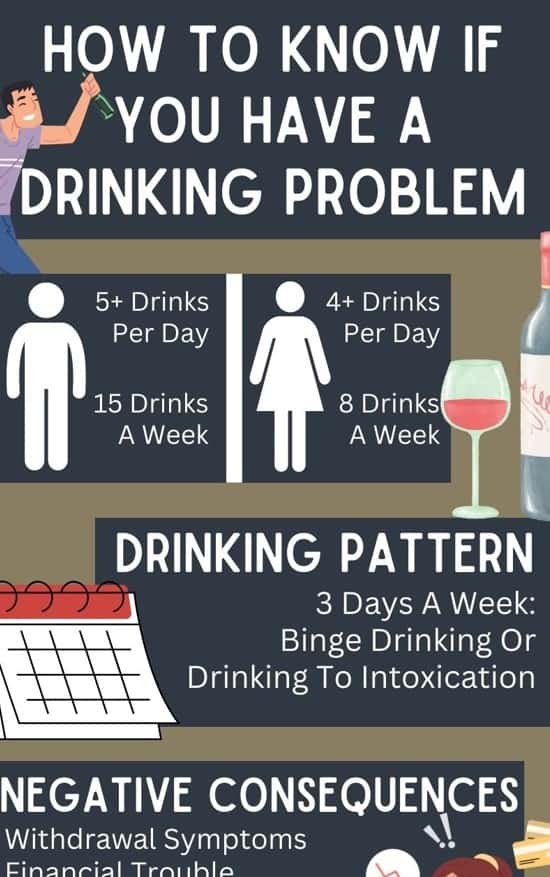
The NIAAA defines a drinking problem as consuming:
more than 5 drinks per day or 15 per week as a man,
more than 4 drinks per day or 8 per week as a woman [4].
WHO
WHO states that moderate alcohol consumption is less than:
1.5 litres of wine per week
3.5 litres of beer per week
450ml of spirits per week [5]
Any consumption over these levels is classed as a drinking problem.
CDC
The CDC define alcohol use disorder as:
Consuming more than 14 drinks a week for a man,
Consuming more than 7 drinks a week for a woman, over the last year [6].
How To Tell If Someone Has A Drinking Problem
Drinking Pattern & Intake Level
Drinking patterns and intake levels that indicate potential alcohol addiction include:
Drinking to intoxication - 3 or more days per week
Physical withdrawal symptoms, such as nausea, vomiting, and shakiness occur in all casual drinking patterns, but symptoms that indicate a drinking problem include:
Secrecy or denial about drinking problem - 67% of alcoholics either completely deny or downplay alcohol abuse [8]
Impulsivity - drinking problems disrupt neurotransmitter levels that induce and magnify impulsive behaviour [9]
Anger - chronic alcoholics are in the 98th percentile for anger [10]
Obsessing over the next drink
Only attending social events where drinking will occur
Being unable to stop drinking before intoxication, illness or memory blackouts occur
Work
A 1-litre increase in alcohol consumption leads to a 13% increase in sickness absences; with absenteeism and poor work performance also being clear indicators of a drinking problem [11].
Only exceed limits on less than 5 days per month [19]
Do not drink drive
Header
Non Drinkers
Social Drinking
Binge Drinking
Chronic Alcoholism
Amount Consumed
0 drinks
1/2 drinks per day [20]
4/5 drinks in 2 hours [21]
4/5 drinks per day [22]
Consumption Frequency
Never
Only at social events
At least 1 day per month [23]
5 or more days per month [19]
Alcohol Cravings?
No
No
Yes
Yes
Needing Alcohol To Socialise
No
Yes
No
No
Relationship Problems
No
No
Yes
Yes
Liver Issues
No
No
Yes
Yes
Legal Issues
No
No
Yes
Yes
Unusual Changes In Routine
No
No
No
Yes
Overreacting To Questions About Drinking
No
No
No
Yes
Reduced Exercise Or Healthy Diet
No
No
No
Yes
Conditions Mistaken For A Drinking Problem
Dementia
Dementia may be confused with a drinking problem due to:
Memory loss
Difficulty concentrating
Changes in mood
Anxiety
Conversely, alcoholism includes these factors, where dementia does not:
Withdrawal symptoms - nausea, vomiting and shakiness
Inability to stop drinking - unsuccessful detoxes or tapering off alcohol use
Auto-Brewery Syndrome
Auto-brewery syndrome may be confused with a drinking problem due to:
Slurred speech
Dizziness
Loss of motor function
Unlike auto-brewery syndrome, alcoholism shows a sharp increase in alcohol use, as well as prioritising alcohol above all other responsibilities.
Tourette's Syndrome
Tourette's syndrome may be confused with a drinking problem due to:
Repeating specific words or phrases
Swearing
Jerking the head or limbs
Grimacing
Unlike Tourette's syndrome, alcoholics do not always outwardly show physical signs of drinking, especially if they are actively trying to avoid detection.
Multiple Sclerosis
Multiple sclerosis (MS) may be confused with a drinking problem due to:
Difficulty pronouncing words - MS affects how the tongue and lips move
Difficulty controlling volume - MS causes a weakened diaphragm
Not remembering words
Not understanding what is being said
Muscle spasms
Alcoholics experience full body or hand tremors, rather than muscle spasms seen in MS sufferers.
Self-Tests To Evaluate If You Have A Drinking Problem
CAGE Questionnaire
The CAGE questionnaire asks about:
Criticism from others about drinking habits
Guilt caused by drinking
Drinking in the morning as the cure for a hangover
Answering yes to two or more, out of four questions indicates a 91% sensitivity to alcoholism [24].
AUDIT Questionnaire
The AUDIT questionnaire asks about:
Injuries to the person and others as a result of alcohol use
Whether others are concerned about drinking levels
Feelings of guilt and remorse after drinking
The questionnaire asks 10 questions and defines the scores as:
0-7 meaning low risk of alcoholism
8-5 meaning increasing risk of alcoholism
16-19 meaning higher risk of alcoholism
20 or more meaning possible alcohol dependence [25].
Alcohol Screening Test (AST)
An aspartate aminotransferase screening test [AST] level of 4 times above the normal range [8-33 U/L], indicates liver disease or chronic hepatitis as a result of alcohol abuse [26] [27].
Severity Of Alcohol Dependence Questionnaire
The severity of alcohol dependence questionnaire asks about:
The MAST has 22 questions with yes or no answers, with scores over 6 indicating problem drinking [29].
Am I An Alcoholic Checklist
Abbeycare's Am I an Alcoholic checklist asks about:
Experiencing withdrawal symptoms
Whether social life is motivated by drinking
Missing obligations due to alcohol use
The checklist has 10 questions, with mostly A's indicating problem drinking, mostly B's indicating some alcohol abuse and mostly C's indicating controlled drinking [30].
Harriet Garfoot BA, MA has an Undergraduate degree in Education Studies and English, and a Master's degree in English Literature, from Bishop Grosseteste University. Harriet writes on stress & mental health, and is a member of the Burney Society. Content reviewed by Laura Morris (Clinical Lead).