Alcoholism is a disease characterised by continuous heavy drinking. Until people with alcohol use disorder admit to problems with alcohol and stop drinking, the risk of alcohol use disorder continues which affects both physical and mental health.
Alcohol starts to injure the brain once it reaches the bloodstream.
Excessive consumption can lead to Alcohol-Related Brain Damage, or ARBD, which is a type of brain disorder caused by alcohol consumption. Brain shrinkage caused by alcohol abuse is permanent, as alcohol kills brain cells and grey matter.
For more information and effects click ‘Learn More’.
Family Recovery Compass is a newsletter for friends and family members who feel trapped between supporting a loved one in addiction, and protecting their own wellbeing.
Every week, we tackle one specific situation in addiction family dynamics, and deliver practical decision-making frameworks and exact dialogue scripts – that help you respond with confidence instead of reaction.
Every month, we bring you an unfiltered recovery conversation with someone who’s either experienced addiction firsthand, or works closely with those in recovery.
No sanitised success stories – just practical insights on what actually works in recovery, that you can apply, in your life too.
Recovery capital is the internal and external resource used to begin the recovery process and maintain sobriety. This combines personal, social, and community support to provide a joined-up approach that supports the addict through recovery.
Do you or a loved one need addiction treatment for alcohol or drugs? Thousands blindly walk into addiction treatment in expensive rehab centres and find that the reality doesn’t meet expectations.
If you’re considering rehab treatment, first check our ultimate guide for complete instructions on how to find the right rehab centre for you.
Take-home Naloxone kits help families and loved ones respond quickly in an opioid overdose emergency, until emergency services arrive. Kits contain nasal or injectable forms of Naloxone.
Changes in legislation mean Naloxone kits are now more widely available from pharmacies and drug services, including Abbeycare.
For additional information, click ‘Learn More’ below.
Overcoming alcohol addiction means first ceasing alcohol intake, and taking care of physical and chemical withdrawal symptoms.
Detoxing from alcohol means undergoing withdrawal from alcohol, but with the assistance of prescribed medication and detox phase, to substitute in place of the alcohol itself.
Alcohol rehab focuses on tackling the problems underneath alcoholism, such as grief, trauma, depression, and emotional difficulties, in order to reduce continuing drinking after treatment.
Inpatient services at an alcohol rehab programme provides 24 hour access to specialist care.
Alcohol home detox provides a means of semi-supervised addiction treatment in the comfort of your home. It’s often suitable for those with inescapable practical commitments, or where a reduced budget for treatment is available.
An at-home detox is the most basic detox option available from Abbeycare, and assumes you have support available, post-detox, for the other important elements of long-term addiction recovery.
The term alcoholism refers to the consumption of alcohol to the extent that the person is unable to manage their own drinking habits or patterns, resulting in side-effects that are detrimental to the quality of life and health of the alcoholic, or those around them.
An alcoholic is someone who continues to compulsively abuse alcohol in this way, despite the negative consequences to their lives and health.
Immediately following treatment, the early stages of recovery and abstinence are most vulnerable to lapses.
At Abbeycare, a structured and peer-reviewed aftercare plan is usually prepared whilst still in treatment. This comprises social, peer, and therapeutic resources individuals draw upon, following a residential treatment programme for drug or alcohol misuse.
Clinically managed residential detoxification is:
– A structured detox that uses medication-assisted treatment and regular physical health observations
– Takes place in an inpatient rehabilitation unit or hospital
– Typically lasts from 7-10 days, but in Abbeycare, it is incorporated into a 28-day rehab programme
Family Therapy at Abbeycare Scotland or Gloucester is realistic, compassionate, and appropriate for families and loved ones of addicts.
Family therapeutic interventions in residential rehabilitation have been designed to support those living with or caring for participants entering the Abbeycare Programme.
Support for families in a group setting allows for a safe, constructive, and confidential place to listen and share common experiences.
Inpatient rehab is drug and/ or alcohol treatment in a rehab centre, where patients remain on-site for the duration of inpatient rehabilitation.
It includes detoxification from drugs, therapy (group work and 1-2-1 sessions), and aftercare planning. Inpatient rehabs typically last 28 days, but this varies on an individual basis.
Long-term treatment at Abbeycare has been developed for those suffering from alcohol or drug addiction. Completing a long-term drug and alcohol inpatient programme may be the solution to problematic substance use.
Motivational Enhancement Therapy can be used by trained addiction recovery therapists to elicit internal changes within and promote long-term recovery from substance use disorder.
All the answers to addiction can be found within with this comprehensive and successful therapy concept leads to behavioural changes, reflective listening, self-motivational statements, and a comprehensive recovery process.
Outpatient drug or alcohol rehab is daytime treatment as opposed to living in a treatment facility.
Outpatient treatment is similar to inpatient in terms of the methods used to treat substance abuse. Where they differ is in their approach to recovery.
Abbeycare’s prison to rehab is a 12-week structured rehab programme which involves direct transfer from prison. The suitability of the candidate is decided by prison staff.
Short-term residential treatment programmes are the chance to press the reset button and access a therapeutic programme designed to create recovery from the use of alcohol and drugs.
Feeling stuck in a rut. Want to stop but can’t seem to achieve sobriety?
Click below.
The 12-step programme was created by alcoholics anonymous (AA), and is specifically designed to aid addicts in achieving and maintaining abstinence.
The central ethos behind the programme is that participants must admit and surrender to a divine power to live happy lives. Ideas and experiences are shared in meetings, and help is sought in an attempt to achieve abstinence.
Abbeycare’s policy to respect your privacy and comply with any applicable law and regulation regarding any personal information we may collect about you, including across our website and other sites we own and operate.
Children Of Alcoholic Parents Are More Likely To Struggle With Addiction
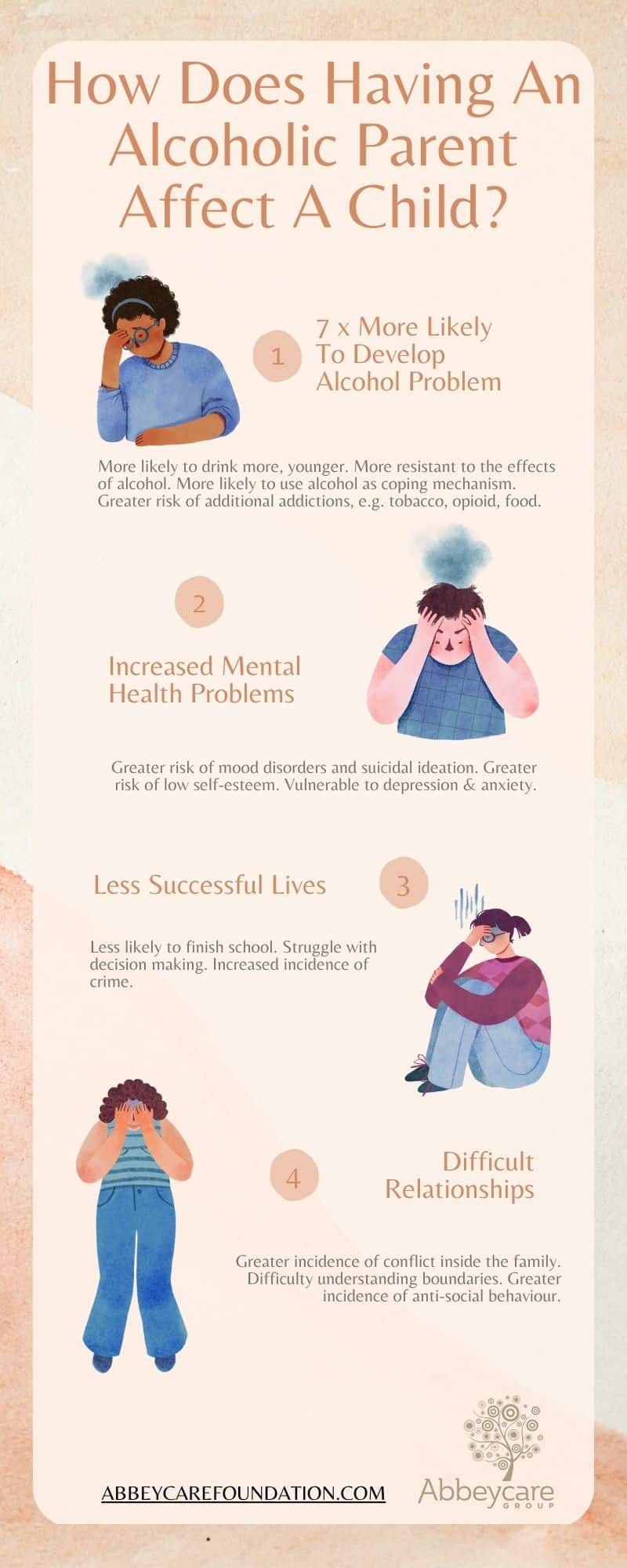
Adult children of alcoholics drink more heavily than children of non-alcoholics and are up to 4 times more likely to develop alcohol problems [8] [9].
One study focusing on homes with alcoholic fathers found that the maternal influences of a non-alcoholic mother did little to offset the increased risk of substance use disorders [10].
Children of alcohol addicts are more likely to have started drinking at a young age, and early onset drinkers are at an increased likelihood of developing alcohol use disorder [11] [12].
Evidence suggests that the children of drinkers are more resistant to the effects of alcohol use, driving them to drink more heavily to feel the effects [13].
Whilst the children of alcoholics respond less intensely to small amounts of alcohol, once intoxicated, their memories and attention spans are inhibited more heavily than the children of non-alcoholics [14].
Even those who are adopted by non-alcoholics are significantly more likely to develop alcohol use disorders, highlighting the genetic component of alcoholism [15] [16].
Children with alcoholic parents are more likely to rely on alcohol as a coping mechanism when dealing with negative emotions [17].
Children raised by parents addicted to alcohol are also more inclined to drink in an attempt to stave off withdrawal symptoms, such as hangovers [18].
Children with multiple alcoholic family members are especially likely to develop a substance abuse disorder [19].
Children of alcoholics are also at an increased risk of developing other addictive disorders, such as:
Tobacco addiction [20]
Opioid addiction [21]
Binge-eating disorders [22]
Kleptomania [23]
Internet addiction disorder [24]
Children With Alcoholic Parents Are More Likely To Experience Abuse
Alcoholic parents are 3 times more likely to physically or sexually abuse their children than non-alcoholics [25].
Intoxicated people have lower inhibitions, which is why a large proportion of violent crimes, including child abuse, involve alcohol use [26].
A parent's substance abuse may also distract them from the warning signs of sexual or physical abuse being inflicted on their child by others- their children are more likely to be abused by a different family or another person, such as a teacher [27].
Adult children who survive child abuse inflicted by an alcoholic family member are more likely to experience further abuse later in life, often inflicted by romantic partners [28].
Children With Alcoholic Parents Are More Likely To Suffer From Mental Health Problems
The children of alcoholic mothers who didn't stop drinking while they were pregnant are more likely to be diagnosed with mood disorders, and to commit suicide [29] [30].
Children of alcoholics are more likely to suffer from low self-esteem, which persists into adulthood- good self-esteem is one of the most important protective factors in averting mental health issues [31] [32] [33].
School-aged children with an alcoholic parent at home have higher rates of depression and anxiety [34].
Later in life, children of drinkers have a greater vulnerability to suffering from depression, suicide, and eating disorders [35].
The high levels of depression in adult children of alcoholics have been linked to parentification- the role reversal that occurs when a child is forced to become an alcoholic parent's caretaker[36].
Male descendants of alcoholics in particular have a higher than average prevalence of schizophrenia [37].
One study focusing on alcoholic fathers found a link between the rate of their alcohol use and suicidal behaviours in their children [38].
The children of alcoholics who struggle with poor mental health were unable to learn good coping skills from their own parents, and consistently turn to unhealthy methods that worsen their symptoms, including:
Denial
Substance use
Ruminating on negative emotions
Withdrawing from a stressful situation or relationship [39]
Child Of Alcoholic Parent Syndrome
Child of alcoholic parent syndrome is not a DSM-V recognised condition, but a collective term used to describe someone who grows up under the conditions of an alcoholic parent, and the effects of those conditions on development and mental health.
These after-effects represent a "Syndrome" due to the unresolved mental associations and conditionings they leave behind.
Children of alcoholic parents experience emotional retriggering of these traumas, later in life, similar to a veteran experiencing symptoms of Post Traumatic Stress Disorder.
Children Of Alcoholic Parents Have Poorer Physical Health
Alcoholic mothers who are unable to stay sober whilst pregnant put their children at risk of fetal alcohol syndrome, which makes them more vulnerable to diseases and more likely to be born with congenital deformations [40].
Children with an alcoholic parent are more frequently admitted to the emergency room for accidental injuries than other children, as alcoholic parents are more likely to leave children unsupervised in unsafe situations [41].
The children of alcoholics are also more likely to be admitted to hospital in adulthood, and to spend longer stretches of time hospitalised [42].
Because life in an alcoholic home can be more chaotic, children of alcoholics often struggle to sleep and are overtired - sleep deprivation can have serious consequences on long-term health [43].
Adults who grew up with an alcoholic parent subsequently have unhealthier lifestyles - they're less physically active, have unhealthier diets, and are more likely to smoke cigarettes [44].
As adults, children whose parents struggled with alcohol abuse are more likely to develop alcohol use disorder themselves, meaning that they are also more vulnerable to the health problems associated with alcohol abuse, and have a shorter lifespan than that of the general population [45].
A study found that adult children of alcoholics who abuse alcohol are at higher risk of being diagnosed with serious health problems, such as cancer, even when compared with others diagnosed with alcohol use disorder [46].
Adult Children of Alcoholic Parents Have Less Successful Lives
Children living in alcoholic households perform more poorly at school in comparison to their peers [47].
Children with alcoholic parents are less likely to finish school [48] [49].
Many children who were forced to take on caretaking responsibilities on behalf of a parent with a substance abuse problem struggle academically in their young adulthood [50].
In later adulthood, children from alcoholic families tend to be of lower socioeconomic status [51].
Adult children raised in an alcoholic home often struggle to make decisions about their careers, which can impede their professional development [52].
The adult child of an alcoholic is more likely to commit a crime than a child raised by non-alcoholics [53].
Children of Alcoholics Have Fraught Interpersonal Relationships
Growing up with a parent with an alcohol problem increases the risk of being raised in a dysfunctional family environment, which undermines a child's basic understanding of how healthy family relationships should function [54].
Adult children of alcoholics are significantly more anxious about dating than their peers, and in men, commitment and trust issues are especially common [56].
In the context of relationships, some children of alcoholics struggle with controlling tendencies and personality traits [57].
Children of alcoholics also feel that they are less competent communicators than their peers [58].
In adulthood, many children of alcoholics who were forced to take on a caretaker role struggle to set or understand emotional boundaries [59].
Parental alcohol abuse can have a negative impact on a child's subsequent romantic relationships, with children of alcoholics experiencing lower levels of marital satisfaction, intimacy, and more incidences of physical aggression [60].
Antisocial or delinquent behaviours are also more common amongst the children of alcoholics [61].
Children of alcoholics report increased levels of loneliness [62].
Lessening The Impact Of Alcoholic Parents
Whilst a child's life is very likely to be negatively impacted in some way by their parent struggling with alcoholism, there are several steps that can be taken to help mitigate the risks.
Anyone concerned about a child whose parents have a substance use problem, can get in touch with their local council to get a licensed social worker involved [63].
Family counselling undertaken whilst an alcoholic relative receives addiction treatment has been found to help their children cope.
For those suffering from mental illness as a result of psychological distress inflicted by an alcoholic parent, there are several treatment options, including mental health services offered by the National Health Service [64].
Younger individuals who have been negatively affected by a parent's substance use disorder can receive treatment from specialised adolescent psychiatry services [65].
Alcoholic Parents Significantly Impact Their Childrens' Lives
Estimates suggest that 1.3 million children in the United Kingdom have a parent suffering from alcohol addiction [67].
Children of alcoholics report lower life satisfaction than the children of non-alcoholics [68].
However, there are treatment options aimed both at alcoholic parents and their children which can help them to live happier, healthier lives.
About the author
Laura Morris
Laura Morris is an experienced clinical practitioner and CQC Registered Manager with over twenty years experience, over ten of which have been as an Independent Nurse Prescriber.
She has held a number of senior leadership roles in the substance use and mental health sector in the NHS, the prison service and in leading social enterprises in the field.