



KEY TAKEAWAYS

What Is A Care Quality Commission Inspection Report?
Purpose | Ensures facilities meet fundamental care standards and identifies areas for improvement [2]. |
Questions Asked | - Are they safe? - Are they effective? - Are they caring? - Are they responsive to people's needs? - Are they well-led? [3] |
Who Is It For? | - The government to assess standard of care - Prospective service users to choose high standard care - The care facility to highlight areas of improvement |
Frequency | New organisations: Within 12 months of opening Established organisations: Depending on previous findings, min every 6 months [4] [5] |
Announced/Unannounced | Notice provided, unless unannounced [6]. |
Structure Of A Report
Five Key Questions Asked About Services
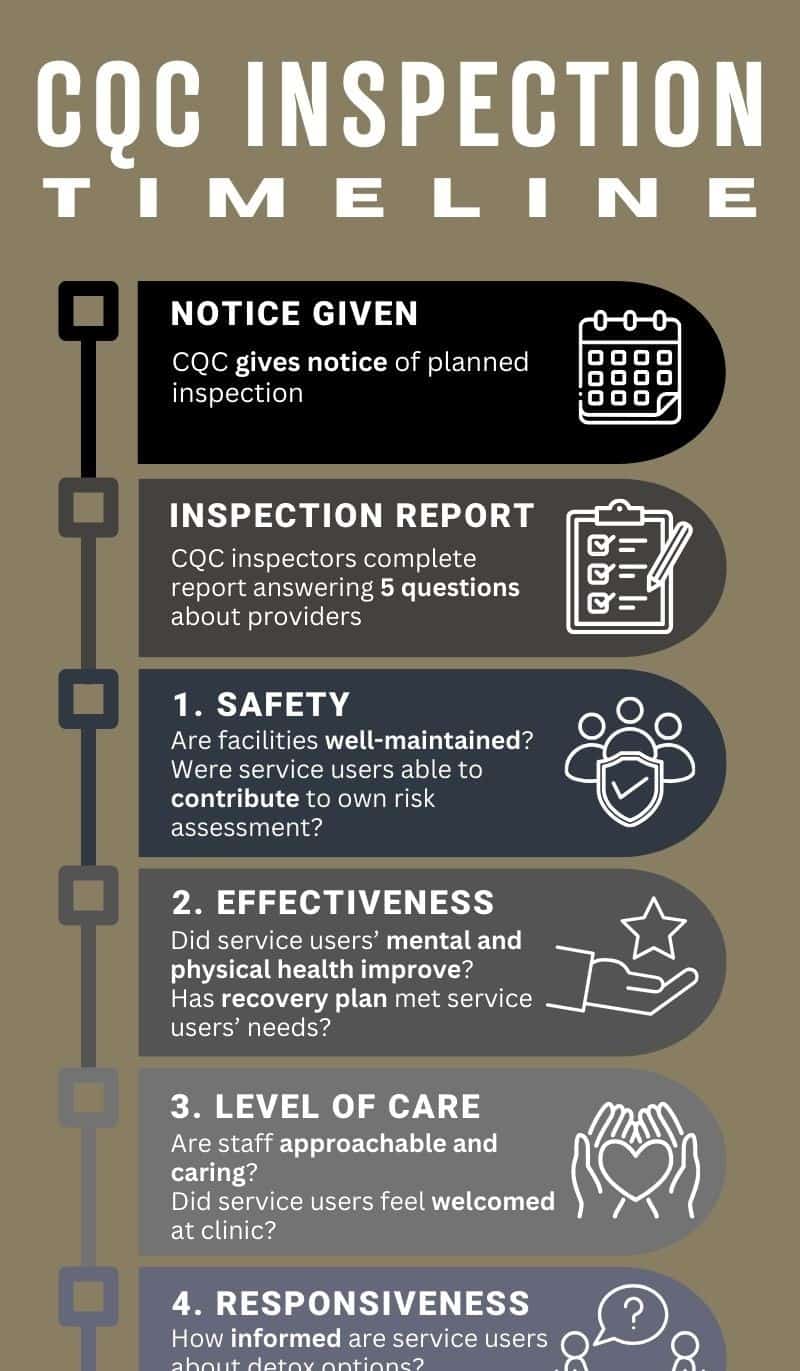
The findings from these questions are consolidated into a comprehensive report that provides guidance on specific areas of improvement, and gives service users detailed information about the quality of the service.
The report rates the service for each of the five questions and provides an overall score [3].
Mental Capacity Act And Deprivation Of Liberty Safeguards
The report includes an assessment of the provider’s compliance with the Mental Capacity Act and Deprivation Of Liberty Safeguards, ensuring services respect individuals' ability to make decisions when possible, and protects client's rights and well-being.
In a drug rehabilitation setting, staff ensure decisions are made by the service user when possible, but decisions are made by staff if clients lack capacity [7].
In a hospital or healthcare practice setting, staff assess patients’ capacity to give informed consent to treatment, and support those who lack the capacity to make decisions [8].
In nursing homes, decisions for those lacking mental capacity must prioritise users' best interests and be minimally restrictive, requiring Deprivation of Liberty Safeguards authorisation [9] [10].
In a mental health facility, if a user lacks decision-making capacity, decisions must be made in the users' best interest, considering users wishes and history [11].

Staff
Inspectorate reports analyse staff ratios to service users to ensure adequate levels of care.
The report assesses the training staff have received, ensuring the facility complies with mandatory training.
The report summarises client feedback regarding staff to give an overview of staff attitudes and behaviours towards clients.
Staff are asked for feedback on the facility, informing the report’s findings on safety, efficacy, care, a user-centred approach, and governance [7].
Discussions With Service Users
The report focuses on feedback from service users by:
Service safety is determined by asking:
Service efficacy is assessed by questions:
Staff levels of care is examined through questions:
Responsiveness to clients' needs is analysed by questions:
Service management is analysed with questions:
Feedback from service users influences the focus areas of investigation work; for example, if concerns have been raised over a safety issue, future reports will focus more intensely on the safety key question [13].
Service user feedback is collated and presented to the facility management team at the end of the visit, in order to address any concerns [7].
A summary of service user feedback is included in the published report for potential future clients to read first-hand experience of previous clients [7].
Feedback alerts inspectors to issues with the service, allowing for further investigation and downgrading evaluation scores if concerns are valid [14].
How Does A Report Evaluate Healthcare Providers?
Rating | Meaning | Actions |
|---|---|---|
Outstanding | Facility is an outstanding practice | No required change |
Good | Level of care at facility meets expectations | No required change |
Requires improvement | The care facility is underperforming and requires a new approach | Changes recommended |
Inadequate | Sub-standard performance or breach of the regulations | 6 months to improve OR Special measures process initiated |
Rating | Inspection Frequency |
|---|---|
Outstanding | Decreased up to 1 year between reports |
Good | Continues at 6 months between reports |
Requires improvement | Increased to up to every 3 months and more unannounced inspections |
Inadequate | Increased to up to every 3 months; more unannounced reviews [15] [16] |
Previous Reports
An exact timeline of evaluation frequency, is currently being finalised [17]:
The special measures process is a framework designed to ensure that services significantly improve within six months, through coordinated enforcement actions and regular re-evaluations, or experience further regulatory actions [16].
The CQC Report Vs Other Regulatory Reports Around The World
Regulatory Body | Country | Healthcare System |
|---|---|---|
CQC | England | Public |
HIW | Wales | Public |
HIS/Care Inspectorate | Scotland | Public |
HIQA | Ireland | Public |
CMS | USA | Private |
ACHS | Australia | Public |
HAS | France | Statutory health insurance system |
Regulatory Body | Nature of Organisation | Scope Outside of Health and Social Care Services? |
|---|---|---|
CQC | Executive non-departmental public body | No |
HIW | Part of a Welsh Government Directorate | No |
HIS/Care Inspectorate | Executive non-departmental public body | No |
HIQA | Independent Authority | No |
CMS | Government Entity | Laboratories [18] |
ACHS | Private accreditation body | Clinical trials and LGBT inclusion in workplaces [19] |
HAS | Independent Public Body | Medical devices and products [20] |
Regulatory Body | Frequency Of Inspection | Publicly Available Reports |
|---|---|---|
CQC | 1 to 5 years [21] | Yes |
HIW | 1 to 3 years [22] | Yes |
HIS/Care Inspectorate | 1 to 5 years [23] | Yes |
HIQA | 1 to 2 years [24] | Yes |
CMS | Varies by state/facility [25] | Yes |
ACHS | 1-4 years [26] | No |
HAS | Varies [27] | Yes |
How Does A Care Inspectorate Investigation Vary By Setting
Rehab
The inspectorate requires services to have clear admission criteria, such as excluding clients who are pregnant or who have a history of seizures; the CQC does not evaluate this in a helathcare practice setting as there are no exclusions from treatment [28].
Services are measured against care and treatment outcomes (e.g relapsing within a year of treatment); this is not evaluated in a nursing home setting, where the focus is on quality of life rather than specific treatment outcomes [29].
Hospital
The report for hospitals analyses the gardens' maintenance and suitability for patients' enjoyment, whereas this is excluded from reports on doctors services that do not have public gardens [30].
The report details the efficiency of hospital staff handovers, whereas this is excluded from doctors reports that only operate during standard working hours [30].
Hospital reports examine the safeguarding procedures for visitors who are children, whereas this is not considered in a general practitioner setting where patients do not receive visitors [30].
The investigation report for hospitals examines how well the catering meets users’ needs, whereas they do not examine this in GP surgeries that do not provide patient food [30].
The report for hospitals explores how well the facility meets its patients' entertainment needs; it does not examine this in a GP setting, where patients visit relatively briefly [30].
CQC reports evaluate the birthing pool safety equipment and procedures in maternity units, which is omitted in nursing homes, GPs, and rehabs that do not have pools [31].

Nursing Home
The report for Nursing Homes evaluates whether call bells are located within reach in service users’ bedrooms, whereas, this is not considered in a report for healthcare surgeries where patients do not sleep [32].
The report for Nursing Homes monitors whether the service washes and dresses service users at a time appropriate for them; this is not evaluated in a rehab setting where service users wash and dress themselves [32].
The report for Nursing Homes evaluates whether staff cut up clients' food for them if their care plan shows a choke hazard risk; this is not considered in a rehab setting where service users can cut up their own food [32].
The report for Nursing Homes checks whether the service has a registered manager, a requirement not mandated for GPs or NHS hospitals [33].
Local Healthcare Surgeries
For GP surgeries, checks will evaluate receptionists' training to recognise the symptoms of sepsis; it does not examine this in a rehab setting where receptionists do not receive medical training.
For medical surgeries, visits evaluate the length of time it takes for doctors to analyse abnormal test results, whereas in rehab or nursing homes, this is not necessary as the tests they run are not diagnostic.
Regulators evaluate how efficiently medical surgeries monitor their patients who have asthma, diabetes, or kidney disease; this is not an area of focus in a rehab where only the patient’s substance misuse is treated.
The report for medical surgeries evaluates child immunisation targets, which are not monitored in reports on rehabs or nursing homes that do not treat children.
The report of medical surgeries evaluates waiting times for medical appointments, which is irrelevant in a nursing home that does not provide appointments to its residents [34].
Elements That Change CQC Reports
Programme Type
High patient turnover in shorter programme lengths requires frequent admission and discharge processes; an assessment looks closely at safeguarding procedures, service users' involvement, and informed consent during these transitions [7].
Size Of Service
Staff shortages in mental health services impact larger facilities more than smaller ones:
Geographical Location
Rural substance misuse services receive less funding than urban facilities, resulting in less well-maintained buildings and lower scores on regulatory visits.
Urban facilities have more specialised services to meet clients' diverse needs than rural ones and facilitate a more person-centred approach.
Rural clinics navigate a limited network of services over larger geographic areas; this makes effective interagency cooperation, as assessed by regulatory reports, more challenging for rural services than urban.
Increased diversity in urban settings challenges facilities' ability to respond to their clients' needs, as many service users do not speak English.
Due to the higher population, heavy caseloads in urban areas strain facilities more than in rural settings, resulting in greater scrutiny on staffing issues [36].
Patient Feedback/ Complaints
Service users are encouraged to complain to the service first; if the issue is not resolved satisfactorily directly, it will be escalated [37].
Feedback is collected through website, helpline, and social media from those who have previously used the service to decide what and when to inspect [14].
Significant concerns arising from complaints, result in focused or expedited comprehensive investigation [14].
Technological Changes
Technology makes sharing care records between services easier, resulting in a higher Effectiveness rating [38].
Technological innovations, such as phones or tablets, give people autonomy over their care with self-monitoring, resulting in a higher rating for Responsiveness [38].
Transitioning to electronic systems causes disruptions to services and patient care, reducing a service’s overall score [39].
Rapid introduction of new technologies puts services at risk of noncompliance with data protection policies, resulting in a lower Safety score [40].
Electronic storage and sharing of patient data without robust cybersecurity measures put patient information at risk of being accessed in a cybersecurity breach, resulting in a lower Safety score [40].
What An Assessment Is Not
Report Feature | Does Report Include This? | Would This Improve The Report? |
|---|---|---|
Comparison tool | No | Would make direct comparisons of facilities easier. |
Costs of alternative approaches | No | Greater perspective on all available options. |
Complaint Record | No | Additional insight into track record. |
Endorsement | No | Would help select an appropriate facility. |
Exhaustive Analysis | No | Would provide wider perspective on the service. |
Guarantee Of Safety | No | Includes only issues observed during evaluation period. |
Healthcare Advice | No | Assesses standard of care only. |
Only Source Of Information | No | Other sources of information should be considered. |

