Alcoholism is a disease characterised by continuous heavy drinking. Until people with alcohol use disorder admit to problems with alcohol and stop drinking, the risk of alcohol use disorder continues which affects both physical and mental health.
Alcohol starts to injure the brain once it reaches the bloodstream.
Excessive consumption can lead to Alcohol-Related Brain Damage, or ARBD, which is a type of brain disorder caused by alcohol consumption. Brain shrinkage caused by alcohol abuse is permanent, as alcohol kills brain cells and grey matter.
For more information and effects click ‘Learn More’.
Family Recovery Compass is a newsletter for friends and family members who feel trapped between supporting a loved one in addiction, and protecting their own wellbeing.
Every week, we tackle one specific situation in addiction family dynamics, and deliver practical decision-making frameworks and exact dialogue scripts – that help you respond with confidence instead of reaction.
Every month, we bring you an unfiltered recovery conversation with someone who’s either experienced addiction firsthand, or works closely with those in recovery.
No sanitised success stories – just practical insights on what actually works in recovery, that you can apply, in your life too.
Recovery capital is the internal and external resource used to begin the recovery process and maintain sobriety. This combines personal, social, and community support to provide a joined-up approach that supports the addict through recovery.
Do you or a loved one need addiction treatment for alcohol or drugs? Thousands blindly walk into addiction treatment in expensive rehab centres and find that the reality doesn’t meet expectations.
If you’re considering rehab treatment, first check our ultimate guide for complete instructions on how to find the right rehab centre for you.
Take-home Naloxone kits help families and loved ones respond quickly in an opioid overdose emergency, until emergency services arrive. Kits contain nasal or injectable forms of Naloxone.
Changes in legislation mean Naloxone kits are now more widely available from pharmacies and drug services, including Abbeycare.
For additional information, click ‘Learn More’ below.
Overcoming alcohol addiction means first ceasing alcohol intake, and taking care of physical and chemical withdrawal symptoms.
Detoxing from alcohol means undergoing withdrawal from alcohol, but with the assistance of prescribed medication and detox phase, to substitute in place of the alcohol itself.
Alcohol rehab focuses on tackling the problems underneath alcoholism, such as grief, trauma, depression, and emotional difficulties, in order to reduce continuing drinking after treatment.
Inpatient services at an alcohol rehab programme provides 24 hour access to specialist care.
Alcohol home detox provides a means of semi-supervised addiction treatment in the comfort of your home. It’s often suitable for those with inescapable practical commitments, or where a reduced budget for treatment is available.
An at-home detox is the most basic detox option available from Abbeycare, and assumes you have support available, post-detox, for the other important elements of long-term addiction recovery.
The term alcoholism refers to the consumption of alcohol to the extent that the person is unable to manage their own drinking habits or patterns, resulting in side-effects that are detrimental to the quality of life and health of the alcoholic, or those around them.
An alcoholic is someone who continues to compulsively abuse alcohol in this way, despite the negative consequences to their lives and health.
Immediately following treatment, the early stages of recovery and abstinence are most vulnerable to lapses.
At Abbeycare, a structured and peer-reviewed aftercare plan is usually prepared whilst still in treatment. This comprises social, peer, and therapeutic resources individuals draw upon, following a residential treatment programme for drug or alcohol misuse.
Clinically managed residential detoxification is:
– A structured detox that uses medication-assisted treatment and regular physical health observations
– Takes place in an inpatient rehabilitation unit or hospital
– Typically lasts from 7-10 days, but in Abbeycare, it is incorporated into a 28-day rehab programme
Family Therapy at Abbeycare Scotland or Gloucester is realistic, compassionate, and appropriate for families and loved ones of addicts.
Family therapeutic interventions in residential rehabilitation have been designed to support those living with or caring for participants entering the Abbeycare Programme.
Support for families in a group setting allows for a safe, constructive, and confidential place to listen and share common experiences.
Inpatient rehab is drug and/ or alcohol treatment in a rehab centre, where patients remain on-site for the duration of inpatient rehabilitation.
It includes detoxification from drugs, therapy (group work and 1-2-1 sessions), and aftercare planning. Inpatient rehabs typically last 28 days, but this varies on an individual basis.
Long-term treatment at Abbeycare has been developed for those suffering from alcohol or drug addiction. Completing a long-term drug and alcohol inpatient programme may be the solution to problematic substance use.
Motivational Enhancement Therapy can be used by trained addiction recovery therapists to elicit internal changes within and promote long-term recovery from substance use disorder.
All the answers to addiction can be found within with this comprehensive and successful therapy concept leads to behavioural changes, reflective listening, self-motivational statements, and a comprehensive recovery process.
Outpatient drug or alcohol rehab is daytime treatment as opposed to living in a treatment facility.
Outpatient treatment is similar to inpatient in terms of the methods used to treat substance abuse. Where they differ is in their approach to recovery.
Abbeycare’s prison to rehab is a 12-week structured rehab programme which involves direct transfer from prison. The suitability of the candidate is decided by prison staff.
Short-term residential treatment programmes are the chance to press the reset button and access a therapeutic programme designed to create recovery from the use of alcohol and drugs.
Feeling stuck in a rut. Want to stop but can’t seem to achieve sobriety?
Click below.
The 12-step programme was created by alcoholics anonymous (AA), and is specifically designed to aid addicts in achieving and maintaining abstinence.
The central ethos behind the programme is that participants must admit and surrender to a divine power to live happy lives. Ideas and experiences are shared in meetings, and help is sought in an attempt to achieve abstinence.
Abbeycare’s policy to respect your privacy and comply with any applicable law and regulation regarding any personal information we may collect about you, including across our website and other sites we own and operate.
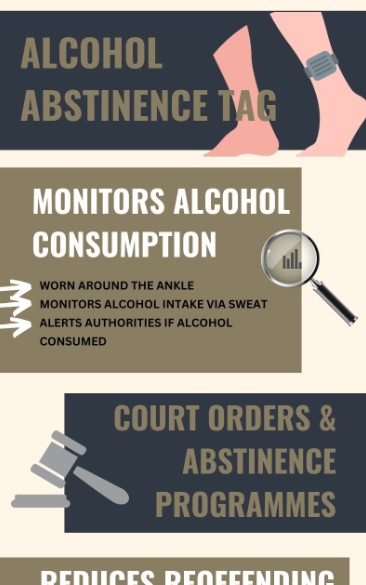
Alcohol tracking devices were first launched in Wales in October 2020, followed by England in March 2021 after a successful trial in Yorkshire and Lincolnshire in 2019 [2].
The devices are given to those either leaving prison; or as a prison alternative when drinking is considered a factor in the crime.
SCRAM is the brand used in England and Wales and is approved by HMP and the court system for alcohol testing [3].
Why Is The Alcohol Tag Used?
The electronic device is used to:
Reduce reoffending - particularly in those where alcohol was a factor in crime [4]
Reduce alcohol-linked crime - alcohol is involved in 39% of violent crimes [5]
Removing the number of prison sentences administered - saving taxpayer money on prison sentences [6]
How Alcohol Tags Work
Alcohol devices detect alcohol abuse by using transdermal testing of sweat on the skin to identify traces of alcohol every 30 minutes, 24 hours a day.
In the event of any level of alcohol being detected or the device being tampered with, an alert via radio frequency is immediately sent to the police [7].
This can result in financial penalties, prolonged probation or a return to prison.
Instructions given to users when having a device fitted:
Do not try to remove or interfere with the device in any way
Make sure to keep the battery charged - failure to do so will be considered tampering with the device
When Alcohol Abstinence Tags Are Used
Cases where alcohol testing devices are most likely to be part of sentencing are:
Aggravated assault, in 64% of violent incidents towards strangers, perpetrators were believed to be intoxicated [8]
Domestic violence - where a pattern of alcohol misuse appears to be a key factor in violence
Drink driving or causing death by dangerous driving if related to alcohol
Cases where alcohol testing devices are less likely, but occasionally still used as part of sentencing are:
Robbery - if the crime occurred whilst drunk or to obtain alcohol
Sexual assault - if the crime occurred whilst drunk, dependent on the judge's sentencing
Public intoxication - alcohol testing devices are used after bans from city/town centres and location tracking devices have not been effective
Those achieving abstinence as a result of a court order may do so with little underlying positive motivation.
Whereas, those undertaking recovery voluntarily, without an abstinence tag, do so as a result of changed internal decision-making around alcohol.
Despite this, offenders have experienced the full extent of the legal process, making it difficult to continue in a state of denial about alcoholism.
Alcohol testing devices provide the ability to become sober at this optimal time, before the drinker is able to rationalise consequences and return to drinking.
Alcohol Abstinence Tags Usage Statistics
In South Dakota, the 24/7 sobriety project is used as an alternative to prison, with 50% of those qualifying for the programme having been previously convicted over 3 times for drunk driving crimes.
In the programme, which has used 287 devices in 10 years, 74% of offenders had a negative result for alcohol throughout, with no signs of tampering with the device [9].
In Virginia, alcohol testing devices have a 72% success rate and are used as either a condition of bail, or as an alternative to prison for drunk driving or domestic violence caused by alcohol [10].
Using Tags Specifically To Reduce Alcohol Misuse
Devices are ordered specifically for alcohol misuse due to:
Alcohol being linked to most or all crimes previously committed
The courts and probation service believe that, given the opportunity to reduce alcohol consumption, the offender will no longer commit crimes
Alcohol testing devices are considered a better option than alcohol rehabs for offenders in certain cases because:
Traditional rehab options are more suited for severe alcohol use disorders. Whereas, testing devices are used for those with low-level alcohol dependency
Provides longer monitoring than a traditional rehab, for low-level alcohol intake . The programme is up to 1 year unlike 28 days in a rehab
After 1 year of alcohol tag monitoring, 97% of offenders have remained completely abstinent from alcohol [12].
The abstinence rate stayed the same after 2 years of the programme, whilst the number of users rising from 100 to 2,250 during 2021 to 2023 [13].
Positive Impacts On Recovery
Data To Improve Interventions & Individualise Care Plans
The alcohol abstinence tag system could provide data to update alcohol-based interventions, allowing more customisation to individuals' needs.
This means that there is appropriate intervention available for those who, due to personal individual needs and circumstances:
Do not actively engage during alcohol treatment
Have repeatedly relapsed
Have numerous previous alcohol-related crimes and have been given other forms of sentencing (community service, bans from town centres, electronic location monitoring etc) [14]
The offender group reconviction scale (using age, gender, crime committed and criminal history to predict reoffending) predicts a high level of reoffending (scale between 0-1) [15]
Early Intervention At Point Of Crisis
With some calibration, alcohol testing devices could connect the drinker with appropriate social care and healthcare professionals after drinking, preventing a slip from becoming a relapse.
A testing device could also be connected to a smartphone app that provides immediate guidance to the user after a lapse has occurred, i.e. direct access to a local ADP team or sponsor via phone or in person.
Opportunity To Access Therapeutic Interventions
Whilst working with a probation officer during imposed tag use, offenders are able to access interventions for pre-existing conditions.
These pre-existing conditions may have been self-medicated with alcohol; or alcohol may have been used to cope with symptoms of these conditions, such as:
Anxiety
PTSD/Trauma
Depression
Being able to access appropriate treatment during enforced abstinence leads to a reduction in reoffending [16].
Disadvantages Of Alcohol Monitoring Tags
False Positives
Whilst uncommon, false positives can occur if the device is older and hasn't been updated, or has not been correctly administered to the body [17].
False positives occur when a user has:
Used mouthwash or breath spray
Used antiperspirant or perfume
Spilt an alcoholic drink over the device
Come into contact with chemicals containing alcohol, particularly if working with paint or chemicals
The impact of a false positive for the user includes:
A financial penalty, community service or prison sentence that is not deserved
Loss of motivation to continue on recovery journey
Negative Motivation vs Positive Motivation In Recovery
Those coerced or forced into treatment, are 17.6% more like to relapse into alcoholism, compared to those who have entered treatment willingly [18].
As a parallel, those assigned electronic monitoring devices, who achieve sustained abstinence over time, may show reduced voluntary motivation for sobriety, potentially reducing long term recovery outcomes.
External vs Internal Locus Of Responsibility
Abstinence as a result of external enforcement and accountability, such as an ankle device, is less likely to help the individual reclaim personal responsibility for themselves.
Drawing from our experience at Abbeycare, enforced tags mean the user is not undertaking recovery of their own volition.
Whereas, those voluntarily choosing sobriety, experience a shift from an external to an internal locus of responsibility through therapeutic intervention.
Those using enforced tags have no therapeutic journey, so do not have a shift in responsibility that encourages successful abstinence journeys.
Short Term Coerced Abstinence vs Long Term Voluntary Abstinence
Whilst enforcing abstinence provides short-term positive results, it does not motivate the individual to:
Gain long-term positive associations with sobriety
Consciously seek recovery of their own volition. Short-term abstinence does not equate to long-term recovery
Improve confidence levels by making positive choices for themselves
Enforced abstinence removes the user's opportunity to experience positive feelings triggered when choosing sobriety voluntarily, resulting in increased motivation.
Our findings in the clinic show that positive feedback loops, such as voluntarily choosing sobriety, are crucial during early recovery for abstinence to last over time.
This means, that whilst tagging produces short-term abstinence, it may not lead to true alcohol recovery.
Negative Emotional Reinforcement
Those suffering from alcoholism experience pre-existing embarrassment, shame and guilt around drinking.
Overcoming shame and guilt makes it easier to overcome the underlying causes of alcoholism.
Wearing a physical tag as an identifier of alcohol-related issues could exacerbate perceived judgement from others, making emotional recovery more difficult.
Alcohol Tag Long-Term Benefits
81% of users of enforced devices predicted drinking less or not at all after the device is removed [19].
Justice Secretary David Gauke predicts that by using alcohol testing devices, alongside community support, there will be 32,000 fewer offences committed per year [20].
When Alcohol Tagging Doesn't Work
False Negatives
Alcohol testing devices have a 99.8% detection rate when consumed over 4-5 drinks, but a 31% detection of less than 5 drinks [21].
This means that, if a user manages to maintain a level of drinking that produces a false negative, there will be no meaning or consequences ascribed to the negative impact of drinking.
Cross Addiction To Drugs
Alcohol testing devices are not able to detect other substances, potentially leading to users choosing to experiment with illicit drugs to replace alcohol.
As enforced abstinence does not resolve the underlying addiction, developing a cross-addiction becomes more likely, to replace alcohol as a pre-existing coping mechanism.
Stigma
30% of device users reported perceived stigma from friends and family due to the device, potentially resulting in isolation and depression.
10% of those with a monitoring device reported that wearing the device hindered the ability to gain employment, further demotivating users from the desire to achieve sobriety [22].
About the author
Harriet Garfoot
Harriet Garfoot BA, MA has an Undergraduate degree in Education Studies and English, and a Master's degree in English Literature, from Bishop Grosseteste University. Harriet writes on stress & mental health, and is a member of the Burney Society. Content reviewed by Laura Morris (Clinical Lead).