Alcoholism is a disease characterised by continuous heavy drinking. Until people with alcohol use disorder admit to problems with alcohol and stop drinking, the risk of alcohol use disorder continues which affects both physical and mental health.
Alcohol starts to injure the brain once it reaches the bloodstream.
Excessive consumption can lead to Alcohol-Related Brain Damage, or ARBD, which is a type of brain disorder caused by alcohol consumption. Brain shrinkage caused by alcohol abuse is permanent, as alcohol kills brain cells and grey matter.
For more information and effects click ‘Learn More’.
Family Recovery Compass is a newsletter for friends and family members who feel trapped between supporting a loved one in addiction, and protecting their own wellbeing.
Every week, we tackle one specific situation in addiction family dynamics, and deliver practical decision-making frameworks and exact dialogue scripts – that help you respond with confidence instead of reaction.
Every month, we bring you an unfiltered recovery conversation with someone who’s either experienced addiction firsthand, or works closely with those in recovery.
No sanitised success stories – just practical insights on what actually works in recovery, that you can apply, in your life too.
Recovery capital is the internal and external resource used to begin the recovery process and maintain sobriety. This combines personal, social, and community support to provide a joined-up approach that supports the addict through recovery.
Do you or a loved one need addiction treatment for alcohol or drugs? Thousands blindly walk into addiction treatment in expensive rehab centres and find that the reality doesn’t meet expectations.
If you’re considering rehab treatment, first check our ultimate guide for complete instructions on how to find the right rehab centre for you.
Take-home Naloxone kits help families and loved ones respond quickly in an opioid overdose emergency, until emergency services arrive. Kits contain nasal or injectable forms of Naloxone.
Changes in legislation mean Naloxone kits are now more widely available from pharmacies and drug services, including Abbeycare.
For additional information, click ‘Learn More’ below.
Overcoming alcohol addiction means first ceasing alcohol intake, and taking care of physical and chemical withdrawal symptoms.
Detoxing from alcohol means undergoing withdrawal from alcohol, but with the assistance of prescribed medication and detox phase, to substitute in place of the alcohol itself.
Alcohol rehab focuses on tackling the problems underneath alcoholism, such as grief, trauma, depression, and emotional difficulties, in order to reduce continuing drinking after treatment.
Inpatient services at an alcohol rehab programme provides 24 hour access to specialist care.
Alcohol home detox provides a means of semi-supervised addiction treatment in the comfort of your home. It’s often suitable for those with inescapable practical commitments, or where a reduced budget for treatment is available.
An at-home detox is the most basic detox option available from Abbeycare, and assumes you have support available, post-detox, for the other important elements of long-term addiction recovery.
The term alcoholism refers to the consumption of alcohol to the extent that the person is unable to manage their own drinking habits or patterns, resulting in side-effects that are detrimental to the quality of life and health of the alcoholic, or those around them.
An alcoholic is someone who continues to compulsively abuse alcohol in this way, despite the negative consequences to their lives and health.
Immediately following treatment, the early stages of recovery and abstinence are most vulnerable to lapses.
At Abbeycare, a structured and peer-reviewed aftercare plan is usually prepared whilst still in treatment. This comprises social, peer, and therapeutic resources individuals draw upon, following a residential treatment programme for drug or alcohol misuse.
Clinically managed residential detoxification is:
– A structured detox that uses medication-assisted treatment and regular physical health observations
– Takes place in an inpatient rehabilitation unit or hospital
– Typically lasts from 7-10 days, but in Abbeycare, it is incorporated into a 28-day rehab programme
Family Therapy at Abbeycare Scotland or Gloucester is realistic, compassionate, and appropriate for families and loved ones of addicts.
Family therapeutic interventions in residential rehabilitation have been designed to support those living with or caring for participants entering the Abbeycare Programme.
Support for families in a group setting allows for a safe, constructive, and confidential place to listen and share common experiences.
Inpatient rehab is drug and/ or alcohol treatment in a rehab centre, where patients remain on-site for the duration of inpatient rehabilitation.
It includes detoxification from drugs, therapy (group work and 1-2-1 sessions), and aftercare planning. Inpatient rehabs typically last 28 days, but this varies on an individual basis.
Long-term treatment at Abbeycare has been developed for those suffering from alcohol or drug addiction. Completing a long-term drug and alcohol inpatient programme may be the solution to problematic substance use.
Motivational Enhancement Therapy can be used by trained addiction recovery therapists to elicit internal changes within and promote long-term recovery from substance use disorder.
All the answers to addiction can be found within with this comprehensive and successful therapy concept leads to behavioural changes, reflective listening, self-motivational statements, and a comprehensive recovery process.
Outpatient drug or alcohol rehab is daytime treatment as opposed to living in a treatment facility.
Outpatient treatment is similar to inpatient in terms of the methods used to treat substance abuse. Where they differ is in their approach to recovery.
Abbeycare’s prison to rehab is a 12-week structured rehab programme which involves direct transfer from prison. The suitability of the candidate is decided by prison staff.
Short-term residential treatment programmes are the chance to press the reset button and access a therapeutic programme designed to create recovery from the use of alcohol and drugs.
Feeling stuck in a rut. Want to stop but can’t seem to achieve sobriety?
Click below.
The 12-step programme was created by alcoholics anonymous (AA), and is specifically designed to aid addicts in achieving and maintaining abstinence.
The central ethos behind the programme is that participants must admit and surrender to a divine power to live happy lives. Ideas and experiences are shared in meetings, and help is sought in an attempt to achieve abstinence.
Abbeycare’s policy to respect your privacy and comply with any applicable law and regulation regarding any personal information we may collect about you, including across our website and other sites we own and operate.
Symptomatically treating spice withdrawal symptoms (e.g. existential panic, hypertension, i.e > 140/90 mmHg) with medication as needed (e.g. 40mg propranolol) for 7 days
Stabilising CB1R/CB2R, dopamine, noradrenaline, and glutamate signalling after being overstimulated or suppressed by spice during active use
Below, we discuss possible approaches that meet the specific detox needs around spice. Not all treatment centres will provide these specific interventions.
For an overview of the Abbeycare programme contents for spice detox, click here.
Spice Detox Symptom Management
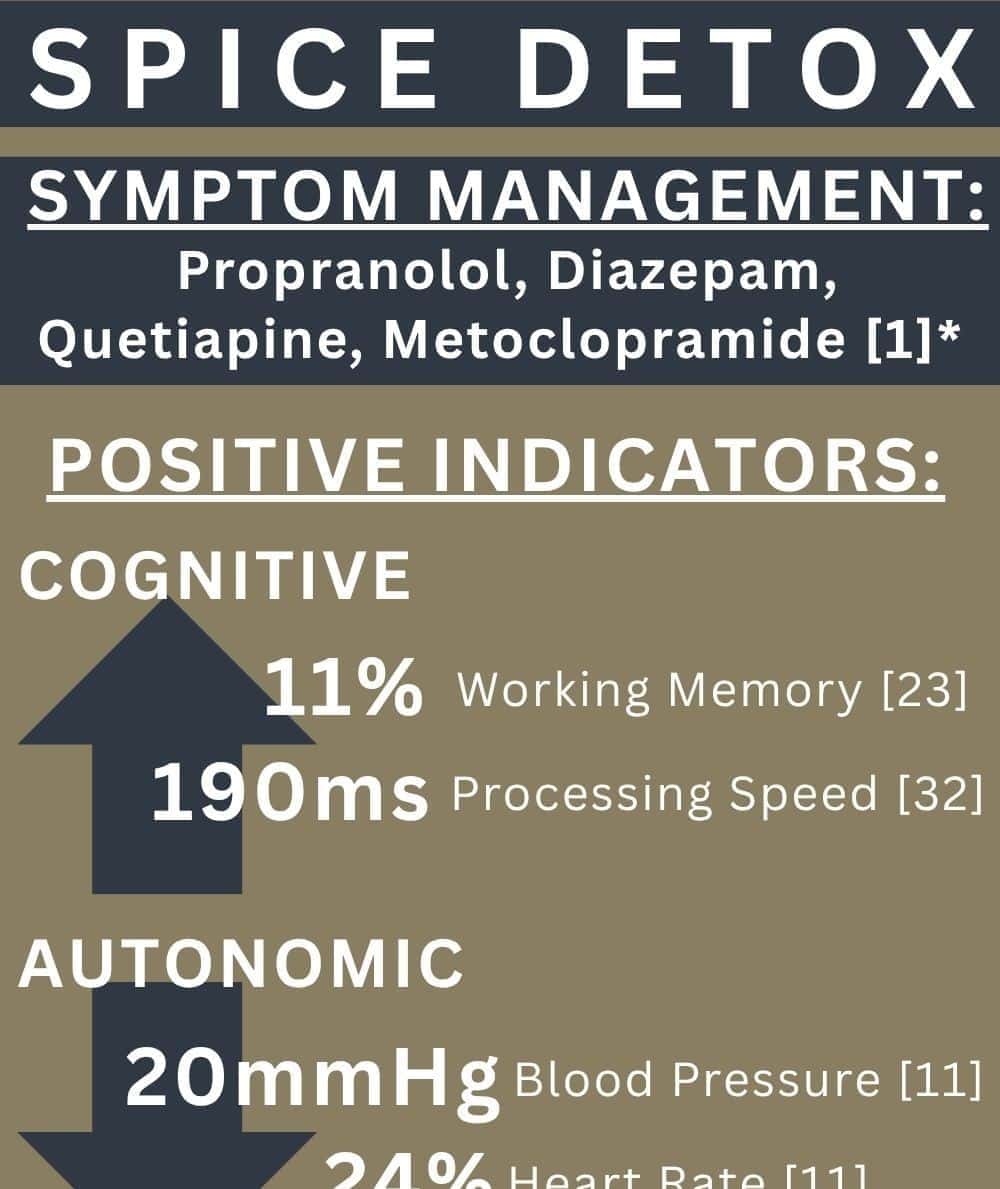
There is no medicated detox available for spice, and symptom management protocols including beta-blockers (e.g. 10mg propranolol), benzodiazepines (e.g. 10mg diazepam), and antipsychotics (e.g. 50mg quetiapine) are used for ≤ 7 days during an inpatient detox to [1]:
Control anxiety, panic, profuse sweating, and palpitations developing within 24 – 48 hours of cessation by inhibiting beta-1 and beta-2 adrenergic stimulation in the heart, although propranolol is avoided in patients with bradycardia (HR = < 60 BPM)
Manage restlessness, agitation, and sleep disturbances (i.e. nightmares, vivid dreams) that peak around 72 hours after last using spice, by binding to GABA-A and 5-HT2A receptors to regulate mood by minimising neuronal excitability
10mg Metoclopramide is administered every 4-6 hours during treatment for spice addiction to mitigate nausea in 30% of patients who previously used 3g a day for 2 years, often developing within 1 hour of last use, peaking during day 2, and subsiding by day 7 [1][2].
The Cannabis Withdrawal Assessment Scale is used during spice rehab to establish the severity of symptoms (e.g. sweating) in the preceding 24 hours using a scoring system (e.g. 3 = severe), and medication is adjusted as needed (e.g. 10mg to 40mg propranolol) [1].
Physical Symptoms Of Spice Detox
Gastrointestinal Cramping
Gastrointestinal cramping is a physical spice withdrawal symptom because cholinergic contractions are no longer inhibited by 77% due to the downregulation of CB1 receptors in the enteric nervous system (ENS), leading to [3]:
A loss of appetite in 43% after discontinuing heavy spice use (e.g. around 2.8g a day) due to abdominal cramps, vomiting, nausea, and epigastric pain for up to 7 days after cessation [2][4]
Some patients claim, “When I quit smoking, I struggle to eat an apple, I vomit more than I urinate, and I have diarrhoea every third hour,” due to the dysregulation of smooth muscle relaxation, gut motility, and the secretion of digestive fluids [5]
Hopkins & Gilchrist (2013) studied a 30-year-old who no longer experienced “severe crampy abdominal pain” with intractable nausea and vomiting within 14 days of abstaining from spice and taking ondansetron, after previously smoking every hour during active use [6].
Abdominal cramps are treated with 20mg Hyoscine Butylbromide for up to 7 days during spice withdrawal, and nurses encourage patients to maintain hydration (e.g. 2L of liquids daily) and eat regular light meals to manage nausea and dehydration after vomiting [1].
Uncontrollable Tremors
Uncontrollable tremors are physical spice withdrawal symptoms because the sympathetic nervous system becomes overactive as noradrenaline rebounds after being suppressed by 27 - 50% in the cerebral cortex, cerebellum, and hippocampus during active use [7].
Uncontrollable tremors typically last 3 – 4 days and are exacerbated by motor instability caused by a 62% decrease in dopaminergic activity within 24 hours of abstaining from spice, after being elevated by up to 150% while actively using up to 10g a day [8][9][10].
Zimmermann et al. (2009) studied a 20-year-old man who developed tremors with “electrical shocks” and “twitches” on the 4th day of spice abstinence after using 3g daily for 8 months, subsiding by day 7 after taking 25mg Promethazine and 0.175mg Clonidine [11].
Nacca et al. (2013) studied a 20-year-old man who presented with tremors on the 6th day of spice cessation, after 18 months of daily use, alleviated by taking 50mg Quetiapine daily due to the stabilisation of dopamine and serotonin levels in the brain [12].
Seizures
Seizures are a physical withdrawal symptom because the 46% CB1R-mediated inhibition of hippocampal glutamate release is reversed due to the desensitisation of the endocannabinoid system (ECS) during detox [13].
8% of spice users have seizures after smoking the drug up to 4 times a day, as using synthetic cannabinoids increases the risk of having a seizure by 3-fold due to imbalances in excitatory (e.g. glutamate) and inhibitory (e.g. GABA) neurotransmission in the brain [14][15]:
Havenon et al. (2011) investigated a 24-year-old man who experienced a 3 – 5-minute generalised tonic-clonic seizure after taking spice, followed by a 1-minute seizure with urinary incontinence and postictal confusion later that day [16]
Schep et al. (2015) studied a 23-year-old spice user who had 2 generalised tonic–clonic seizures within 4 - 6 hours of last use, leading to urinary incontinence and tongue lacerations, although seizure activity stopped within 12 hours of taking diazepam [17]
Some spice users have seizures within 2 hours of last use, and others have recurrent seizures after day 1, although anticonvulsants (e.g. Fosphenytoin 15mg/kg) and barbiturates (e.g. 100mg Phenobarbital) are used during treatment to control convulsions as needed [18].
Abbeycare conducts regular observations (e.g. every 15 - 30 minutes) for patients at risk of having seizures during spice withdrawal, and each single-occupancy room includes emergency pull cords to alert nurses if necessary.
Hypertension
Hypertension (BP ≥ 140/90 mmHg) is a physical K2 withdrawal symptom because the sympathetic nervous system becomes overactive due to disruptions in CB1R signalling, leading to dizziness, blurred vision, headaches, and chest pain in up to 68% of patients [15].
Zimmermann et al. (2009) investigated the case of a 20-year-old man who experienced hypertension during a detoxification from spice after previously consuming 1-3g daily for around 8 months:
Headaches and feelings of numbness in the right arm and fingers lasting around 1 minute each time developed as blood pressure reached a maximum of 180/90 mmHg on the 4th day of abstinence
Blood pressure remained elevated at 140/90 mmHg (normal values = 90/60 - 120/80 mmHg) until the 21st day of treatment and gradually stabilised after taking 0.175 mg clonidine [11]
Nacca et al. (2013) found that blood pressure stabilised at 106/58 mmHg by the 6th day of spice cessation, although chest pain, dyspnea, palpitations, and headaches remained due to tachycardia (HR = 120 BPM) in a 20-year-old ex-daily user [12].
Psychological Symptoms Of Spice Detox
Paranoid Ideation
Paranoid ideation is a psychological spice withdrawal symptom because within 1 day of cessation, dopamine levels drop by 15 - 62% in brain regions (e.g. lateral temporal cortex, hippocampus) responsible for sensory integration and context processing, leading to [8]:
Paranoia with “intense fear” in 9%, as some patients claim to have been ‘wiretapped’ by intelligence agencies (e.g. MI5) using ‘special equipment’ (e.g. inductive coil taps) from the 3rd day of spice withdrawal [19]
Excessive suspiciousness and paranoia about imaginary threats after 24 hours of last abusing spice, as one patient claimed, “I believed there were spiders behind me wherever I went” [5]
Paranoid ideation typically lasts 10 – 14 days after the last use of spice, and is exacerbated in 30% of patients who develop paranoid schizophrenia after drug-taking, leading to severe paranoia, agitation, and persecutory delusions within 72 hours of cessation [19][20].
Antipsychotics (e.g. 7.5mg Haloperidol) are administered on a case-by-case basis to mitigate paranoia and delusions (e.g. thoughts about being targeted by drug traffickers) during the first week of the synthetic cannabinoid detox process [20].
Night Terrors
Night terrors are a psychological K2 withdrawal symptom caused by the rebound of REM sleep after being suppressed by spice, exacerbated by neurochemical imbalances (e.g. a 62% decrease in hippocampal dopamine) within 24 hours of cessation [8]:
53% experience sleeplessness during withdrawal due to a 3-fold increase in spells of terror and panic, thoughts of death, and becoming suddenly scared compared to natural cannabis users, after using up to 3g a day for 2+ years [2][21]
Zimmermann et al. (2009) studied a 20-year-old who slept < 5 hours a night after having nocturnal nightmares and sweating profusely during days 4 - 18 of withdrawal, despite claiming to “sleep so well” whilst previously using up to 4g of spice daily [11]
Craft et al. (2022) found that sleep issues (e.g. night terrors) were the most common (59%) symptom reported after abstaining from spice for ≥ 1 day, and for every extra gram of spice taken during active use, the severity of withdrawal increased by 13% [22].
If required, benzodiazepines (e.g. 5-10mg Diazepam) or Z-drugs (e.g. 7.5 - 15mg Zopiclone) are administered at bedtime to control night terrors by stimulating GABA in the brain to promote sleep and relaxation during a medically managed spice withdrawal [1].
Cognitive Disorganisation
Psychomotor slowing, described by patients as “getting stuck”, is a psychological withdrawal symptom that typically occurs within 1 – 2 days of detoxing from synthetic cannabinoids, and in some cases lasts up to 18 months because [19]:
Dopamine is reduced by up to 62% in the lateral temporal cortex and hippocampus within 24 hours of cessation, resulting in thought blocking and memory loss due to impaired semantic processing, thought integration, and memory contextualisation [8]
Chronic spice use (e.g. 1 – 7g daily for up to 12 years) leads to a 37% reduction in executive functioning (e.g. ability to organise thoughts or inhibit responses), causing patients to feel "mentally sluggish" and "absent-minded" after cessation [5][24]
Roberto et al. (2016) found that cognitive disorganisation resolved within 14 days of spice abstinence and daily Risperidone treatment in an 18-year-old male who initially presented with slowed cognition, thought-blocking, and disorganised speech after daily use [25].
Existential Panic
Experiencing a “hazy existence” marked by apathy and depersonalisation is a psychological symptom of K2 detoxification because 50% of patients have high levels of dissociation (DES score > 30) after long-term use (12+ months), resulting in [5][26]:
Feeling “disconnected from life” within 24 hours of last taking spice, as some patients become distressed after claiming, “It’s like losing the magic of life, the thing that makes me feel animated, soulful and having a personality.” [5]
Alterations in perception (e.g. dissociation from reality, hallucinations) in 68% after previously consuming spice up to 4 times a day, as some patients claim “Time felt 3-times slower than normal, as if space and time were altered” during withdrawal [4][15]
Dadi et al. (2016) studied a 20-year-old man who experienced depersonalisation for 17 months after abstaining from spice, resulting in emotional numbing, the impression of “being in a dream”, and detachment from the body, thoughts, and feelings [27].
Existential panic contributes to anxiety, restlessness, and panic attacks in up to 67% of patients during spice withdrawal, and beta-blockers (e.g. 40mg propranolol) are provided to alleviate palpitations, sweating, chest pains, and shaking if necessary [2].
Spice Detoxification Vs Cannabis Detoxification
Spice Detox
Cannabis Detox
Pharmacological Action
Downregulation of the endocannabinoid system after spice acts as a full agonist at CB1/CB2R
Striatal dopamine decreases by 20% within 1 day [9]
Desensitisation of CB1R + CB2R after THC acts as a partial agonist
Striatal dopamine decreases by 18% within 5 days [28]
Withdrawal Onset
≥ 1 hour [1]
24 - 48 hours [1]
Withdrawal Duration
Around 7 days (peaks on day 2); depersonalisation may last up to 17 months [1] [27]
7 - 14 days (peaks between days 2 - 5); depersonalisation may last 6 - 10 months [1][29]
Risk Of Psychosis?
Increased by 11-fold [30]
Increased by 3-fold [30]
Psychological Symptoms
Existential panic, cognitive disorganisation, paranoid ideation, night terrors
An 11% increase in working memory capacity and attentional control, and a 190 ms increase in cognitive processing speed within 28 days, is a positive marker of spice recovery because synaptic plasticity and long-term potentiation are no longer disrupted by [23][32]:
A 62% decrease in dopamine activity in brain regions (e.g. hippocampus) responsible for memory encoding and spatial learning, occurring within 24 hours of cessation, and stabilising within 6 weeks after previously consuming up to 10g of spice daily [8][9]
A 2-3-fold increase in inflammatory cytokines (e.g. TNF-α, IL1β, IL6) during active spice addiction, leading to excitotoxicity and damage to the brain’s immune cells (e.g. monocytes, microglia) as a result of excessive CB2R stimulation in the CNS [33]
A 3-fold increase in oxidative stress levels caused by the overactivation of CB1 receptors during intoxication, disrupting the prooxidant–antioxidant balance due to the accumulation of reactive oxygen species after misusing spice [33]
Improved Autonomic Responses
A 20 mmHg reduction in systolic blood pressure and a 24% reduction in heart rate (e.g. 125 BPM to 95 BPM) within 48 hours is a positive marker of recovery during spice addiction treatment because [11]:
Tachycardia (HR >100 BPM) and hypertension (BP>140/90 mmHg) subside within 21 days of cessation and treatment with 0.175mg Clonidine due to the regulation of sympathetic outflow after abstaining from heavy spice use (e.g. 1-3g daily) [11]
Body temperature stabilises at 36.7°C within 8 days of abstinence after being increased by up to 41°C and causing profuse sweating during days 4 – 7 as a result of autonomic nervous system dysregulation [7][11][34]
Autonomic responses (e.g. cardiac rhythm) typically stabilise within 5 – 9 days of spice abstinence after becoming irregular within the first 48 hours due to sympathetic hyperactivity caused by the downregulation of CB1 receptors during abrupt withdrawal [19].
Reduction In Anxiety
A 4% reduction in scores on The State-Trait Anxiety Inventory is a positive marker of recovery from spice addiction because patients are no longer “Completely struck by panic” due to the stabilisation of the endocannabinoid system within 4 weeks of cessation [5][23][32].
29% of patients recover from anxiety and panic attacks within 2 weeks of last taking spice, initially triggered by a 31% spike in cortisol following the activation of the hypothalamic-pituitary-adrenal (HPA) axis stress response during abrupt cessation [35][36].
Samaan et al. (2019) studied an 18-year-old ex-spice user whose anxiety subsided within 2 – 3 weeks of discharge from an inpatient facility after experiencing panic attacks, sweating, palpitations, and chest tightness during the first 4 days of withdrawal [37].
Spice addiction treatment programmes manage anxiety and panic attacks in up to 67% by providing a quiet environment with low stimulation to promote relaxation and beta-blockers (e.g. 20mg Propranolol) to control palpitations and sweating [2].
How Does Spice Being Used With Other Drugs Alter Detoxification from Spice?
Changes in Tapering Rate
Changes In Detox Duration
Detox Assessments
Benzodiazepines
10% reduction every 10 - 14 days
3 - 20+ weeks (depending on starting dose, e.g. 40mg diazepam = up to 5 months)
Clinical Institute Withdrawal Assessment Scale – Benzodiazepines + The Glasgow Coma Scale
Opioids
Buprenorphine (2 - 16mg) tapering regimen for up to 60 days
5 - 10 days for short-acting (e.g. heroin) vs up to 6 weeks for long-acting (e.g. methadone)
No taper required + symptomatic treatment (e.g. 100mg Lamotrigine for HPPD)
Around 7 - 14 days
The Drug Abuse Screening Test + Strasbourg Visual Scale + Oral Health Assessment Tool
SSRIs
The current dose (e.g. 100mg sertraline) is reduced by 25% every week
6 - 8 weeks
Severity of Dependence Scale + The Hunter Serotonin Toxicity Criteria
Alcohol
Diazepam/Chlordiazepoxide is tapered over 5 - 7 days (e.g. ≤ 120mg in 24 hours)
Up to 14 days for severe withdrawal (CIWA-Ar score > 20)
Clinical Institute Withdrawal Assessment of Alcohol Scale + Liver and Kidney function (e.g. eGFR, ALT/AST) tests
Ketamine
Up to 250mg of Chlordiazepoxide is tapered over 1 week (case-by-case basis)
Around 10 days
Clinical Institute Narcotic Assessment + Pelvic Pain and Urgency/Frequency Questionnaire
How Does Pre-Existing Schizophrenia Alter Detoxification from Spice?
Pre-existing schizophrenia alters detox programmes for spice addiction because:
Psychosis caused by dopaminergic and glutaminergic abnormalities in schizophrenic patients is exacerbated by disruptions in the endocannabinoid system and D2/D3 receptor binding (-15% in the lateral temporal cortex) during spice withdrawal [9]
Schizophrenic patients are 168% more likely to experience auditory hallucinations compared to the general population, and the addition of spice abuse increases the risk of auditory disturbances by 11-fold [30][38]
12% of patients with paranoid schizophrenia experience delirium within 96 hours of spice cessation, requiring higher doses of antipsychotics (e.g. 5 vs 10mg Haloperidol) to control disorientation, hallucinations, anxiety, and agitation [20]
Detox may last 2 months rather than 7 - 14 days because some schizophrenic patients experience delayed “flashbacks” around 4 – 8 weeks after the onset of spice withdrawal, including pseudo-hallucinations and persecutory delusions [20]
Schizophrenic patients are assessed on a case-by-case basis to establish whether Abbeycare’s spice rehab programme is appropriate, or if psychiatric hospitalisation is required for severely ill (CGI-S > 6) patients; please contact the admissions team for more information.
Spice (K2) Detox At Abbeycare
At Abbeycare, each patient’s detox from spice depends on physical and psychological assessments and decisions made by medical professionals during the 28-day rehab programme, although standard protocols include:
Medically managing withdrawal symptoms (e.g. gastrointestinal cramping, hypertension) with medication (e.g 20mg Hyoscine butylbromide) as needed, retrieved from the nurse's office each day whilst staying in the detoxification wing during week 1
Assigning patients with a keyworker within the first 72 hours of admission and providing an agenda for the following day of treatment (e.g. 7:00 am breakfast, 8:00 am medication) to create structure and ease anxiety during early recovery
Maintaining patient safety by conducting regular observations (e.g. every 30 minutes) and installing emergency pull cords in bedrooms and bathrooms to alert medical staff in the event of severe panic attacks or seizures after withdrawing from spice
Liaising with GPs to discuss treatment options (e.g. antidepressants) for persistent anxiety, sleep disturbances, or psychosis, and referring patients to psychiatric services if appropriate
About the author
Mischa Ezekpo
Mischa Ezekpo has a Bachelors degree in Psychology from Northumbria
University, and a Masters degree in Childhood Development and
Wellbeing, from Manchester Metropolitan University. Since 2018, Mischa
has written and published work on Addiction, Mental Health, Depression, and Eating Disorders. Content reviewed by Laura Morris (Clinical Lead).