Alcoholism is a disease characterised by continuous heavy drinking. Until people with alcohol use disorder admit to problems with alcohol and stop drinking, the risk of alcohol use disorder continues which affects both physical and mental health.
Alcohol starts to injure the brain once it reaches the bloodstream.
Excessive consumption can lead to Alcohol-Related Brain Damage, or ARBD, which is a type of brain disorder caused by alcohol consumption. Brain shrinkage caused by alcohol abuse is permanent, as alcohol kills brain cells and grey matter.
For more information and effects click ‘Learn More’.
Family Recovery Compass is a newsletter for friends and family members who feel trapped between supporting a loved one in addiction, and protecting their own wellbeing.
Every week, we tackle one specific situation in addiction family dynamics, and deliver practical decision-making frameworks and exact dialogue scripts – that help you respond with confidence instead of reaction.
Every month, we bring you an unfiltered recovery conversation with someone who’s either experienced addiction firsthand, or works closely with those in recovery.
No sanitised success stories – just practical insights on what actually works in recovery, that you can apply, in your life too.
Recovery capital is the internal and external resource used to begin the recovery process and maintain sobriety. This combines personal, social, and community support to provide a joined-up approach that supports the addict through recovery.
Do you or a loved one need addiction treatment for alcohol or drugs? Thousands blindly walk into addiction treatment in expensive rehab centres and find that the reality doesn’t meet expectations.
If you’re considering rehab treatment, first check our ultimate guide for complete instructions on how to find the right rehab centre for you.
Take-home Naloxone kits help families and loved ones respond quickly in an opioid overdose emergency, until emergency services arrive. Kits contain nasal or injectable forms of Naloxone.
Changes in legislation mean Naloxone kits are now more widely available from pharmacies and drug services, including Abbeycare.
For additional information, click ‘Learn More’ below.
Overcoming alcohol addiction means first ceasing alcohol intake, and taking care of physical and chemical withdrawal symptoms.
Detoxing from alcohol means undergoing withdrawal from alcohol, but with the assistance of prescribed medication and detox phase, to substitute in place of the alcohol itself.
Alcohol rehab focuses on tackling the problems underneath alcoholism, such as grief, trauma, depression, and emotional difficulties, in order to reduce continuing drinking after treatment.
Inpatient services at an alcohol rehab programme provides 24 hour access to specialist care.
Alcohol home detox provides a means of semi-supervised addiction treatment in the comfort of your home. It’s often suitable for those with inescapable practical commitments, or where a reduced budget for treatment is available.
An at-home detox is the most basic detox option available from Abbeycare, and assumes you have support available, post-detox, for the other important elements of long-term addiction recovery.
The term alcoholism refers to the consumption of alcohol to the extent that the person is unable to manage their own drinking habits or patterns, resulting in side-effects that are detrimental to the quality of life and health of the alcoholic, or those around them.
An alcoholic is someone who continues to compulsively abuse alcohol in this way, despite the negative consequences to their lives and health.
Immediately following treatment, the early stages of recovery and abstinence are most vulnerable to lapses.
At Abbeycare, a structured and peer-reviewed aftercare plan is usually prepared whilst still in treatment. This comprises social, peer, and therapeutic resources individuals draw upon, following a residential treatment programme for drug or alcohol misuse.
Clinically managed residential detoxification is:
– A structured detox that uses medication-assisted treatment and regular physical health observations
– Takes place in an inpatient rehabilitation unit or hospital
– Typically lasts from 7-10 days, but in Abbeycare, it is incorporated into a 28-day rehab programme
Family Therapy at Abbeycare Scotland or Gloucester is realistic, compassionate, and appropriate for families and loved ones of addicts.
Family therapeutic interventions in residential rehabilitation have been designed to support those living with or caring for participants entering the Abbeycare Programme.
Support for families in a group setting allows for a safe, constructive, and confidential place to listen and share common experiences.
Inpatient rehab is drug and/ or alcohol treatment in a rehab centre, where patients remain on-site for the duration of inpatient rehabilitation.
It includes detoxification from drugs, therapy (group work and 1-2-1 sessions), and aftercare planning. Inpatient rehabs typically last 28 days, but this varies on an individual basis.
Long-term treatment at Abbeycare has been developed for those suffering from alcohol or drug addiction. Completing a long-term drug and alcohol inpatient programme may be the solution to problematic substance use.
Motivational Enhancement Therapy can be used by trained addiction recovery therapists to elicit internal changes within and promote long-term recovery from substance use disorder.
All the answers to addiction can be found within with this comprehensive and successful therapy concept leads to behavioural changes, reflective listening, self-motivational statements, and a comprehensive recovery process.
Outpatient drug or alcohol rehab is daytime treatment as opposed to living in a treatment facility.
Outpatient treatment is similar to inpatient in terms of the methods used to treat substance abuse. Where they differ is in their approach to recovery.
Abbeycare’s prison to rehab is a 12-week structured rehab programme which involves direct transfer from prison. The suitability of the candidate is decided by prison staff.
Short-term residential treatment programmes are the chance to press the reset button and access a therapeutic programme designed to create recovery from the use of alcohol and drugs.
Feeling stuck in a rut. Want to stop but can’t seem to achieve sobriety?
Click below.
The 12-step programme was created by alcoholics anonymous (AA), and is specifically designed to aid addicts in achieving and maintaining abstinence.
The central ethos behind the programme is that participants must admit and surrender to a divine power to live happy lives. Ideas and experiences are shared in meetings, and help is sought in an attempt to achieve abstinence.
Abbeycare’s policy to respect your privacy and comply with any applicable law and regulation regarding any personal information we may collect about you, including across our website and other sites we own and operate.
Nasoseptal and palatal necrosis is a physical sign of OxyContin addiction because repeatedly inhaling crushed 10-80mg tablets to bypass the 12-hour sustained release mechanism restricts blood flow to the nasal tissues and causes chronic inflammation [2][3].
Greene (2005) studied a 37-year-old man with complaints of congestion, postnasal drip, sinusitis symptoms (e.g. green mucus), and reflux of liquid into the back of the nose after abusing OxyContin intranasally:
Physical/Oral examinations and a CT scan revealed a saddle nose deformity secondary to a collapse of the dorsum, and complete absence of the cartilaginous septum, a cavity within the nose, and extensive erosion of the turbinates
The patient declined surgical treatment, although otolaryngologic care is usually required for the reconstruction of damaged nasal structures (e.g. septum) after intranasal OxyContin abuse [2]
OxyContin abuse leads to nosebleeds, a diminished sense of smell, and a hoarseness of the voice due to the drug's rapid delivery into the circulating blood (within 5 minutes of use) and high intranasal bioavailability (54 - 101%) when sniffing the powder from pills [4].
Dental Erosion Patterns
Dental erosion patterns are a physical sign of OxyContin addiction because:
Oxycodone is an acidic substance (pKa = 8.5) that is transferred into oral fluid through the salivary gland membranes after 38% chew up to 400mg of extended-release (12-hour) pills during a single session [5][6]
The risk of needing 6 or more permanent teeth (e.g. premolars) removed increases by 26% after using OxyContin ≥ once per month due to tooth decay, gum disease, or infection caused by xerostomia (dry mouth) and salivary hypofunction [7]
Fraser et al. (2017) studied a 26-year-old who developed cervical, occlusal, and interproximal lesions with gingival inflammation after chewing oxycodone pills daily for 3 years, resulting in frothy saliva and a loss of dorsum tongue papillae due to hyposalivation [8].
Injection Site Infections
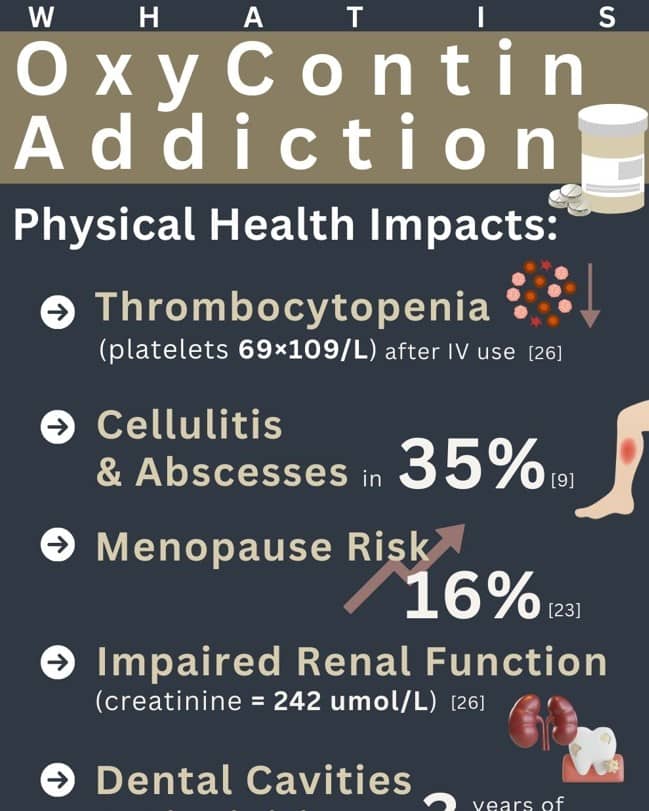
Injection site infections are a physical sign of OxyContin addiction because microorganisms (e.g. bacteria, fungi) present in the injecting environment cause redness, swelling, cellulitis, and abscesses in up to 35% of daily OxyContin users [9].
Up to 20% develop phlebitis and embolism due to obstructions in the veins after dissolving the crushed powder from 80mg OxyContin tablets in water and injecting insoluble excipients (e.g. talc, titanium dioxide, magnesium stearate) [9].
33% of users do not use a filtering method (e.g. cigarette/cotton wool or wheel filter) when preparing oxycodone pills for intravenous use, although 3 – 10% of those who do still develop serious infections (e.g. osteomyelitis or septicemia) [9].
Psychological Signs Of OxyContin Addiction
Fixation On Doses
Fixation on dosages is a psychological sign of OxyContin addiction that leads to a 2-fold increase in writing fake prescriptions, stealing from pharmacies, hospitals, or relatives without asking to obtain enough pills to provide up to 20 uses of Oxycodone daily [8][10].
Carise et al. (2007) found that some daily OxyContin users spend over £1000 on the drug every 2 weeks to get "high" or a "buzz", despite initially taking OxyContin for legitimate medical reasons (e.g. pain relief for arthritis) [1].
Kats & Hays (2004) studied three individuals who became psychologically addicted to OxyContin within 1 - 6 months of regular use and began stealing needles from doctors offices and selling personal belongings to facilitate taking 150 – 200 mg of OxyContin daily [11].
Rationalising OxyContin Addiction Due To It Being A Prescription Drug
Rationalising OxyContin addiction due to it being a prescription painkiller is a psychological sign of OxyContin dependence because:
Up to 86% initially take prescribed OxyContin to manage chronic pain and condone taking higher than the recommended amounts (e.g. 21 pills daily) to cope with “ongoing pain problems”, despite 10% experiencing an overdose [12][28]
Around 36% use the drug ≥ 3 times per week after initially receiving a prescription for “chronic medical problems”, although 33% simultaneously access OxyContin via illicit sources (e.g. a drug dealer) for the purpose of “getting high” [1]
Up to 92% abuse prescribed OxyContin by manipulating the formulation of extended-release oxycodone for intranasal use by grinding and sniffing the powder from pills, and may rationalise drug-taking to manage “intractable back pain" [2][13]
Firestone & Fischer (2008) interviewed a 49-year-old who claimed, “I was in a car accident and went through the windshield. So, they prescribed me 2 40's [OxyContin] a day, for 3 consecutive weeks. It didn't take long before I was like, I love these now, I can't cope.” [14].
Who Is More Likely To Develop An OxyContin Addiction?
Demographic
Why?
30 - 60 year old's
Extramedical OxyContin use is 41% higher in over 35s compared to 12 - 17 y/o [10]
40 - 64 y/o are 43x more likely than 18 - 24 y/o to develop an Opioid Use Disorder (OUD) [15]
Chronic Pain
Chronic pain increases the risk of developing a prescription OUD by 41% within 3 years [16]
22% of heavy OxyContin abusers (≥ 3x weekly for 1 year) are initially prescribed the drug for pain relief [1]
Pre-existing Mental Health Disorders
Having anxiety, depression, or psychosis increases the risk of developing an OUD by 3-fold [15]
OxyContin abusers are 2x more likely to have anxiety or depression compared to other opioid analgesic users (e.g. morphine) [10]
Polydrug Abuse
Co-occurring alcohol, marijuana, or cocaine abuse increases the odds of developing an OUD by 6-fold [15]
46 - 77% of OxyContin abusers have a history of abusing amphetamines, cocaine, or heroin [1]
Long-Term Health Complications Of OxyContin Addiction
Bowel Damage
Haemorrhoids are a long-term health complication of OxyContin addiction because 23% experience constipation due to delayed gastric emptying, spasms of the sphincter of Oddi, and the suppression of intestinal motility after regularly taking 10 – 160mg pills [17].
Daily OxyContin users experience chronic constipation due to a 25% reduction in complete spontaneous bowel movements within 5 weeks of taking 100 – 160mg prolonged-release formulations of Oxycodone, increasing the risk of haemorrhoids by 4-fold [18][19].
Symptoms of bowel dysfunction (e.g. constipation, feelings of incomplete bowel evacuation) increase by 45% within 1 week of taking 20mg of OxyContin daily, and in some cases, long-term abuse (e.g. ≥ 3x weekly for 9 years) leads to bowel perforation[1][20].
Hormonal Dysfunction
Reduced fecundability (fecundability odds ratio = 0.71) is a long-term health complication of OxyContin dependence because [21]:
Testosterone and oestrogen levels are reduced by up to 52% after taking between 60 – 400mg of sustained-action Oxycodone for an average of 2 years [22]
Long-term use (≥ 90 days)of long-acting opioids (e.g12 hours) increases the risk of amenorrhoea (absent menstruation) and oligomenorrhoea (< 9 menstrual periods per year or at least 35 days in between menstrual periods) by 13% [23]
18 - 55-year-old women who take OxyContin for 3 months or longer have a 16% increased risk of experiencing menopausal symptoms (e.g. hot flashes, vaginal dryness, low libido) within a 5-year period [23]
Kidney And Liver Strain
Cholestatic hepatitis is a long-term health complication of OxyContin addiction because 45% of the drug's total quantity is metabolised through the CYP3A4/5 pathway, and the pill’s hydrophobic ingredients (e.g. magnesium stearate) accumulate in the liver, resulting in [24]:
Jaundice and Biliary calculi (Gallstones) caused by increased bilirubin levels (140 μmol/L vs normal levels = <20 μmol/L) after consuming 80mg of OxyContin daily
Drug-induced hepatotoxicity marked by elevated liver enzymes, including alanine aminotransferase (ALT) at 295 u/L (normal levels < 45 u/L) and aspartate aminotransferase (AST) at 149 u/L (normal levels < 40 u/L) [25]
Robson et al. (2017) studied a 35-year-old with deteriorating renal function (creatinine = 242 umol/L) and recurrent anaemia (haemoglobin = 85 g/L), although renal function normalised after 6 months of abstaining from intravenous OxyContin use [26].
How Does OxyContin Addiction Develop?
Addiction through prescribed use
Addiction through Recreational Use
Addiction through Self-Medication
Previously opioid naïve, leading to addiction?
Yes
No, 92% have previously used ≥ 1 other opioid (e.g. heroin) [1]
In some cases, other prescription opioids (e.g. Percocet) may be used first [11]
Underlying trauma of illness/chronic pain leading to addiction?
Yes, 22% abuse prescribed OxyContin intended for pain relief [1]
No, 86% use ≥ 3x weekly just to create a “buzz” [1]
In some cases, also used by up to 28% to self-treat anxiety/depression [12]
Up to 86% use to cope with chronic pain or past trauma (e.g. sexual abuse) [12]
Up to 28% use to self-treat anxiety/depression [12]
Withdrawal Symptoms
Deep muscle aches + Hot/cold flashes
Rebound emotional sensitivity + Obsessive fear of pain returning
Onset: 24 - 72 hours after last use
Diarrhoea + Abdominal pain
Dilated pupils + Restlessness + Irritability
Onset: 6 - 12 hours after last use
Risk of Overdose
10% overdose + intravenous use increases the risk by 10-fold compared to intranasal use [27][28]
0.4% overdose + daily abuse of 5mg tablets increases the risk of overdose by 65% [29]
Denial?
Yes, some condone daily use to manage chronic pain, despite having co-occurring alcohol addictions [1]
Yes, some claim, “Makes me normal. Without it, I can't get out of bed.” [14]
About the author
Mischa Ezekpo
Mischa Ezekpo has a Bachelors degree in Psychology from Northumbria
University, and a Masters degree in Childhood Development and
Wellbeing, from Manchester Metropolitan University. Since 2018, Mischa
has written and published work on Addiction, Mental Health, Depression, and Eating Disorders. Content reviewed by Laura Morris (Clinical Lead).