Alcoholism is a disease characterised by continuous heavy drinking. Until people with alcohol use disorder admit to problems with alcohol and stop drinking, the risk of alcohol use disorder continues which affects both physical and mental health.
Alcohol starts to injure the brain once it reaches the bloodstream.
Excessive consumption can lead to Alcohol-Related Brain Damage, or ARBD, which is a type of brain disorder caused by alcohol consumption. Brain shrinkage caused by alcohol abuse is permanent, as alcohol kills brain cells and grey matter.
For more information and effects click ‘Learn More’.
Family Recovery Compass is a newsletter for friends and family members who feel trapped between supporting a loved one in addiction, and protecting their own wellbeing.
Every week, we tackle one specific situation in addiction family dynamics, and deliver practical decision-making frameworks and exact dialogue scripts – that help you respond with confidence instead of reaction.
Every month, we bring you an unfiltered recovery conversation with someone who’s either experienced addiction firsthand, or works closely with those in recovery.
No sanitised success stories – just practical insights on what actually works in recovery, that you can apply, in your life too.
Recovery capital is the internal and external resource used to begin the recovery process and maintain sobriety. This combines personal, social, and community support to provide a joined-up approach that supports the addict through recovery.
Do you or a loved one need addiction treatment for alcohol or drugs? Thousands blindly walk into addiction treatment in expensive rehab centres and find that the reality doesn’t meet expectations.
If you’re considering rehab treatment, first check our ultimate guide for complete instructions on how to find the right rehab centre for you.
Take-home Naloxone kits help families and loved ones respond quickly in an opioid overdose emergency, until emergency services arrive. Kits contain nasal or injectable forms of Naloxone.
Changes in legislation mean Naloxone kits are now more widely available from pharmacies and drug services, including Abbeycare.
For additional information, click ‘Learn More’ below.
Overcoming alcohol addiction means first ceasing alcohol intake, and taking care of physical and chemical withdrawal symptoms.
Detoxing from alcohol means undergoing withdrawal from alcohol, but with the assistance of prescribed medication and detox phase, to substitute in place of the alcohol itself.
Alcohol rehab focuses on tackling the problems underneath alcoholism, such as grief, trauma, depression, and emotional difficulties, in order to reduce continuing drinking after treatment.
Inpatient services at an alcohol rehab programme provides 24 hour access to specialist care.
Alcohol home detox provides a means of semi-supervised addiction treatment in the comfort of your home. It’s often suitable for those with inescapable practical commitments, or where a reduced budget for treatment is available.
An at-home detox is the most basic detox option available from Abbeycare, and assumes you have support available, post-detox, for the other important elements of long-term addiction recovery.
The term alcoholism refers to the consumption of alcohol to the extent that the person is unable to manage their own drinking habits or patterns, resulting in side-effects that are detrimental to the quality of life and health of the alcoholic, or those around them.
An alcoholic is someone who continues to compulsively abuse alcohol in this way, despite the negative consequences to their lives and health.
Immediately following treatment, the early stages of recovery and abstinence are most vulnerable to lapses.
At Abbeycare, a structured and peer-reviewed aftercare plan is usually prepared whilst still in treatment. This comprises social, peer, and therapeutic resources individuals draw upon, following a residential treatment programme for drug or alcohol misuse.
Clinically managed residential detoxification is:
– A structured detox that uses medication-assisted treatment and regular physical health observations
– Takes place in an inpatient rehabilitation unit or hospital
– Typically lasts from 7-10 days, but in Abbeycare, it is incorporated into a 28-day rehab programme
Family Therapy at Abbeycare Scotland or Gloucester is realistic, compassionate, and appropriate for families and loved ones of addicts.
Family therapeutic interventions in residential rehabilitation have been designed to support those living with or caring for participants entering the Abbeycare Programme.
Support for families in a group setting allows for a safe, constructive, and confidential place to listen and share common experiences.
Inpatient rehab is drug and/ or alcohol treatment in a rehab centre, where patients remain on-site for the duration of inpatient rehabilitation.
It includes detoxification from drugs, therapy (group work and 1-2-1 sessions), and aftercare planning. Inpatient rehabs typically last 28 days, but this varies on an individual basis.
Long-term treatment at Abbeycare has been developed for those suffering from alcohol or drug addiction. Completing a long-term drug and alcohol inpatient programme may be the solution to problematic substance use.
Motivational Enhancement Therapy can be used by trained addiction recovery therapists to elicit internal changes within and promote long-term recovery from substance use disorder.
All the answers to addiction can be found within with this comprehensive and successful therapy concept leads to behavioural changes, reflective listening, self-motivational statements, and a comprehensive recovery process.
Outpatient drug or alcohol rehab is daytime treatment as opposed to living in a treatment facility.
Outpatient treatment is similar to inpatient in terms of the methods used to treat substance abuse. Where they differ is in their approach to recovery.
Abbeycare’s prison to rehab is a 12-week structured rehab programme which involves direct transfer from prison. The suitability of the candidate is decided by prison staff.
Short-term residential treatment programmes are the chance to press the reset button and access a therapeutic programme designed to create recovery from the use of alcohol and drugs.
Feeling stuck in a rut. Want to stop but can’t seem to achieve sobriety?
Click below.
The 12-step programme was created by alcoholics anonymous (AA), and is specifically designed to aid addicts in achieving and maintaining abstinence.
The central ethos behind the programme is that participants must admit and surrender to a divine power to live happy lives. Ideas and experiences are shared in meetings, and help is sought in an attempt to achieve abstinence.
Abbeycare’s policy to respect your privacy and comply with any applicable law and regulation regarding any personal information we may collect about you, including across our website and other sites we own and operate.
Occurs when users become physically dependent, caused by opioid receptor desensitisation
Becomes psychological dependence when methadone is used for its sedative effects to mask past trauma and current triggers
Results in fatigue, aches and pain during periods of non-use, necessitating rehabilitation
Defining Methadone Addiction
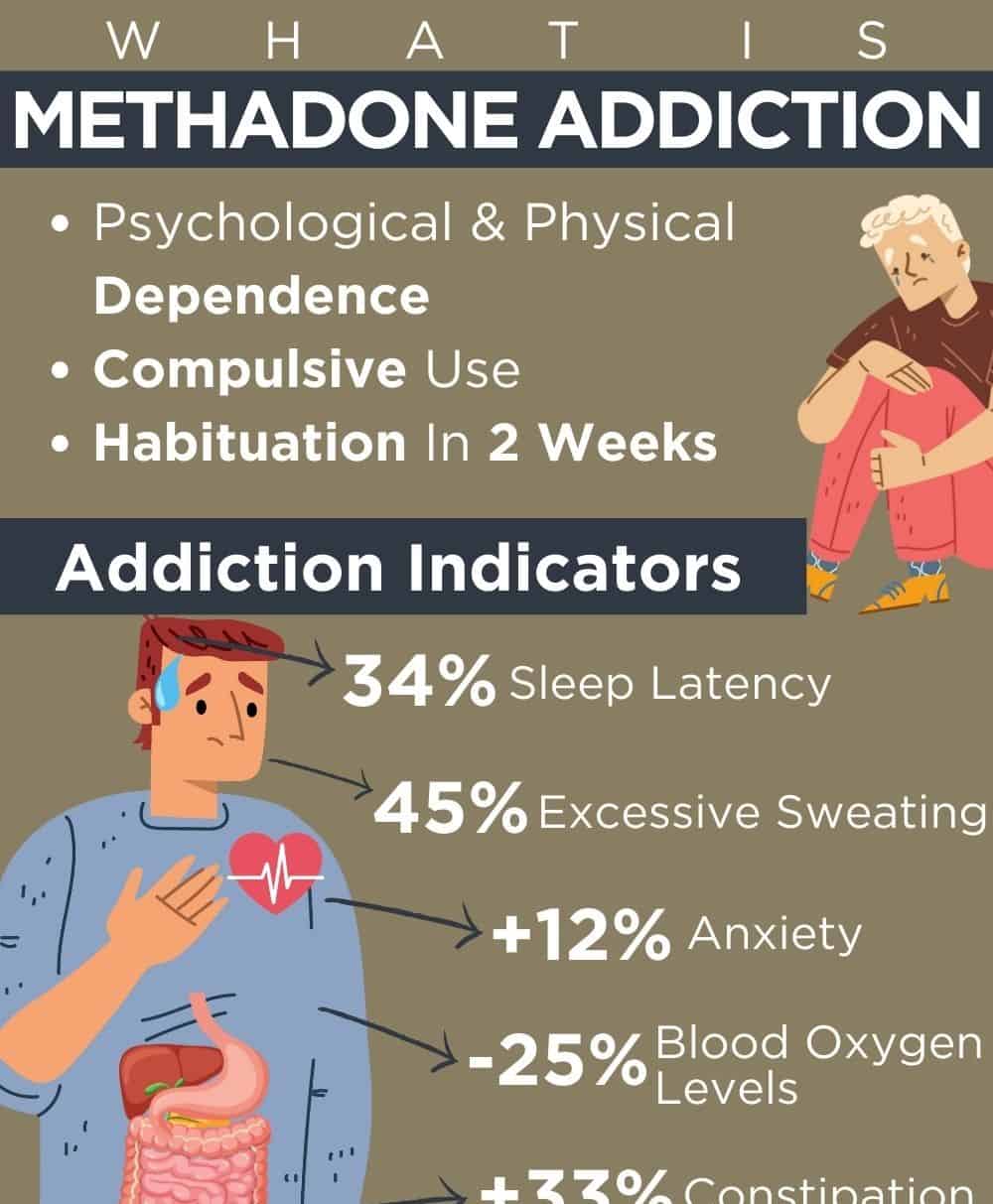
Methadone addiction begins when mu and NMDA receptors become habituated to methadone, so more is needed to experience sedation and detachment, creating a cycle of physical dependence.
Psychological dependence on methadone is caused by repeated overuse to mask pain, depression and anxiety - this results in methadone being used as an unhealthy coping mechanism.
Physical dependence occurs when methadone, a full opioid agonist, binds to mu receptors that become habituated over ~2 weeks, depending on dosage.
Methadone addiction results in persistent drowsiness and pain relief over 24-36 hours, compared to 3-5 for heroin, providing a longer time for users to become addicted.
Although methadone provides a less intense high than heroin, users may stock up on doses and take more than recommended to experience euphoria.
Physiological Indicators Of Methadone Addiction
Nausea And Constipation
Methadone-dependent patients experience 33.4% more constipation due to a lack of fluid in the bowels [1].
Methadone patients are 3.89 times less likely to have clear intestinal linings due to reduced peristalsis, resulting in less nutrient absorption and discomfort passing bowels [2].
Nausea and vomiting are physical signs of methadone dependency, resulting from stimulation of the Chemoreceptor Trigger Zone (CTZ) and dizziness from a sensitive vestibular system [3].
Disrupted Sleep And Libido
33.9% of users experience sleep latency - the time it takes to fall asleep - and struggle to remain asleep at night [4].
23.1% of users supplement with sleeping aids, such as melatonin, to help with sleeping problems [5].
A disrupted sleep-wake cycle caused by methadone dependency results from GABA inhibition, keeping the brain active at night.
Sexual libido is decreased in 14% of male methadone users, caused by inhibition on the hypothalamic-pituitary-gonadal axis [6].
Methadone consumption for 6+ months results in a 22% decrease in testosterone levels, causing reduced libido in both males and females [7].
Respiratory And Cardiovascular Dysfunction
Two months of methadone doses of 60-100mg+ result in hypoventilation due to CO2 accumulation and hypoxia [8].
Shallow breathing and a low breathing rate (<12/minute) occur when doses three times higher than recommended are consumed, caused by blood oxygen levels decreasing to 75% [9].
Heart palpitations and fainting episodes during methadone dependence are caused by QT prolongation of the heart (615ms ± 77) compared to normal readings (440-460ms) [10].
Wheezing, shortness of breath and rapid pulse occur during anaphylaxis and methadone overdose, caused by histamine release in the body during dependency [11].
Psychological Indicators Of Methadone Addiction
Rationalising Methadone Addiction
Methadone users perceive methadone as a necessary drug that replaces heroin, adding to psychological dependence.
Normalising methadone use as a prescription medication is harmful when overuse is not viewed as addiction, as professional help is not sought.
Depression And Anxiety
A psychological indicator of methadone dependency is fear of withdrawal symptoms, causing continued use in 30% [12].
Confusion and anxiety are psychological indicators of serotonin syndrome caused by misuse and overdose of methadone.
Negative self-talk about methadone use is an indicator of addiction, as users are aware of the consequences but cannot stop taking methadone without professional methadone treatment.
Behavioural Indicators Of Methadone Addiction
Behavioural indicators of methadone addiction are:
Rationalising use by obtaining methadone legally via medically authorised prescriptions, as it can be deemed as 'safe' and 'necessary' for health
Seeking surplus doses of methadone that do not fit the medication timeframe, as this indicates doses higher than recommended have been consumed
Being resistant to changing methadone dispensaries out of fear of stricter monitoring and potential cuts in supply, especially when patients are using more than recommended
Stockpiling and hiding excess methadone tablets from family members to conceal dependence
Who Is Most Likely To Develop A Methadone Addiction?
Methadone is classified as a Class A substance under the Misuse of Drugs Act 1971, making possession, supply and production illegal in the UK; however, having methadone dependence itself is not illegal.
Methadone is a Schedule 2 controlled drug under the Misuse of Drugs Regulations 2001, making it a legally accessible option to maintain methadone dependence.
Strict rules on providing handwritten signatures for methadone orders prevent prescriptions from being fabricated and methadone being handed out to illicit dependent users.
Formal risk assessments take place to ensure that patients with a history of opioid dependence are assessed before methadone is issued, avoiding the risk of dependence.
Methadone 'take home' prescriptions are collected by the patient only, except under exceptional circumstances, to prevent misuse and dependency in others [13].
Methadone regulations do not allow an 'emergency supply' or the collection of repeat prescriptions before the date of issue to mitigate risks of misuse or overdose.
What Changes Methadone Dependency?
Medication Interactions
Heart palpitations occur when methadone is combined with haloperidol, as this combination results in a prolonged QT interval over 500ms.
55μM of fluoxetine reduces the enzyme breakdown of methadone by 50%, resulting in higher levels of circulating methadone and respiratory depression [14].
There is a 4.8 times increased risk of fatal toxicity when methadone is combined with benzodiazepines due to respiratory depression [15].
St John's Wort reduces the blood concentration of methadone by 47% by inducing the enzyme CYP3A4 [16].
Methadone Legality
Country
Legal Status
Overdose/Fatality Rate
UK
Class A
Overdose deaths: 1.37% [17]
USA
Schedule II Controlled Substance
Overdose deaths: 3.2% [18]
Australia
S8 (controlled drug)
Overdose deaths: 1.27% [19]
Sweden
Schedule II controlled substance
Responsible for 46% of drug-related deaths [20]
Russia
Schedule I prohibited substance
Data not available
Saudi Arabia
Schedule I prohibited substance
Data not available
Iran
Schedule II Controlled Narcotic
Responsible for 35.8% of drug-related deaths [21]
Country
Police Approach To Illicit Use
Primary Use of Methadone
UK
Possession: < 7 years imprisonment
Methadone Maintenance Therapy
Chronic pain management
USA
Possession: < 1 year imprisonment
Methadone Maintenance Therapy
Pain management
Australia
Possession: < 3 years imprisonment
Methadone Maintenance Therapy
Pain management
Sweden
Police engage with drug services
Possession: < 6 months imprisonment
Methadone Maintenance Therapy: 20+ year olds
End-of-life care
Russia
Possession: < 3 years imprisonment
No legal use for methadone
Saudi Arabia
Possession: < 2 years imprisonment
No legal use for methadone
Iran
Possession: months - years (case dependent)
Methadone Maintenance Therapy
Method Of Administration
Oral and nasal administration of methadone results in 85% bioavailability, leading to rapid absorption and physical dependence [22].
Injectable methadone has the most potential for developing dependence as 100% of the drug enters the bloodstream.
Injectable methadone is not available for take-home use and is administered by a healthcare professional, limiting the possibility of maintaining self-managed dependence.
Physical dependence occurs quicker in rectal methadone compared to oral use, where peak blood methadone concentration occurs in 3-4 hours [23].
About the author
Philippa Scammell
Philippa Scammell MSci holds an integrated Master's degree in Psychology
from the University of York and has completed undergraduate statistical studies at Harvard University. Philippa has substantial experience in inpatient psychiatric care (Foss Park Hospital York), Research in Psychology at University of York, and group therapy facilitation (Kyra Women's Project). Philippa writes on clinical psychology and addiction recovery. Content reviewed by Laura Morris (Clinical Lead).