Alcoholism is a disease characterised by continuous heavy drinking. Until people with alcohol use disorder admit to problems with alcohol and stop drinking, the risk of alcohol use disorder continues which affects both physical and mental health.
Alcohol starts to injure the brain once it reaches the bloodstream.
Excessive consumption can lead to Alcohol-Related Brain Damage, or ARBD, which is a type of brain disorder caused by alcohol consumption. Brain shrinkage caused by alcohol abuse is permanent, as alcohol kills brain cells and grey matter.
For more information and effects click ‘Learn More’.
Family Recovery Compass is a newsletter for friends and family members who feel trapped between supporting a loved one in addiction, and protecting their own wellbeing.
Every week, we tackle one specific situation in addiction family dynamics, and deliver practical decision-making frameworks and exact dialogue scripts – that help you respond with confidence instead of reaction.
Every month, we bring you an unfiltered recovery conversation with someone who’s either experienced addiction firsthand, or works closely with those in recovery.
No sanitised success stories – just practical insights on what actually works in recovery, that you can apply, in your life too.
Recovery capital is the internal and external resource used to begin the recovery process and maintain sobriety. This combines personal, social, and community support to provide a joined-up approach that supports the addict through recovery.
Do you or a loved one need addiction treatment for alcohol or drugs? Thousands blindly walk into addiction treatment in expensive rehab centres and find that the reality doesn’t meet expectations.
If you’re considering rehab treatment, first check our ultimate guide for complete instructions on how to find the right rehab centre for you.
Take-home Naloxone kits help families and loved ones respond quickly in an opioid overdose emergency, until emergency services arrive. Kits contain nasal or injectable forms of Naloxone.
Changes in legislation mean Naloxone kits are now more widely available from pharmacies and drug services, including Abbeycare.
For additional information, click ‘Learn More’ below.
Overcoming alcohol addiction means first ceasing alcohol intake, and taking care of physical and chemical withdrawal symptoms.
Detoxing from alcohol means undergoing withdrawal from alcohol, but with the assistance of prescribed medication and detox phase, to substitute in place of the alcohol itself.
Alcohol rehab focuses on tackling the problems underneath alcoholism, such as grief, trauma, depression, and emotional difficulties, in order to reduce continuing drinking after treatment.
Inpatient services at an alcohol rehab programme provides 24 hour access to specialist care.
Alcohol home detox provides a means of semi-supervised addiction treatment in the comfort of your home. It’s often suitable for those with inescapable practical commitments, or where a reduced budget for treatment is available.
An at-home detox is the most basic detox option available from Abbeycare, and assumes you have support available, post-detox, for the other important elements of long-term addiction recovery.
The term alcoholism refers to the consumption of alcohol to the extent that the person is unable to manage their own drinking habits or patterns, resulting in side-effects that are detrimental to the quality of life and health of the alcoholic, or those around them.
An alcoholic is someone who continues to compulsively abuse alcohol in this way, despite the negative consequences to their lives and health.
Immediately following treatment, the early stages of recovery and abstinence are most vulnerable to lapses.
At Abbeycare, a structured and peer-reviewed aftercare plan is usually prepared whilst still in treatment. This comprises social, peer, and therapeutic resources individuals draw upon, following a residential treatment programme for drug or alcohol misuse.
Clinically managed residential detoxification is:
– A structured detox that uses medication-assisted treatment and regular physical health observations
– Takes place in an inpatient rehabilitation unit or hospital
– Typically lasts from 7-10 days, but in Abbeycare, it is incorporated into a 28-day rehab programme
Family Therapy at Abbeycare Scotland or Gloucester is realistic, compassionate, and appropriate for families and loved ones of addicts.
Family therapeutic interventions in residential rehabilitation have been designed to support those living with or caring for participants entering the Abbeycare Programme.
Support for families in a group setting allows for a safe, constructive, and confidential place to listen and share common experiences.
Inpatient rehab is drug and/ or alcohol treatment in a rehab centre, where patients remain on-site for the duration of inpatient rehabilitation.
It includes detoxification from drugs, therapy (group work and 1-2-1 sessions), and aftercare planning. Inpatient rehabs typically last 28 days, but this varies on an individual basis.
Long-term treatment at Abbeycare has been developed for those suffering from alcohol or drug addiction. Completing a long-term drug and alcohol inpatient programme may be the solution to problematic substance use.
Motivational Enhancement Therapy can be used by trained addiction recovery therapists to elicit internal changes within and promote long-term recovery from substance use disorder.
All the answers to addiction can be found within with this comprehensive and successful therapy concept leads to behavioural changes, reflective listening, self-motivational statements, and a comprehensive recovery process.
Outpatient drug or alcohol rehab is daytime treatment as opposed to living in a treatment facility.
Outpatient treatment is similar to inpatient in terms of the methods used to treat substance abuse. Where they differ is in their approach to recovery.
Abbeycare’s prison to rehab is a 12-week structured rehab programme which involves direct transfer from prison. The suitability of the candidate is decided by prison staff.
Short-term residential treatment programmes are the chance to press the reset button and access a therapeutic programme designed to create recovery from the use of alcohol and drugs.
Feeling stuck in a rut. Want to stop but can’t seem to achieve sobriety?
Click below.
The 12-step programme was created by alcoholics anonymous (AA), and is specifically designed to aid addicts in achieving and maintaining abstinence.
The central ethos behind the programme is that participants must admit and surrender to a divine power to live happy lives. Ideas and experiences are shared in meetings, and help is sought in an attempt to achieve abstinence.
Abbeycare’s policy to respect your privacy and comply with any applicable law and regulation regarding any personal information we may collect about you, including across our website and other sites we own and operate.
Develop coping skills for managing pain and anxiety instead of taking 32 codeine tablets to cope with “bad days” [1]
Evoke change talk and self-acceptance in patients who believe "I can’t be an addict" or that codeine addiction is "shameful" [1]
*Programme content varies
When Is Rehab For Codeine Addiction Required?
Previous Denial About Addiction
Claiming “I can’t be an addict” despite abusing up to 800 g of codeine daily and keeping tablets hidden from family members, friends, and work colleagues means rehab is required because [1]:
The Stages of Change Readiness and Treatment Eagerness Scale is used to assess denial patterns using the recognition subscale, where 7 – 26 = “I am not addicted" vs 35 = “I am addicted to codeine and would like to make a change” [2]
60-minute compassion-based skills training sessions are provided to address self-criticism and underlying feelings of guilt and shame in codeine users who believe “I can’t discuss it with my family, ... shameful, and it makes you feel dirty and guilty.” [1][3]
Counsellors use the “Importance Ruler” (e.g. 0 = not important vs 10 = extremely important) and the DARN (desire, ability, reasons, need) method to evoke change talk by asking open questions (e.g. “What don't you like about using codeine?") [2]
30-minute motivational counselling sessions adopt the FRAMES (feedback, responsibility, advice, menu of options, empathy, self-efficacy) approachto encourage behaviour change by emphasising patient autonomy in a non-judgmental rehab setting [2]
Emotional Dependency On Codeine
Codeine rehab is required for 38 – 78% of patients who rely on codeine for the treatment of pain, to help sleep, or “feel better when down or depressed”, because integrated cognitive behavioural therapy (CBT) is provided to [4]:
Inform patients about the interaction between codeine and the human brain using a psychoeducational approach to discuss how long-term codeine abuse (e.g. 5 years) exacerbates insomnia and anxiety due to a 24% reduction in prefrontal GABA [5]
Assess the role of “quick fix” behaviours to alleviate distress by practising functional analysis and developing a “coping plan” to modify “stuck thinking” and “thinking traps”, e.g. “That lift or buzz would go and the only way to sustain that is to take more.” [1]
Encourage patients to become aware of present-moment experiences by practising mindfulness for 5 minutes at the end of each session using deep breathing and body scan to identify and process uncomfortable emotions (e.g. shame, guilt) [3]
Strengthen interpersonal skills and provide strategies for managing pain (e.g. 20 min exercise 3x p/wk) to increase endorphin levels by up to 49% within 1 month, rather than consuming 32 codeine + ibuprofen tablets to cope with “really bad days” [1][6]
Rehab is required to minimise risk behaviours in patients who self-medicate with codeine because 10% consume higher doses (> 240mg daily) than recommended by the BNF guidelines, and 3% obtain codeine from the internet without having a prescription [4].
Polydrug Use With Over-The-Counter Medication
Polydrug use of codeine and promethazine means rehab is needed because 35 - 63% of users have overdosed or had a seizure at least once after consuming the drugs simultaneously, requiring [7]:
60-minute skills training exercises focused on “Coping with Cravings” to identify and manage situational cues (e.g. rap music) that trigger impulses to engage in risky behaviour (e.g. stealing from a doctor) to get a ”million dollar high” [8][9]
2-hour relaxation training sessions to practice visualisation and deep breathing techniques as an alternative to self-medicating with codeine and promethazine to “relax” or “feel good” when “going through a lot” [9][10]
CBT incorporates psychoeducation to discuss the emotional impacts of using promethazine with codeine, as 67% struggle with anxiety and depression after regular use, despite 40% initially taking the combination to “cope with emotions” [11]
Codeine rehab treatment is personalised because 32–37% of users who are addicted to promethazine + codeine also meet the criteria for Alcohol or Cannabis Use Disorder, and additional support (e.g. thiamine supplements, trauma-informed care) may be required [7].
Previous Unsuccessful Attempts To Quit "Cold Turkey"
Previous unsuccessful attempts to quit codeine use “cold turkey” means rehab is required because 40% of patients are “unaware they are addicted”, despite some claiming “I tried to cut down, then I’d just have a bad day, and I’d be straight back up to 24 tablets" [12][13].
Codeine rehab provides 2-hour sessions of compassion-focused CBT that uses psychoeducation and cognitive restructuring to address and modify minimised cognitions that reinforce addictive behaviour (e.g. abusing codeine daily to numb emotions), including [10]:
“Lightening” the language and using humour when talking about consuming codeine in excess (e.g. “going a bit far” or “popping pills”) to downplay the level of dependence
Rationalisation, e.g. “I don’t inject so I am not addicted”, and normalisation, e.g. “Everyone takes co-codamol for headaches”, to create a false sense of security by dismissing the harms associated with codeine abuse (e.g. bowel dysfunction)
Projection, i.e. “My partner broke up with me so I took codeine,” to place blame onto others, shift responsibility, and reinforce distorted thinking patterns, e.g. “It’s only one tablet, it won’t hurt”, or “It won’t be like last time.”
“Addicts are people on the street who haven’t got a job. I’m sat here in a suit in an office. I can’t be an addict” due to other opioids (i.e. heroin) being 25% more common in homeless populations and typically considered “more serious” than codeine [1][14]
Detox For Codeine Addiction In A Controlled Setting
Codeine detox is done by:
Providing an initial dose of Suboxone (2/0.5 - 8/2mg) 12 – 24 hours after last consuming codeine and stabilising patients on a higher dose (e.g. 12/3 to 16/4 mg daily) for around 7 – 10 days to mitigate severe withdrawal (COWS > 36) [15]
Administering symptomatic medication (e.g. 50 µg clonidine) as needed to manage codeine withdrawal symptoms (e.g. anxiety, body aches, lacrimation) by inhibiting the rebound of sympathetic activity within 4 – 48 hours of last use [16]
Therapy For Codeine Addiction In A Controlled Setting
Reframing Pain Perception
CBT therapy in codeine rehab attempts to reframe pain perception using psychoeducation, cognitive restructuring, and coping skills training during 30 – 45-minute weekly sessions to [17]:
Educate patients about the distinctions between acute and chronic pain whilst addressing “thinking errors” related to codeine misuse and pain, e.g. “Eventually there was not any pain, but I was scared of the pain in my mind.” [18]
Strengthen coping skills in 80% of patients who use codeine to cope with physical pain by developing an “All-purpose Coping Plan” to manage pain flare-ups using distraction and relaxation techniques (e.g. diaphragmatic breathing) [11]
Enhance sensory awareness by monitoring the 3 channels (e.g. thoughts, feelings, body) and engaging in a “compassionate body scan” to show gratitude to the physical body during 5 minutes of mindfulness practice at the end of each session [3][10]
Aid emotion regulation by encouraging participation in exercise and non-drug related activities (e.g. reading) whilst modifying maladaptive thinking patterns that perpetuate the pain cycle (e.g. pain catastrophising, behavioural deactivation)
Barry et al. (2019) found that pain interference (in relation to mood/enjoyment of life) decreased by ≥ 2 points on the BPI in prescription opioid users who received 12 weeks of CBT integrated with psychoeducation, coping skills training, and cognitive restructuring [17].
Addressing Internalised Shame
Therapy for codeine addiction attempts to resolve internalised shame by providing 2-hour therapy sessions that use cognitive-behavioural (e.g. psychoeducation) and mindfulness-based strategies (e.g. deep breathing) to [10]:
Address the fear of being stigmatised in up to 85% of users who claim that having a codeine dependency is “shameful” as “It makes you feel dirty and guilty” by engaging in exercises (e.g. “writing a letter to the self”) to encourage positive self-talk [1][13]
Minimise “self-critical inner voices” and blame via education about the “3-system model” to understand how codeine addiction can develop when the affiliative system for feeling safe and self-soothed is neglected due to a lack of care from others [10]
Discuss how relationships are affected by drug use and elements of healthy relationships (e.g. open communication) in recovery because some claim “I can’t discuss it with my family” due to internalised shame whilst actively consuming 32 tablets daily [1]
Some codeine rehabs provide Acceptance and Commitment Therapy (ACT) to reduce internalised shame and stigma by up to 21% using cognitive defusion and mindfulness techniques to build self-esteem, psychological flexibility, and self-awareness [19].
Identifying And Replacing Trigger Situations
Therapy in codeine rehab attempts to identify and replace trigger situations by developing an “all-purpose coping plan” and using functional analysis or behavioural activation during 45-minute sessions to [17]:
Identify activating events or situations (e.g. the weekend) that trigger beliefs (e.g. wanting an “intense high”) and lead to consequences (e.g. consuming codeine and alcohol for the extra “buzz”) to reinforce addictive patterns [12]
Encourage participation in non-drug related activities (e.g. running) to naturally enhance mood by increasing endorphin levels by up to 49% instead of abusing >240mg codeine to relieve emotional pain caused by anxiety, depression, or heartache [6][12]
Strengthen coping skills for managing pain “flare-ups” using self-soothing techniques (e.g. mindfulness meditation, deep breathing) as an alternative to consuming 64 codeine + ibuprofen tablets to cope with “really bad days” [1]
Create sober support systems during group therapy sessions for patients whose codeine use was triggered by loneliness, as some claim: “My friends are gone. It’s a companion addiction. It feels like it has its arm around you. It gives a sense of security” [12]
Develop structured routines to be implemented in recovery (e.g. Friday evenings = meal with friends) to counteract previous thought and behavioural patterns, e.g. “I used to look forward to it throughout the week ... to treat myself on Friday.” [12]
Aftercare Planning For Codeine Addiction In A Controlled Setting
Handling Pharmacy Environments
Aftercare planning for codeine addiction attempts to help patients handle pharmacy environments by establishing social support systems to assist with daily activities in early recovery (< 12 months), including [8]:
Shopping for groceries or personal care items (e.g. toothpaste) in supermarkets with in-store pharmacies to minimise anxiety associated with being recognised by pharmacy staff or temptation to purchase over-the-counter tablets (e.g. co-codamol 8/500)
Financial literacy (e.g. creating and sticking to a weekly budget for groceries or rent, setting daily cash withdrawal limits) to prevent users from spending up to £175 a day on codeine-based medications (e.g. Nurofen Plus) after discharge [10]
Managing communication with others (e.g. using a telephone or app to contact the bank about setting card-access restrictions at local pharmacies) and enhancing organisation/planning skills to promote independence in recovery
Mursaleen et al. (2025) found that performance in everyday activities (e.g. managing finances) improved by 50% within 4 weeks in patients who received 45-minute sessions focused on cravings control, budgeting, and problem-solving during rehab [20].
Managing Pain Without Opioid Use
Aftercare planning for codeine addiction uses rehab strategies to provide an emotional outlet for pain by:
Encouraging patients to keep a “pain diary” to monitor changes in mood, physical activity, and pain intensity for a minimum of 7 consecutive days every month using a 0 - 10 numerical scale (0 = no pain vs 10 = excruciating pain) [21]
Setting goals during counselling sessions (e.g. being able to sit for 2 hours without having back pain) and receiving education about how to achieve the goal (e.g. daily stretching/exercise) during early recovery (first 12 months of abstinence) [8][22]
Creating an “all-purpose coping plan” to strengthen coping skills for dealing with pain, including diaphragmatic breathing and mindfulness for relapse prevention, instead of taking 32 codeine tablets to cope with “really bad days” [1][17]
Codeine rehabs liaise with GPs to develop and review ‘pain management plans’ (e.g. daily schedule = 600mg ibuprofen, 30-minute walk, NA meeting) and refer patients to talking therapies and/or physiotherapy for continued mental health and pain support if needed [23].
Rehab For Codeine Addiction Outcomes
Recovery Success Rate
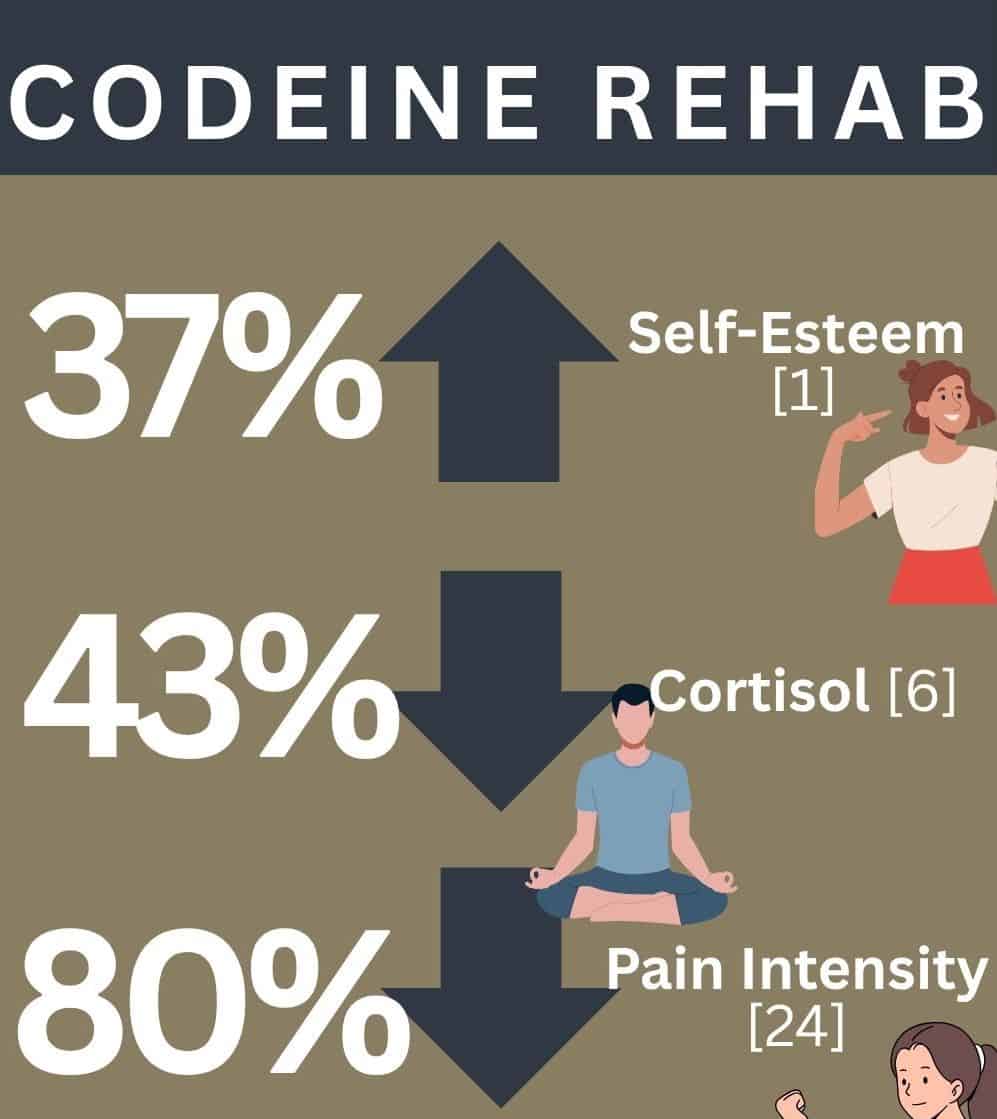
Rehab reduces codeine use by 100% in 6 out of 11 patients who previously abused 180 – 240 mg daily for up to 10 years, as receiving a medical detox and 60-minute weekly CBT sessions during treatment leads to [24]:
An 80% reduction in pain intensity scores on the Brief Pain Inventory (BPI) within 3 months after previously self-medicating musculoskeletal pain with codeine every day for 2 years [24]
A 29% increase in physical functioning (e.g. ability to climb a flight of stairs, move a table, or get dressed) within 2 months after misusing 210 mg of codeine daily for 3 years before entering the treatment programme [24]
A 5-fold increase in mental health functioning (e.g. feeling calm, peaceful, or energised) after identifying and challenging negative thought patterns using verbal reattribution techniques and role play during CBT sessions [24]
Thekiso & Farren (2010) found that 65% of patients who previously abused an average of 261 mg of codeine daily were abstinent 6 months after receiving a detox, psychoeducation, and regular psychiatric assessments during a 4-week inpatient programme [25].
Managing Stress, Anxiety, And Low Mood
Codeine addiction treatment reduces the severity of anxiety by 67% within 3 months in patients who previously abused 240mg of codeine daily for 10 years because [24]:
2-hour psychoeducational sessions with relaxation exercises (e.g. guided imagery) are provided to enhance emotion regulation abilities and sensory awareness as an alternative to taking 28 codeine tablets daily to “feel normal” [10][[12]
Patients are encouraged to participate in 2 – 3 hours of aerobic activity each week (e.g. walking, swimming) to manage stress and low mood by reducing cortisol levels by 43% and increasing endorphins by 5-fold within 4 weeks [6][8]
Antidepressants (e.g. 40mg citalopram) may be provided in rehab to manage pre-existing mood disturbances because 33 – 48% of patients dependent on codeine initially abused the drug to relax, stop worrying about a problem, or when feeling low/depressed [4].
Reducing Shame And Internal Stigma
Codeine rehab reduces internalised shame and stigma by up to 21% within 7 days because [19]:
ACT is used to create self-acceptance and build psychological flexibility in users who feel like being dependent on codeine is “shameful” and “makes you feel dirty and guilty”, using cognitive defusion to “deliteralise” negative thoughts [1][19]
Patients are encouraged to ‘write a letter to the self’ and practice self-soothing techniques (e.g. rhythm breathing) to provoke positive self-talk whilst minimising self-criticism and rumination during 2-hour compassion-focused counselling sessions [10]
Self-esteem increases by up to 37% after engaging in mindfulness exercises (e.g. leaf and stream metaphor) that aim to prevent getting “hooked” on stigmatising thoughts, e.g. “I can’t discuss it with family,” or “I hurt people that I love” [1][19]
Patients develop coping plans that include strategies for managing guilt/shame (e.g. support group + meditation), and cognitive restructuring is used to modify negative beliefs (e.g. “It’s taken away my self-respect.”) during 45-minute weekly sessions [12][17]
Codeine Rehab At Abbeycare
Abbeycare's 4-week codeine rehab programme uses a compassion-focused approach, aiming to address denial patterns, guilt, internalised shame or stigma, and using codeine to self-medicate pain, anxiety, or insomnia by:
Providing “feelings check-in" sessions every morning during the first 7 days of treatment to practice mindfulness and discuss self-identity and triggers whilst receiving a medically supervised detox, typically using 2/0.5 - 32/8 mg Suboxone
Delivering 60-minute group CBT to strengthen coping skills using cognitive restructuring and psychoeducation alongside weekly “swim, gym, and sauna” sessions to aid emotion regulation via exercise and muscle relaxation
Developing personalised aftercare plans during stage 2 of the programme to encourage independence and establish the types of support required (e.g. assisted shopping in pharmacy environments) during early recovery (< 12 months)
Continuing care for up to 12 months after leaving rehab by providing weekly telephone check-ins, family support groups, and liaising with GPs to discuss non-opioid treatment options (e.g. ibuprofen, sertraline) for any remaining pain or mood disturbances
About the author
Mischa Ezekpo
Mischa Ezekpo has a Bachelors degree in Psychology from Northumbria
University, and a Masters degree in Childhood Development and
Wellbeing, from Manchester Metropolitan University. Since 2018, Mischa
has written and published work on Addiction, Mental Health, Depression, and Eating Disorders. Content reviewed by Laura Morris (Clinical Lead).