



KEY TAKEAWAYS
Codeine addiction is:

How Does Codeine Addiction Occur?
When used to medicate or self-medicate for pain, codeine inhibits the release of nociceptive neurotransmitters (e.g. glutamate) in the central nervous system, providing an analgesic effect and subsequent relief, driving emotional dependence.
Emotional dependence on codeine occurs when using the substance to self-medicate underlying anxiety or depression due to temporarily numbing emotional pain, even when these mental health disorders have not been directly addressed.
Codeine addiction occurs when physical tolerance is built to a particular dose (e.g. 60mg every 4 hours), resulting in more being taken to experience the same pain relief and/or euphoric effects [1][2].
Codeine is an opioid agonist that primarily has a weak binding affinity of 79 nM to μ-opioid (MOR) receptors in the brain; however, it is converted into morphine, a substance with a stronger binding affinity (1.8 nM) at MOR receptors.
It is estimated that 5.4% use prescription codeine and 4.5% use over-the-counter codeine for a non-medical purpose, indicating addiction and its use for relaxation and euphoric effects [1].
Physical Indicators Of Codeine Addiction
Itching
Itching in codeine addiction occurs due to [3]:
Peterson et al. (1995) demonstrate that a 6-fold increase in codeine dosing (0.01-3 mg/mL) causes itching, indicating that pruritus in addiction to codeine occurs in a dose-dependent manner [4].
As soon as histamines are released, it takes, on average, 4 minutes to induce an itch response [4].
Although the half-life for codeine-induced histamines is 2-3 minutes, continuous administration of codeine in addiction prolongs histamine's effects [4].
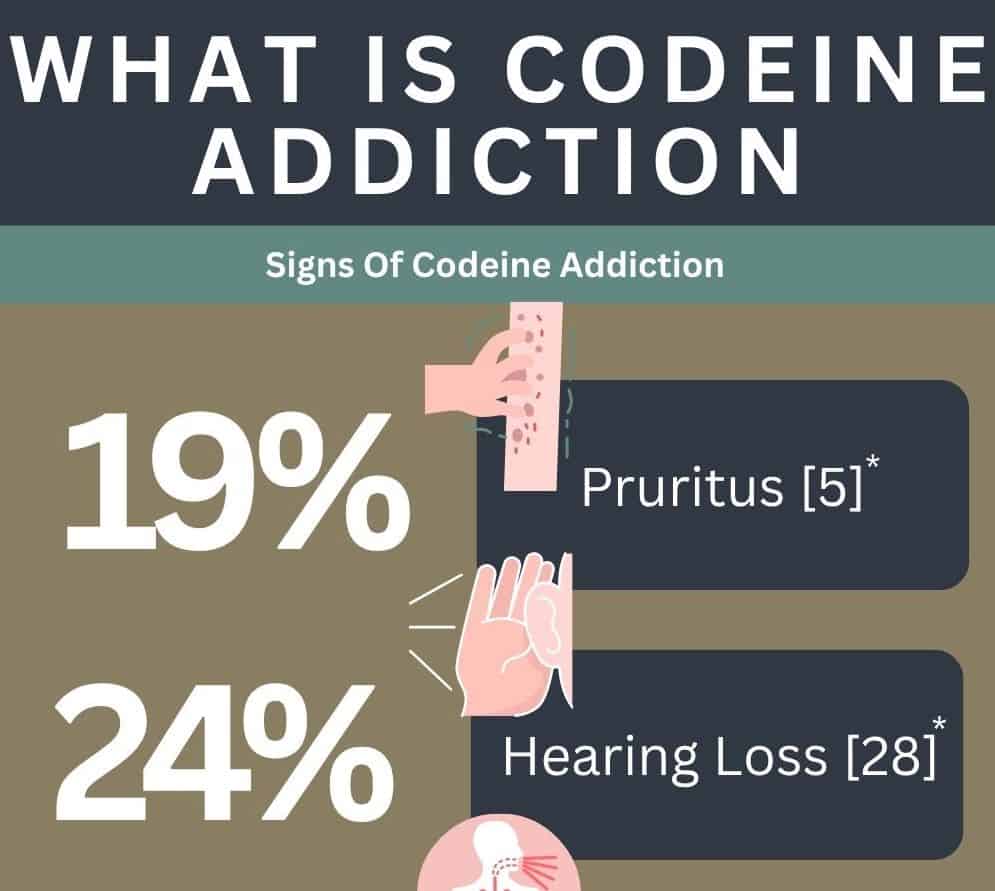
The prevalence of itching from codeine varies up to 19% from person to person, indicating that, while itching is a physical symptom of codeine addiction, it may not be a visible warning sign in every user [5].
Compared to pruritus from skin disorders, such as eczema, codeine-induced pruritus typically fluctuates with drug use.
Eczema flare-ups are typically localised to specific areas (e.g. the wrists), but in active codeine usage, itching may be widespread or move to different areas [6].
Dry Mouth
Dry mouth is a physiological indicator of codeine addiction, caused by the activation of opiate mu receptors in the peripheral nervous system, thereby inhibiting parasympathetic physiological mechanisms, such as saliva production.
Xerostomia, or dry mouth, is found to occur in users taking 120+mg of codeine in one sitting, almost double the typical prescribed dose, indicating improper use [7][2].
Out of 1927 case reports of xerostomia, 27 have been caused by prescription opiate use, such as codeine, making dry mouth a potential warning sign for active codeine usage [8].
Dry mouth in codeine addiction causes a 110% increased rate of tooth decay [9].
Tooth decay leads to:
Continuous dry mouth from codeine usage poses a 153% increased risk of developing periodontal disease, due to the lack of saliva to neutralise acid present in the mouth [10].
Facial Flushing
Facial flushing is a physical indicator of codeine dependency, resulting from the degranulation of mast cells triggered by the activation of mu receptors through opiate action [11].
When mast cells break down, this initiates the release of histamines into the bloodstream, causing vasodilation, observed as flushing in the face [11].
Facial flushing in codeine dependence is seen as:
Facial flushing occurs within 30 minutes following codeine administration; however, ongoing flushing depends on whether the use is continuous, as well as the volume of the dose [12].
Sheen et al. (2007) explain facial flushing as an outcome of allergic inflammation, resulting in histamine release and subsequent blood vessel dilation [13].
Blood vessel dilation in the inflammatory response causes centralised blood flow, resulting in redness in the face.
Compared to codeine dependency, facial flushing is often overlooked in addiction to other opiates due to the prevalence of stronger and more severe symptoms, such as vomiting.
Shallow Breathing
Shallow breathing is a physical indicator of codeine dependency and causes the breathing rate to fall to <12 breaths per minute.
Shallow breathing occurs in codeine dependency due to the suppression of the central nervous system, primarily in the medulla oblongata, a brainstem area responsible for respiration.
Shallow breathing in codeine dependency causes a 2.7 I/min decrease in total ventilation, resulting in [14]:
Following codeine administration, shallow breathing in codeine dependency often results in a dry cough in 60% of cases, caused by the suppression of the natural cough reflex and the inability to clear ventilation pathways [15].
When conducting light exercise, such as walking, there is a 21% decrease in minute ventilation compared to a placebo, demonstrating continued suppression of breathing during movement [16].
Heart rate following codeine use decreases by 7.2%, resulting in symptoms similar to those of shallow breathing, indicating slowed cardiac activity and ventilation [17].

Psychological Indicators Of Codeine Addiction
Mild Calming Euphoria
Salihu et al. (2019) state that although codeine does not produce the same levels of euphoric effects as heroin, for example, it is still addictive for its euphoric-like effects in a dose-dependent manner [18].
Codeine's analgesic and euphoric-like effects take effect within 15-30 minutes and begin to dissipate after two hours, as its half-life is 2.2 ± 0.10 hours in plasma [19].
Codeine is 7-14 times less potent compared to Oramorph, so users taking the substance for euphoric effects consume it in higher doses or alongside other substances [20].
Kim et al. (2002) found that euphoric effects occur in high doses (120 mg or more) over one sitting, whereas hydrocodone requires a dosage of 30 mg or less [21].
The breakdown of codeine and its ability to produce euphoric and analgesic effects depend on the presence of CYP2D6, as this enzyme breaks codeine down [22].
Users with ultrafast metabolism of CYP2D6 typically experience more euphoric effects due to codeine being broken down in < 30 minutes.
Dissociation
Dissociation indicates codeine dependency, as codeine metabolites bind to opiate receptors in brain areas such as the default mode network, an area responsible for self-referential processes [23].
Experiencing dissociation in codeine dependency looks like:
Ishola et al. (2022) experimented on mice to compare dissociative states between tramadol and codeine, finding that while tramadol caused hyperactivity and restlessness, codeine resulted in lowered activity and a loss of motor function [24].
Dissociation in codeine dependency is caused by nitroso-oxidative stress in the mitochondria, resulting in the inhibition of the prefrontal cortex, a brain area responsible for reality-checking and executive functioning [25].
In total, codeine alters the expression of 70 neurotoxic genes (i.e. genes that cause harm to neurons), resulting in prefrontal cortex dysfunction and detached reality [26].
Compared to a temporary lack of attention in non-users, those addicted to codeine may be unaware of the current dissociative state and are not easily brought back to reality unless treatment is sought.
Rationalising Addiction
Rationalising addiction is indicative of codeine dependency because it demonstrates that the consumer feels the need to explain and justify use.
Having medical instructions for codeine or being given codeine by a pharmacist to use for pain enables consumers to justify addiction as the tablets serve a medical purpose; however, not using the medication as instructed is overlooked.
Consumers may outsource surplus codeine (i.e. obtain codeine from more than one place) to avoid getting noticed by friends or family, especially as codeine tablets or tinctures can be hidden amongst other medications.
Codeine may be seen as the "healthier" option due to being 20 times less potent than intravenous morphine; however, this means addiction is typically downplayed.
Experiencing withdrawal symptoms from codeine usage (e.g. muscle aches) encourages the continuation of use for pain relief; however, these symptoms may not be recognised as withdrawal symptoms in active addiction.

Long Term Complications Of Codeine Addiction
Tinnitus
Tinnitus and/or unilateral/bilateral hearing loss occur as a long-term complication of codeine dependency due to the binding of mu receptors in the cochlear.
Patients taking higher-than-prescribed dosages of codeine for 3+ years with complaints of bilateral deafness present with macrocytosis (mean cell volume 115 fL) [27].
Tinnitus itself is prevalent in 24% of opiate-induced hearing loss, causing [28]:
Although 29% of cases of tinnitus in codeine dependency occur as a result of hypoxia, 61% experience tinnitus with no hypoxic event, indicating that tinnitus in codeine dependency is caused by more mechanisms than oxygen deprivation alone [29].
Tinnitus may also be confused with hypoacusis, occurring in 37% of all opiate-induced hearing loss [28].
Improper use of codeine for 4+ years may result in deafness and tinnitus, but this outcome is dosage-dependent as well as time-dependent [30].
Liver Damage
Liver serum proteins fall by 50% following 6 weeks of taking 10 mg/kg codeine every day, resulting in impaired hepatic function and metabolism of other toxins [31].
Hepatic AST (aspartate aminotransferase) (U/g tissue) increases by 74% from 6-week administration of 10 mg/kg codeine, indicating damage to liver tissues and hepatic function occurs from 6+ weeks of use [31].
Compared to controls, hepatic DNA fragmentation increases by 1.7-fold during active codeine dependency, indicating current apoptosis (i.e. cell death) in the liver [32].
Liver damage in codeine dependency results from oxidative stress on hepatic cells, increasing the 8OHdG concentration by 62% [32].
Lymphocyte counts are reduced by 30% in cases of codeine dependency lasting for 28 days or more, thus impairing the inflammatory healing response to liver damage [33].
Liver damage in codeine dependency creates the following visible symptoms:
Pancreatitis
One patient taking acetaminophen plus codeine (500/30 mg) alongside amoxicillin had epigastric pain 1 hour after combining these, indicating pancreatic irritation when mixing medication [34].
Four patients have reported pancreatic symptoms 1-3 hours after codeine administration, indicating that this depends on the duration of codeine usage and the liver's metabolic capacity [35].
Recurrent codeine consumers have a 2.67 times increased vulnerability of developing pancreatitis compared to non-consumers, with vulnerability depending also on current health and pancreatic function [36].
Kim et al. (2019) found that codeine consumers have 5.37 times increased rate of developing pancreatitis in the first 15 days of codeine usage, indicating that this pancreatitis is more closely linked to disease vulnerability than recurring codeine usage [37].
One vulnerability of pancreatitis in codeine-dependent patients is cholecystectomy, as these patients lack pressure regulation between the gall bladder and pancreas [38].
In codeine-induced pancreatitis, serum amylase levels are approximately three times higher than usual (normal high average = 300 U/L), serving as an effective biomarker in medical settings [39].
What Is The Progression Of Codeine Dependence?
Progression | Prescription Use | Self-Medication |
|---|---|---|
Initial Codeine Use | Codeine is provided as pain relief and/or cough syrup | Codeine is bought from a pharmacy in the form of Co-Codamol, or codeine-containing ibuprofen tablets |
Developing Tolerance | - The user attempts to fill multiple prescriptions - Stockpiling codeine tablets - Using others’ prescriptions to use more | - Used beyond the initial intended use to experience euphoria - More doses are taken than instructed |
Developing Dependence | Withdrawal symptoms when not used | - Rationalising use due to medical need - Withdrawal symptoms when not used |
Seeking Other Substances | More potent opioids (e.g. morphine) are sought via the GP | Illicit benzodiazepines may be sought to enhance the relaxant effects |
Seeking Rehab | Treatment is typically encouraged for codeine addiction by friends/family or concerned medical staff | Treatment is often overlooked due to using codeine for pain relief |
Progression | Recreational Use |
|---|---|
Initial Codeine Use | - Codeine is obtained via friends/family - Codeine is used when primary opioid is unavailable |
Developing Tolerance | More is consumed to prevent withdrawal symptoms |
Developing Dependence | Turns to other substances to avoid withdrawal symptoms |
Seeking Other Substances | Recreational users may seek more potent opioids (e.g. heroin) |
Seeking Rehab | Treatment may be needed for codeine and other substance misuse |

Codeine Addiction Vs Valium Addiction
Codeine and valium are typically interchanged or used alongside each other by recreational consumers to amplify euphoric and analgesic effects.
Codeine | Valium | |
|---|---|---|
Drug Class | Class B - Opioid | Class C - Benzodiazepine |
Prescribed Usage | Costs of alternative therapy approaches | Free (NHS) |
Addiction Development Pathway | - Opioid-induced tolerance on mu receptors - Physical and psychological dependence when self-medicating pain and/or trauma | - Anxiolytic tolerance develops - Physical and psychological dependence for anxiety |
Psychological Effects | Pain relief, euphoria, and relaxation | Drowsiness, calmness, and emotional numbing |
Combination Risks | Risks when combining with benzodiazepines, alcohol, stimulants, and other opioids or relaxants | Risks when combining with opioids, alcohol, and other muscle relaxants |
Typical User Profiles | - Taking it as a form of pain medication or becoming addicted through prescription cough syrup - Codeine may also be sought when there is no longer access to valium | - Users take valium as an anti-anxiety medication or for muscle relaxation - Valium may be used when codeine is not currently available |
How Does Mixing Codeine With Other Drugs Change Codeine Addiction?
Combined Use | How It Changes Addiction From Codeine Alone | Risks Of Polydrug Combination |
|---|---|---|
Codeine And Alcohol | - Synergistic effects of the central nervous system - Co-occurring addiction to alcohol and codeine develops | - Sedation - Drowsiness and dizziness - Respiratory depression - Liver damage |
Codeine And Benzodiazepines | Anxiolytic effects increase psychological dependence on both substances | - Risk of overdose - Sedation - Coma - Respiratory depression |
Codeine And Cannabis | Cannabis use masks codeine withdrawal symptoms, continuing codeine addiction | - Risk-taking behaviour - Poor judgment and cognitive functioning - Drowsiness causing weakened senses |
Codeine And Stimulants | - Stimulants mask the depressant effects of codeine - Used together to attempt to 2 cancel each other out | - Irregular heart rhythm and heart strain - Dehydration - Overheating - Kidney strain and subsequent failure if left untreated |
Codeine And Other Opioids | Builds cross-tolerance across 2 or more opioids | Central nervous system depression (e.g. respiration and sedation) |
Changes In Pattern Of Use | |
|---|---|
Codeine And Alcohol | - Use in social settings - As tolerance builds, more of each substance is used to experience the same effects |
Codeine And Benzodiazepines | - Used together for self-medicating physical or mental pain - Co-occurring dependence develops |
Codeine And Cannabis | - Cannabis is used after codeine to extend relaxation and mask codeine withdrawal - Substances used together when tolerance builds to codeine |
Codeine And Stimulants | - Codeine may be used after stimulants for relaxation and sedation or to help with the ‘come down’ from stimulants - Used together to mask the sedative effects of codeine |
Codeine And Other Opioids | Used concurrently to amplify effects |

