Alcoholism is a disease characterised by continuous heavy drinking. Until people with alcohol use disorder admit to problems with alcohol and stop drinking, the risk of alcohol use disorder continues which affects both physical and mental health.
Alcohol starts to injure the brain once it reaches the bloodstream.
Excessive consumption can lead to Alcohol-Related Brain Damage, or ARBD, which is a type of brain disorder caused by alcohol consumption. Brain shrinkage caused by alcohol abuse is permanent, as alcohol kills brain cells and grey matter.
For more information and effects click ‘Learn More’.
Family Recovery Compass is a newsletter for friends and family members who feel trapped between supporting a loved one in addiction, and protecting their own wellbeing.
Every week, we tackle one specific situation in addiction family dynamics, and deliver practical decision-making frameworks and exact dialogue scripts – that help you respond with confidence instead of reaction.
Every month, we bring you an unfiltered recovery conversation with someone who’s either experienced addiction firsthand, or works closely with those in recovery.
No sanitised success stories – just practical insights on what actually works in recovery, that you can apply, in your life too.
Recovery capital is the internal and external resource used to begin the recovery process and maintain sobriety. This combines personal, social, and community support to provide a joined-up approach that supports the addict through recovery.
Do you or a loved one need addiction treatment for alcohol or drugs? Thousands blindly walk into addiction treatment in expensive rehab centres and find that the reality doesn’t meet expectations.
If you’re considering rehab treatment, first check our ultimate guide for complete instructions on how to find the right rehab centre for you.
Take-home Naloxone kits help families and loved ones respond quickly in an opioid overdose emergency, until emergency services arrive. Kits contain nasal or injectable forms of Naloxone.
Changes in legislation mean Naloxone kits are now more widely available from pharmacies and drug services, including Abbeycare.
For additional information, click ‘Learn More’ below.
Overcoming alcohol addiction means first ceasing alcohol intake, and taking care of physical and chemical withdrawal symptoms.
Detoxing from alcohol means undergoing withdrawal from alcohol, but with the assistance of prescribed medication and detox phase, to substitute in place of the alcohol itself.
Alcohol rehab focuses on tackling the problems underneath alcoholism, such as grief, trauma, depression, and emotional difficulties, in order to reduce continuing drinking after treatment.
Inpatient services at an alcohol rehab programme provides 24 hour access to specialist care.
Alcohol home detox provides a means of semi-supervised addiction treatment in the comfort of your home. It’s often suitable for those with inescapable practical commitments, or where a reduced budget for treatment is available.
An at-home detox is the most basic detox option available from Abbeycare, and assumes you have support available, post-detox, for the other important elements of long-term addiction recovery.
The term alcoholism refers to the consumption of alcohol to the extent that the person is unable to manage their own drinking habits or patterns, resulting in side-effects that are detrimental to the quality of life and health of the alcoholic, or those around them.
An alcoholic is someone who continues to compulsively abuse alcohol in this way, despite the negative consequences to their lives and health.
Immediately following treatment, the early stages of recovery and abstinence are most vulnerable to lapses.
At Abbeycare, a structured and peer-reviewed aftercare plan is usually prepared whilst still in treatment. This comprises social, peer, and therapeutic resources individuals draw upon, following a residential treatment programme for drug or alcohol misuse.
Clinically managed residential detoxification is:
– A structured detox that uses medication-assisted treatment and regular physical health observations
– Takes place in an inpatient rehabilitation unit or hospital
– Typically lasts from 7-10 days, but in Abbeycare, it is incorporated into a 28-day rehab programme
Family Therapy at Abbeycare Scotland or Gloucester is realistic, compassionate, and appropriate for families and loved ones of addicts.
Family therapeutic interventions in residential rehabilitation have been designed to support those living with or caring for participants entering the Abbeycare Programme.
Support for families in a group setting allows for a safe, constructive, and confidential place to listen and share common experiences.
Inpatient rehab is drug and/ or alcohol treatment in a rehab centre, where patients remain on-site for the duration of inpatient rehabilitation.
It includes detoxification from drugs, therapy (group work and 1-2-1 sessions), and aftercare planning. Inpatient rehabs typically last 28 days, but this varies on an individual basis.
Long-term treatment at Abbeycare has been developed for those suffering from alcohol or drug addiction. Completing a long-term drug and alcohol inpatient programme may be the solution to problematic substance use.
Motivational Enhancement Therapy can be used by trained addiction recovery therapists to elicit internal changes within and promote long-term recovery from substance use disorder.
All the answers to addiction can be found within with this comprehensive and successful therapy concept leads to behavioural changes, reflective listening, self-motivational statements, and a comprehensive recovery process.
Outpatient drug or alcohol rehab is daytime treatment as opposed to living in a treatment facility.
Outpatient treatment is similar to inpatient in terms of the methods used to treat substance abuse. Where they differ is in their approach to recovery.
Abbeycare’s prison to rehab is a 12-week structured rehab programme which involves direct transfer from prison. The suitability of the candidate is decided by prison staff.
Short-term residential treatment programmes are the chance to press the reset button and access a therapeutic programme designed to create recovery from the use of alcohol and drugs.
Feeling stuck in a rut. Want to stop but can’t seem to achieve sobriety?
Click below.
The 12-step programme was created by alcoholics anonymous (AA), and is specifically designed to aid addicts in achieving and maintaining abstinence.
The central ethos behind the programme is that participants must admit and surrender to a divine power to live happy lives. Ideas and experiences are shared in meetings, and help is sought in an attempt to achieve abstinence.
Abbeycare’s policy to respect your privacy and comply with any applicable law and regulation regarding any personal information we may collect about you, including across our website and other sites we own and operate.
At Abbeycare, we provide you with details of how alcohol detox is completed, including potential withdrawal symptoms, to prepare you for the recovery journey.
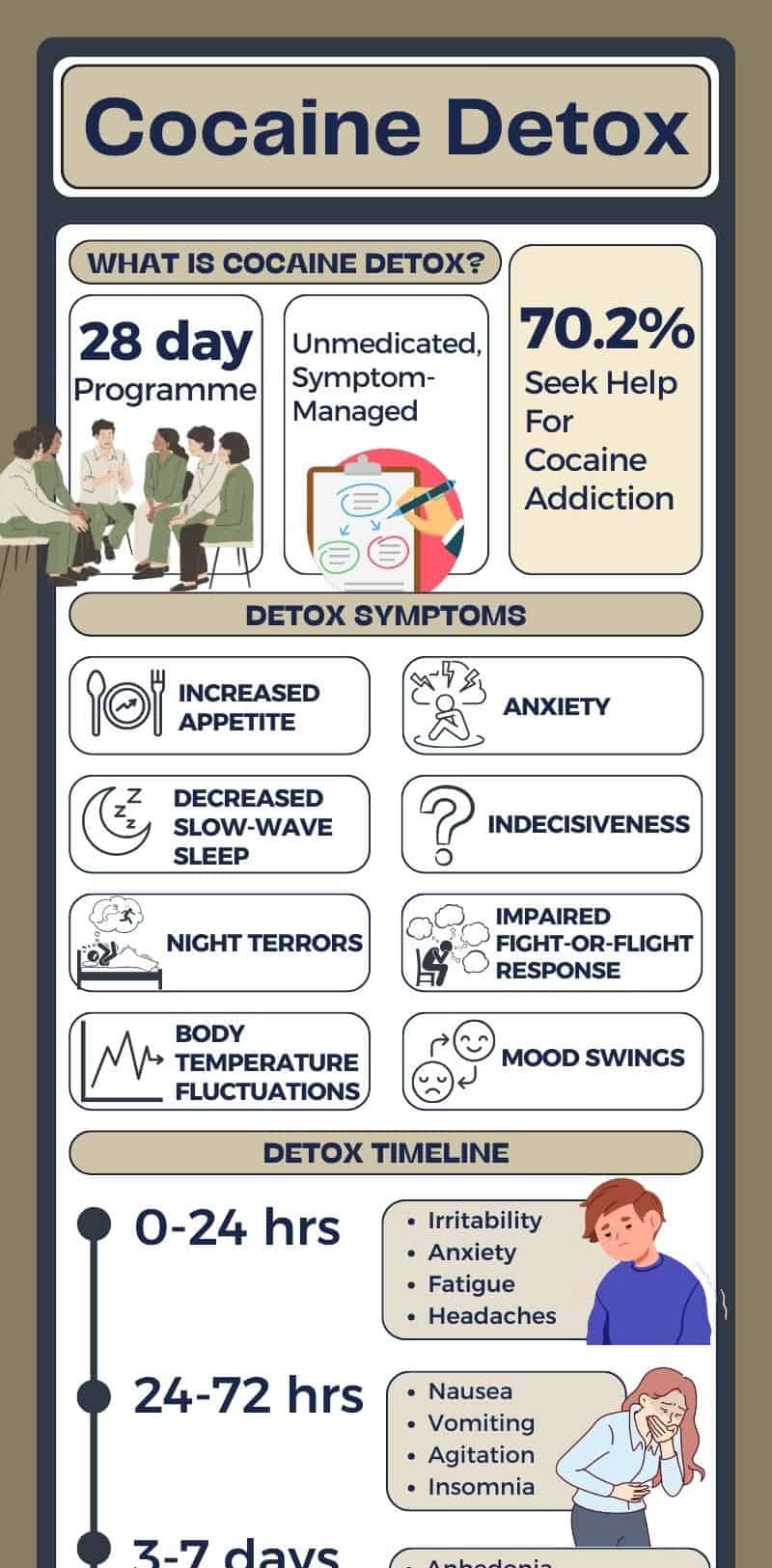
The depleted volume of dopamine receptors in cocaine recovery results in hypersomnia.
In the first 72 hours of withdrawal, an increase in REM sleep results in vivid dreams and night terrors [7].
Slow-wave sleep activity is lowest between 4 and 9 days of abstinence, causing minimal deep sleep [8].
Increased appetite from dopamine depletion and circulating hunger hormones result in hunger and weight gain.
Withdrawal results in a suppressed vasodilation response, leading to fluctuations in temperature.
Cessation results in an inability to regulate body temperature as less dopamine is available for homeostasis.
Cocaine Detox Psychological Symptoms
If you’re concerned about psychological side effects in the detox process, our experienced clinicians are here to address your worries and create a tailored plan for your detox.
12 weeks of cocaine abstinence results in a 40% reduction in cortical levels of 5-HT compared to 1 week, increasing the risk of depression in the mid-stages of detox [9].
Mood swings occur due to a lack of quality sleep and decreased dopamine responsible for emotional regulation.
A lowered volume of dopamine receptors and dysregulated noradrenergic receptors leads to an impaired fight-or-flight response, resulting in high attrition rates for cocaine detox programmes.
Anxiety occurs due to oxidative stress damage observed 4 days into detoxification.
Indecisiveness results in psychological stress as cocaine is no longer available to help concentration in decision-making.
Symptom Monitoring
Symptom monitoring assesses whether medications are required to manage secondary side effects.
Medications used are:
Sertraline: 200mg/day for depression
Fluoxetine: 20mg/day for depression
Ondansetron: 4mg/kg per day for severe nausea and vomiting
Beta-blockers: for heart arrhythmias and anxiety
Intravenous fluids: for kidney inflammation prevention
Cocaine Detox Recovery Indicators
Detoxing from cocaine causes:
An 18% decrease in NMSP binding to dopamine receptors after 10 days of withdrawal, removing anhedonia and causing feelings of pleasure from stimuli other than cocaine use [10]
A 35% decreased risk of HIV infection [11]
Memory function improves to pre-addiction levels after 1 year of abstinence [12]
The following factors that change cocaine detox are either assessed ahead of admission, or a client is referred to an appropriate care facility for detox. Please speak to our admission team for more information.
Pre-existing chronic stress (cortisol ≥0.69 µg/dL) results in a 2.39 times increased chance of dropout from cocaine treatment programmes [17].
For pre-existing diabetes, withdrawal takes place in a hospital due to the risk of ketoacidosis from circulating cortisol.
Immune system responses decrease by 45% one day after substance cessation, so cases of weakened immunity require nutritional support and supplements to prevent immune suppression [1].
In cases of malnutrition, the programme integrates nutritional assessments and support, as nutritional deficiencies exacerbate fatigue experienced in cocaine withdrawal.
Pre-existing bipolar disorder requires treatment with lithium to regulate mood before recovery begins, delaying the programme until patients are stable.
Duration And Severity Of Cocaine Usage
Daily cocaine administration over 2 weeks causes reduced dopamine responses in 75% of neurons, so long-term users require more support with managing triggers as the brain is less able to regulate pleasure [19].
Short-term use typically results in fewer and less severe symptoms of withdrawal that do not always require a full 28-day detox.
Infrequent use leads to decreased psychological dependence, so not all 28 days for recovery are required.
Repetitive cardiovascular strain from binge use warrants beta blockers that are used before detox can start.
Overdose results in seizures in 7.9% of cases and requires close monitoring and anticonvulsant medication before recovery can begin [20].
Early-onset and long-term cannabis use exacerbates cocaine withdrawal symptoms.
5+ days of cannabis use in the 30 days before treatment leads to higher scores on the Beck Depression Index 3 weeks after treatment [21].
3+ years of cannabis use increases the number of re-hospitalisations for cocaine misuse 2.5 years after the first assessment [22].
The byproduct cocaethylene from the combined use of alcohol and cocaine has a half-life of 2 hours compared to 1 hour for cocaine alone, providing longer periods for withdrawal and detoxification for co-occurring addiction.
Patients with co-occurring pathological gambling spend, on average, 4.5% longer in recovery due to cross-overs in craving [2].
Co-occurring opioid addiction requires a medicated detox, as quitting without treatment is life-threatening.
Improvements In Treatment
If withdrawal from cocaine was treated medically, the following may be evident:
200mg/day of Modafinil leads to 8.9% more substance-free days compared with a placebo, increasing the length of abstinence [23]
400mg/day of Modafinil results in 56.6% more days of consecutive abstinence, making treatment more effective for longer [23]
Patients using Topiramate have a 2.43 times increased chance of continued abstinence compared to a placebo [24]
Topiramate improves day-to-day functioning and craving compared to placebos
Disulfiram is effective at reducing substance use when used with CBT, reducing the recovery timeframe
The use of Transcranial Magnetic Stimulation minimises substance use by 50% compared to a placebo, evidencing stronger adherence to recovery programmes [25]
Pregnancy
High arterial blood pressure (>85 mm Hg) seen in withdrawal increases the chances of pre-eclampsia in pregnant women by 27% [26].
85.7% of patients experience an abnormal heart rhythm during the first 3 weeks of abstinence, and this affects 10 in 100,000 pregnancies [27] [28].
Recovery includes vitamin deficiency testing and supplementation of folic acid and calcium to support foetal development in pregnancy.
Iron supplements prevent iron deficiency anaemia and lowered birthweight in pregnancy, so this changes the supplement regime for cocaine treatment.
When Is Cocaine Withdrawal MOST Appropriate?
In cases of low psychological control that require inpatient treatment so patients can be professionally monitored
In low-stress pregnancy, because increasing cortisol >0.69 µg/dL puts stress on the foetus [29]
In ADHD when extended methylphenidate is prescribed, decreasing the Addiction Severity Index by 4.9 in this population [30]
In ADHD because 60% have one other diagnosed psychiatric disorder, necessitating inpatient care [30]
When Is Cocaine Withdrawal Not Appropriate?
For pregnant women with pre-eclampsia because this is the leading cause of death in pregnancy [31]
When Sumatriptan is prescribed as combined with withdrawal this causes blood pressure to increase over 6 ± 5 mm Hg [32]
In cases of good psychological control as recovery may be done at home or outpatient - under professional medical advice only
In cases of combined fibromyalgia - an 8.6% reduction in dopamine in the substantia nigra worsens pre-existing fatigue and anhedonia [33]
For dual heroin/cocaine addiction as this requires medication
Engaging in work deadlines during recovery triggers stress that can lead to relapse in some cases, especially when the substance is used as a coping mechanism.
Please speak with our admissions team for further advice.
About the author
Philippa Scammell
Philippa Scammell MSci holds an integrated Master's degree in Psychology
from the University of York and has completed undergraduate statistical studies at Harvard University. Philippa has substantial experience in inpatient psychiatric care (Foss Park Hospital York), Research in Psychology at University of York, and group therapy facilitation (Kyra Women's Project). Philippa writes on clinical psychology and addiction recovery. Content reviewed by Laura Morris (Clinical Lead).