Alcoholism is a disease characterised by continuous heavy drinking. Until people with alcohol use disorder admit to problems with alcohol and stop drinking, the risk of alcohol use disorder continues which affects both physical and mental health.
Alcohol starts to injure the brain once it reaches the bloodstream.
Excessive consumption can lead to Alcohol-Related Brain Damage, or ARBD, which is a type of brain disorder caused by alcohol consumption. Brain shrinkage caused by alcohol abuse is permanent, as alcohol kills brain cells and grey matter.
For more information and effects click ‘Learn More’.
Family Recovery Compass is a newsletter for friends and family members who feel trapped between supporting a loved one in addiction, and protecting their own wellbeing.
Every week, we tackle one specific situation in addiction family dynamics, and deliver practical decision-making frameworks and exact dialogue scripts – that help you respond with confidence instead of reaction.
Every month, we bring you an unfiltered recovery conversation with someone who’s either experienced addiction firsthand, or works closely with those in recovery.
No sanitised success stories – just practical insights on what actually works in recovery, that you can apply, in your life too.
Recovery capital is the internal and external resource used to begin the recovery process and maintain sobriety. This combines personal, social, and community support to provide a joined-up approach that supports the addict through recovery.
Do you or a loved one need addiction treatment for alcohol or drugs? Thousands blindly walk into addiction treatment in expensive rehab centres and find that the reality doesn’t meet expectations.
If you’re considering rehab treatment, first check our ultimate guide for complete instructions on how to find the right rehab centre for you.
Take-home Naloxone kits help families and loved ones respond quickly in an opioid overdose emergency, until emergency services arrive. Kits contain nasal or injectable forms of Naloxone.
Changes in legislation mean Naloxone kits are now more widely available from pharmacies and drug services, including Abbeycare.
For additional information, click ‘Learn More’ below.
Overcoming alcohol addiction means first ceasing alcohol intake, and taking care of physical and chemical withdrawal symptoms.
Detoxing from alcohol means undergoing withdrawal from alcohol, but with the assistance of prescribed medication and detox phase, to substitute in place of the alcohol itself.
Alcohol rehab focuses on tackling the problems underneath alcoholism, such as grief, trauma, depression, and emotional difficulties, in order to reduce continuing drinking after treatment.
Inpatient services at an alcohol rehab programme provides 24 hour access to specialist care.
Alcohol home detox provides a means of semi-supervised addiction treatment in the comfort of your home. It’s often suitable for those with inescapable practical commitments, or where a reduced budget for treatment is available.
An at-home detox is the most basic detox option available from Abbeycare, and assumes you have support available, post-detox, for the other important elements of long-term addiction recovery.
The term alcoholism refers to the consumption of alcohol to the extent that the person is unable to manage their own drinking habits or patterns, resulting in side-effects that are detrimental to the quality of life and health of the alcoholic, or those around them.
An alcoholic is someone who continues to compulsively abuse alcohol in this way, despite the negative consequences to their lives and health.
Immediately following treatment, the early stages of recovery and abstinence are most vulnerable to lapses.
At Abbeycare, a structured and peer-reviewed aftercare plan is usually prepared whilst still in treatment. This comprises social, peer, and therapeutic resources individuals draw upon, following a residential treatment programme for drug or alcohol misuse.
Clinically managed residential detoxification is:
– A structured detox that uses medication-assisted treatment and regular physical health observations
– Takes place in an inpatient rehabilitation unit or hospital
– Typically lasts from 7-10 days, but in Abbeycare, it is incorporated into a 28-day rehab programme
Family Therapy at Abbeycare Scotland or Gloucester is realistic, compassionate, and appropriate for families and loved ones of addicts.
Family therapeutic interventions in residential rehabilitation have been designed to support those living with or caring for participants entering the Abbeycare Programme.
Support for families in a group setting allows for a safe, constructive, and confidential place to listen and share common experiences.
Inpatient rehab is drug and/ or alcohol treatment in a rehab centre, where patients remain on-site for the duration of inpatient rehabilitation.
It includes detoxification from drugs, therapy (group work and 1-2-1 sessions), and aftercare planning. Inpatient rehabs typically last 28 days, but this varies on an individual basis.
Long-term treatment at Abbeycare has been developed for those suffering from alcohol or drug addiction. Completing a long-term drug and alcohol inpatient programme may be the solution to problematic substance use.
Motivational Enhancement Therapy can be used by trained addiction recovery therapists to elicit internal changes within and promote long-term recovery from substance use disorder.
All the answers to addiction can be found within with this comprehensive and successful therapy concept leads to behavioural changes, reflective listening, self-motivational statements, and a comprehensive recovery process.
Outpatient drug or alcohol rehab is daytime treatment as opposed to living in a treatment facility.
Outpatient treatment is similar to inpatient in terms of the methods used to treat substance abuse. Where they differ is in their approach to recovery.
Abbeycare’s prison to rehab is a 12-week structured rehab programme which involves direct transfer from prison. The suitability of the candidate is decided by prison staff.
Short-term residential treatment programmes are the chance to press the reset button and access a therapeutic programme designed to create recovery from the use of alcohol and drugs.
Feeling stuck in a rut. Want to stop but can’t seem to achieve sobriety?
Click below.
The 12-step programme was created by alcoholics anonymous (AA), and is specifically designed to aid addicts in achieving and maintaining abstinence.
The central ethos behind the programme is that participants must admit and surrender to a divine power to live happy lives. Ideas and experiences are shared in meetings, and help is sought in an attempt to achieve abstinence.
Abbeycare’s policy to respect your privacy and comply with any applicable law and regulation regarding any personal information we may collect about you, including across our website and other sites we own and operate.
Having daily non-negotiables like connecting with friends, journaling, reading, exercise, and cooking nutritious meals
Maintaining an active social life with supportive friendships, including those found at groups like Al-Anon - 94% of Al-Anon members report Al-Anon affects their life "very positively" [4]
Positive And Negative Reinforcement
Positive reinforcement includes:
Giving words of encouragement if the alcohol addict attends a support group or goes to the doctor for help with cutting down drinking
Sitting and listening when the alcohol addict expresses they're experiencing challenges instead of immediately drinking
Praising the alcohol addict for building a routine in sobriety
Giving the alcohol addict a lift to attend meet-ups with friends in sobriety
Financial planning with the drinker to help pay off debts
Negative reinforcement includes:
Withdrawing from the relationship if the alcohol addict misses support group - the alcoholic learns to attend support group if they want their child's support
Hanging up the phone immediately if the alcohol addict has been drinking - the alcoholic learns to make sober calls to the child
Letting the alcohol abuser experience the consequences of phoning their employer to explain work absences
Stopping doing the alcohol addict's food shopping - the alcoholic learns to buy their own food instead of relying on the child
Abandoning a conversation with the alcohol addict if they ask for money - the alcoholic learns to not ask for money
Recovery is not a linear process, but positive reinforcement encourages the alcohol addict to proactively seek recovery, while negative reinforcement encourages the alcohol addict to take responsibility for their own recovery [5].
What Is Detrimental When Dealing With An Alcoholic Parent
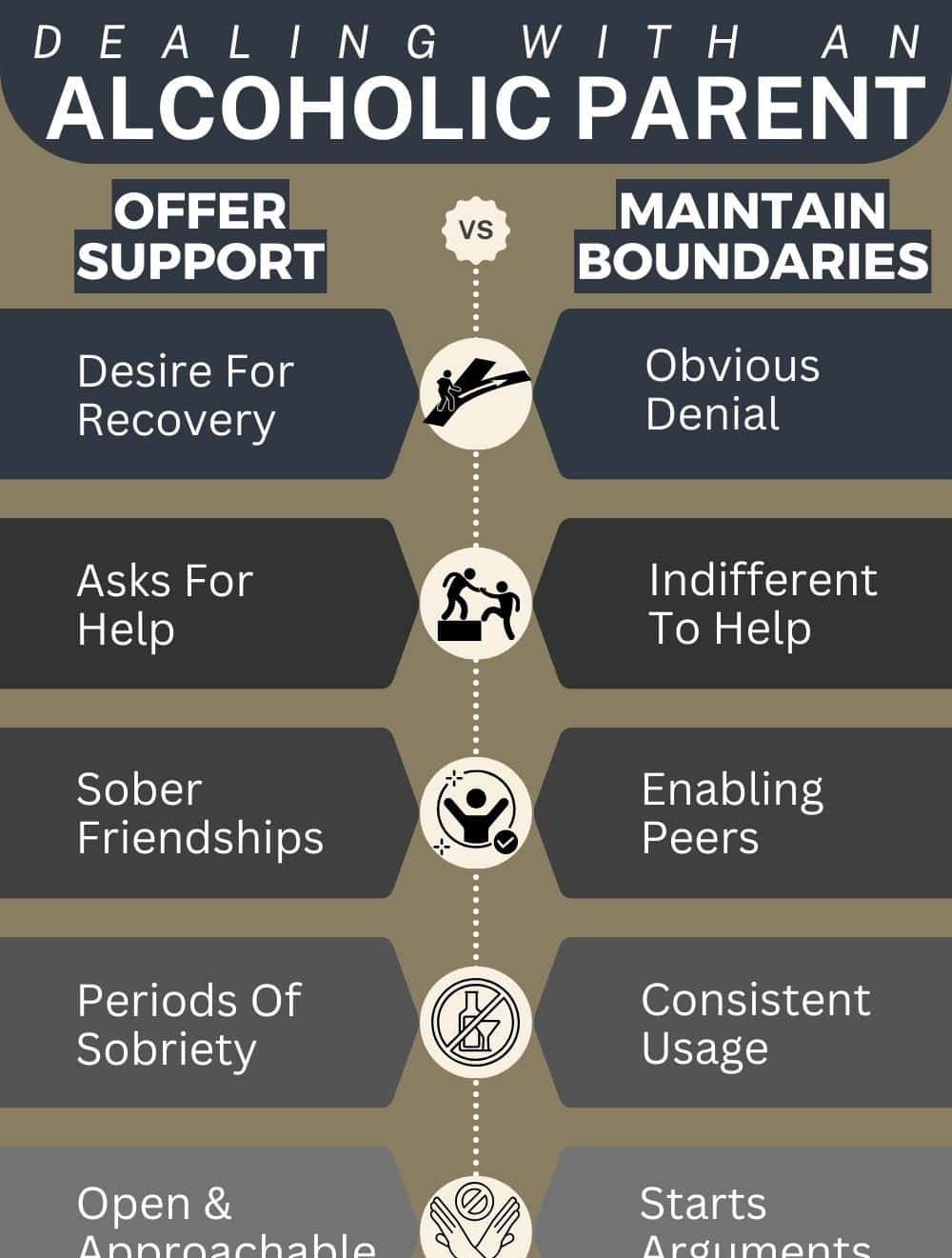
Arguments
Arguments are detrimental when coping with a parent because:
The alcohol abuser is actively starting arguments as an excuse to drink, so remaining non-reactive removes that excuse, making it easier to deal with the alcohol addicted parent
Bargaining with the drinker causes the drinker to unconsciously believe that the grown up child can be coerced into agreeing with alcoholism
Arguments can lead to physical and emotional violence. A study from the Netherlands of young people aged 18-30 found that 50% of participants experienced physical and emotional violence from an alcoholic family member, making it impossible to deal with a parent with alcoholism [6]
Arguments contribute to increased anxiety (with 18% of those with an alcoholic family member meeting the diagnostic criteria for serious or very serious anxiety) making it more difficult to deal with a parent with alcoholism [7]
The grown up child of an alcohol addict gains autonomy through not engaging in arguments with the alcohol addict, and choosing to walk away from an argument instead.
Taking Control Of Recovery
Taking control of alcohol recovery is detrimental when coping with a parent because:
The alcohol addict must admit powerlessness over addiction, take responsibility for their drinking, and take responsibility for their recovery if they want to achieve long-term abstinence
The child of the parent with alcoholism must detach from the drinker's recovery - detachment helps the child support the parent in recovery and not micro-manage the alcohol addict's recovery
Attempting to control how much the alcohol addict drinks will not help the addict recover because the alcohol addict may drink in secret or steal more alcohol - the drinker must decide to stop drinking for themselves
Criticism Of The Alcoholic Parent
Criticism of the parent is detrimental because criticism leads to a vicious cycle of criticism and drinking, such as:
The child criticises the parent
The parent drinks because of the criticism from the child
The parent blames the child for causing more drinking
The parent continues to drink, and the child continues to criticise the parent, furthering the cycle of addiction [8]
Co-dependency
A co-dependent relationship with a parent is detrimental because:
Resentment builds between the child and the parent, and resentment makes it harder for the child to deal with the parent
The grown up child of the alcohol addict feels obligated to care for the addict at the expense of their own needs
The alcohol abuser does not take accountability for their own addiction, worsening alcoholism
To stop co-dependent behaviours, the grown up child of the alcohol addict needs to:
Set and maintain boundaries
Be direct and communicate own needs
Be open, honest, and non-judgemental when the alcohol abuser approaches the child
Work with a therapist to process difficult emotions in a safe environment and identify unhealthy relationship patterns [9]
Enabling
Enabling is detrimental when coping with a parent because:
Enabling allows the drinker to be protected from consequences of actions - worsening addiction and making it harder to deal with the drinker
The child of the parent with alcohol addiction may think enabling helps to deal with the parent in the short term, as it makes it easier to be around the alcohol addict, but long-term enabling prevents the drinker from recovering
What Conditions Change How To Deal With An Alcoholic Parent?
Severity Of Alcoholism
The severity of alcoholism changes how to handle dynamics with a parent because:
A drinker early in their addiction may be more defensive and may be harder to deal with than a drinker who has realised that their addiction is unmanageable [10]
An alcohol addict who can see the consequences of their drinking through losing a job, losing their driving license, or needing to drink every day, may be more open to accepting help
If alcoholism is severe, problems with thinking and reasoning caused by alcohol-related dementia prevent the alcohol addict from understanding they need to stop drinking, and the priority for the child becomes the support the alcohol addict needs day-to-day and not longer term goals of recovery [11]
Safety
There are steps to take to protect oneself if an alcohol addict is abusive:
Establish clear boundaries for engaging with the alcohol addict
Make a plan to go and stay with a trusted friend, neighbour, or family member if needed
Do not engage with the drinker if the child suspects the drinker is about to become violent or abusive
Involve authorities if there is a risk of harm [12]
Culture And Society
The widespread culture of blaming alcohol addicts contributes to stigma, affecting the family who has to deal with the drinker:
33% of people worldwide believe alcoholism is not a disease [13]
94.5% worldwide believe someone who abuses alcohol can “get better if they wanted to” [14]
54% of the UK population believes alcohol-dependent individuals are personally to blame for any problems, and are irresponsible and lack self-control [15]
Muslim women (whose religion prohibits alcohol) are more likely to seek treatment for substance abuse where they will not be seen by others in the community, including private counselling and care in remote residential facilities [16].
Those whose religion prohibits alcohol may have more trouble dealing with a family member with alcohol use disorder, with less support in the community.
Finances
28% of drinkers have over $1,000 of credit card debt [17].
The amount of debt that a drinker goes into while waiting for treatment depends on the difference in admission times:
3 weeks is the average waiting time for charity-funded residential rehab [18]
Whereas private clinic admission can happen within 24 hours
If the alcohol addict cannot go to an inpatient rehab, the grown up child will have more responsibility for the alcohol addict's care as the addict detoxes at home.
An NHS home detox involves a detox nurse visiting 4 times a day, for 15mins each visit - outside of this, the child would have to cope with and care for the parent.
Mental Health Issues
Anxiety
Adult children of alcohol abusers are hyper-vigilant, with high levels of anxiety [19].
The alcohol abuser's erratic behaviour is anxiety-provoking, particularly for a child diagnosed with an anxiety disorder which is managed with a consistent daily routine. The drinker's behaviour is difficult to deal with:
Skipping doctor's appointments
Unpredictable mood changes
Sleeping in
Cancelling plans last-minute
Requesting large sums of money at short notice
Vast differences between behaviour before and after drinking
This chaotic home life can cause more anxiety in the child of the drinker, leading to a repetitive cycle:
The child of the alcohol addict feels anxious
The alcohol addict's continued drinking means the child does not feel like the relationship with the parent is emotionally safe
The child's pre-existing anxiety disorder worsens
The cycle repeats
When Dealing With A Parent Suffering With Alcoholism Is MOST Appropriate
The drinker reaches out for help
The drinker asks for support attending GP appointments [20]
The drinker asks about ways to change and is willing to attend AA meetings
The drinker is able to admit to alcoholism - if a drinker in this state is approached, they may be willing to open up when approached even if they are unable to directly ask for help
The drinker is not in denial and is not drinking for a period of time, even just early in the morning - when the drinker is not under the influence of alcohol, they are most aware of the consequences of drinking, and will be most responsive to accepting help [21]
The grown up child is not living with the drinker - there are clear boundaries in the relationship
The grown up child is not co-dependent with the parent, and the parent is not being enabled by the child
When Dealing With A Parent Suffering With Alcoholism Is NOT Appropriate
Harriet Garfoot BA, MA has an Undergraduate degree in Education Studies and English, and a Master's degree in English Literature, from Bishop Grosseteste University. Harriet writes on stress & mental health, and is a member of the Burney Society. Content reviewed by Laura Morris (Clinical Lead).