Alcoholism is a disease characterised by continuous heavy drinking. Until people with alcohol use disorder admit to problems with alcohol and stop drinking, the risk of alcohol use disorder continues which affects both physical and mental health.
Alcohol starts to injure the brain once it reaches the bloodstream.
Excessive consumption can lead to Alcohol-Related Brain Damage, or ARBD, which is a type of brain disorder caused by alcohol consumption. Brain shrinkage caused by alcohol abuse is permanent, as alcohol kills brain cells and grey matter.
For more information and effects click ‘Learn More’.
Family Recovery Compass is a newsletter for friends and family members who feel trapped between supporting a loved one in addiction, and protecting their own wellbeing.
Every week, we tackle one specific situation in addiction family dynamics, and deliver practical decision-making frameworks and exact dialogue scripts – that help you respond with confidence instead of reaction.
Every month, we bring you an unfiltered recovery conversation with someone who’s either experienced addiction firsthand, or works closely with those in recovery.
No sanitised success stories – just practical insights on what actually works in recovery, that you can apply, in your life too.
Recovery capital is the internal and external resource used to begin the recovery process and maintain sobriety. This combines personal, social, and community support to provide a joined-up approach that supports the addict through recovery.
Do you or a loved one need addiction treatment for alcohol or drugs? Thousands blindly walk into addiction treatment in expensive rehab centres and find that the reality doesn’t meet expectations.
If you’re considering rehab treatment, first check our ultimate guide for complete instructions on how to find the right rehab centre for you.
Take-home Naloxone kits help families and loved ones respond quickly in an opioid overdose emergency, until emergency services arrive. Kits contain nasal or injectable forms of Naloxone.
Changes in legislation mean Naloxone kits are now more widely available from pharmacies and drug services, including Abbeycare.
For additional information, click ‘Learn More’ below.
Overcoming alcohol addiction means first ceasing alcohol intake, and taking care of physical and chemical withdrawal symptoms.
Detoxing from alcohol means undergoing withdrawal from alcohol, but with the assistance of prescribed medication and detox phase, to substitute in place of the alcohol itself.
Alcohol rehab focuses on tackling the problems underneath alcoholism, such as grief, trauma, depression, and emotional difficulties, in order to reduce continuing drinking after treatment.
Inpatient services at an alcohol rehab programme provides 24 hour access to specialist care.
Alcohol home detox provides a means of semi-supervised addiction treatment in the comfort of your home. It’s often suitable for those with inescapable practical commitments, or where a reduced budget for treatment is available.
An at-home detox is the most basic detox option available from Abbeycare, and assumes you have support available, post-detox, for the other important elements of long-term addiction recovery.
The term alcoholism refers to the consumption of alcohol to the extent that the person is unable to manage their own drinking habits or patterns, resulting in side-effects that are detrimental to the quality of life and health of the alcoholic, or those around them.
An alcoholic is someone who continues to compulsively abuse alcohol in this way, despite the negative consequences to their lives and health.
Immediately following treatment, the early stages of recovery and abstinence are most vulnerable to lapses.
At Abbeycare, a structured and peer-reviewed aftercare plan is usually prepared whilst still in treatment. This comprises social, peer, and therapeutic resources individuals draw upon, following a residential treatment programme for drug or alcohol misuse.
Clinically managed residential detoxification is:
– A structured detox that uses medication-assisted treatment and regular physical health observations
– Takes place in an inpatient rehabilitation unit or hospital
– Typically lasts from 7-10 days, but in Abbeycare, it is incorporated into a 28-day rehab programme
Family Therapy at Abbeycare Scotland or Gloucester is realistic, compassionate, and appropriate for families and loved ones of addicts.
Family therapeutic interventions in residential rehabilitation have been designed to support those living with or caring for participants entering the Abbeycare Programme.
Support for families in a group setting allows for a safe, constructive, and confidential place to listen and share common experiences.
Inpatient rehab is drug and/ or alcohol treatment in a rehab centre, where patients remain on-site for the duration of inpatient rehabilitation.
It includes detoxification from drugs, therapy (group work and 1-2-1 sessions), and aftercare planning. Inpatient rehabs typically last 28 days, but this varies on an individual basis.
Long-term treatment at Abbeycare has been developed for those suffering from alcohol or drug addiction. Completing a long-term drug and alcohol inpatient programme may be the solution to problematic substance use.
Motivational Enhancement Therapy can be used by trained addiction recovery therapists to elicit internal changes within and promote long-term recovery from substance use disorder.
All the answers to addiction can be found within with this comprehensive and successful therapy concept leads to behavioural changes, reflective listening, self-motivational statements, and a comprehensive recovery process.
Outpatient drug or alcohol rehab is daytime treatment as opposed to living in a treatment facility.
Outpatient treatment is similar to inpatient in terms of the methods used to treat substance abuse. Where they differ is in their approach to recovery.
Abbeycare’s prison to rehab is a 12-week structured rehab programme which involves direct transfer from prison. The suitability of the candidate is decided by prison staff.
Short-term residential treatment programmes are the chance to press the reset button and access a therapeutic programme designed to create recovery from the use of alcohol and drugs.
Feeling stuck in a rut. Want to stop but can’t seem to achieve sobriety?
Click below.
The 12-step programme was created by alcoholics anonymous (AA), and is specifically designed to aid addicts in achieving and maintaining abstinence.
The central ethos behind the programme is that participants must admit and surrender to a divine power to live happy lives. Ideas and experiences are shared in meetings, and help is sought in an attempt to achieve abstinence.
Abbeycare’s policy to respect your privacy and comply with any applicable law and regulation regarding any personal information we may collect about you, including across our website and other sites we own and operate.
Alcohol + opioids in 3% = oversedation & hypotension [8]
Medical detox for both withdrawal syndromes
Non-opioid medication advice + physio referrals
Alcohol Rehab Process For The Elderly
Detox
Detox Differing From Standard Approaches
Standard Detox Protocols
Elderly Detox Protocols
Average Duration
6 days [1]
9 days [1]
Medication
Long-acting BZDs
(e.g. 100mg chlordiazepoxide) for 5-7 days [9]
Short-acting BZDs (e.g. 30mg oxazepam) for ≤ 7 days [9]
Monitoring Frequency
Hourly for severe withdrawal (AWS > 14) [9]
Continuous for severe withdrawal (AWS>14) [9]
Symptomatic Treatment
2.5-5mg Olanzapine + 600mg Carbamazepine [9]
≤20mg Olanzapine + 800mg/d Carbamazepine [10]
Why Are Detox Protocols Modified?
Average Duration
+21% withdrawal symptoms in over 65s vs under 30s [1]
Medication
To avoid prolonged sedation + daytime sleepiness in 43% [1]
Monitoring Frequency
3-fold increase in withdrawal delirium = 24hr hospital care [10]
Symptomatic Treatment
34 - 40% increase in seizures + hallucination severity [10]
Delirium Tremens
Detox protocols are modified for elderly patients in addiction treatment to mitigate the 2-fold elevated risk of developing delirium tremens (DTs) during withdrawal caused by systolic blood pressure (SBP) > 150mmHg (over 60s = 168 vs under 35s = 145mmHg), requiring [1][11]:
Higher doses of clonidine (e.g. 150 vs 75μg every 6 – 8 hrs) to adequately treat high blood pressure in 88% (vs 69% in under 35s) during withdrawal after long-term alcohol abuse (15+ years) [1][9]
Beta-blockers (e.g. propranolol) may be provided alongside a salt-restricted diet plan due to a hypertensive history in 25% of elderly clients (vs 3% of younger clients) with severe alcohol addictions (i.e. 18 drinks p/d) [1]
Around 6% of elderly clients who enter addiction treatment have previously experienced delirium tremens (vs 0% of younger patients) and may be admitted to hospital for detox due to [1]:
Higher rates of withdrawal delirium (12% vs 4%), seizures (10% vs 7%), and cognitive impairment (50% vs 8%) in over 60s vs under 30s, requiring 1-1 nursing care to reorient patients and monitor progress continuously [1][9][10]
Extended monitoring requirements for signs of DTs (e.g. hallucinations, psycho-motor agitation) because older adults are still symptomatic after 9 days, compared to 6 – 7 days for younger adults in addiction treatment [1]
A 90% increase in concomitant medical disorders, including cardiac disease and pancreatitis, compared to younger patients after drinking heavily for 5 – 13 years [10]
Weekly 90-min group sessions to modify maladaptive schemas (e.g. "I drink because I’m ashamed") [3]
Schema-CBT increases healthy schemas by 9% in 60 - 78 y/o [14]
11% reduction in dysfunctional schemas after 2 months [14]
Aftercare
Aftercare is adapted for older adults in addiction recovery programmes to focus on the “5 Ms” (i.e matters most, medication, mind, mobility, multicomplexity) by [15]:
Using a person-focused approach rather than a policy-focused approach to help elderly clients set and achieve specific, attainable goals (e.g. turning bedroom lights off at 10 pm) with keyworkers during recovery [1]
Actively linking patients with self-management programmes to build structure into daily routines and provide support with living independently and adhering to medication schedules (e.g. 500mg/d Metformin for diabetes)
Liaising with GPs for medical advice, treatment, and referrals to specialist mental health services if needed to manage anxiety and depression in up to 77% of long-term elderly drinkers (i.e. 15+ years) [1]
Integrating home-based primary care and virtual visits into the continuing care plan as an alternative to weekly face-to-face check-ups for patients with mobility and transportation limitations (e.g. walking difficulties, unable to drive due to visual impairment)
Communicating with health care professionals (e.g. cardiologist, dietician) for the management of comorbid diagnoses (e.g. cardiac or pancreatic disease in up to 56%) to prevent health complications from hindering the addiction recovery process [1]
What Changes Alcohol Addiction Treatment For Older Adults?
Accessibility
Health And Safety Adaptations
Pharmacological and nonpharmacological interventions are adapted for the health and safety of elderly clients in rehab with drug or alcohol addictions due to cognitive impairment, muscle weakness, and daytime sleepiness in up to 50%, altering rehabilitation protocols because [1]:
Withdrawal symptoms are treated with short-acting benzodiazepines (e.g. 30mg oxazepam) as an alternative to long-acting benzodiazepines (e.g. 80mg diazepam) to avoid prolonged sedation in older adults [9]
Low-impact age-sensitive wellness activities (e.g. tai chi, swimming, meditation) are incorporated into senior rehab programmes to help patients gain muscle strength and regulate mood whilst preventing future falls or accidents
Older adults may be required to participate in a 3-minute verbal memory and clock drawing task (i.e. Mini-Cog) to establish the severity of cognitive impairments before clinicians develop an appropriate treatment plan [3]
Coping skills training is adapted to highlight the antecedents (e.g. feeling lonely), behaviours (e.g. drinking brandy before bed), and consequences (e.g. insomnia + wrist break) of elderly alcohol use to encourage behaviour change and minimise future high-risk situations [3]
Fall Risk Assessments
Older people in addiction rehab with ≥ 2 past-year falls and walking or balance difficulties require a fall risk assessment, including the “Timed Up & Go” test (TUG) to measure the patient’s ability to stand from a seated position, walk 10 feet, and turn around [3].
Katz Index of Independence in Activities of Daily Living is used in addiction treatment facilities to gauge older patients’ care needs and prevent future falls by evaluating performance in bathing, dressing, toileting, transferring, continence, and feeding (e.g. < 2 = severe functional impairment) [3].
After a fall risk assessment, the duration of benzodiazepine use (e.g. ≤ 80mg diazepam) during alcohol treatment is limited to 5 – 7 days to minimise excessive sedation in elderly clients who are at risk of falling (i.e. TUG ≥12 seconds) [9].
Visual Or Hearing Impairments
Substance abuse treatment programmes for older people with an addiction to alcohol and visual or hearing impairments are adapted by:
Speaking at a slower pace, repeating instructions/questions as needed, and allowing time for patients to respond and process information during short, low-intensity therapy sessions (e.g. 4x 15 mins) [3]
Offering individual therapy sessions for deaf or hard-of-hearing patients rather than group sessions because some seniors may become overwhelmed by various tones, pitches, or volumes during group discussions
Conducting regular observations (e.g. every 15 mins) to minimise harm by supporting visually impaired patients who struggle with activities of daily living (e.g. Katz ADL: 0 = needs help transferring to the toilet or moving from bed to chair) [3]
Providing frequent orientation, reassurance, and explanations of procedures to minimise anxiety or confusion and ensuring glasses and/or hearing aids are clean and functional during each stage of the programme
Some addiction rehab facilities provide British Sign Language (BSL) interpreters, braille, and large printed worksheets to assist elderly clients with alcohol use disorder during treatment sessions, although these services depend on the patient’s level of functioning (e.g. Katz ADL ≤ 2 = severe impairment) and the treatment provider [3].
Timing Of Development Of Alcohol Use Disorder
Early-Onset Alcohol Use Disorder (EOAD)
Late-Onset Alcohol Use Disorder (LOAD)
Detox
60mg lorazepam + 100mg naltrexone [17]
30mg lorazepam + 50mg naltrexone [17]
Therapy
Cognitive Processing & Narrative Exposure
Non-confrontational & coping skills training
Aftercare Planning
GP liaison for EMDR + anxiety management
GP liaison for grief counselling + SSRIs
Why Does Rehab Differ?
Detox
13% increased cravings in EOAD + severe withdrawal expected (CIWA-Ar > 20) after 42 yrs vs 6 yrs of use [16]
Therapy
EOAD develops < 25 y/o due to unresolved early trauma vs LOAD > 45 y/o due to major life transitions [16]
Aftercare Planning
LOAD 2x more likely to be widowed & depressed (+5%) vs EOAD = deep-rooted trauma & anxiety (+26%) [16]
Decreased Function Due To Ageing
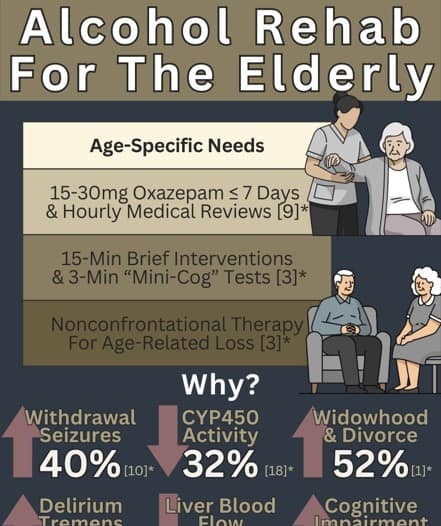
A 32 - 50% reduction in Cytochrome P450 activity and liver blood flow in elderly people alters alcohol addiction rehab because benzodiazepines with a short or intermediate half-life and no active metabolites are required to prevent oversedation, including [18]:
15 – 30mg Oxazepam (6 – 8-hour half-life) as an alternative to the typical fixed-dose tapering regimen using a long-acting BZD (e.g. 40mg/d Diazepam, reducing by 10mg daily after day 5 and ceasing on day 7) [9]
30 – 60mg lorazepam (8 –15-hour half-life) every 4 hours to replace a symptom-triggered regimen (e.g. AWS>14 = 20mg diazepam) with a longer-acting BZD, minimising the risk of drug accumulation, ataxia, and confusion in older patients [9][17]
Elderly clients require low-intensity age-specific rehab treatment with regular liver function tests because 50% are cognitively impaired and 53% have liver disease with elevated AST levels (72 IU/L vs normal = 5 – 42 IU/L) after drinking heavily (18 drinks p/d) for 19 years [1].
Does Alcohol Rehab For Seniors Offer End-Of-Life Care?
Drug and alcohol rehabs are unable to provide end-of-life care due to a lack of appropriate facilities (e.g. family rooms for overnight stays) and licenses to store or administer certain pain medications (e.g. IV 30mg Ketolorac tromethamine) initiated by specialist palliative care teams [19].
Addiction rehabs do not offer end-of-life care due to ethical complications (e.g. a lack of decision-making capacity) because delirium occurs in up to 75% of terminally ill patients, which would be exacerbated by [19]:
Delirium tremens and hallucinations in up to 17% of over 60s with severe alcohol addictions (i.e. 18 drinks per day) [1]
Cognitive impairment and depression in up to 60% of elderly individuals after 15+ years of alcohol abuse [1]
Psychomotor agitation and daytime sleepiness in up to 43% of elderly rehab patients who detox from alcohol in a hospital setting [1]
Does Insurance Cover Elderly Substance Abuse Treatment?
Some insurance policies cover residential rehab for addiction in the elderly, although coverage depends on strict eligibility criteria, such as policy entry ages (i.e. 61 - 75 y/o only), only providing coverage after a ≥ 6 week NHS wait, or 1 addiction treatment programme during each member's lifetime.
Most insurance policies for elderly adults aged ≥ 75 only provide coverage with full medical underwriting, limiting addiction treatment options for seniors with co-occurring physical or mental health conditions due to various exclusions (e.g. 24hr care requirements after a heart attack within the last 2 years).
About the author
Mischa Ezekpo
Mischa Ezekpo has a Bachelors degree in Psychology from Northumbria
University, and a Masters degree in Childhood Development and
Wellbeing, from Manchester Metropolitan University. Since 2018, Mischa
has written and published work on Addiction, Mental Health, Depression, and Eating Disorders. Content reviewed by Laura Morris (Clinical Lead).