Alcoholism is a disease characterised by continuous heavy drinking. Until people with alcohol use disorder admit to problems with alcohol and stop drinking, the risk of alcohol use disorder continues which affects both physical and mental health.
Alcohol starts to injure the brain once it reaches the bloodstream.
Excessive consumption can lead to Alcohol-Related Brain Damage, or ARBD, which is a type of brain disorder caused by alcohol consumption. Brain shrinkage caused by alcohol abuse is permanent, as alcohol kills brain cells and grey matter.
For more information and effects click ‘Learn More’.
Family Recovery Compass is a newsletter for friends and family members who feel trapped between supporting a loved one in addiction, and protecting their own wellbeing.
Every week, we tackle one specific situation in addiction family dynamics, and deliver practical decision-making frameworks and exact dialogue scripts – that help you respond with confidence instead of reaction.
Every month, we bring you an unfiltered recovery conversation with someone who’s either experienced addiction firsthand, or works closely with those in recovery.
No sanitised success stories – just practical insights on what actually works in recovery, that you can apply, in your life too.
Recovery capital is the internal and external resource used to begin the recovery process and maintain sobriety. This combines personal, social, and community support to provide a joined-up approach that supports the addict through recovery.
Do you or a loved one need addiction treatment for alcohol or drugs? Thousands blindly walk into addiction treatment in expensive rehab centres and find that the reality doesn’t meet expectations.
If you’re considering rehab treatment, first check our ultimate guide for complete instructions on how to find the right rehab centre for you.
Take-home Naloxone kits help families and loved ones respond quickly in an opioid overdose emergency, until emergency services arrive. Kits contain nasal or injectable forms of Naloxone.
Changes in legislation mean Naloxone kits are now more widely available from pharmacies and drug services, including Abbeycare.
For additional information, click ‘Learn More’ below.
Overcoming alcohol addiction means first ceasing alcohol intake, and taking care of physical and chemical withdrawal symptoms.
Detoxing from alcohol means undergoing withdrawal from alcohol, but with the assistance of prescribed medication and detox phase, to substitute in place of the alcohol itself.
Alcohol rehab focuses on tackling the problems underneath alcoholism, such as grief, trauma, depression, and emotional difficulties, in order to reduce continuing drinking after treatment.
Inpatient services at an alcohol rehab programme provides 24 hour access to specialist care.
Alcohol home detox provides a means of semi-supervised addiction treatment in the comfort of your home. It’s often suitable for those with inescapable practical commitments, or where a reduced budget for treatment is available.
An at-home detox is the most basic detox option available from Abbeycare, and assumes you have support available, post-detox, for the other important elements of long-term addiction recovery.
The term alcoholism refers to the consumption of alcohol to the extent that the person is unable to manage their own drinking habits or patterns, resulting in side-effects that are detrimental to the quality of life and health of the alcoholic, or those around them.
An alcoholic is someone who continues to compulsively abuse alcohol in this way, despite the negative consequences to their lives and health.
Immediately following treatment, the early stages of recovery and abstinence are most vulnerable to lapses.
At Abbeycare, a structured and peer-reviewed aftercare plan is usually prepared whilst still in treatment. This comprises social, peer, and therapeutic resources individuals draw upon, following a residential treatment programme for drug or alcohol misuse.
Clinically managed residential detoxification is:
– A structured detox that uses medication-assisted treatment and regular physical health observations
– Takes place in an inpatient rehabilitation unit or hospital
– Typically lasts from 7-10 days, but in Abbeycare, it is incorporated into a 28-day rehab programme
Cognitive Behavioural Therapy is a well-known therapy option used by doctors at drug and alcohol treatment facilities for the treatment of substance use disorders.
It is a form of talking therapy that helps one mange their problems by changing how they think and behave. This form of therapy is used to treat depression and anxiety and is useful for physical health problems as well as one’s mental health.
Family Therapy at Abbeycare Scotland or Gloucester is realistic, compassionate, and appropriate for families and loved ones of addicts.
Family therapeutic interventions in residential rehabilitation have been designed to support those living with or caring for participants entering the Abbeycare Programme.
Support for families in a group setting allows for a safe, constructive, and confidential place to listen and share common experiences.
Inpatient rehab is drug and/ or alcohol treatment in a rehab centre, where patients remain on-site for the duration of inpatient rehabilitation.
It includes detoxification from drugs, therapy (group work and 1-2-1 sessions), and aftercare planning. Inpatient rehabs typically last 28 days, but this varies on an individual basis.
Long-term treatment at Abbeycare has been developed for those suffering from alcohol or drug addiction. Completing a long-term drug and alcohol inpatient programme may be the solution to problematic substance use.
Motivational Enhancement Therapy can be used by trained addiction recovery therapists to elicit internal changes within and promote long-term recovery from substance use disorder.
All the answers to addiction can be found within with this comprehensive and successful therapy concept leads to behavioural changes, reflective listening, self-motivational statements, and a comprehensive recovery process.
Outpatient drug or alcohol rehab is daytime treatment as opposed to living in a treatment facility.
Outpatient treatment is similar to inpatient in terms of the methods used to treat substance abuse. Where they differ is in their approach to recovery.
Abbeycare’s prison to rehab is a 12-week structured rehab programme which involves direct transfer from prison. The suitability of the candidate is decided by prison staff.
Short-term residential treatment programmes are the chance to press the reset button and access a therapeutic programme designed to create recovery from the use of alcohol and drugs.
Feeling stuck in a rut. Want to stop but can’t seem to achieve sobriety?
Click below.
The 12-step programme was created by alcoholics anonymous (AA), and is specifically designed to aid addicts in achieving and maintaining abstinence.
The central ethos behind the programme is that participants must admit and surrender to a divine power to live happy lives. Ideas and experiences are shared in meetings, and help is sought in an attempt to achieve abstinence.
Abbeycare’s policy to respect your privacy and comply with any applicable law and regulation regarding any personal information we may collect about you, including across our website and other sites we own and operate.
6% of cocaine consumers who visit the emergency room for chest pain after the use of cocaine experience a myocardial infarction; ischemia and infarction occur in chronic cocaine abusers [4].
47% of daily cocaine addicts experience nasal membrane irritation, such as nasal crusts or scabs, and recurrent nosebleeds [5].
Cocaine abusers with a history of pre-existing seizures have a 200% increased risk of seizure caused by cocaine [6].
6 to 26% of those who take cocaine experience haemoptysis [7].
77 to 85% of those addicted to cocaine who died from cocaine use experienced pulmonary edemas [8].
Coronary stenosis increases by 50% after 6 months of cocaine use [9].
24% of cocaine abusers develop rhabdomyolysis [10].
Psychological Indicators Of Cocaine Addiction
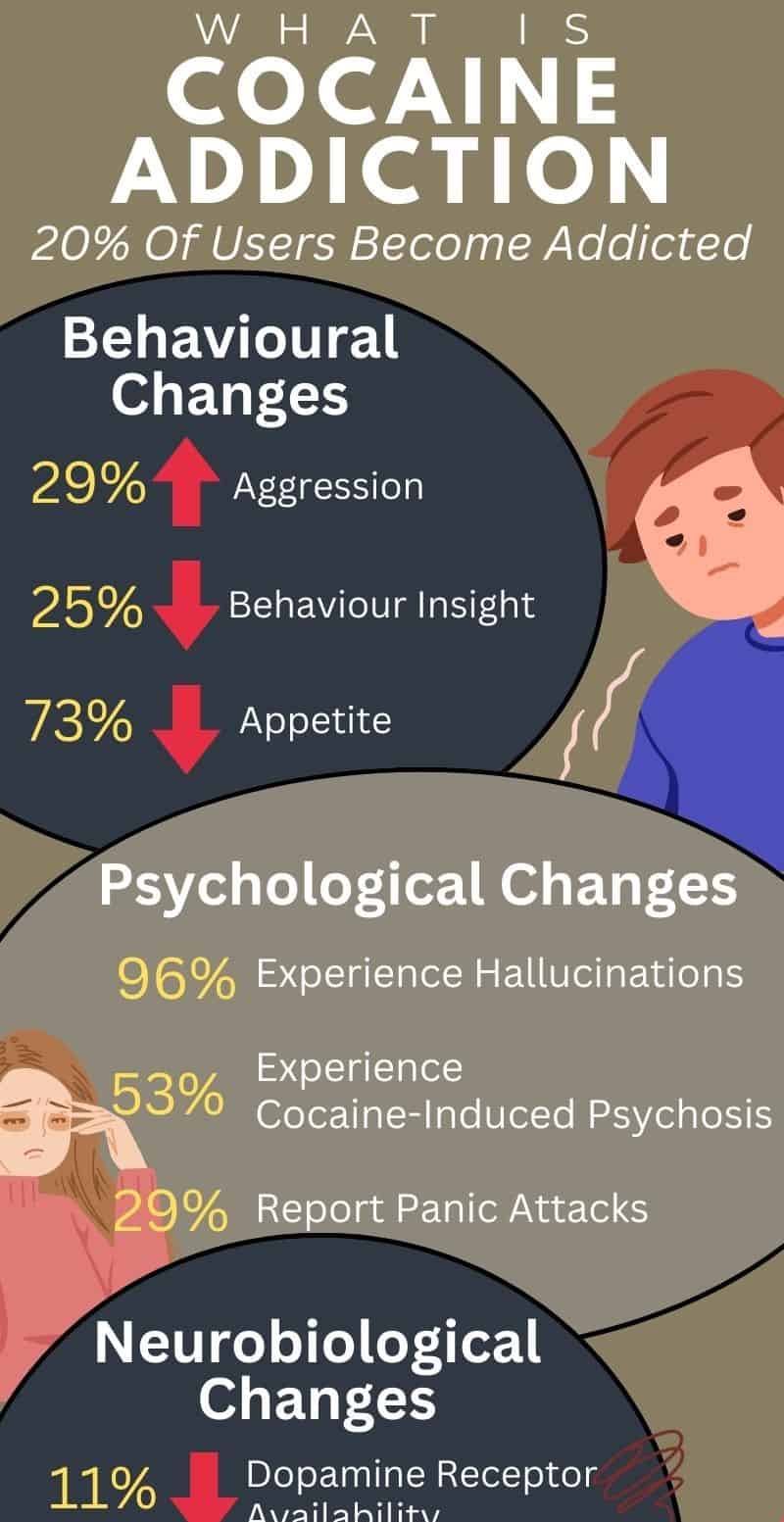
53% of cocaine-dependent people experience cocaine-induced psychosis [11].
96% of cocaine addicts experience hallucinations:
83% experience auditory hallucinations
38% experience visual hallucinations
21% experience tactile hallucinations [2]
Cocaine abusers exhibit a 32.28% impairment in memory and attention compared to individuals who do not use cocaine [12].
68% of cocaine abusers experience paranoia following cocaine use [13].
Chronic cocaine consumers exhibit 39% less empathy compared to non-users, indicating a decline in sociocognitive functioning [14].
The risk of developing OCD is 310% higher in cocaine abusers than in non-users [15].
29% of regular cocaine users report panic attacks [16].
Behavioural Indicators Of Cocaine Addiction
Cocaine use increases aggression by 29% [17].
Cocaine-dependent people have 25% less behaviour insight than non-dependent people, resulting in a lack of social awareness [3].
In a study of rats:
Drug-seeking behaviour in subjects with limited cocaine exposure was reduced by 50% with the use of shock aversives.
After prolonged cocaine exposure, drug-seeking behaviour continued 100% of the time despite shock aversives [18].
73% of regular cocaine consumers report a loss of appetite [16].
Defining Cocaine Addiction By Neurobiological Mechanisms
Neurotransmitter Behaviour
Dopamine receptor availability is 10.7% lower in cocaine addicts than in non-addicts; suppressed dopamine reduces the pleasure experienced from everyday activities and reinforces drug-seeking behaviour [1].
Cocaine blocks serotonin transporters; in a study on mice with insensitive serotonin transporters, researchers found that, after extended use, the mice had a 16.67% higher preference for cocaine compared to the mice with normal serotonin transporters [19].
Changes In Brain Regions
Cocaine addicts have an 18% decrease in amygdala volume compared to non-addicts, predisposing them to cocaine dependence [20].
In a study on mice, repeated exposure to cocaine increased dendritic spine density in the prefrontal cortex by 50% compared to mice who did not consume cocaine; the addicted mice displayed heightened neural responsiveness to the drug, driving repeated drug use [21].
Neurobiological Changes
Cocaine abusers have a 43% decrease in myelin-related gene expression compared to non-addicts, increasing vulnerability to addiction due to disrupted neural communication and structural brain integrity [22].
Prefrontal glutamate concentration decreases by 20.28% when using cocaine, increasing addictive behaviour by forming drug-associated memories and increasing cravings [23].
Cocaine Addiction Vs Addiction To Other Drugs
Cocaine
Ecstasy
How many users get addicted?
20% [24]
8.5% [25]
Withdrawal symptoms
Agitation and restless behaviour
Depressed mood
Fatigue
Feeling of discomfort
Increased appetite
Sleep disturbance
Slowing of activity
Depression
Insomnia
Psychomotor agitation
Typical acute withdrawal duration
7 days [26]
7-20 days [27]
Short-term effects
Euphoria
Energy bursts that peak within 5 mins
Mental alertness
Emotional warmth
Altered sensory perception
Long-term effects
Sensitisation, in which less cocaine is needed to produce anxiety, convulsions, or other toxic effects.
UK prisoners are referred to support services in the local community when released.
81% of US prisons offer drug and alcohol programs, but only 10% of prisoners receive clinical treatment [39].
In the criminal justice systems of many Asian countries, such as Vietnam, Cambodia, China and Thailand, centre-based compulsory treatment (CCT) is used to resolve illicit drug use problems; this approach has been criticised on human-rights grounds [40].
Historical Patterns Of Cocaine Addiction
In the mid-1880s, cocaine was readily available in commercial and medical products.
In 1980, using cocaine 2 or 3 times a week was thought to cause no serious problems and incapable of causing dependence [41].
The 1980s “crack epidemic” in the USA shifted public perception of cocaine from a harmless party drug to an addictive and dangerous substance [42].
At the beginning of the 1990s, the harmful and addictive qualities of cocaine were well-acknowledged, and it was declared to be the drug of greatest national health concern in the USA [43].
Public Health Initiatives
Aspect
Description
Impact
Harm Reduction Strategies
Educational campaigns on safer practices, advising on:
Conducting extensive surveillance to monitor cocaine use and its health consequences.
Informs public health strategies and ensures responsive, evidence-based interventions.
Aspect
Examples of Public Health Initiatives
Harm Reduction Strategies
Health service leaflets
Government-sponsored websites
Safe Inhalation Pipe Provision kits
Community-Based Interventions
Prize-based systems that reward cocaine abstinence
Cocaine Anonymous meetings
Outpatient Facilities
Outpatient rehab facilities
Treatment Funding
£267 million boost to drug and alcohol treatment in the UK
€500,000 funding for cocaine services in Ireland
Public Health Surveillance and Data Collection
National Drug Treatment Reporting System in Ireland
The National Drug and Alcohol Treatment Monitoring System in the UK
About the author
Harriet Garfoot
Harriet Garfoot BA, MA has an Undergraduate degree in Education Studies and English, and a Master's degree in English Literature, from Bishop Grosseteste University. Harriet writes on stress & mental health, and is a member of the Burney Society. Content reviewed by Laura Morris (Clinical Lead).