


KEY TAKEAWAYS
Cannabis rehab is:

When Is Cannabis Rehab Necessary?
Cannabis rehab is necessary when:
Cannabis Rehab Process
Detox
Structured cannabis rehab programmes incorporate a 7-14 day detox period as cannabis is eliminated from the body, followed by a 14-21 day rehab period that includes psychotherapy and relapse prevention.
During the detox period, symptoms are medically managed so that patients become stable enough to engage in the rest of the rehab programme.
Rehab
Adding case management is 1.3 times more effective than cognitive behavioural therapy in rehab for cannabis addiction, as it coordinates medical care for cannabis-induced bronchitis [3].
Motivational interviewing in cannabis rehab works by utilising "change talk" that incorporates quantifiable goals, like financial motivation to save £100 every week that otherwise would have been spent on cannabis.
Involving family members in motivational interviewing helps build a support network and increases adherence rates to cannabis addiction treatment by 20% [4].
The 12-step programme for cannabis addiction uniquely fosters peer support through weekly group sessions that allow members to share triggers for cannabis use and motivations for abstinence.
Aftercare Planning
Ongoing cognitive behavioural therapy for cannabis addiction post-rehab increases abstinence rates by 36% over 3-6 months after rehab, therefore making it ideal for those with a history of relapse [5].
Compared to heroin addiction, in cannabis rehab, cognitive behavioural therapy works to explore underlying core beliefs that maintain psychological dependence, such as intrusive thoughts.
Cannabis rehab incorporates structured routines to prevent old marijuana use patterns from returning, such as replacing "wake and bake" with morning journalling and gratitude practices.

Cannabis Rehab Vs Other Treatment Approaches
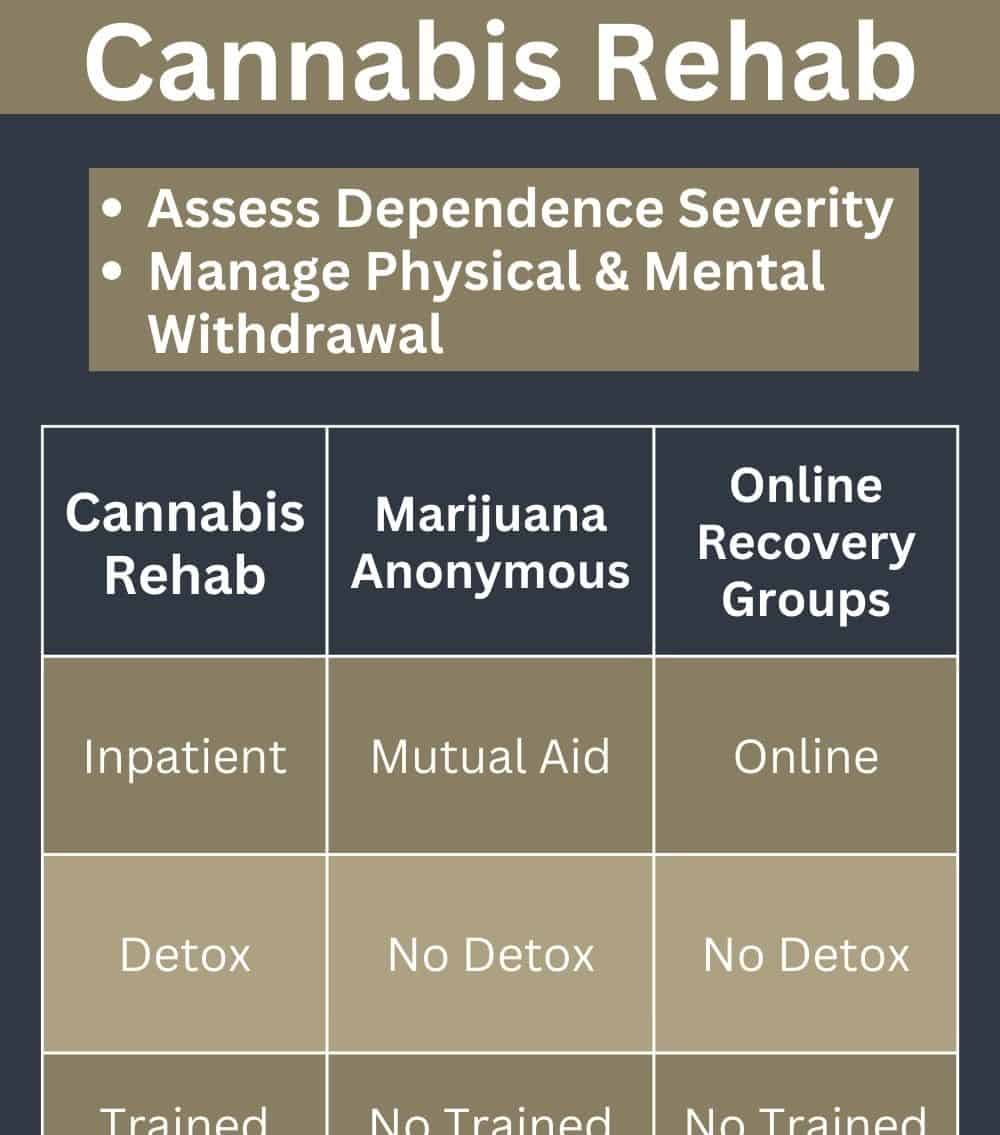
Cannabis Rehab | Marijuana Anonymous | Online Recovery Communities | |
|---|---|---|---|
Setting | Inpatient | Outpatient community | Online Community |
Detox? | Yes | No | No |
In-person? | Yes | Yes | No |
Trained Therapist Required? | Yes | No | No |
Relapse Management | Yes | Yes | No |
Public Or Private Treatment? | Private | Public | Public |
Mindfulness-Based Cessation Programmes | CBT For Cannabis Use | Cannabis Moderation Programmes | |
|---|---|---|---|
Setting | Outpatient | Outpatient individual | Outpatient |
Detox? | No | No | No |
In-person? | Yes | Yes | No |
Trained Therapist Required? | Yes | Yes | Yes |
Relapse Management | Yes | Yes | No |
Public Or Private Treatment? | Public and private | Public and private | Public and private |
What Changes Cannabis Rehab?
Medical Marijuana
The prevalence of abusing medical cannabis among those with chronic pain is 10.6-21.2%, so cannabis rehab incorporates pain management using CBT and analgesics for pain relief [6].
Marijuana users with Multiple Sclerosis (MS) have 32% worse symptoms of MS than non-cannabis users, necessitating rehab with external medical support to ensure comfort [7].
Comorbid Conditions
Those with Tourette's self-medicating with cannabis require specific skills in CBT, such as tic awareness and habit reversal training that mitigate the future need for marijuana.
Patients with Parkinson's Disease require supplementary neurological care coordination with a neurologist outside of rehab - to ensure that Parkinson's medication doses match the severity of symptoms seen when cannabis is no longer used.
Those with ADHD have limited attention spans, so therapy sessions in rehab are 30 minutes shorter to ensure engagement.
Dual Diagnosis
Dual diagnosis of Generalised Anxiety Disorder with Cannabis Use Disorder necessitates ongoing aftercare and relapse prevention so that cannabis is not used to self-medicate anxiety.
Cannabis use worsens schizophrenia symptoms in 80% of patients, necessitating the use of psychoeducational in CBT on the adverse effects of cannabis on causing hallucinations [8].
Cannabis Rehab Outcomes
One study on abstinence rates showed that 27% of patients undergoing CBT, contingency management and motivational enhancement therapy remain abstinent for 14 months post-rehab [9].
Rehabilitation retention increases by 21% when cannabis use frequency used to be once or more per day, compared to less frequent or sporadic use [10].
Factors that predict successful rehabilitation outcomes include cannabis removal, motivation enhancement, distraction, and coping skills learnt in CBT [11].
Anxiety scores decrease by 47% when CBT in rehab extends for 8 weeks after treatment [12].
12 weeks of CBT in rehab improves overall physical health symptoms by 38% [13].
An average of 6.63% relapse over 3.6 years; however, this rate increases when there is co-occurring depression that has not been treated [14].
Cannabis Rehab At Abbeycare
Cannabis rehab at Abbeycare incorporates the 7-10 day detox with either a 28 day or 12 week rehabilitation programme with individual and group psychotherapy, cannabis withdrawal symptom management and scheduled activities (e.g., outdoor walks).
Abbeycare plans cannabis aftercare by signposting to help groups for peer support (e.g., Marijuana Anonymous).
The primary psychological intervention used in Abbeycare is cognitive behavioural therapy, as this works by reframing unhelpful thoughts that were maintaining cannabis addiction.

References
[1] Parliamentary Select Committee on Science and Technology. House of Lords - Science and Technology - Ninth Report. 2024. Accessed 14 Nov. 2024. “Individuals spent £100 or more per week.”
[2] Vaziri-harami, Roya, et al. “Prevalence of Anxiety and Depression among Engineering Students Consuming Cannabis.” Annals of Medicine and Surgery, vol. 80, Aug. 2022, p. 104144. Accessed 18 Sept. 2022. “Anxiety in the population of cannabis users was 60% and ... depression was 33%.”
[3] Walther, Lisa, et al. “Evidence-Based Treatment Options in Cannabis Dependency.” Deutsches Aerzteblatt Online, vol. 113, no. 39, Sept. 2016. “Table 2.”
[4] Smeerdijk, Maarten, et al. “Feasibility of Teaching Motivational Interviewing to Parents of Young Adults with Recent-Onset Schizophrenia and Co-Occurring Cannabis Use.” Journal of Substance Abuse Treatment, vol. 46, no. 3, Mar. 2014, pp. 340–45. Accessed 6 Apr. 2020. “Table 2.”
[5] Hoch, E., et al. “Efficacy of a Targeted Cognitive–Behavioral Treatment Program for Cannabis Use Disorders (CANDIS*).” European Neuropsychopharmacology, vol. 22, no. 4, Apr. 2012, pp. 267–80. Accessed 17 Nov. 2021. “Abstinence was achieved in 49% of AT patients and in 13% of those in DTC (p < 0.001; intend-to-treat (ITT) analysis).”
[6] Feingold, Daniel, et al. “Problematic Use of Prescription Opioids and Medicinal Cannabis among Patients Suffering from Chronic Pain.” Pain Medicine, vol. 18, no. 2, June 2016, p. pnw134. “Prevalence of problematic use ... according to DSM-IV and PC was 21.2% and 10.6%, respectively.”
[7] Stuchiner, Tamela, et al. “Use of Medical Marijuana for Symptoms of Multiple Sclerosis (MS) among Participants of the Pacific Northwest MS Registry (PNWMSR) (P7.250).” Neurology, vol. 82, no. 10_supplement, Lippincott Williams & Wilkins, Apr. 2014. Accessed 14 Nov. 2024. “Had worse physical (44.7 vs. 33.9, p<.001).”
[8] Ahmed, Saeed, et al. “The Impact of THC and CBD in Schizophrenia: A Systematic Review.” Frontiers in Psychiatry, vol. 12, July 2021. “THC resulted in worsening of positive symptoms (80% of patients had PANNS subscale score worsened).”
[9] Kadden, Ronald M., et al. “Abstinence Rates Following Behavioral Treatments for Marijuana Dependence.” Addictive Behaviors, vol. 32, no. 6, June 2007, pp. 1220–36. Accessed 29 Jan. 2020. “14 months after entering the study, 27% of those in MET+CBT+ContM ... reported continuous abstinence.”
[10] Socías, Maria Eugenia, et al. “High-Intensity Cannabis Use Is Associated with Retention in Opioid Agonist Treatment: A Longitudinal Analysis.” Addiction, vol. 113, no. 12, Sept. 2018, pp. 2250–58. “21% greater odds of retention in treatment compared with less than daily consumption.”
[11] Rooke, Sally E., et al. “Successful and Unsuccessful Cannabis Quitters: Comparing Group Characteristics and Quitting Strategies.” Substance Abuse Treatment, Prevention, and Policy, vol. 6, no. 1, Nov. 2011. Accessed 13 Aug. 2019. “The analysis yielded four components, representing (1) Stimulus Removal, (2) Motivation Enhancement, (3) (lack of) Distraction, and (4) (lack of) Coping.”
[12] Trick, Leanne, et al. “Implementation and Preliminary Evaluation of a 12-Week Cognitive Behavioural and Motivational Enhancement Group Therapy for Cannabis Use Disorder.” Substance Abuse, vol. 17, SAGE Publishing, Jan. 2023. “GAD-7b 18 8.78 (1.22) 8.50 (9.00) 1.00-17.00 4.67 (.84) 4.00 (5.50) 0.00-12.00 z = −2.67 .006 r = −.63.”
[13] Trick, Leanne, et al. “Implementation and Preliminary Evaluation of a 12-Week Cognitive Behavioural and Motivational Enhancement Group Therapy for Cannabis Use Disorder.” Substance Abuse, vol. 17, SAGE Publishing, Jan. 2023. "PHQ-9b1811.94 (1.55)11.00 (11.25)0.00-22.007.39 (1.74)5.50 (7.25)0.00-24.00z = −2.49.010r = −.59."
[14] Flórez-Salamanca, Ludwing, et al. “Probability and Predictors of Cannabis Use Disorders Relapse: Results of the National Epidemiologic Survey on Alcohol and Related Conditions (NESARC).” Drug and Alcohol Dependence, vol. 132, no. 1-2, Sept. 2013, pp. 127–33. Accessed 24 Nov. 2019. “The relapse rate of CUD was 6.63% over an average of 3.6 year follow-up period ... whereas having ... a major depressive disorder ... increased the risk of relapse.”
